Judge tosses citizenship provisions in Trump elections order
Full article1,419 words · extracted from cyberscoop.com · click to collapse
Get our latest cybersecurity news first on Google.
Requests to block federal agencies from sharing federal data with states and to condition federal election funding were denied by Judge Colleen Kollar-Kotelly.
Listen to this article
0:00
Learn more.
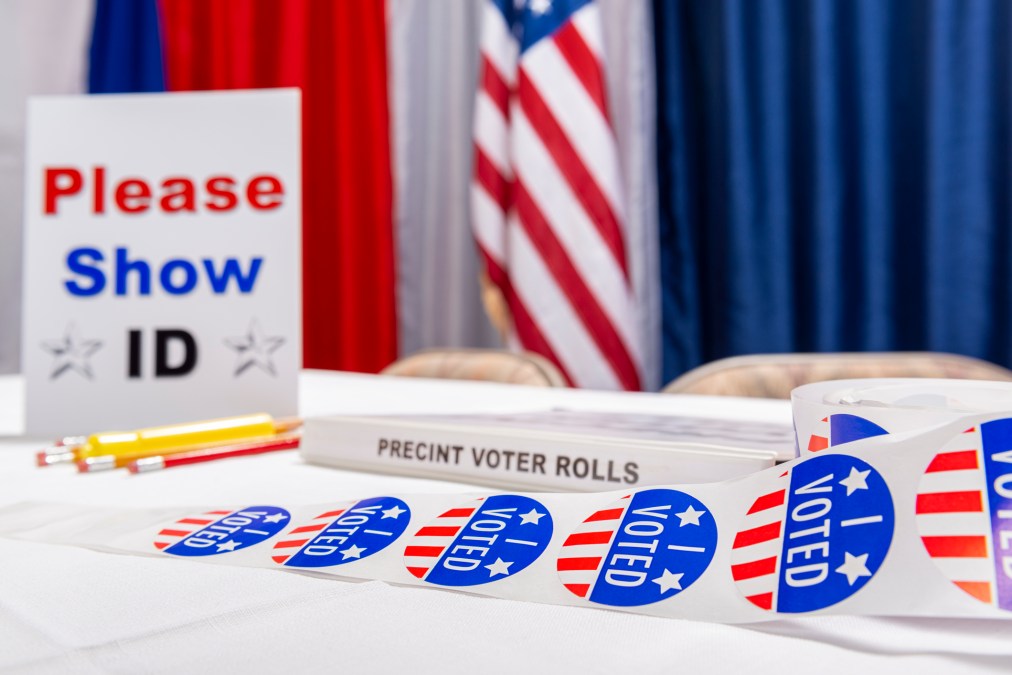
A federal court partially blocked a Trump administration executive order Thursday that seeks to impose requirements on states to use the White House’s definition of “documentary proof” of citizenship, inhibit mail voting and other election-related elements by threatening to withhold federal funding.
The order was subject to multiple lawsuits from Democratic Party organizations as well as civic groups like the League of United Latin American Citizens, the League of Women Voters of the United States, the National Association for the Advancement of Colored People and others.
In a three-page order issued in the U.S. District Court for the District of Columbia, Judge Colleen Kollar-Kotelly granted the parties partial relief from the order, blocking the Election Assistance Commission from altering federal voter registration forms to include a proof of citizenship section. That would have required voters to present one of several forms of identification — including REAL ID, a valid passport or state-based ID forms that specify citizenship status.
Kollar-Kotelly also struck down provisions challenged by Democrats to prevent federal agencies from denying or refusing to send federal voter registration forms to voters.
The Constitution explicitly empowers states — and, to a lesser extent, Congress — to set rules around elections, with no mention of a role for the executive branch. States also verify citizenship when residents get their driver’s license and other forms of ID.
Moreover, federal law already prohibits noncitizens from voting, and post-election audits across numerous states have found that the number of noncitizens registered to vote are often in the double digits, or at most several hundred out of hundreds of thousands or millions of registered voters. Of those noncitizens that are registered, a tiny fraction have actually cast a vote.
In her opinion, Kollar-Kotelly said the questions at hand were not about the wisdom behind the executive order, but strictly about the executive branch and the White House’s authority to set election rules under the Constitution.
“The many defendants in these consolidated cases — federal officers and agencies — say little about that question,” she wrote. “They have offered almost no defense of the President’s order on the merits. Instead, they argue that these suits have been brought by the wrong plaintiffs at the wrong time.”
When reached for comment, White House spokesperson Harrison Fields indicated that the administration will appeal the ruling.
“President Trump will keep fighting for election integrity, despite Democrat objections that reveal their disdain for commonsense safeguards like verifying citizenship,” Fields said in a statement. “Free and fair elections are the bedrock of our Constitutional Republic, and we’re confident in securing an ultimate victory in the courtroom.”
Kollar-Kotelly also expressed the belief that the plaintiffs “are substantially likely to prevail” in their case on the merits, at least with respect to the citizenship provisions.
“Congress is currently debating legislation that would [affect] many of the changes the President purports to order. And no statutory delegation of authority to the Executive Branch permits the President to short-circuit Congress’s deliberative process by executive order,” she wrote.
However, Kollar-Kotelly denied requests to block federal agencies from sharing federal data and seeking access to state-level databases on voters to cross-check citizenship. The court also declined requests to block federal officials from including absentee and mail-in ballots that arrive after Election Day, and a provision that would seek to condition EAC funding on making Election Day the final day to accept any form of ballots.
That provision, however, specifies that agencies can only do so in accordance with Title 52, a section of U.S. law that includes a passage specifying that “adoption of [EAC] guidelines and guidance [are] not required to receive payment” and that “nothing in this subpart may be construed to require a State to implement any of the voluntary voting system guidelines or any of the voluntary guidance adopted by the [EAC] with respect to any matter as a condition for receiving a requirements payment.”
Meanwhile, the plaintiffs in this case have argued that millions of eligible voters lack the forms of ID specified by the Trump administration’s order.
Kollar-Kotelly did not rule against the plaintiff’s requests on the merits, but rather felt they were not best positioned to legally challenge those provisions.
“On the present record, challenges to those provisions are premature or properly presented not by these plaintiffs but by the States themselves. In fact, many States are already bringing those challenges elsewhere,” she wrote.
In a joint statement Democratic leaders, including Senate Minority Leader Chuck Schumer, D-N.Y., House Minority Leader Hakeem Jeffries, D-N.Y., Democratic National Committee Chair Ken Martin, Democratic Governors Association Chair Laura Kelly and others praised the decision but said their fight over other provisions would continue.
“Our work is not over — we will continue fighting to block DOGE from accessing sensitive voter information and ensure states can freely run their own elections,” the group said.
Samantha Tarazi, chief operating officer and co-founder of Voting Rights Lab, argued that the White House order was not designed to surmount court challenges, but rather to intimidate states into complying with federal preferences and inject uncertainty into their prospects for federal funding.
“To President Trump, whether the executive order would survive legal scrutiny was beside the point,” Tarazi said in a statement. “The goal was to send a clear directive to his allies in the states — and in Congress — outlining precisely how the president wants them to change their laws, and they are already following his marching orders.“
More Scoops
Election official says Tina Peters would be consultant, won’t have access to election systems
Shasta County registrar Clint Curtis told CyberScoop he needs Peters to help manage the county’s 2026 elections and he’s not concerned about her past conviction.
SCOTUS tosses one of two injunctions against Trump USPS mail-in ballot rules

A California county wants to hire Tina Peters to help run its elections
Latest Podcasts
Government
FBI officials say AI is bolstering adversaries, emphasizing need to focus on cyber basics, patching
Feds accuse China of ‘systematic’ distillation of U.S. AI models
CIA’s Michael Ellis says cyber intelligence is changing how the agency operates
The G7 tells industry to hurry up and prep for post-quantum encryption
Technology
Threats
Chinese espionage groups swarm to exploit triple-link chain of zero-days
Microsoft discloses two actively exploited zero-days among 974 vulnerabilities
Russian national extradited to US for alleged involvement in bank-account takeover scheme
Attackers exploit zero-days in consistently besieged SonicWall product
Policy
‘Watershed 250’ test program in Texas looks to private sector for water cybersecurity help
Former sexual abuse victims say Grok used their images, videos to train deepfake capabilities
Cyber threats nudge Trump to sign executive order on foreign equipment in U.S. energy infrastructure
Bipartisan Senate bill aims to prepare energy sector for Q-Day
Text extracted automatically; images, tables and formatting may be missing. Original: https://cyberscoop.com/elections-white-house-executive-order-court-proof-of-citizenship-requirements/