Election security legislation gains attention on Capitol Hill
Full article992 words · extracted from cyberscoop.com · click to collapse
Get our latest cybersecurity news first on Google.
Senators are making a renewed push to secure voting infrastructure ahead of the midterm elections.

Senators are making a renewed push to secure voting infrastructure ahead of the midterm elections through measures that would boost states’ cooperation with U.S. intelligence agencies and require the use of paper ballots.
As the Senate considers an annual defense policy bill, Sen. Amy Klobuchar, D-Minn., is urging support for a bipartisan amendment that would tighten cyberthreat information sharing between states and the intelligence community.
“With the new kind of [information] warfare we’re seeing,” Klobuchar said Tuesday at a Senate Judiciary Committee hearing, failing to update U.S. law would be “a very big lost opportunity.”
The Secure Elections Act sponsored by Klobuchar and Sen. James Lankford, R-Okla., would task the Department of Homeland Security – which is already a hub for passing intelligence from federal to state officials – with quickly sharing election-related threats with all state election agencies. The bill also aims to speed up the security-clearance process for state officials so more of them can access classified information.
The senators last week submitted the Secure Elections Act as an amendment to the fiscal 2019 National Defense Authorization Act, but Klobuchar said Tuesday that the amendment had not yet made it into the bill. The top Republican and Democrat on the Senate Intelligence Committee have backed the Secure Elections Act.
After the U.S. intelligence community concluded that the Russian government meddled in the 2016 presidential election, U.S. officials have warned of renewed Russian information operations ahead of the midterms. Before the 2016 election, Russian hackers probed IT networks in 21 states but did not breach any voting machines or manipulate vote tallies, according to DHS. Department officials say they have yet to detect any Russian activity on state networks this election season.
At the Senate Judiciary hearing, California Democrat Dianne Feinstein asked whether the Justice Department had opened any investigations into election interference occurring this year. Adam Hickey, a top DOJ cybersecurity official, declined to confirm or deny the existence of an investigation.
Matthew Masterson, one of DHS’s top election-security officials, told lawmakers the $380 million that Congress allotted for state election security in March was a welcome reinforcement. “Resources — whether it be money or expertise or support — are hard to come by for state and local officials,” he said.
To prepare for the midterms, DHS has been offering states vulnerability assessments of their networks. Of the 17 states that requested those assessments, 10 have received them, one is in the process of doing so, and six are scheduled to receive them, according to a DHS official.
As Virginia voters went to the primary polls Tuesday, Christopher Krebs, another DHS official, said the department’s advice on cyber risk to states doesn’t come in a vacuum.
“[W]e’re also introducing some context around the risk,” Krebs said at the Arlington County Voting and Elections Office. “Just because there could be a vulnerability in the system, doesn’t mean that there’s a certainty or likelihood that it’s going to happen.”
Also on Tuesday, six Democratic senators introduced a bill that would require paper ballots to be used in all federal elections, and for rigorous audits to accompany those elections. Election security experts say those measures are key in preventing the manipulation of election results. Twenty-two states currently don’t require any post-election audits, the senators said.
That legislation is sponsored by Oregon’s Ron Wyden and Jeff Merkley; Massachusetts’ Ed Markey and Elizabeth Warren; Kirsten Gillibrand of New York; and Patty Murray of Washington.
“Why would we give foreign adversaries the opportunity to hack into our voting systems when we have better, more secure alternatives?” Merkley said in a statement.
The legislation comes a day after Wyden asked the Election Assistance Commission to make key updates to its cybersecurity guidance to states.
Zaid Shoorbajee contributed to this story.
More Scoops
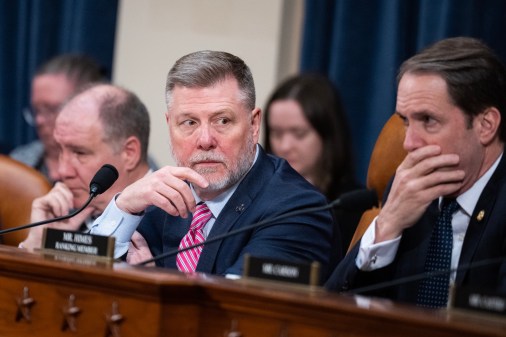
House intel bill includes provisions on state and local threat intelligence, election security, AI
The House Intelligence Committee advanced its fiscal 2027 authorization legislation Monday.
State officials, election experts pan Trump speech: ‘This is what desperation looks like’
Dems press DNI nominee Jay Clayton on election security questions, but leave dismayed
Latest Podcasts
Government
FBI officials say AI is bolstering adversaries, emphasizing need to focus on cyber basics, patching
Feds accuse China of ‘systematic’ distillation of U.S. AI models
CIA’s Michael Ellis says cyber intelligence is changing how the agency operates
The G7 tells industry to hurry up and prep for post-quantum encryption
Technology
Threats
Chinese espionage groups swarm to exploit triple-link chain of zero-days
Microsoft discloses two actively exploited zero-days among 974 vulnerabilities
Russian national extradited to US for alleged involvement in bank-account takeover scheme
Attackers exploit zero-days in consistently besieged SonicWall product
Policy
Whistleblower says USPS deploying new, ‘untested’ IT systems governing mail-in ballots
‘Watershed 250’ test program in Texas looks to private sector for water cybersecurity help
Former sexual abuse victims say Grok used their images, videos to train deepfake capabilities
Cyber threats nudge Trump to sign executive order on foreign equipment in U.S. energy infrastructure
Text extracted automatically; images, tables and formatting may be missing. Original: https://cyberscoop.com/election-security-legislation-gains-attention-capitol-hill/