Facebook Security Phishing Attack In The Wild
Full article431 words · extracted from securelist.com · click to collapse



At the time of writing there is a new Facebook phishing attack going on. It will not just try to steal your Facebook credentials; it will also try to steal credit card information and other important information such as security questions.
This Facebook phishing attack is pretty interesting because it does not just try to trick the victim of visiting a phishing website. It will reuse the stolen information and login to the compromised account and change both profile picture and name. The profile picture will be changed to the Facebook logo and the name will be translated to “Facebook Security” but containing special ascii characters replacing letters such as “a” “k” “S” and “t”.
Once an account is compromised it will also send out a message to all contacts of the compromised account. The message looks like this:

“Last Warning: Your Facebook account will be turned off Because someone has reported you. Please do re-confirm your account security by: => http://apps-xxxx-xxxxx-user.de.vu
Thank you.
The Facebook Team”
When clicking on the link you will be redirected to a website which looks very similar to Facebook, and asks you for personal information such as: Name, Email, Password, Webmail system, Password to email etc. When submitting this form the details will be sent to the attacker, and they can automatically login to your Facebook account and compromise it.

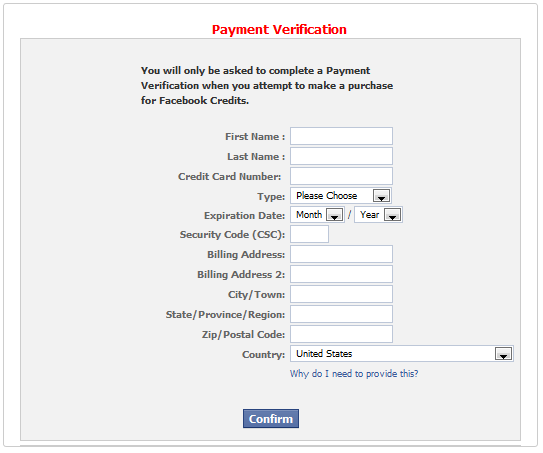
After the victim submitted the information another webpage will appear, this page states that you need to confirm your identify with a payment and asks for your Card Number.

The last page of the phishing scam will try to confirm your Credit card information including CSC/CVV code.
These scams are just getting more popular and we really recommend not giving out personal information, especially not email, password and credit card information over social medias. It is also recommend that you contact your security vendor and the social media vendor if you encounter these sites.
Latest Webinars
Reports
Kaspersky researchers have discovered new Mirage Kitten attacks using previously undocumented malware families: NodeRabbit in Node.js and PollCat in JavaScript.
Our experts discovered a new CoolClient backdoor variant with a kernel-mode rootkit driver that hides malicious processes, files, and network connections from security tools and threat analysts.
Kaspersky experts break down a new Armored Likho campaign that poses as a fundraising efforts and delivers a new Still Toolkit aimed at stealing Telegram data and eavesdropping on victims.
Kaspersky researchers reveal previously undocumented malware attributed to Mirage Kitten (UNC1549, Smoke Sandstorm, Nimbus Manticore): NightLedger backdoor, ArcBridge, and BridgeHead tunneling tools.
Text extracted automatically; images, tables and formatting may be missing. Original: https://securelist.com/facebook-security-phishing-attack-in-the-wild/31951/