Google Search Makes It Harder to See Where a Link Really Goes Before You Click
Google now routes some Search results through opaque google.com/goto redirects, weakening hover-to-verify anti-phishing checks.
Google has begun serving some organic search results as opaque google.com/goto?url= redirects whose destinations can only be resolved server-side by Google, likely to raise scraping costs for rank trackers and archival services. The change removes the pre-click hover preview of the true destination URL, undermining a long-standing anti-phishing habit for spotting lookalike, typosquatted, or search-optimized phishing domains. Security teams are advised to rely on layered defenses such as domain reputation, DNS and web filtering, browser isolation, and user training rather than hover text.
- Opaque google.com/goto redirects hide true destination URLs before click
- Change likely targets scrapers but weakens hover-link phishing verification
- Destinations only resolvable through Google's server-side redirect
- Teams should layer domain reputation, filtering, and training
Full article696 words · extracted from gbhackers.com · click to collapse
Google has begun routing some organic Search result links through opaque google.com/goto?url=… redirects, reducing users’ ability to independently inspect a destination URL before clicking.
The change appears designed to raise the technical and financial cost of mass scraping. However, it also weakens a long-standing, basic anti-phishing habit: hovering over a link to verify where it leads.
Rather than embedding a publisher’s URL directly in the result link, affected Google Search pages now serve a Google-controlled passthrough URL containing an unreadable, Google-specific encoded value.
When a user selects the result, the browser contacts Google’s /goto endpoint first and is then redirected to the intended destination.
The visible site label displayed above or near the result remains unchanged, but the browser’s hover preview or status bar may reveal only the intermediary Google URL.
The company has not publicly identified the specific abuse category driving the change.
The most likely rationale is anti-scraping enforcement. Previously, rank trackers, SEO platforms, research systems, archival services, and alternative search providers could extract final destination URLs directly from the Search results page HTML.
Under the new model, automated collectors must resolve each google.com/goto link individually to determine where it points.
Search-data provider Autom said the final URL is available in the HTTP redirect response’s Location header.
In practice, a collector must send a request to the /goto URL without automatically following the redirect, then read the returned Location value.
That adds at least one lookup per result and gives Google more opportunity to apply request limits, behavioral analysis, bot detection, or access controls.
The implementation is technically significant because the opaque url parameter is not simply a URL-encoded destination that can be decoded locally.
The destination must be resolved by Google’s infrastructure, turning what was once passive extraction from a search page into an active request workflow.
For end users, the change creates a transparency problem. Security guidance has long advised people to hover over links in email, chat messages, documents, and web pages before clicking, checking whether the browser preview matches the claimed destination.
Malwarebytes confirmed the rollout in a statement, saying it has “a long history of deploying technical measures against evolving forms of abuse” and regularly acts to protect its services and users.
Harder Link Verification
In affected Google Search results, that preview no longer provides an independent confirmation of the outbound domain.
This does not mean Google redirects inherently send users to malicious websites. The redirect is expected to forward the user to the selected result.
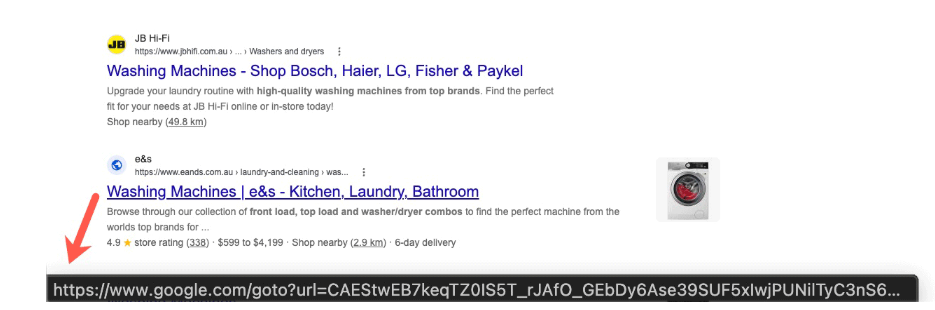
However, hiding the destination from the pre-click interface removes a useful verification layer, especially for users evaluating lookalike brands, typosquatted domains, sponsored-content impersonation, or search-optimized phishing pages.
The visible destination label remains available, but it is not equivalent to examining the actual clickable URL.
A security-conscious user can normally compare the displayed domain, hyperlink target, certificate details after landing, and contextual signals.
The new design makes the first of those checks substantially less reliable at the moment it is most useful: before navigation occurs.
The operational consequences extend beyond hostile bots. SEO monitoring access, digital forensics, accessibility tooling, academic research, web archiving.
Independent indexing services may all face additional infrastructure costs and rate-limit exposure because each result now requires server-side resolution.
Community discussions have also highlighted the irony that Google’s own search engine depends on automated collection of publicly reachable web content while making its own results more difficult to collect programmatically.
For security teams, the development is another reminder not to rely on hover text alone.
Organizations should reinforce layered URL-verification practices, including domain reputation controls, DNS and web filtering, browser isolation where appropriate, email security protections, and user training focused on validating domains rather than trusting search rankings or page appearance.
Google’s redirect architecture may deter large-scale extraction, but it does so by placing a Google-controlled opaque layer between users and the link they are being asked to trust.
★ Learn 7 Metric-Gated AI SOC Deployment Phases – Download Free AI SOC Deployment Playbook 2026.
Mayura Kathirhttps://gbhackers.com/
Mayura Kathir is a cybersecurity reporter at GBHackers News, covering daily incidents including data breaches, malware attacks, cybercrime, vulnerabilities, zero-day exploits, and more.
Text extracted automatically; images, tables and formatting may be missing. Original: https://gbhackers.com/harder-link-verification/