Warden Stealer Malware Targets Claude, Codex, Grok and Cursor to Steal AI Agent Data
Warden Stealer, a Rust malware-as-a-service, harvests tokens and prompts from Claude, Codex, Grok, and Cursor.
Warden Stealer, also tracked as CallbackBeaver, is a Rust malware-as-a-service infostealer advertised on Russian-language underground forums since August 2026. Version 1.9, announced on September 29, officially steals tokens, prompt histories, conversation databases, and MCP settings from Claude, Codex, Grok, and Cursor, in addition to browsers, crypto wallets, password managers, and VPN clients. Its loader rebuilds the payload in memory and injects it into explorer.exe, with heavy obfuscation and anti-VM checks. Researchers say it bypasses Chromium Application-Bound Encryption by locating v20 key material and calling CryptUnprotectMemory inside the browser, a method similar to Vidar and Remus.
- Rust MaaS stealer advertised on Russian-language forums since August 2026.
- Version 1.9 steals AI-agent tokens, prompts, conversation databases, and MCP settings.
- Loader injects the payload into explorer.exe via remote thread execution.
- Bypasses Chromium app-bound encryption by injecting into the browser process.
- Spread through cracked software, game cheats, malvertising, and ClickFix.
Indicators of compromiseauto-extracted · verify before use · export allAll →
| Type | Indicator | Context |
|---|---|---|
| sha256 | 006510ce1da2b7410376f0788c19e55616eb4bcc30072d25b7d0871dc32aa11c | of Compromise Malware Hash Type Hash Warden Loader SHA-256 006510ce1da2b7410376f0788c19e55616eb4bcc30072d25b7d0871dc32aa11c Warden Loader SHA-256 0d727a4ef1178e767afdd0080ba1ebda0f24a |
| sha256 | 0d727a4ef1178e767afdd0080ba1ebda0f24ac52b639f0501021affd8f88d26a | 9e55616eb4bcc30072d25b7d0871dc32aa11c Warden Loader SHA-256 0d727a4ef1178e767afdd0080ba1ebda0f24ac52b639f0501021affd8f88d26a Warden Loader SHA-256 63959ef6309cd01b5d3c7262a3a41394dca2d |
| sha256 | 63959ef6309cd01b5d3c7262a3a41394dca2db2dc74bd030a517b7e23a2c3fef | 1ebda0f24ac52b639f0501021affd8f88d26a Warden Loader SHA-256 63959ef6309cd01b5d3c7262a3a41394dca2db2dc74bd030a517b7e23a2c3fef Warden Loader SHA-256 77c8266935bc040c992ab70abd402bd203b9c |
| sha256 | 77c8266935bc040c992ab70abd402bd203b9c12e7548c80b84fd21308c250f0e | 41394dca2db2dc74bd030a517b7e23a2c3fef Warden Loader SHA-256 77c8266935bc040c992ab70abd402bd203b9c12e7548c80b84fd21308c250f0e Warden Loader SHA-256 77cc246272f2af21b64bbc6c6173d57affee9 |
| sha256 | 77cc246272f2af21b64bbc6c6173d57affee97eb0ccf747d89492d06d4c52865 |
Full article773 words · extracted from gbhackers.com · click to collapse
Warden Stealer as a rapidly growing malware-as-a-service operation targeting data stored by AI assistants and coding agents, including Claude, Codex, Grok, and Cursor.
The Rust-based infostealer is among the first malware families observed systematically harvesting AI-agent configuration files, local tokens, prompt histories, conversation databases, and Model Context Protocol (MCP) settings.
The campaign signals a significant expansion of the infostealer threat model. Rather than stealing only browser passwords, cryptocurrency wallets, and session cookies, operators are increasingly pursuing AI tools as a concentrated source of credentials and sensitive developer context.
Local AI-agent data can expose access and refresh tokens, API keys, MCP connection details, project names, internal source-code context, and historical prompts that reveal an organization’s systems and ongoing work.
Researchers attributed CallbackBeaver to Warden based on technical overlap, including Rust development, highly distinctive code morphing, a dedicated loader, and matching cryptocurrency clipper configurations.
The malware supports Windows 8 through Windows 11 and is marketed as an expansive data-theft platform capable of collecting data from Chromium- and Gecko-based browsers, cryptocurrency wallet extensions, password managers, messaging apps, 2FA tools, and VPN clients.
Its actual collection scope varies by operator-controlled build configuration, enabling affiliates to customize targets and file-grabbing rules.
Warden version 1.9, announced on September 29, added officially advertised support for stealing tokens from AI coding agents.
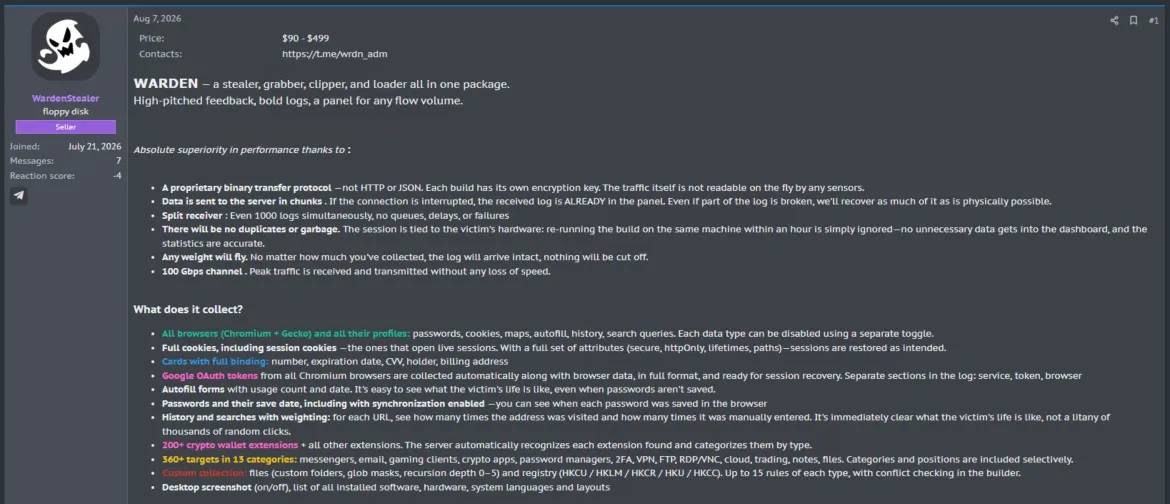
Earlier samples already contained custom collection rules for AI-agent data, indicating that operators had begun pursuing these artifacts before the capability became a mainstream feature.
The development matters because AI assistants increasingly function as a developer’s working memory.
A stolen archive can give attackers both a route into an account and the operational context to identify high-value projects, connected services, repositories, cloud environments, or credentials.
Unlike many MaaS stealers that leave payload delivery and evasion to affiliates, Warden includes its own loader and cryptocurrency clipper.
Gen said in a report shared with GBhackers, Warden Stealer as CallbackBeaver, has been advertised on Russian-language underground forums since August 2026.
Warden Stealer Malware
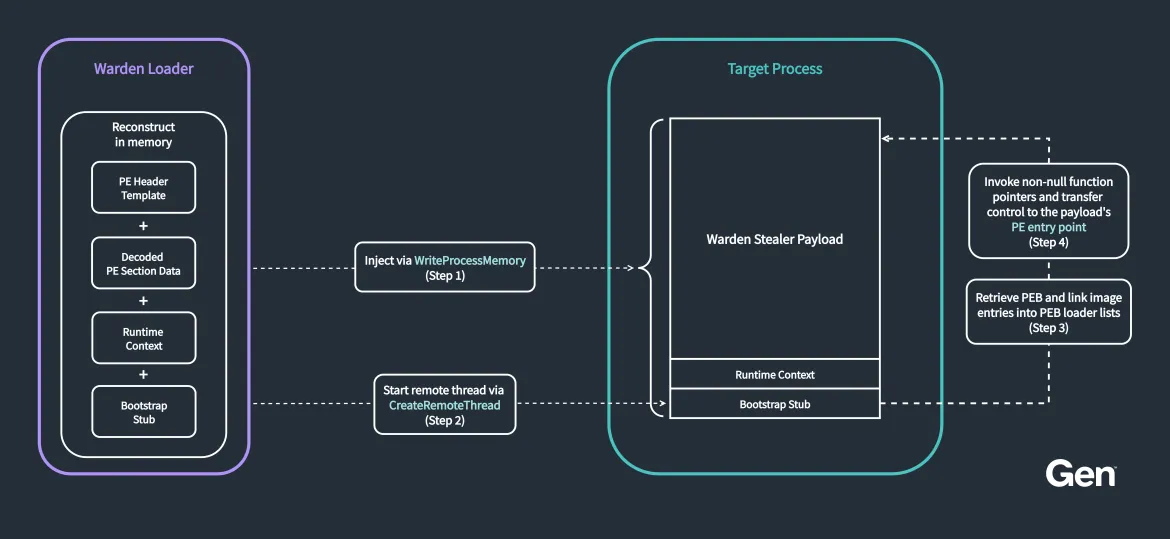
The loader reconstructs an embedded stealer payload in memory and commonly injects it into explorer.exe through remote-process memory allocation, payload writing, and remote-thread execution.
Its builds use a per-sample Base64-like encoding alphabet, custom LZSS-style decompression, lazy string decoding, dynamic API resolution, indirect control-flow obfuscation, opaque predicates, junk code, and constant masking.
The malware also inflates binaries with oversized PE overlays, a technique intended to complicate scanning, sandboxing, and automated analysis.
Warden conducts anti-virtual-machine checks through SMBIOS inspection, CPUID vendor checks, registry enumeration for VirtIO software, and display-adapter checks.
If it detects a virtualized environment, it halts its reporting workflow, helping operators reduce exposure to researchers and automated malware-analysis systems.
Warden also targets Chromium browser secrets protected by Application-Bound Encryption (ABE).
Google introduced ABE to bind encrypted browser data to the legitimate application and machine, making ordinary malware decryption attempts fail unless attackers elevate privileges or inject into Chrome.
Researchers found that Warden scans browser memory for the v20 key material associated with Chromium’s encryption system, then injects shellcode into the browser process to invoke CryptUnprotectMemory.
This allows the malware to decrypt the browser’s v20_master_key within the process context where Windows permits the operation.
The technique resembles recent ABE bypass work observed in Vidar and Remus. Vidar, for example, extracts the encrypted browser key from memory and executes decryption within the victim browser process through code injection.
Warden’s implementation differs in execution details, suggesting independent development rather than a direct code copy.
Warden is delivered through common infostealer channels, including cracked software, game cheats, malvertising, and ClickFix campaigns.
Organizations should now include AI assistants in endpoint inventories, secret-management reviews, and incident-response playbooks.
After a suspected infostealer infection, teams should revoke AI-service sessions, rotate API keys and MCP-linked credentials, review agent-connected applications, investigate prompt and conversation-history exposure, and assess whether browser sessions or developer credentials were stolen.
Local agent files should be treated with the same sensitivity as browser profiles, password stores, cloud CLI credentials, and source-control tokens.
Indicators of Compromise
| Malware | Hash Type | Hash |
|---|---|---|
| Warden Loader | SHA-256 | 006510ce1da2b7410376f0788c19e55616eb4bcc30072d25b7d0871dc32aa11c |
| Warden Loader | SHA-256 | 0d727a4ef1178e767afdd0080ba1ebda0f24ac52b639f0501021affd8f88d26a |
| Warden Loader | SHA-256 | 63959ef6309cd01b5d3c7262a3a41394dca2db2dc74bd030a517b7e23a2c3fef |
| Warden Loader | SHA-256 | 77c8266935bc040c992ab70abd402bd203b9c12e7548c80b84fd21308c250f0e |
| Warden Loader | SHA-256 | 77cc246272f2af21b64bbc6c6173d57affee97eb0ccf747d89492d06d4c52865 |
Note: IP addresses and domains are intentionally defanged (e.g., [.]) to prevent accidental resolution or hyperlinking. Re-fang only within controlled threat intelligence platforms such as MISP, VirusTotal, or your SIEM.
Stops Cyber threats before impact with 21 min faster MTTR. Integrate ANYRUN’s Sandbox in your SOC.
Mayura Kathirhttps://gbhackers.com/
Mayura Kathir is a cybersecurity reporter at GBHackers News, covering daily incidents including data breaches, malware attacks, cybercrime, vulnerabilities, zero-day exploits, and more.