PrintNightmare: Here’s what you need to know and Talos’ coverage
Vulnerabilities mentionedAll →
| CVE | Vulnerability | CVSS | EPSS | Flags | Affected | Exposure | Published |
|---|---|---|---|---|---|---|---|
| CVE-2021-1675 | Remote Code Execution in Microsoft Windows Print Spooler (PrintNightmare) CVE-2021-1675 is a code execution flaw in the Windows Print Spooler service affecting the listed Windows 10, 7, 8.1, RT 8.1 and Windows Server editions. It is triggered through print operations processed by the spooler, notably print driver handling; the public PoC demonstrates DLL injection into the spooler, allowing an attacker to run arbitrary code with the privileges of the spooler service, typically SYSTEM. Successful exploitation yields full system compromise: installing programs, viewing or deleting data, creating accounts, and lateral movement into domains, which is why it has been widely used as a ransomware entry vector. Any Windows system with the Print Spooler service enabled is exposed, and the service runs by default on servers, domain controllers, and most workstations. Exploitation is confirmed in the wild: a public PoC is available, the flaw was weaponized by the Magniber and Vice Society ransomware groups, it was added to CISA KEV on 2021-11-03 with known ransomware use, and Microsoft issued out-of-band fixes after it was being exploited in the wild. Do: Apply Microsoft's out-of-band security updates immediately on all affected Windows client and server systems (per CISA KEV required action), prioritizing domain controllers and print/file servers. As an interim mitigation, disable the Print Spooler service on hosts that do not need printing (e.g., domain controllers) and restrict RPC/network access to the spooler on systems that must keep it running. Check for compromise by looking for unexpected DLL or driver files loaded by the spooler, spoolsv.exe spawning unusual child processes, and ransomware indicators given documented Magniber and Vice Society abuse. | 7.8 | 86% | KEV ransomware PoC |
| masshundreds of millions of Windows endpoints and servers (Print Spooler runs by default across the 1B+ device Windows installed base) | |
| CVE-2021-34527 | PrintNightmare: Remote Code Execution in Microsoft Windows Print Spooler CVE-2021-34527, widely known as 'PrintNightmare', is a remote code execution flaw in the Microsoft Windows Print Spooler service, which improperly performs privileged file operations such as loading printer driver DLLs. An attacker with low-level access who can reach a machine's spooler, for example a domain user able to add a printer connection via Point and Print, can induce the SYSTEM-privileged service to load an attacker-controlled DLL with no user interaction required (CVSS:3.1 vector AV:N/AC:L/PR:L/UI:N). Successful exploitation yields arbitrary code execution as SYSTEM, letting the attacker install programs, view, change or delete data, and create new accounts with full user rights, effectively achieving complete host compromise. The flaw affects all supported Windows client and server releases in the CISA data, Windows 10 from 1507 through 22H2, Windows 11, Windows RT 8.1, and Windows Server 2008, 2012 and 2016, wherever the Print Spooler service is running. Exploitation is confirmed in the wild: the bug was added to CISA's Known Exploited Vulnerabilities catalog on 2021-11-03 with known ransomware use, the FBI and CISA have warned of Russian actors exploiting it, and EPSS places the 30-day exploitation probability at 99.8%. Do: Install the July 2021 security updates immediately, released July 6, 2021 with additional updates on July 7 for Windows Server 2012, Windows Server 2016 and Windows 10 version 1607, and review KB5005010 for restricting installation of new printer drivers after applying the July 6 updates. Where patching is delayed, disable the Print Spooler service on hosts that do not need printing or restrict Point and Print, and verify that NoWarningNoElevationOnInstall and UpdatePromptSettings under HKLM\SOFTWARE\Policies\Microsoft\Windows NT\Printers\PointAndPrint are set to 0 or not defined (these keys do not exist by default, which is the secure state; NoWarningNoElevationOnInstall = 1 makes the system vulnerable by design). Prioritize domain controllers and servers with exposed spoolers, and hunt… | 8.8 | 100% | KEV ransomware PoC ×3 |
| masshundreds of millions of Windows systems (order of magnitude 10^8) |
Full article481 words · extracted from blog.talosintelligence.com · click to collapse
Thursday, July 8, 2021 16:06
Over the past several weeks, there's been a lot of discussion about a particular privilege escalation vulnerability in Windows affecting the print spooler, dubbed PrintNightmare. The vulnerability (CVE-2021-1675/CVE-2021-34527) has now been patched multiple times but is believed to still be exploitable.
The vulnerability itself is a privilege escalation bug found in the print spooler service on Windows platforms. It was believed to allow authenticated users to achieve escalated privileges, including admin rights. The vulnerability's severity was complicated by the fact that, if triggered, the vulnerability could affect domain controllers in enterprise networks. To make matters worse, this privilege escalation vulnerability can be used to achieve remote code execution. This can be done by using the print spooler to load drivers which, until the most recent patch, included both signed and unsigned drivers.
The most recent patch released by Microsoft included some additional protections. These protections include restricting the ability for non-administrative users to install unsigned drivers using the print spooler. Going forward, if unsigned drivers are attempted to be installed, administrative credentials will be required. Administrators are encouraged to install the patch, despite it being incomplete, to ensure they have as much protection as possible and can implement the mitigations described above.
Timeline June 8, 2021: Microsoft patches a privilege escalation vulnerability in the print spooler service (CVE-2021-1675).
June 21, 2021: Microsoft changes the classification of the vulnerability to remote code execution (RCE).
June 29, 2021: Researchers release and subsequently retract proof-of-concept (PoC) code demonstrating the exploitability of CVE-2021-1675.
June 30, 2021: It is confirmed that the patch released earlier this month doesn't completely patch the vulnerability.
July 2, 2021: Microsoft assigns a new CVE for what it called a "similar but distinct" vulnerability in the print spooler service (CVE-2021-34527).
July 6, 2021: Microsoft releases out-of-band patch to address CVE-2021-34527 and provides additional protections to defend against the exploit.
July 7, 2021: It is confirmed the new patch applied an incomplete fix and can be bypassed.
Coverage Snort SIDs 57876 and 57877 have been released to address this vulnerability.
Ways our customers can detect and block this threat are listed below.
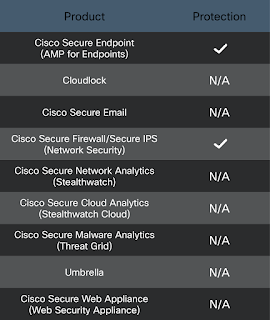
Cisco Secure Endpoint (formerly AMP for Endpoints) is ideally suited to prevent the execution of the malware detailed in this post. Try Secure Endpoint for free here.
Cisco Secure Firewall (formerly Next-Generation Firewall and Firepower NGFW) appliances such as Threat Defense Virtual, Adaptive Security Appliance and Meraki MX can detect malicious activity associated with this threat.
Additional protections with context to your specific environment and threat data are available from the Firewall Management Center.
Cisco Duo provides multi-factor authentication for users to ensure only those authorized are accessing your network.
Open-source Snort Subscriber Rule Set customers can stay up to date by downloading the latest rule pack available for purchase on Snort.org.
Text extracted automatically; images, tables and formatting may be missing. Original: https://blog.talosintelligence.com/printnightmare-coverage/