Skip to content 80,000+ Organizations Had AI Logins Stolen.Is Yours One of Them? 88 AI Platforms. 3 Billion Stolen Credential Records.Access the Report • Blog • Trainings • Request a Demo • Login • EN • English • Español [](https://socradar.io/) • Products • Solutions • Use Cases • Plans & Pricing • Resources • Free Tools • Company Dark Web ReportStart for Free Platform modules Cyber Threat…
PHP has various global state that temporarily points into request memory
PHP has various global state that temporarily points into request memory. In some scenarios, global state may not be correctly reset, or may be repopulated after being reset. The global state may then refer to request memory even after it has been freed. Subsequent requests may read or branch on this stale state before it is fully initialized. Multiple strategies can trigger this condition and produce remote code execution (RCE).
PHP2Shell is the name researchers now use for two critical vulnerabilities in PHP, the server-side language behind WordPress, Drupal, Magento, Laravel, and many custom web applications. Tracked as CVE-2026-109618 and CVE-2026-109619, both flaws reportedly allow Remote Code Execution (RCE), and the PHP security team rated each 9.2 on CVSS v4.0.
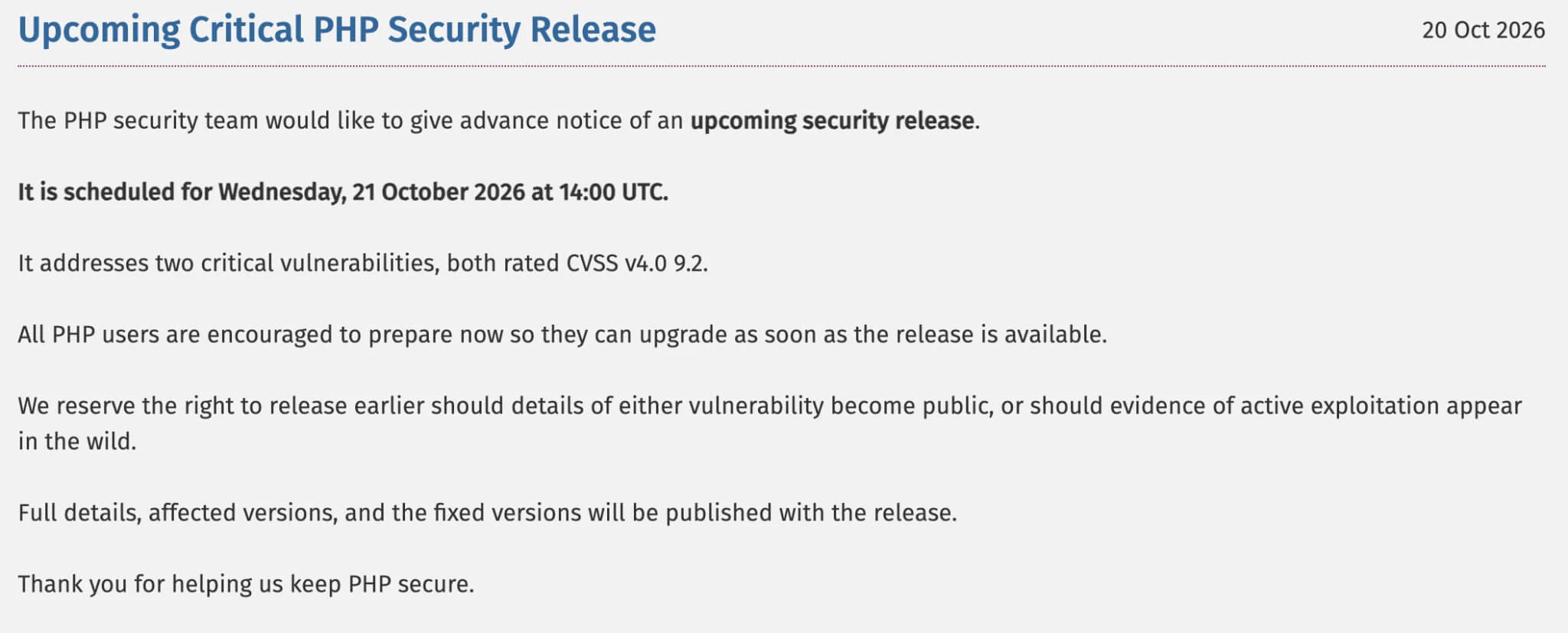
The flaws surfaced ahead of schedule. Their existence was leaked on October 20, 2026, two days before a coordinated disclosure, and the PHP security team responded that evening with an advance notice of an upcoming security release set for October 21, 2026, at 14:00 Coordinated Universal Time (UTC).
_Advance notice of the upcoming security release for PHP2Shell vulnerabilities_
The following FAQ separates what PHP has confirmed from what remains leaked or unverified, shows which PHP branches will receive fixes, and lists what defenders should do before and after the release.
PHP2Shell at a Glance
Attribute
Details
CVE ID
CVE-2026-109618, CVE-2026-109619 (not yet named in PHP’s notice)
CVSS
9.2 CVSS v4.0 for each (PHP security team); vector not yet published
Affected Products
PHP
Affected Versions
Not confirmed by PHP; the leak claims PHP 5 onward
Fixed In
To be published with the release; fixes only for 8.2, 8.3, 8.4, and 8.5
Exploitation Status
No confirmed in-the-wild exploitation; not in the Known Exploited Vulnerabilities (KEV) catalog
Patch Available
Scheduled for October 21, 2026, at 14:00 UTC
Discovered By
Not yet disclosed
PHP2Shell Timeline
Date (UTC)
Event
October 20, 2026
Details of two critical PHP RCE flaws leak ahead of a coordinated disclosure
October 20, 2026
Researchers confirm the flaws are leaked
October 20, 2026
PHP security team publishes its advance notice of a security release
October 20, 2026
CERT-EU publishes Security Advisory 2026-018
October 21, 2026, 14:00
Scheduled PHP security release
October 22, 2026
Original coordinated disclosure date
1. What Is PHP2Shell?
PHP2Shell is the nickname for two critical PHP vulnerabilities, CVE-2026-109618 and CVE-2026-109619, that researchers say let a remote attacker run code on a server running PHP. The name points to the expected result, a shell on the target.
Because the fix ships in PHP itself, protection for WordPress, Drupal, Magento, and other PHP applications depends on updating the server’s PHP version. Updating the application alone does not close the gap.
2. How Did PHP2Shell Become Public Before the Patch?
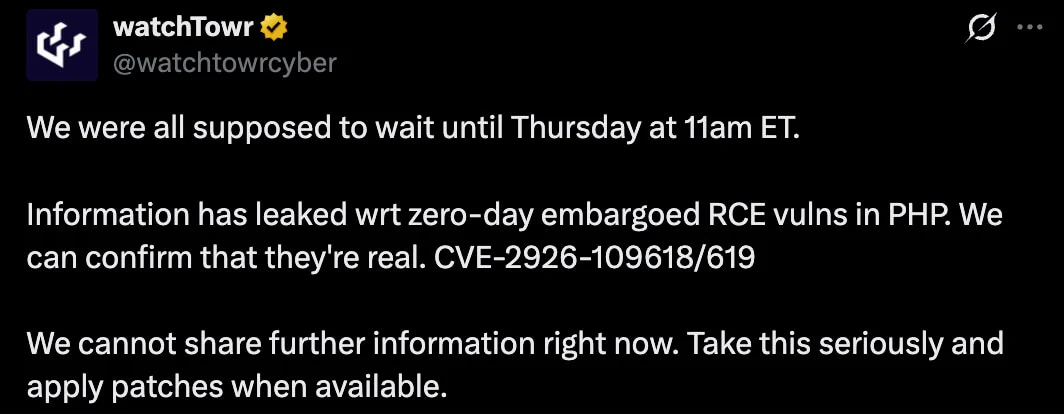
PHP2Shell became public through a leak. On October 20, 2026, details surfaced claiming that two PHP RCE flaws, rated critical and affecting every version since PHP 5, would be disclosed on Thursday, October 22, 2026. watchTowr then confirmed on X that the flaws were real and under embargo, and urged users to apply patches once available.
_WatchTowr’s post on_ _X_ _, confirming the leak of PHP2Shell vulnerabilities_
3. How Severe Are CVE-2026-109618 and CVE-2026-109619?
The PHP security team rates both flaws 9.2 on CVSS v4.0, which is critical severity. As of October 21, 2026, PHP had not published the scoring vector, root cause, or affected component for either flaw.
CERT-EU, the cybersecurity service for European Union institutions, says the 9.2 scores point to possible unauthenticated RCE.
4. Which PHP Versions Are Affected by PHP2Shell?
PHP has not yet confirmed which versions are affected. The reports claimed every release from PHP 5 onward, butno vendor advisory has confirmed that scope or described any configuration or feature requirement. PHP will publish affected and fixed versions with the release.
Fixes will ship only for the four supported PHP branches:
Branch
Latest Release Before the Fix
Support Status
Receives the Fix
8.5
8.5.11 (September 24, 2026)
Active support until December 31, 2027
Yes
8.4
8.4.26 (September 24, 2026)
Active support until December 31, 2026
Yes
8.3
8.3.35 (September 24, 2026)
Security fixes only until December 31, 2027
Yes
8.2
8.2.34 (September 24, 2026)
Security fixes only until December 31, 2026
Yes
8.1, 8.0, 7.x, 5.x
No further releases
End of life
No
5. Will End-of-Life PHP Versions Get a PHP2Shell Fix?
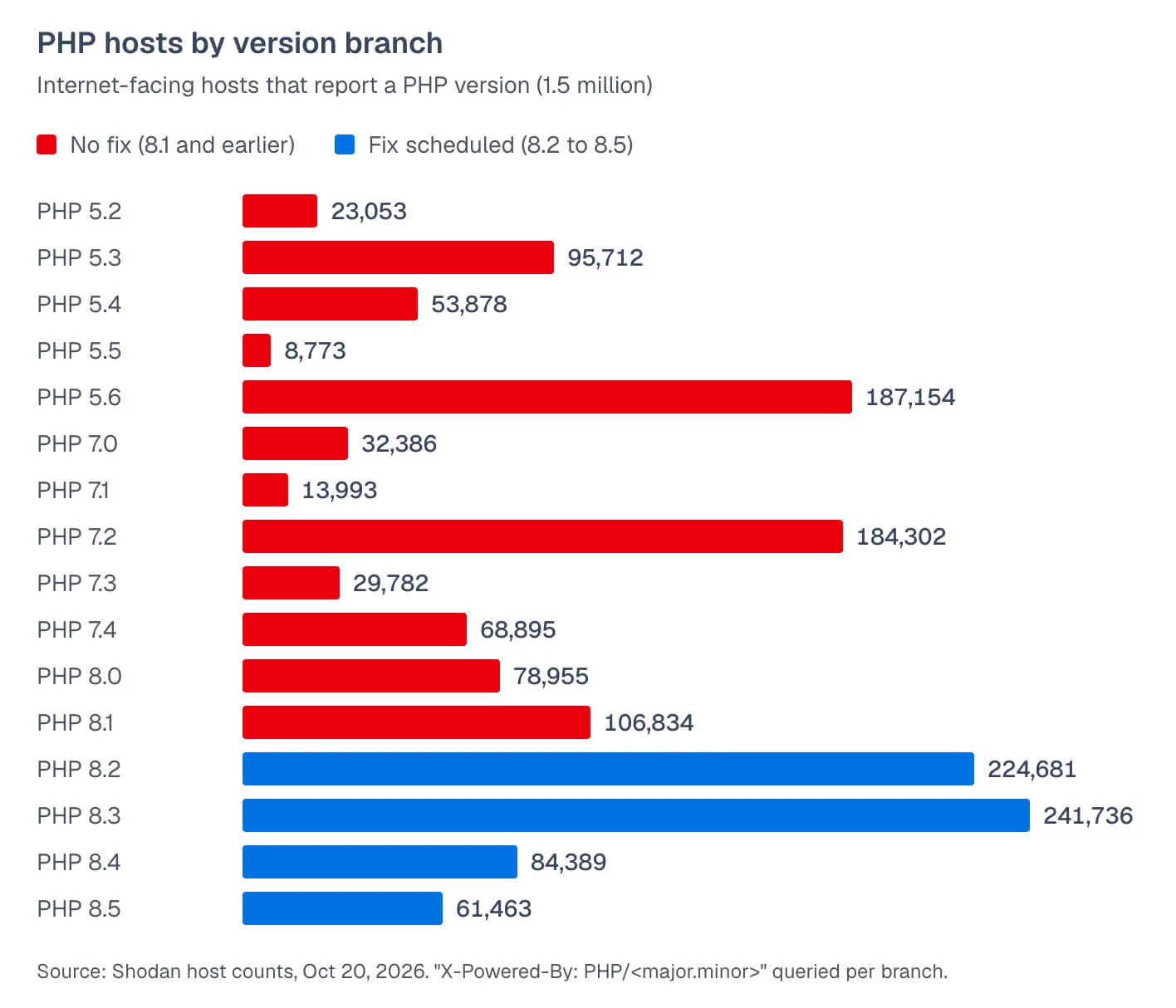
No. End-of-life PHP branches, including 8.1, 8.0, 7.x, and 5.x, will get no fix from PHP. If PHP2Shell reaches those versions, servers running them will have no vendor patch, which makes upgrading to a supported branch the only permanent remedy.
Shodan lists around 884,000 internet-facing hosts running PHP 8.1 or older. An additional 740,000 hosts run PHP without specifying a version number.
_Shodan results for PHP hosts by version (_ _Source_ _)_
6. Is PHP2Shell Being Exploited in the Wild?
As of October 21, 2026, no in-the-wild exploitation of PHP2Shell has been reported, and neither CVE are listed in the KEV catalog of the Cybersecurity and Infrastructure Security Agency (CISA).
However, unverified attack claims are circulating. Patchstack said on October 21, 2026, that multiple active exploitation incidents had been confirmed, without publishing technical evidence. Treat such reports as unconfirmed until PHP, CERT-EU, or CISA corroborates them.
7. Is There a Public PHP2Shell Exploit or Proof-of-Concept (PoC)?
As of October 21, 2026, some online posts claim that both CVE-2026-109618 and CVE-2026-109619 have been recreated and tested in lab and real-world environments. Separately, watchTowr says it has reproduced CVE-2026-109618 and is withholding details until patches ship.
8. How Fast Could Attackers Exploit PHP2Shell After the Patch?
Attackers could move within minutes, because published fixes show where the bugs are.When CVE-2024-4577, a flaw in PHP’s Common Gateway Interface (CGI) mode on Windows, became public in June 2024, Akamai saw exploit attempts against its honeypots within 24 hours.
9. Is There a PHP2Shell Workaround Before the Patch?
PHP has published no workaround for PHP2Shell, so upgrading is the only vendor-backed fix. Where immediate patching is not feasible, CERT-EU advises organizations to consider isolating internet-facing applications from public networks until a fix can be applied.
10. How Can Security Teams Detect PHP2Shell Exploitation?
Detection has to focus on post-exploitation behavior, because PHP has not described how the flaws work. Alert when php-fpm, php-cgi, httpd, or apache2 launch shells, script interpreters, or download tools such as curl and wget.
If an alert fires, isolate the server, preserve web server and PHP logs, and hunt for web shells, new files in the web root, new cron jobs or scheduled tasks, and unexpected accounts.
11. How Can SOCRadar Help Track PHP2Shell Exposure?
With a critical PHP release landing and attacks expected soon after, organizations need to know both which PHP2Shell details are confirmed and where PHP is externally exposed.
SOCRadar can support that process through:
Attack Surface Management****: Helps identify internet-facing assets running PHP and prioritize exposed systems, including those on end-of-life branches, for patching or isolation.
Cyber Threat Intelligence****: Tracks CVE severity, exploitation developments, KEV status, affected and fixed versions, and changes in public vulnerability intelligence for CVE-2026-109618 and CVE-2026-109619.
Combining external asset visibility with vulnerability intelligence can help security teams find exposed PHP servers quickly while patching and compromise assessment proceed.
12. What Should Organizations Do Right Now?
Find every PHP installation now, then upgrade the moment PHP’s release lands. As of October 21, 2026, the priorities are:
Inventory every install: Include PHP bundled in vendor appliances, Windows software, and hosting control panels such as cPanel and Plesk.
Patch at release: Move supported branches to PHP’s fixed versions, internet-facing systems first, then restart the PHP FastCGI Process Manager (PHP-FPM) or web server so the new build loads.
Check backports: Watch your Linux distribution and hosting provider for patched packages.
Isolate what you cannot patch: Keep end-of-life and unpatched internet-facing systems off public networks, or behind a VPN or web application firewall, until a fix is applied.
Verify and monitor: Confirm affected and fixed versions against PHP’s release notes, and keep watching PHP worker processes for unexpected child processes.
Yağmur is a Senior Content Development Specialist at SOCRadar, covering both breaking cybersecurity news and the broader issues behind it. Through articles and regular Radar roundups, she tracks vulnerabilities, cybercrime, dark web activity, and other developments across the threat landscape.
Extended threat intelligence platform. Outside-in visibility across the surface, deep, and dark web, for defenders who need to act before threats land.
Get the SOCRadar brief every Thursday.
New threat research, vulnerability alerts, and dark web trends, read by 30,000+ security professionals.
 Cyber Threat Intelligence Threat hunting and threat actor tracking with behavioral analytics.
 Advanced Dark Web Monitoring Detect credentials and sensitive data leaked on dark web markets, forums & Telegram.
 Attack Surface Management Discover your assets with a hacker mindset. Continuously map and monitor exposure.
 Brand Protection Actionable alerts against phishing, impersonation and brand abuse.
 Supply Chain Intelligence Detect compromised vendors and evaluate your entire supply network's posture.
 Latest Report October 2026 Brazil Threat Landscape Report 2026 Read the Report


 Cisco Secure Email & PAN-OS Zero-Days Exploited Oct 15, 2026
 CVE-2026-105445: Docker Hub PAT Reassignment Flaw Oct 14, 2026
 CVE-2026-89111: Critical SAP Cloud SDK SSRF Oct 14, 2026
 October 2026 Patch Tuesday: 1,413 Flaws, 3 Zero-Days Oct 14, 2026
 Ivanti Connect Secure Zero-Day CVE-2026-104935 Exploited in Chained Attacks Oct 14, 2026
 Oct 15, 2026 ### Cisco Secure Email & PAN-OS Zero-Days Exploited
 Oct 14, 2026 ### CVE-2026-105445: Docker Hub PAT Reassignment Flaw
 Oct 14, 2026 ### CVE-2026-89111: Critical SAP Cloud SDK SSRF
 Oct 14, 2026 ### October 2026 Patch Tuesday: 1,413 Flaws, 3 Zero-Days




 4.7/5★★★★★★★★★★




 Akamai Blog