Printer bug sends researchers into uproar, affects major Linux distros
Vulnerabilities mentionedAll →
| CVE | Vulnerability | CVSS | EPSS | Flags | Affected | Exposure | Published |
|---|---|---|---|---|---|---|---|
| CVE-2024-47076 | Unsanitized IPP attribute injection in OpenPrinting libcupsfilters (CWE-20) OpenPrinting's libcupsfilters, the library providing CUPS filter functionality for printer data-format conversion, fails to sanitize IPP attributes returned from IPP servers in its cfGetPrinterAttributes5 function (CWE-20, CVSS 8.6). The flaw is triggered when a system running CUPS contacts an attacker-controlled or untrusted IPP server and uses the returned attributes, for example to generate a PPD file, allowing attacker-controlled data to flow into the rest of the CUPS system. On its own this yields high-integrity attacker data injection (per the CVSS vector, no direct confidentiality or availability loss), but it is one of several CUPS flaws disclosed together in late September 2024 that, when chained under certain conditions, can result in remote code execution on Linux and Unix systems. Any system running libcupsfilters is affected; CUPS and its filter libraries ship by default with most major Linux distributions, and public internet scans around disclosure found roughly 75,000 hosts exposing the IPP service (TCP 631) directly to the internet. Proof-of-concept details are public (an EvilSocket writeup and the OpenPrinting GitHub advisory GHSA-w63j-6g73-wmg5), the flaw is not yet in CISA KEV, and EPSS assigns a 77.6% probability of exploitation within 30 days, though no confirmed in-the-wild exploitation appears in the provided data. Do: Upgrade libcupsfilters to the patched release identified in the OpenPrinting advisory GHSA-w63j-6g73-wmg5 (fixed in libcupsfilters 2.1.0), applying your distribution's updated cups-filters/CUPS packages; also install the companion CUPS component fixes released the same week, since this flaw is typically chained with other CUPS bugs (notably in cups-browsed) for remote code execution. Until patched, restrict or disable exposure of the IPP service (TCP 631) to untrusted networks and avoid creating or refreshing printer queues from untrusted or mDNS-advertised IPP servers. | 8.6 | 78% | PoC ×2 |
| masstens of millions of Linux/Unix systems ship the vulnerable library; ~75,000 hosts expose IPP (TCP 631) directly to the internet per public scans | |
| CVE-2024-47175 | Unsanitized IPP input in OpenPrinting libppd enables RCE chain on Linux CUPS CVE-2024-47175 is an improper input validation flaw (CWE-20) in OpenPrinting's libppd: the ppdCreatePPDFromIPP2 function fails to sanitize IPP attributes when writing them into a generated PPD buffer. When this unsanitized, attacker-controlled input flows through the CUPS print pipeline — for example via the cups-browsed entry point abused in CVE-2024-47176, in combination with functions such as cfGetPrinterAttributes5 — it can ultimately be executed by Foomatic print filters, giving remote code execution. Affected systems are Linux/Unix hosts running the CUPS printing stack with vulnerable libppd components, which includes widely used distributions such as Debian and, per press coverage, most other major Linux distros. Exploitation status: public proofs of concept and researcher write-ups exist, the flaw carries a high EPSS score (63.6% probability of exploitation within 30 days, 99th percentile) and warnings about abuse including DDoS, but it is not yet in CISA's KEV catalog, so no confirmed widespread in-the-wild exploitation is documented in the available data. Do: Install your distribution's security updates — upgrade libppd to the patched release (2.1b1 or later, per the OpenPrinting advisory GHSA-7xfx-47qg-grp6) and apply the matching cups/cups-filters fixes. As interim mitigation, disable or stop cups-browsed if not needed and block or restrict inbound UDP 631 (and IPP/port 631 generally) from untrusted networks, particularly on internet-facing hosts. Check whether CUPS is running and reachable on your systems and whether configured printers rely on Foomatic filters, which the RCE chain requires. | 9.8 | 64% | PoC ×2 |
| largetens of thousands of internet-exposed CUPS hosts (roughly 75,000 per public internet-wide scans at disclosure), on top of a far larger install base of Linux… | |
| CVE-2024-47176 | Unauthenticated RCE chain in OpenPrinting cups-browsed (CVE-2024-47176) CVE-2024-47176 is a flaw in cups-browsed, the network printer auto-discovery component of the OpenPrinting CUPS printing stack shipped with most major Linux and Unix distributions, which binds to UDP port 631 on all interfaces (INADDR_ANY) and therefore accepts and trusts unauthenticated packets from any source. A remote attacker can send a crafted browse/IPP packet that makes cups-browsed issue a Get-Printer-Attributes IPP request to an attacker-controlled URL. On its own this flaw is rated Medium (5.3), but chained with companion flaws in libcupsfilters (CVE-2024-47076), libppd (CVE-2024-47175), and cups-filters (CVE-2024-47177) it enables unauthenticated arbitrary command execution when a user prints to the attacker's malicious printer; the exposure has also been noted as abusable for DDoS amplification. Any Linux/Unix system running cups-browsed with UDP/631 reachable from an untrusted network is affected. No confirmed widespread in-the-wild exploitation has been reported and the flaw is not yet in CISA's KEV, but public proofs of concept exist and EPSS assigns a ~51% probability of exploitation within 30 days (99th percentile). Do: Update cups-browsed and the companion cups-filters/libcupsfilters/libppd packages to the patched releases published by OpenPrinting and your distribution alongside the September 2024 advisories (see GHSA-rj88-6mr5-rcw8). If patched packages are not yet available, stop or disable the cups-browsed service, or firewall inbound UDP port 631 from untrusted networks and ensure it binds only to localhost where network printer discovery is not needed. Audit whether cups-browsed is running and whether UDP/631 is reachable from the internet, and treat any network-reachable CUPS host as a candidate for the full RCE chain. | 5.3 | 51% | PoC ×2 |
| massmillions of Linux/Unix installations (cups-browsed ships in the default print stack of major distributions), of which only on the order of tens of thousands of… | |
| CVE-2024-47177 | Rejected reason: ** REJECT ** DO NOT USE THIS CANDIDATE NUMBER. Rejected reason: ** REJECT ** DO NOT USE THIS CANDIDATE NUMBER. ConsultIDs: CVE-2024-47076, CVE-2024-47175, CVE-2024-47176. Reason: This candidate is a duplicate of CVE-2024-47076, CVE-2024-47175, and CVE-2024-47176. Notes: All CVE users should reference CVE-2024-47076, CVE-2024-47175, and/or CVE-2024-47176 instead of this candidate. This CVE was issued to a vulnerability that is dependent on CVE-2024-47076, CVE-2024-47175, and CVE-2024-47176. According to rule 4.2.15 of the CVE CNA rules, \"CNAs MUST NOT assign a different CVE ID to a Vulnerability that is fully interdependent with another Vulnerability. The Vulnerabilities are effectively the same single Vulnerability and MUST use one CVE ID. NVD description · AI analysis pending | — | — | — | — |
Full article885 words · extracted from cyberscoop.com · click to collapse
Get our latest cybersecurity news first on Google.
The vulns would allow attackers to run any commands on targeted computers without user knowledge. But it would take a lot of work to get to that point.

A series of vulnerabilities impacting nearly all major Linux distributions that became the talk amongst cybersecurity professionals on Thursday appears to fall short of the “next Log4Shell” hype and can be fixed with a simple remediation.
The bugs impact OpenPrinting CUPS (Common Unix Printing System), the default printing system found in most popular versions of Linux, like Red Hat, Debian, and Canonical’s Ubuntu. While CUPS is installed on most Linux systems, it often isn’t configured to handle printing tasks, which is needed for the vulnerabilities to be exploited in an attack.
Additionally, for most systems, CUPS has to be manually enabled and the attacker has to have access to the server. The affected server also has to have public internet and local network connections access.
Luckily, this spares cyber defenders from immediate widespread impact, said Brian Fox, co-founder and chief technology officer for the open-source cybersecurity firm Sonatype.
“This means that although an attacker can plant the malicious device, they cannot exploit the vulnerability unless a print job is sent to it,” Fox said. “However, this situation is concerning because future attacks following a similar pattern might not require a print job to trigger and could exploit similar vulnerabilities.”
Simone Margaritelli, a vulnerability researcher who made the discovery, reported the bugs and exploit chain weeks ago but says he had difficulty with the process. Margaritelli, who initially planned to disclose the bug next week, took to social media Thursday morning to warn that something urgent was coming, while also noting there should have been additional CVEs assigned as well.
“If your software has been running on everything for the last 20 years, you have a freaking responsibility to own and fix your bugs instead of using your energies to explain to the poor bastard that reported them how wrong he is, even tho he’s literally giving you [Proof of Concept] after [Proof of Concept] and systematically proving your assumptions about your own software wrong at every comment,” he posted on X. “This is just insane.”
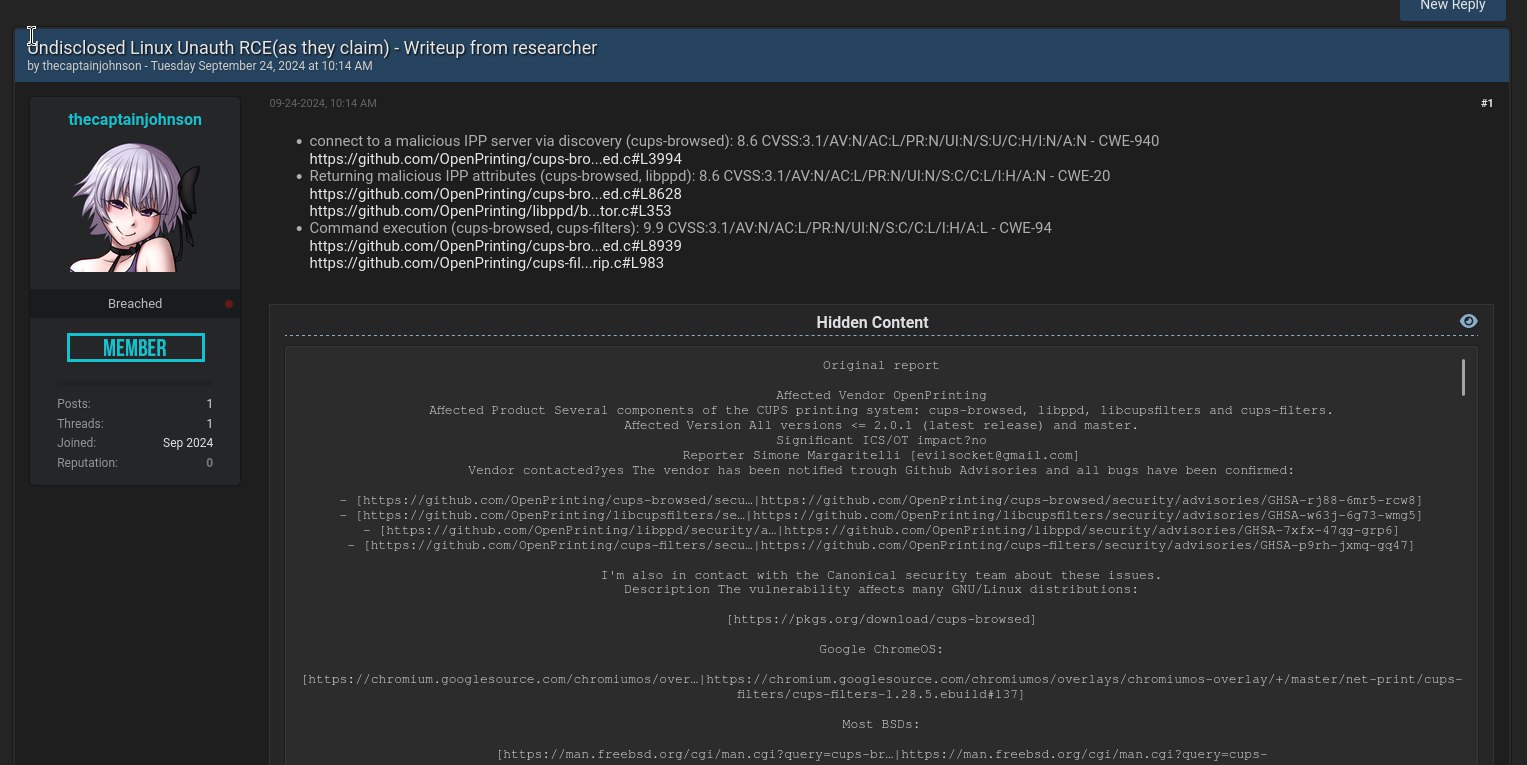
Later Thursday, Margaritelli claimed the embargo was dropped because his initial report — exploit included — was leaked by the Vulnerability Information and Coordination Environment (VINCE), the CERT coordination center run by Carnegie Mellon University. Margaritelli’s blog post included a screenshot of a submission on the cybercrime forum BreachForums on Tuesday, which detailed his submission to VINCE. He told CyberScoop in an email did not submit the information anywhere else.
For the record: this is a coordinated disclosure because CERT's VINCE had a leak.
— Simone Margaritelli (@evilsocket) September 26, 2024
In all, four vulnerabilities were created due to Margaritelli’s research:
- CVE-2024-47176 cups-browsed version 2.0.1 and below
- CVE-2024-47076 libcupsfilters version 2.1b1 and below
- CVE-2024-47175 libppd version 2.1b1 and below
- CVE-2024-47177 cups-filters version 2.0.1 and below
Matthiew Morin, head of product with the XIoT security firm NetRise, said the bug could still be a “big deal” for servers that might be affected. Shodan, a search engine that indexes information about internet-connected devices, posted on X Thursday that there are “at least 75,000 exposed CUPS daemons on the Internet.”
Morin said operators they work with running IoT devices often “have no idea what software is running on them let alone being able to manage and secure these devices.”
“From a remediation perspective, it’s pretty ‘simple,'” he said. “The problem is that it’s installed on pretty much every Linux system by default.”
Red Hat noted that users can check if they are vulnerable by running: sudo systemctl status cups-browsed
Margaritelli’s blog post lists the following directions for remediation:
- Disable and remove the cups-browsed service if you don’t need it (and probably you don’t).
- Update the CUPS package on your systems.
- In case your system can’t be updated and for some reason you rely on this service, block all traffic to UDP port 631 and possibly all DNS-SD traffic.
Latest Podcasts
Government
FBI officials say AI is bolstering adversaries, emphasizing need to focus on cyber basics, patching
Feds accuse China of ‘systematic’ distillation of U.S. AI models
CIA’s Michael Ellis says cyber intelligence is changing how the agency operates
The G7 tells industry to hurry up and prep for post-quantum encryption
Technology
Threats
Policy
Whistleblower says USPS deploying new, ‘untested’ IT systems governing mail-in ballots
‘Watershed 250’ test program in Texas looks to private sector for water cybersecurity help
Former sexual abuse victims say Grok used their images, videos to train deepfake capabilities
Cyber threats nudge Trump to sign executive order on foreign equipment in U.S. energy infrastructure
Text extracted automatically; images, tables and formatting may be missing. Original: https://cyberscoop.com/cups-linux-vulnerability-red-hat-ubuntu/