Analyzing the vulnerability landscape in Q3 2024
Vulnerabilities mentionedAll →
| CVE | Vulnerability | CVSS | EPSS | Flags | Affected | Exposure | Published |
|---|---|---|---|---|---|---|---|
| CVE-2017-0199 | Remote Code Execution in Microsoft Office and WordPad via crafted document files CVE-2017-0199 is a remote code execution vulnerability in Microsoft Office and WordPad that stems from improper parsing of specially crafted files. Attackers trigger it by getting a user to open a malicious document, after which attacker-controlled code executes with the privileges of the logged-in user. Anyone running the affected Microsoft Office or WordPad software is exposed, and CISA notes the flaw has been leveraged in ransomware campaigns; no CVSS score is available in the source data. The flaw was added to CISA's Known Exploited Vulnerabilities catalog on 2021-11-03, and EPSS assigns a 99.9% probability of exploitation within 30 days (100th percentile), indicating active, ongoing exploitation. Do: Apply Microsoft's security updates for Office and Windows per vendor instructions, as required by CISA's KEV catalog; the flaw was publicly reported as fixed in Microsoft's April 2017 security updates. Until patched, treat unsolicited Office documents and email attachments as high-risk, since exploitation requires a user to open a crafted file. Verify that all Office and WordPad installations across the estate—especially endpoints that handle untrusted documents—have received the update. | 7.8 | 100% | KEV ransomware PoC ×6 |
| masshundreds of millions of Office installations worldwide (exact count unknown) | |
| CVE-2017-11882 | Memory Corruption RCE in Microsoft Office via Legacy Equation Editor CVE-2017-11882 is a memory corruption vulnerability (CWE-119) in Microsoft Office, residing in the legacy Microsoft Equation Editor component (EQNEDT32.EXE), that allows remote code execution in the context of the current user. Attackers trigger it by persuading a user to open a crafted document, most commonly an RTF file or other Office document carrying a malicious embedded equation object, which overflows a buffer while the equation content is parsed. Successful exploitation lets the attacker run arbitrary code with the privileges of the signed-in user, a typical foothold for malware delivery and, per CISA, for ransomware operations. Any environment running affected Microsoft Office builds is exposed; the source data does not enumerate specific affected version ranges. The flaw is confirmed exploited in the wild: it was added to the CISA Known Exploited Vulnerabilities catalog on 2021-11-03 with known ransomware use and holds a 99.9% EPSS score (percentile 100), though the source data lists no public PoC. Do: Apply Microsoft's Office security updates (November 2017 or later) across all endpoints, prioritizing this KEV-listed flaw given its known ransomware use. On systems that cannot yet be patched, disable or unregister the legacy Equation Editor (EQNEDT32.EXE) and consider blocking or warning on RTF attachments as interim mitigations. Check for indicators of abuse such as EQNEDT32.EXE spawning unexpected child processes after document opens. | 7.8 | 100% | KEV ransomware PoC ×10 |
| masshundreds of millions of users/installations (Office is near-ubiquitous on Windows and in enterprises; the share still unpatched is unknown) | |
| CVE-2018-0802 | Memory Corruption RCE in Microsoft Office Equation Editor A memory-corruption flaw (out-of-bounds write, CWE-787) in the legacy Equation Editor component (EQNEDT32.EXE) shipped with Microsoft Office 2007, 2010, 2013, and 2016 allows remote code execution due to improper handling of objects in memory. An attacker triggers it by persuading a user to open a specially crafted document (for example an RTF or DOCX containing a malformed embedded equation object), causing the Equation Editor process to corrupt memory when the file is opened in Word; the user-interaction requirement is reflected in the CVSS 3.1 vector (AV:L/UI:R). Successful exploitation gives the attacker code execution in the context of the current user, with high impact on confidentiality, integrity, and availability (CVSS 3.1 score 7.8, High). Any user of the affected Office versions, the Office Compatibility Pack, or Word on an unpatched system is affected. Exploitation is confirmed in the wild: the flaw is in CISA's Known Exploited Vulnerabilities catalog (added 2021-11-03) with known ransomware use, carries a 93.3% EPSS probability of exploitation within 30 days, and multiple public analyses and proof-of-concepts exist. Do: Apply Microsoft's January 2018 security updates for Office 2007, 2010, 2013, and 2016 and the Office Compatibility Pack, and verify the legacy Equation Editor executable (EQNEDT32.EXE) on endpoints has been patched or removed (Microsoft later retired the component). Because the flaw is exploited in the wild and used in ransomware campaigns, prioritize remediation per CISA KEV required action and hunt for Word spawning EQNEDT32.EXE or unexpected child processes when documents are opened. Until patched, open untrusted documents in Protected View and treat email-delivered RTF/DOCX attachments as untrusted. | 7.8 | 93% | KEV ransomware PoC ×3 |
| masshundreds of millions of Office users at time of disclosure (vulnerable Equation Editor shipped by default with Office 2007-2016); largely patched today, with… | |
| CVE-2021-40444 | Remote Code Execution via MSHTML Rendering Engine in Microsoft Windows/Office (CVE-2021-40444) CVE-2021-40444 is a remote code execution vulnerability in the Microsoft MSHTML browser rendering engine, which Microsoft Office documents can load on Windows systems. It is triggered when a user is convinced to open a specially crafted Office document containing a malicious ActiveX control hosted by the MSHTML engine (tracked as a path-traversal-class issue, CWE-22). A successful attacker gains the ability to run arbitrary code in the context of the logged-on user, with greater impact when that user has administrative rights. Any Windows system that can open Office documents is exposed, spanning Windows 7, 8.1, RT 8.1, Windows 10 (1507 through 21H1) and Windows Server 2004/2008. Exploitation is confirmed in the wild: Microsoft observed targeted attacks at disclosure, the flaw is in CISA's KEV with known ransomware use, and Microsoft released security updates on September 14, 2021. Do: Apply Microsoft's security updates released September 14, 2021 for your Windows version immediately; this is a CISA KEV item with known ransomware use, so patching is treated as mandatory. As interim protection, keep Microsoft Defender Antivirus/Defender for Endpoint signatures current (enterprise detection build 1.349.22.0 or newer, with alerts appearing as 'Suspicious Cpl File Execution') and avoid opening untrusted Office documents, since exploitation requires user interaction with a crafted file. | 8.8 | 97% | KEV ransomware PoC ×2 |
| masshundreds of millions of Windows PCs and servers (nearly all Windows desktop/laptop installs on affected versions at disclosure) | |
| CVE-2023-22809 | In Sudo before 1.9.12p2, the sudoedit (aka -e) feature mishandles extra arguments passed in the user-provided environment variables (SUDO_EDITOR, VISUAL, and ED In Sudo before 1.9.12p2, the sudoedit (aka -e) feature mishandles extra arguments passed in the user-provided environment variables (SUDO_EDITOR, VISUAL, and EDITOR), allowing a local attacker to append arbitrary entries to the list of files to process. This can lead to privilege escalation. Affected versions are 1.8.0 through 1.9.12.p1. The problem exists because a user-specified editor may contain a "--" argument that defeats a protection mechanism, e.g., an EDITOR='vim -- /path/to/extra/file' value. NVD description · AI analysis pending | 7.8 | 55% | PoC ×3 |
| — | |
| CVE-2023-23397 | Zero-Click Elevation of Privilege in Microsoft Outlook (Forced NTLM Credential Leak) CVE-2023-23397 is an elevation of privilege vulnerability in Microsoft Outlook caused by improper input validation (CWE-20) combined with authentication bypass via spoofed authentication data on the channel (CWE-294), allowing an attacker to force Outlook to authenticate to an attacker-controlled SMB/WebDAV server. It is triggered when Outlook processes a crafted email or calendar object — for example a meeting or task reminder whose sound property points to an attacker-supplied UNC path — and requires no user interaction. That authentication exchange leaks the victim's NTLM credential hash, which the attacker can crack offline or relay to authenticate as the victim and access resources such as Exchange mailboxes, effectively escalating privileges. Affected software spans Microsoft 365 Apps, Microsoft Office (including the Long Term Servicing Channel), and Microsoft Outlook, which are deployed across enterprises, governments, and militaries worldwide. It is actively exploited in the wild — added to CISA's Known Exploited Vulnerabilities catalog on 2023-03-14 with a 97.4% EPSS — and Microsoft has warned of exploitation by Russia-aligned threat actors in campaigns against government and military mail servers, with patches shipped in Microsoft's March 2023 security updates. Do: Apply Microsoft's March 2023 security updates to Microsoft 365 Apps, Office/LTSC, and Outlook immediately, per CISA's required action. As interim mitigation, enable Extended Protection for Authentication or add accounts to the Protected Users group to block the NTLM credential leak, and audit calendar and task reminder sound properties for UNC paths (Microsoft published an audit/cleanup script for this) while watching for unexpected outbound SMB/WebDAV connections from hosts running Outlook. | 9.8 | 97% | KEV |
| masson the order of hundreds of millions of users (Outlook ships with Microsoft Office/Microsoft 365, the dominant enterprise and government email suite) | |
| CVE-2023-2640 | On Ubuntu kernels carrying both c914c0e27eb0 and "UBUNTU: On Ubuntu kernels carrying both c914c0e27eb0 and "UBUNTU: SAUCE: overlayfs: Skip permission checking for trusted.overlayfs.* xattrs", an unprivileged user may set privileged extended attributes on the mounted files, leading them to be set on the upper files without the appropriate security checks. NVD description · AI analysis pending | 7.8 | 15% | PoC |
| — | |
| CVE-2023-31248 | Linux Kernel nftables Use-After-Free Local Privilege Escalation Vulnerability; Linux Kernel nftables Use-After-Free Local Privilege Escalation Vulnerability; `nft_chain_lookup_byid()` failed to check whether a chain was active and CAP_NET_ADMIN is in any user or network namespace NVD description · AI analysis pending | 7.8 | 2% |
| — | ||
| CVE-2023-32233 | In the Linux kernel through 6.3.1, a use-after-free in Netfilter nf_tables when processing batch requests can be abused to perform arbitrary read and write oper In the Linux kernel through 6.3.1, a use-after-free in Netfilter nf_tables when processing batch requests can be abused to perform arbitrary read and write operations on kernel memory. Unprivileged local users can obtain root privileges. This occurs because anonymous sets are mishandled. NVD description · AI analysis pending | 7.8 | 13% |
| — | ||
| CVE-2023-3269 | A vulnerability exists in the memory management subsystem of the Linux kernel. A vulnerability exists in the memory management subsystem of the Linux kernel. The lock handling for accessing and updating virtual memory areas (VMAs) is incorrect, leading to use-after-free problems. This issue can be successfully exploited to execute arbitrary kernel code, escalate containers, and gain root privileges. NVD description · AI analysis pending | 7.8 | 1% |
| — | ||
| CVE-2023-36802 | Use-After-Free Privilege Escalation in Microsoft Streaming Service Proxy CVE-2023-36802 is a use-after-free vulnerability (CWE-416) in the Microsoft Streaming Service Proxy, a component that ships with Windows, that allows an attacker to escalate privileges. It is triggered by a local attacker who can already execute code on a target machine and interacts with the streaming service proxy component in a way that mishandles freed memory. Successful exploitation typically yields elevated (SYSTEM/kernel-level) privileges, giving an attacker full control of the host and making it a common link in chained attack sequences alongside other exploits. Any Windows system carrying the affected component is potentially affected, which in practice means a very broad installed base of Windows client and server machines. The flaw is being actively exploited — CISA added it to the Known Exploited Vulnerabilities catalog on 2023-09-12 — though no public proof-of-concept is known and Microsoft's severity scoring was not yet available in the source data; EPSS estimates a high 27.5% chance of exploitation within 30 days (98th percentile). Do: Apply Microsoft's security updates for this vulnerability via the vendor's mitigation instructions (Windows Update/patch channel), as required by the CISA KEV listing, prioritizing internet-reachable and multi-user Windows hosts. Since exploitation requires local access, limit who can run code on Windows systems and review endpoints for signs of local privilege escalation activity; confirm the patch landed by checking installed updates against Microsoft's advisory. | 7.8 | 28% | KEV |
| mass≈hundreds of millions of Windows devices (the Streaming Service Proxy component ships with Windows, so exposure broadly mirrors the Windows install base) | |
| CVE-2023-36874 | Local Privilege Escalation in Microsoft Windows Error Reporting Service CVE-2023-36874 is a privilege escalation vulnerability in the Microsoft Windows Error Reporting Service, associated with improper handling of linked resources (CWE-59), that allows a local attacker to elevate privileges beyond their current user context. It is triggered when an attacker who can already execute code on a target Windows machine interacts with the Error Reporting Service such that the service processes attacker-influenced files or links in a way that grants it unintended access. Successful exploitation yields elevated privileges on the host, a common post-compromise step used to chain with malware or other exploits to disable defenses and move laterally. Any Windows system running the Error Reporting Service is affected — effectively all supported Windows client and server releases per CISA, though specific version ranges are not enumerated in the source data. CISA added the flaw to its Known Exploited Vulnerabilities catalog on 2023-07-11, confirming exploitation in the wild; no public proof-of-concept is documented, ransomware use is unknown, and EPSS estimates a 43.4% probability of exploitation within 30 days (99th percentile). Do: Apply the Microsoft security updates that fix CVE-2023-36874 (July 2023 Windows security updates or any later cumulative update) on all Windows endpoints and servers, prioritizing hosts where untrusted users have interactive logon (RDS/VDI, kiosks, jump servers). Because the flaw requires local access, limiting interactive logon rights on shared systems reduces risk as a compensating measure. Federal agencies must patch within CISA's standard two-week KEV remediation timeline from the 2023-07-11 listing. | 7.8 | 43% | KEV PoC |
| mass≈1 billion+ Windows devices (Error Reporting Service is a default OS component across supported Windows releases) | |
| CVE-2023-38831 | Code Execution in RARLAB WinRAR via Crafted ZIP File/Folder Name Confusion RARLAB WinRAR before 6.23 mishandles ZIP archives that contain a benign file (such as a JPG) alongside a folder with the same name, causing the folder's contents - which can include malicious executable files - to be processed when the user merely attempts to view the benign file. By sending a crafted ZIP archive, an attacker gains arbitrary code execution on the victim's machine with the user's privileges. Because the flaw is local (AV:L) and requires user interaction, risk is limited to Windows systems running an unpatched copy of WinRAR, while machines without the tool are unaffected. The bug was actively exploited in the wild from April through October 2023, including by government-backed actors (APT28), SideCopy attacks on Indian government entities, ransomware operations, and trading-account theft campaigns, and it was added to CISA's Known Exploited Vulnerabilities catalog on 2023-08-24. Do: Upgrade all Windows systems running WinRAR to version 6.23 or later, which fixes this flaw; if patching is not immediately possible, treat ZIP files from untrusted sources with caution and check archives for duplicate file/folder names before opening. Given KEV listing with known ransomware use and public proof-of-concept exploits, hunt for compromise by reviewing whether unexpected executables or scripts ran when ZIP archives were opened, and apply vendor mitigations per CISA's required action or discontinue use if mitigations are unavailable. | 7.8 | 98% | KEV ransomware PoC ×4 |
| masshundreds of millions of users/installations worldwide (WinRAR is one of the most widely installed Windows archive utilities) | |
| CVE-2023-4911 | Buffer Overflow in GNU C Library ld.so Grants Root via SUID Binaries CVE-2023-4911 ('Looney Tunables') is a buffer overflow in the GNU C Library's dynamic loader (ld.so) that occurs while processing the GLIBC_TUNABLES environment variable. A local attacker triggers it by launching a set-user-ID (SUID) binary with a maliciously crafted GLIBC_TUNABLES value, corrupting memory in the privileged process. This allows the attacker to execute code with elevated (root) privileges on the host. Any system running an affected glibc is potentially exposed, including major Linux distributions (Fedora, Red Hat, Canonical, Debian), Red Hat CodeReady Linux Builder channels, NetApp products, and Siemens SIMATIC S7-1500 firmware, although exploitation requires local execution capability or a foothold on the machine. Exploitation is confirmed in the wild: Qualys published a working proof-of-concept, the flaw was added to CISA's Known Exploited Vulnerabilities catalog on 2023-11-21, and Kinsing threat actors have used it for cryptojacking and to breach cloud environments. Do: Install patched glibc updates from your distribution vendor (Fedora, Red Hat, Canonical/Ubuntu, Debian) and apply Siemens firmware updates for affected SIMATIC S7-1500 MFP devices; NetApp customers should follow NetApp's remediation guidance. Until patched, audit SUID/SGID binaries (which the attacker needs as the escalation trigger) and limit untrusted local access and shell access on multi-user or cloud-hosted Linux systems. Per the CISA KEV required action, apply vendor mitigations or discontinue use, prioritizing internet-facing hosts given active Kinsing cryptojacking and cloud-breach activity. | 7.8 | 81% | KEV PoC ×6 |
| masshundreds of millions of Linux installations worldwide (glibc is the standard C library shipped with virtually every major distribution) | |
| CVE-2024-47177 | Rejected reason: ** REJECT ** DO NOT USE THIS CANDIDATE NUMBER. Rejected reason: ** REJECT ** DO NOT USE THIS CANDIDATE NUMBER. ConsultIDs: CVE-2024-47076, CVE-2024-47175, CVE-2024-47176. Reason: This candidate is a duplicate of CVE-2024-47076, CVE-2024-47175, and CVE-2024-47176. Notes: All CVE users should reference CVE-2024-47076, CVE-2024-47175, and/or CVE-2024-47176 instead of this candidate. This CVE was issued to a vulnerability that is dependent on CVE-2024-47076, CVE-2024-47175, and CVE-2024-47176. According to rule 4.2.15 of the CVE CNA rules, \"CNAs MUST NOT assign a different CVE ID to a Vulnerability that is fully interdependent with another Vulnerability. The Vulnerabilities are effectively the same single Vulnerability and MUST use one CVE ID. NVD description · AI analysis pending | — | — | — | — |
Full article2,146 words · extracted from securelist.com · click to collapse
Q3 2024 saw multiple vulnerabilities discovered in Windows and Linux subsystems that are not standard for cyberattacks. This is because operating system developers have been releasing new security mitigations for whole sets of vulnerabilities in commonly used subsystems. For example, a log integrity check is set to appear in the Common Log Filing System (CLFS) in Windows, so the number of exploits for it will drop. As for Linux, this operating system has the Linux Kernel Runtime Guard (LKRG), implemented as a separate kernel module. Although the first version of LKRG was released back in 2018, it is undergoing constant refinement. And it is becoming more actively used in various Linux builds.
Statistics on registered vulnerabilities
As is customary, this section presents statistics on registered vulnerabilities. The data is taken from cve.org.
Total number of registered vulnerabilities and number of critical ones, Q3 2023 and Q3 2024 (download)

Q3 2024 preserved the upward trend in the number of vulnerabilities detected and registered. As before, the graph shows an increase relative to the same period in 2023 in both the total number of vulnerabilities and the number of critical ones. Notably, the number of discovered vulnerabilities over the three quarters is almost four-fifths of the whole of last year’s figure, further evidence of a marked increase.
Number of vulnerabilities and the shares of those that are critical and of those for which exploits exist, 2019 — 2024 (download)

The total number of first-time publications of PoCs for fresh CVEs rose by 2%, which indicates an acceleration in exploit creation. The rise in the number of PoCs may also be due to the fact that security researchers increasingly are not just commenting on vulnerability detection, but releasing detailed data that includes an exploit. Most PoCs appear within a week of the developers of vulnerable software releasing a patch.
Exploitation statistics
This section presents statistics on exploit usage in Q3 2024. The data is obtained from open sources and our own telemetry.
Windows and Linux vulnerability exploitation
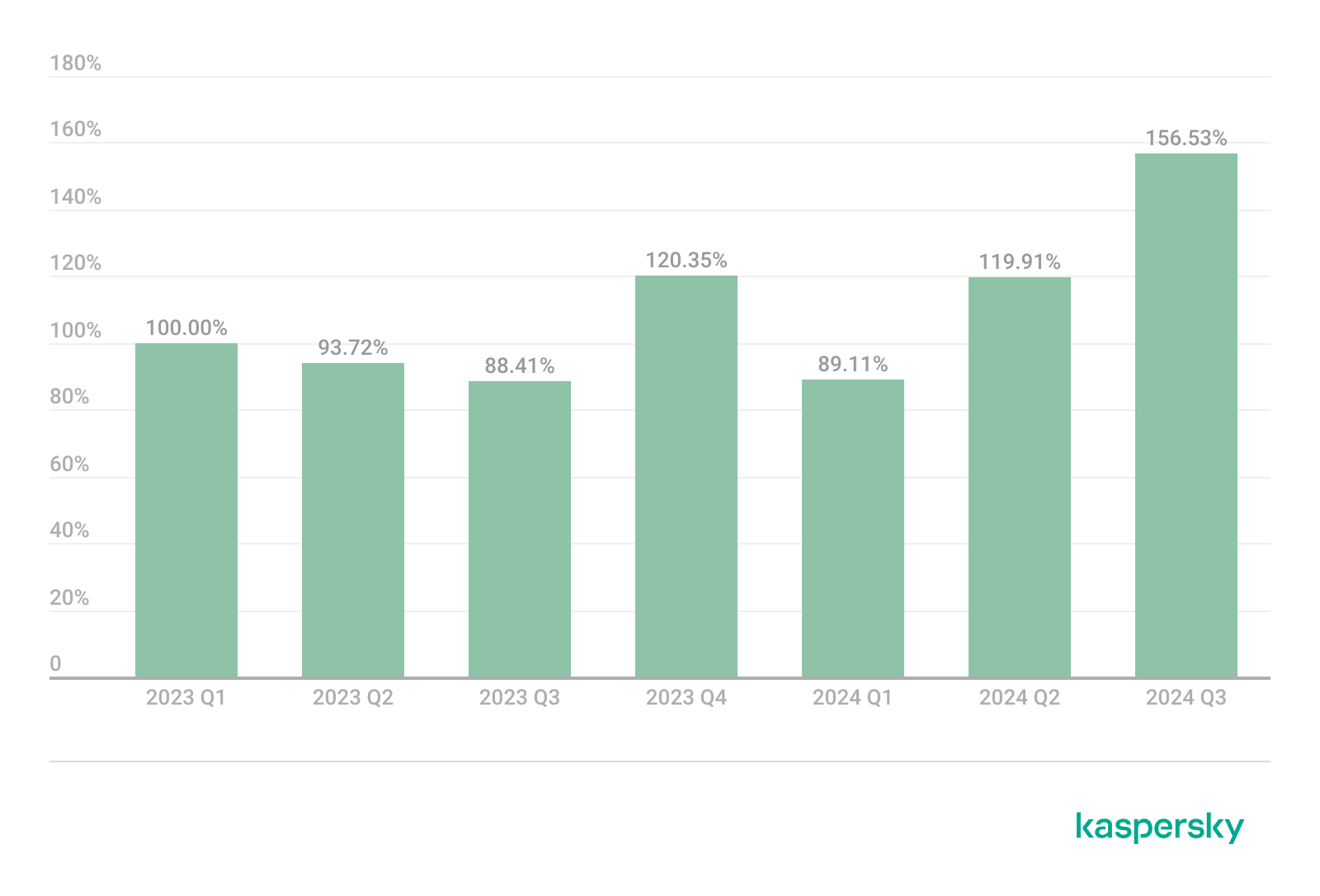
Among the exploits detected by Kaspersky solutions for Windows are ones for relatively new vulnerabilities that are gaining popularity. These include vulnerabilities in WinRAR, Microsoft Office, Windows Error Reporting Service and Microsoft Streaming Service Proxy:
- CVE-2023-38831 – a vulnerability in WinRAR to do with incorrect handling of objects in an archive;
- CVE-2023-23397 – a vulnerability that allows an attacker to steal authentication data from Outlook;
- CVE-2023-36874 – an impersonation vulnerability that allows the CreateProcess function to run under SYSTEM user;
- CVE-2023-36802 – a UAF vulnerability in the mskssrv.sys driver.
Meanwhile, the most common vulnerabilities in Microsoft Office products are quite old ones:
- CVE-2018-0802 – a remote code execution vulnerability in the Equation Editor component;
- CVE-2017-11882 – another remote code execution vulnerability in Equation Editor;
- CVE-2017-0199 – Microsoft Office and WordPad vulnerability that can be used to gain control over the victim system;
- CVE-2021-40444 – a remote code execution vulnerability in the MSHTML component.
Because these old vulnerabilities are leveraged as tools for initial access to user systems, we recommend updating the relevant software.
Dynamics of the number of Windows users who encountered exploits, Q1 2023 — Q3 2024. The number of users who encountered exploits in Q1 2023 is taken as 100% (download)
For Linux, Kaspersky products detected exploits for the following vulnerabilities:
- CVE-2023-2640 – a vulnerability in the OverlayFS kernel module. Allows privileged labels to be applied to files that can be used after mounting the file system;
- CVE-2023-22809 – a vulnerability in the Sudo utility that allows an attacker to run commands under another user in the system. An attacker can bypass initial settings restricting access to the utility’s functionality and act as any user;
- CVE-2023-4911 – a vulnerability in the dynamic loader ld.so to do with a buffer overflow when processing the environment variable GLIBC_TUNABLES;
- CVE-2023-32233 – a UAF vulnerability in the Netfilter subsystem that allows writing and reading data at arbitrary addresses in kernel memory;
- CVE-2023-3269 – a UAF vulnerability in the kernel memory management system that allows an attacker to run arbitrary code;
- CVE-2023-31248 – a UAF vulnerability in nftables that allows an attacker to run arbitrary code when firewall rules are being processed.
Changes in the number of Linux users who encountered exploits in Q1 2023 — Q3 2024. The number of users who encountered exploits in Q1 2023 is taken as 100% (download)
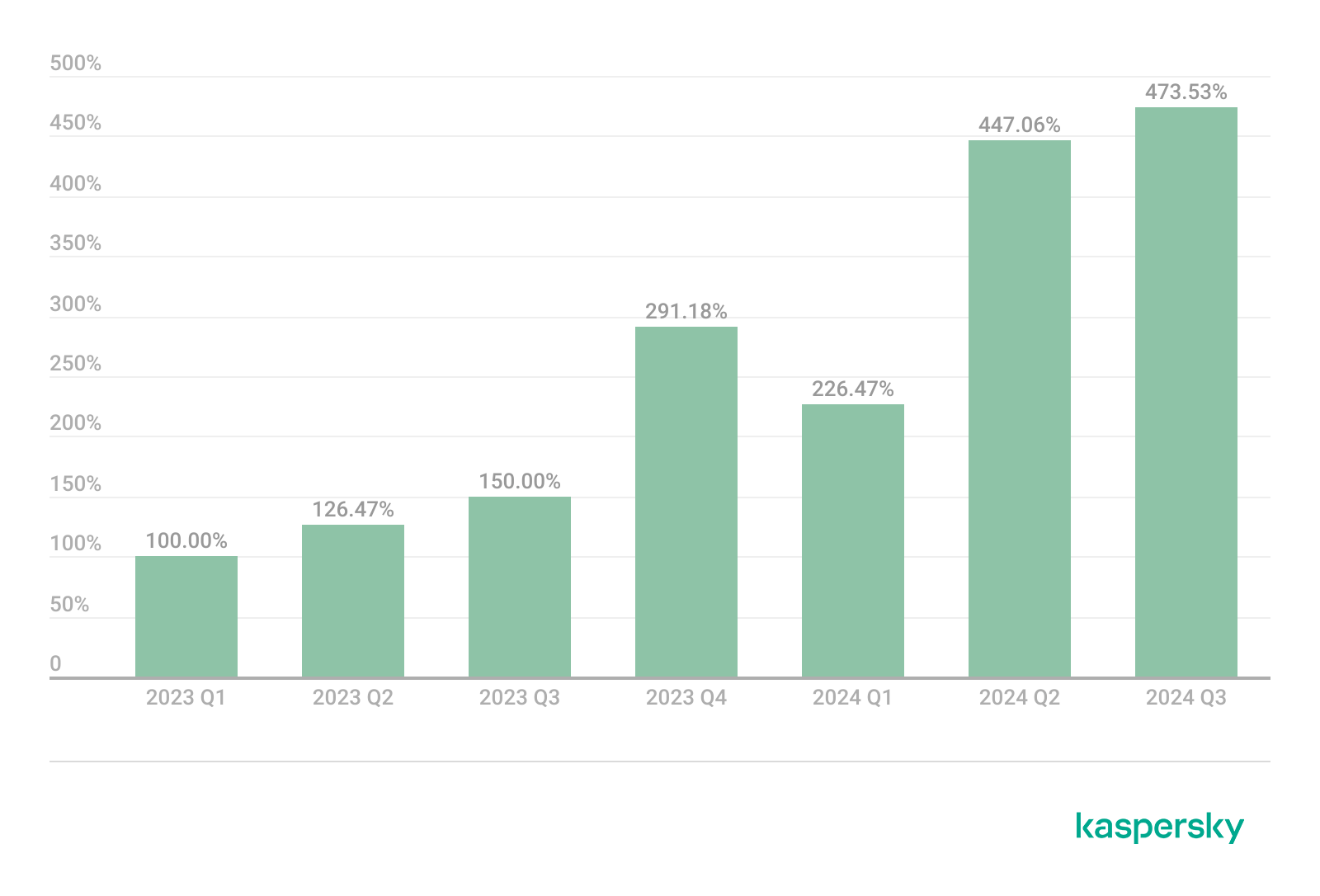
As the detection statistics and the list of common exploits for Linux show, it is critical to update both kernel components and applications that you use regularly.
Most prevalent exploits
Distribution of exploits for critical vulnerabilities by platform, Q1 2024 (download)

Distribution of exploits for critical vulnerabilities by platform, Q2 2024 (download)

Distribution of exploits for critical vulnerabilities by platform, Q3 2024 (download)

In Q3, vulnerabilities that have workable exploits and are considered the most critical (according to our methodology) were more likely than before to be related to operating system subsystems. This is because researchers, like attackers, give preference to code that is present in the operating system regardless of what software the user prefers. This allows them to target more devices and find new ways to run commands on vulnerable systems.
Vulnerability exploitation in APT attacks
We analyzed which vulnerabilities were most often used in advanced persistent threats (APTs) in Q3. The ranking below is based on our telemetry, research and open sources.
TОР 10 vulnerabilities exploited in APT attacks, Q3 2024
The list of vulnerabilities exploited in APT attacks has changed since last quarter. It now includes vulnerabilities that grant access to systems running web applications and mail servers. Some of the vulnerabilities are quite fresh, with one being registered last year and three this year. That said, most of the listed vulnerabilities are at least three years old. This suggests that developing exploits for new vulnerabilities is a harder task than writing new code for known ones. The longer an issue remains unfixed, the more information about it available to attackers since researchers and vendors publish data on vulnerabilities. In addition, if potential targets fail to patch old vulnerabilities for whatever reason, there is no need for attackers to look for new ones. This only goes to show yet again how important it is to update systems in a timely manner.
Interesting vulnerabilities
This section presents information about vulnerabilities of interest that were registered in Q3 2024.
CVE-2024-47177 (CUPS filters)
The issue was discovered in the Linux version of CUPS, a printing toolkit for Unix-like operating systems, such as iOS, macOS and Linux. Specifically, CUPS helps manage printers on a local network. See below for a flowchart of how it works.
CUPS flowchart
To start any job, the CUPS scheduler creates a job file. The file may contain print setup information and special PostScript commands. One of these commands, FoomaticRIPCommandLine, contains a logical vulnerability that allows arbitrary commands to be run in the operating system shell. To exploit the vulnerability, an attacker just needs to create a malicious printer configuration, but in order to run the code, the user must be persuaded to print any document on that printer. The malicious code automatically executes when printing begins.
The main problem with CUPS is the lack of restrictions on actions that can be performed in the system using this toolkit. To detect an exploitation of the vulnerability, it is essential to monitor commands executed on the part of the foomatic-rip print filter.
CVE-2024-38112 (MSHTML Spoofing)
Discovered in active attacks carried out in May 2024, this vulnerability can be used to run code on a system through an old version of Internet Explorer. It stems from being able to create a malicious .url file that bypasses Microsoft Edge and runs an old version of Internet Explorer. This is achieved by using !x-usc, a special directive that must be handled by the MSHTML protocol. Such sleight of hand recalls to mind the exploitation of another popular vulnerability in Microsoft Office, CVE-2021-40444, which we wrote about here.
While researching the vulnerability, we learned that in early August an exploit with functionality similar to the exploit for CVE-2024-38112 was up for sale on the dark web:
Such attacks can be prevented by denylisting emails with .url file attachments and, of course, by applying Microsoft patch.
CVE-2024-6387 (regreSSHion)
Security issues with the OpenSSH tool always reverberate far and wide, since many systems run on the Linux kernel, where effectively the main way to remotely access the OS functionality is via an SSH server. In 2023, for instance, the CVE-2023-51385 vulnerability was found to exist in all versions of OpenSSH right up to 9.6 – the dark web was selling an exploit that covered this invulnerable version too, but it may have been a dummy:
A new vulnerability, CVE-2024-6387, dubbed regreSSHion, also caused a stir in Q3 2024. The issue arises during SSH authentication. The vulnerable code is located in the SIGALRM handler, which runs asynchronously and uses unsafe functions to interact with memory. This makes it possible to launch an attack on the system at the very stage when the SSH server receives authentication data.
Threat actors have used regreSSHion to attack researchers in a very unconventional way. No sooner had the general principle of the vulnerability been published than there appeared false PoCs and various malware projects that in reality had nothing to do with regreSSHion.
At the time of writing this post, around 105 fake projects had been published online claiming to contain an exploit for CVE-2024-6387. However, a working proof of concept (PoC) for this vulnerability has not yet been published.
CVE-2024-3183 (Free IPA)
A vulnerability found inside the open-source FreeIPA, which provides centralized identity management and authentication for Linux systems. The issue occurs during Kerberos authentication. A user with minimal privileges on the network can sniff ticket encryption data and use it to carry out a Kerberoasting attack, which attackers have previously done to gain access to Windows-based infrastructure.
Most interesting of all, this vulnerability can be exploited by performing a minimal update of the toolkit used for Kerberoasting attacks on Windows Active Directory systems.
An effective countermeasure is this patch, but if for some reason installation isn’t possible, you need to monitor ticket requests for users (principals) that are on the FreeIPA network and are different from the user making the request.
CVE-2024-45519 (Zimbra)
A vulnerability in the postjournal service allowing an attacker to manipulate email messages. What the vulnerability essentially allows is an OS Command Injection attack in its simplest form. An attacker with the ability to send emails to the server can specify in the To field of a message a payload to run in the target service. The command will be executed with the privileges of the mail user.
You can guard against this vulnerability by disabling the postjournal service or updating the mail server to the latest version. At the time of posting, it was no longer possible to install the vulnerable postjournal. Instead, the patched version is automatically loaded when deploying the mail server.
CVE-2024-5290 (Ubuntu wpa_supplicant)
Wpa_supplicant is a set of tools for handling wireless security protocols. It includes utilities with graphical and terminal interfaces.
These interfaces can be used either directly through the command line, or through RPC mechanisms. The Ubuntu operating system uses D-Bus to describe RPC functions. This technology can be used to communicate with an application and leverage its functionality. It was a misconfigured RPC interface that caused the wpa_supplicant vulnerability: the default settings allowed a regular user to access quite critical functionality.
Through this vulnerability, any .so file could be loaded into process memory, with its path specified by the user when interfacing with wpa_supplicant via D-Bus.
Conclusion and advice
The number of discovered vulnerabilities for which there are working PoCs continues to grow. Some exploits are sold on the dark web, others are in the public domain. Moreover, threat actors leverage not only real PoCs, but also interest in the topic of high-profile vulnerabilities. For instance, they create fake exploits to attack security researchers: while the victim is studying the behavior of the pseudo-exploit, an entirely different malicious payload compromises their system.
To stay safe, it is essential to respond promptly to the evolving threat landscape. Also, make sure that you:
- Never research exploits for vulnerabilities outside of a secure virtual environment.
- Know your way around and closely monitor your infrastructure, paying special attention to the perimeter.
- Wherever possible, install patches for vulnerabilities as soon as they become available. Specialized solutions such as Vulnerability Assessment and Patch Management and Kaspersky Vulnerability Data Feed can automate and simplify vulnerability and patch management.
- Use comprehensive solutions that feature not only basic malware protection, but incident response scenarios, employee awareness training and an up-to-date database of cyberthreats. Our Kaspersky NEXT line of solutions ticks all these boxes and more.
Text extracted automatically; images, tables and formatting may be missing. Original: https://securelist.com/exploits-and-vulnerabilities-q3-2024/114839/