New Exploit Targeting Java Vulnerability Found in BlackHole Arsenal
Vulnerabilities mentionedAll →
| CVE | Vulnerability | CVSS | EPSS | Flags | Affected | Exposure | Published |
|---|---|---|---|---|---|---|---|
| CVE-2010-0188 | Arbitrary Code Execution in Adobe Reader and Acrobat via Malicious PDF Handling CVE-2010-0188 is an unspecified code-injection (CWE-94) flaw in Adobe Reader and Acrobat that allows attackers to cause a denial of service or possibly execute arbitrary code on the victim's machine. It is triggered when an affected application processes a maliciously crafted PDF document, typically delivered as an email attachment or downloaded from a website, so simply viewing the file with vulnerable software is enough to expose the user. A successful attack gives the attacker code execution in the context of the logged-on user, which can be leveraged to install malware or ransomware. Anyone running Adobe Reader or Acrobat is affected; CISA lists the products without published version ranges, so all Adobe deployments should be treated as potentially in scope. Exploitation is confirmed in the wild: the flaw is in CISA KEV (added 2022-03-03) with known ransomware use, and EPSS assigns an 88.2% probability of exploitation within 30 days (100th percentile). Do: Apply updates per vendor instructions: install the Adobe security update that fixes CVE-2010-0188 on any legacy Acrobat/Reader deployment and migrate unsupported installations to a currently supported Acrobat/Reader release. Given the known ransomware association, hunt for signs of compromise such as suspicious PDF attachments opened around malware activity, and block or sandbox PDFs at email and web gateways. Verify no critical hosts or automated workflows still depend on outdated Reader/Acrobat components for PDF processing. | — | 88% | KEV ransomware |
| masshundreds of millions of installed copies (Reader/Acrobat historically shipped as the default PDF handler on most Windows PCs; exact count of still-vulnerable… | |
| CVE-2011-3544 | Remote Code Execution in Oracle Java SE JRE Applet Rhino Script Engine CVE-2011-3544 is an access control flaw in the Rhino JavaScript Script Engine component used by Java applets in Oracle's Java Runtime Environment. It is triggered when a user's browser loads a malicious Java applet, allowing script executed through the Rhino engine to bypass Java's access restrictions. An attacker who successfully exploits it gains the ability to run arbitrary code on the victim's machine with the privileges of the logged-in user, typically via drive-by download from a compromised or attacker-controlled website. Any system with a vulnerable Oracle Java SE JDK or JRE and an enabled Java browser plugin is affected. Exploitation is confirmed in the wild: the flaw was added to CISA's KEV on 2022-03-03, carries a 96.7% EPSS probability of exploitation within 30 days, and contemporary reports show it weaponized in the BlackHole/Whitehole exploit kits and used in mass OS X exploitation. Do: Apply updated Oracle Java SE builds per Oracle's vendor instructions, prioritizing internet-facing and end-user systems listed in the KEV guidance. Where patching is delayed, disable the Java browser plugin or block Java applets at the web gateway, since the attack vector is malicious applets served over the web. Review endpoints for signs of exploit-kit drive-by compromise, especially legacy Windows and OS X machines with outdated Java. | — | 97% | KEV |
| masshundreds of millions of desktops and servers with a Java runtime installed; exact count unknown |
Full article397 words · extracted from securelist.com · click to collapse



On 3 December, we noted a rapid growth in the number of detections for exploits targeting the vulnerability CVE-2011-3544 in Java virtual machine. The vulnerability was published on 18 October, but malicious users have only recently begun to make active use of it. It can be used by exploits in drive-by attacks to download and launch malicious programs.
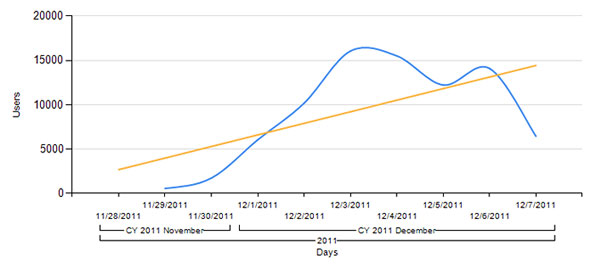
Number of unique detections of Exploit.Java.CVE-2011-3544
According to KSN data, most of the exploits targeting CVE-2011-3544 are used in the BlackHole Exploit Kit, which is currently the most popular exploit pack.
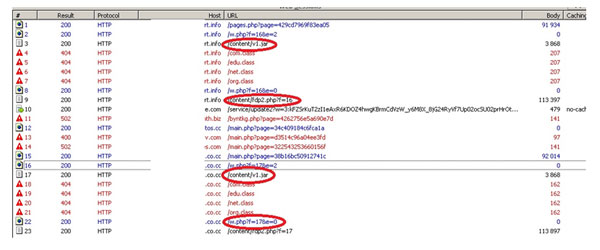
We analyzed the latest BlackHole kits. The sites that carry out drive-by attacks with the help of BlackHole turned up quite an old exploit – a PDF file that targets the vulnerability CVE-2010-0188, and a new Java exploit targeting the vulnerability CVE-2011-3544. The corresponding files are circled in red in the screenshot below.
A screenshot of the list of files intercepted when visiting websites where BlackHole is installed
Brian Krebs reports that the creators of BlackHole have successfully integrated the new exploit into their kit. According to KSN statistics, the new exploits attack users in Russia, the US, the UK and Germany. This appears to be related to the fact that new exploits that are integrated in BlackHole and target the vulnerability CVE-2011-3544, install the Trojan Carberp that steals banking data, as well as SMS blockers. SMS blockers are mostly used in Russia, while Trojan bankers attack users in developed countries.
Once again we see that malware writers are forging ahead and are continually improving their creations. It is, therefore, critical that all users install Java updates from Oracle in a timely manner. The patch for (among other things) the CVE-2011-3544 vulnerability can be downloaded here.
Latest Webinars
Reports
Kaspersky researchers have discovered new Mirage Kitten attacks using previously undocumented malware families: NodeRabbit in Node.js and PollCat in JavaScript.
Our experts discovered a new CoolClient backdoor variant with a kernel-mode rootkit driver that hides malicious processes, files, and network connections from security tools and threat analysts.
Kaspersky experts break down a new Armored Likho campaign that poses as a fundraising efforts and delivers a new Still Toolkit aimed at stealing Telegram data and eavesdropping on victims.
Kaspersky researchers reveal previously undocumented malware attributed to Mirage Kitten (UNC1549, Smoke Sandstorm, Nimbus Manticore): NightLedger backdoor, ArcBridge, and BridgeHead tunneling tools.
Text extracted automatically; images, tables and formatting may be missing. Original: https://securelist.com/new-exploit-targeting-java-vulnerability-found-in-blackhole-arsenal-3/31841/