What to know about ToolShell, the SharePoint threat under mass exploitation
Vulnerabilities mentionedAll →
| CVE | Vulnerability | CVSS | EPSS | Flags | Affected | Exposure | Published |
|---|---|---|---|---|---|---|---|
| CVE-2025-49704 +1 in the same advisory: …49706 | Authenticated Code Injection RCE in Microsoft SharePoint CVE-2025-49704 is a code injection vulnerability (CWE-94) in Microsoft SharePoint that allows an authorized (authenticated) attacker to execute arbitrary code on the server over the network, by sending requests whose attacker-controlled input SharePoint executes as code. It can be chained with CVE-2025-49706, and Microsoft subsequently issued CVE-2025-53770 as a patch bypass of the original CVE-2025-49704 fix, meaning the CVE-2025-53770 updates provide stronger protection and should be treated as the definitive remediation. Successful exploitation yields remote code execution on the SharePoint server, and CISA added the flaw to the KEV on 2025-07-22 with known ransomware use. Organizations running on-premises SharePoint Server are affected; CISA directs owners of public-facing servers running EOL/EOS versions (SharePoint Server 2013 and earlier) to disconnect them, and operators of supported versions to apply the CISA and vendor mitigations and updates, with cloud SharePoint services governed by BOD 22-01. Exploitation is confirmed in the wild and EPSS assigns a 100% probability of exploitation within 30 days (top percentile), although no public proof-of-concept code is documented. Do: Apply Microsoft's SharePoint Server updates for CVE-2025-53770, which supersede the original CVE-2025-49704 fixes with more robust protection, prioritizing internet-facing servers. Disconnect public-facing SharePoint servers running EOL/EOS versions (SharePoint Server 2013 and earlier), and for supported versions follow the CISA and vendor mitigations, with cloud services handled per BOD 22-01. Because in-the-wild exploitation and ransomware use are confirmed, hunt for indicators of compromise and ransomware activity on exposed SharePoint servers. | 8.8 group max | 100% | KEV ransomware |
| masstens of thousands of internet-exposed SharePoint servers per public scans, within a total on-premises install base plausibly exceeding 100,000 deployments… |
Full article340 words · extracted from arstechnica.com · click to collapse
Microsoft fixed the vulnerability pair—CVE-2025-49706 and CVE-2025-49704—two weeks ago as part of the company’s monthly update release. As the world learned over the weekend, the patches were incomplete, a lapse that opened organizations around the world to the new attacks.
Q: What sorts of malicious things are attackers doing with these newer ToolShell exploits?
A: According to numerous technical analyses, the attackers first infect vulnerable systems with a webshell-based backdoor that gains access to some of the most sensitive parts of a SharePoint Server. From there, the webshell extracts tokens and other credentials that allow the attackers to gain administrative privileges, even when systems are protected by multifactor authentication and single sign-on. Once inside, the attackers exfiltrate sensitive data and deploy additional backdoors that provide persistent access for future use.
For those who want more technical details, the opening volley in the attack is POST Web requests the attackers send to the ToolPane endpoint. The requests look like this:
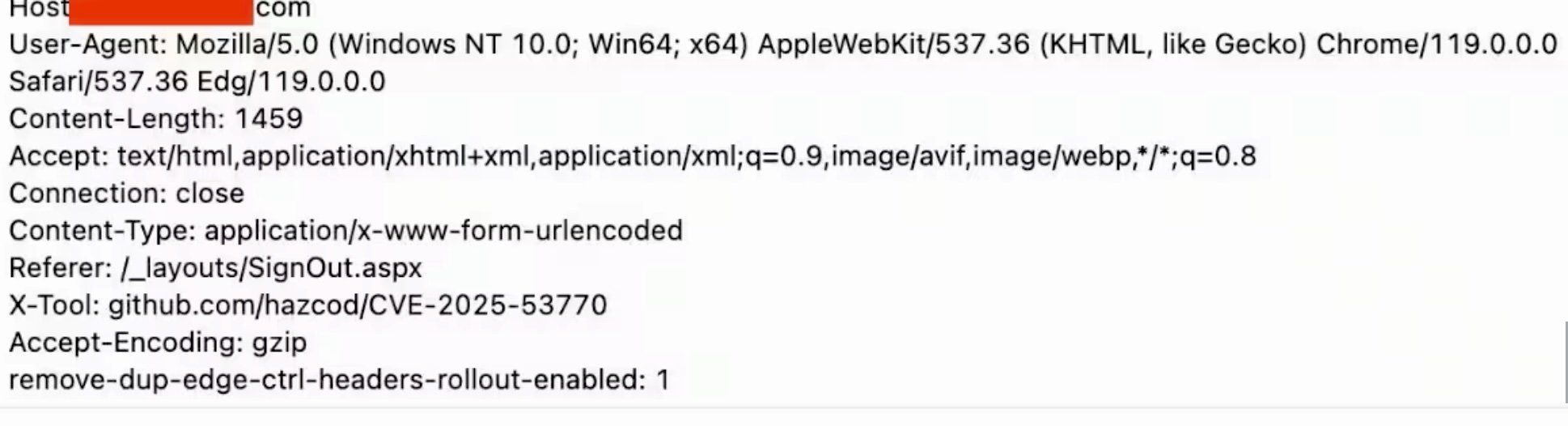
Microsoft said these requests upload a malicious script named spinstall0.aspx, or alternatively spinstall.aspx, spinstall1.aspx, spinstall2.aspx, and so on. The script contains commands for retrieving a SharePoint server’s encrypted MachineKey configuration and returning the decrypted results to the attacker through a GET request.
Q: I maintain an on-premises SharePoint server. What should I do?
A: In short, drop whatever else you were doing and take time to carefully inspect your system. The first thing to look for is whether it has received the emergency patches Microsoft released Saturday. Install the patch immediately if it hasn’t already been done.
Patching the vulnerability is only the first step, since systems infected through the vulnerability show few or no signs of compromise. The next step is to pore through system event logs in search of indicators of compromise. These indicators can be found in numerous write-ups, including those from Microsoft and Eye Security (at the links above), the US Cybersecurity and Information Security Agency, and security firms Sentinel One, Akamai, Tenable, and Palo Alto Networks.
Text extracted automatically; images, tables and formatting may be missing. Original: https://arstechnica.com/security/2025/07/what-to-know-about-toolshell-the-sharepoint-threat-under-mass-exploitation/