Chinese Hacker Uses DeepSeek AI to Orchestrate Vulnerability Exploits
Vulnerabilities mentionedAll →
| CVE | Vulnerability | CVSS | EPSS | Flags | Affected | Exposure | Published |
|---|---|---|---|---|---|---|---|
| CVE-2025-68613 | Authenticated RCE in n8n Workflow Automation Expression Evaluation n8n, an open source workflow automation platform, contains a critical remote code execution vulnerability (CVE-2025-68613, CWE-913) in its workflow expression evaluation system, affecting versions starting at 0.211.0 and prior to 1.120.4, 1.121.1, and 1.122.0. The flaw is triggered when expressions supplied by authenticated users during workflow configuration are evaluated in an execution context that is not sufficiently isolated from the underlying runtime, allowing the attacker to execute arbitrary code with the privileges of the n8n process. Successful exploitation can result in full compromise of the affected instance, including unauthorized access to sensitive data, modification of workflows, and execution of system-level operations. Any self-hosted or cloud n8n deployment running an affected version is exposed, with public scans indicating roughly 24,700 instances remain exposed on the internet. The flaw was added to CISA's Known Exploited Vulnerabilities catalog on 2026-03-11, EPSS places the 30-day exploitation probability at 99.1% (100th percentile), and Akamai has documented a ZeroBot malware campaign targeting n8n instances. Do: Upgrade immediately to n8n 1.120.4, 1.121.1, or 1.122.0 (or later), as the flaw is in CISA KEV and actively exploited by the ZeroBot malware campaign documented by Akamai. If immediate upgrade is not possible, restrict workflow creation and editing permissions to fully trusted users and run n8n in a hardened environment with restricted OS privileges and network access, keeping in mind these mitigations do not fully eliminate the risk. Review instances for signs of compromise, including unexpected workflow changes and suspicious process activity, and apply BOD 22-01 requirements if the product is used in federal cloud services. | 8.8 | 99% | KEV PoC |
| large≈24,700 internet-exposed n8n instances (public internet scan counts cited in exploit reporting) | |
| CVE-2026-0300 | Unauthenticated Out-of-bounds Write RCE in Palo Alto Networks PAN-OS Palo Alto Networks PAN-OS contains an out-of-bounds write vulnerability (CWE-787) in the User-ID Authentication Portal, also known as the Captive Portal service. An unauthenticated attacker can trigger the flaw by sending specially crafted packets to the portal, without needing valid credentials. Successful exploitation allows the attacker to execute arbitrary code with root privileges on the firewall, giving full control of PA-Series and VM-Series devices. Any organization running PA-Series or VM-Series firewalls with the User-ID Authentication Portal service enabled is affected. The flaw was added to CISA's Known Exploited Vulnerabilities catalog on 2026-05-06, indicating exploitation in the wild; EPSS puts the 30-day exploitation probability at 31.7% (98th percentile), patches were released on 2026-05-13, no public PoC is known, and CVSS scoring is not yet available. Do: Apply the PAN-OS patches Palo Alto Networks released on 5/13/2026, prioritizing internet-facing PA-Series and VM-Series firewalls. As an interim mitigation, restrict User-ID Authentication Portal access to trusted zones only, or disable the service entirely if it is not required. Inventory your deployments for use of the Captive Portal/User-ID Authentication Portal and follow CISA KEV and BOD 22-01 requirements, including for affected cloud service instances; note that federal agencies face KEV remediation deadlines. | 9.3 | 32% | KEV |
| large≈100,000+ PAN-OS firewall deployments; the vulnerable subset (installs with the User-ID Authentication Portal enabled) is likely in the tens of thousands,… | |
| CVE-2026-21858 | Unauthenticated RCE in n8n Workflow Automation (Ni8mare) n8n versions 1.65.0 through below 1.121.0 contain an input-validation flaw (CWE-20) in the handling of certain form-based workflows, allowing an unauthenticated remote attacker to reach the underlying server through form endpoints. By triggering a vulnerable form workflow, the attacker can access files on the host and expose sensitive information stored there; the Cyera research team (which named the bug "Ni8mare") and the CVSS 10.0 score with high integrity impact indicate this yields unauthenticated remote code execution and potential full takeover. Any self-hosted n8n instance running an affected version that exposes form-based workflows over the network is at risk, with blast radius amplified by n8n's typical access to credentials, secrets, and connected internal systems. The issue is fixed in version 1.121.0; the flaw is not yet in CISA's KEV, but a public proof-of-concept is available and EPSS assigns a 78.4% probability of exploitation within 30 days, so defenders should treat exploitation as likely and imminent. Do: Upgrade n8n to version 1.121.0 or later immediately. If you cannot upgrade right away, check whether any workflows use form triggers and remove those form endpoints from untrusted network exposure — place them behind authentication, a reverse proxy, or an IP allowlist. Review instance logs for unexpected requests to form/webhook paths and unusual file access, given the high EPSS score and public proof-of-concept. | 10.0 | 78% | PoC ×2 |
| large≈50,000–100,000 internet-exposed n8n servers (self-hosted automation platform, affected range spans roughly a year of releases) | |
| CVE-2026-3055 | Out-of-Bounds Read in Citrix NetScaler ADC and Gateway When Used as SAML IDP CVE-2026-3055 is an out-of-bounds read (CWE-125) in Citrix NetScaler ADC and NetScaler Gateway caused by insufficient input validation when the appliance is configured as a SAML Identity Provider (IDP). An unauthenticated remote attacker can trigger the flaw by sending crafted input to the SAML IDP functionality, causing the appliance to read beyond the bounds of allocated memory and potentially disclose sensitive information from it. The CVSS 4.0 base score of 9.3 (critical) reflects a network-vector flaw requiring no privileges or user interaction. Only organizations running NetScaler ADC or NetScaler Gateway appliances with SAML IDP configured are affected, according to the available data. The flaw was added to CISA's Known Exploited Vulnerabilities catalog on 2026-03-30, carries an 87.2% EPSS probability of exploitation within 30 days, has a public proof-of-concept, and headlines indicate active reconnaissance and exploitation against NetScaler deployments, including federal patch directives. Do: Apply the patched NetScaler ADC and NetScaler Gateway releases from Citrix's advisory as soon as possible, prioritizing internet-facing appliances (exact fixed version numbers are not in this data; check the vendor bulletin). Determine whether SAML IDP is configured on your appliances and, if it is not needed, disable or unbind it as an interim mitigation while reviewing appliance logs for suspicious authentication or reconnaissance traffic. Federal agencies must follow the CISA required action and BOD 22-01 guidance, with CISA directing patching by the stated Thursday deadline. | 9.3 | 87% | KEV PoC |
| largetens of thousands of internet-exposed NetScaler ADC/Gateway appliances, with the directly exposed subset limited to those configured as SAML IDPs | |
| CVE-2026-33017 | Unauthenticated RCE in Langflow AI Workflow Builder CVE-2026-33017 is an unauthenticated remote code execution flaw in Langflow, an open-source tool for building and deploying AI-powered agents and workflows. The POST /api/v1/build_public_tmp/{flow_id}/flow endpoint, which by design requires no authentication for building public flows, accepts an optional data parameter; when present, attacker-controlled flow data — including arbitrary Python code embedded in node definitions — is used instead of the flow stored in the database and passed to exec() with no sandboxing. An attacker who can reach this endpoint on an affected instance can therefore execute arbitrary Python code without any credentials, typically yielding full compromise of the underlying server. All Langflow versions prior to 1.9.0 are affected; the issue was fixed in 1.9.0 and is distinct from CVE-2025-3248, which only added authentication to the /api/v1/validate/code endpoint. The flaw was added to CISA's KEV catalog on 2026-03-25 (confirming exploitation in the wild), carries a 96.2% EPSS probability of exploitation within 30 days, and related reporting describes Langflow RCE attacks, including ransomware activity targeting AI model files. Do: Upgrade all Langflow deployments to 1.9.0 or later. If immediate patching is not possible, keep Langflow off direct internet exposure (place it behind an authenticating reverse proxy or firewall) and review logs for unauthenticated POST requests to /api/v1/build_public_tmp/{flow_id}/flow that include a data parameter, which would indicate exploitation attempts. As a KEV entry, federal agencies must apply mitigations per vendor guidance and BOD 22-01, or discontinue use of the product if mitigations are unavailable. | 9.3 | 96% | KEV PoC ×4 |
| moderateon the order of several thousand internet-exposed Langflow instances (estimate) | |
| CVE-2026-33824 | Unauthenticated Double-Free RCE in Microsoft Windows IKE Extension A double-free memory-corruption flaw (CWE-415) in the Microsoft Windows Internet Key Exchange (IKE) service extension allows a remote, unauthenticated attacker to trigger the bug with crafted network traffic, with no privileges or user interaction required. Successful exploitation yields remote code execution with full system impact, reflected in the critical 9.8 CVSS score (high confidentiality, integrity, and availability). The vulnerable IKE component is present in Windows 10 (1607, 1809, 21H2, 22H2), Windows 11 (23H2, 24H2, 25H2, 26H1), and Windows Server 2016, 2019, and 2022 (including 23H2), which ship it as a built-in feature. CISA added the flaw to the Known Exploited Vulnerabilities catalog on 2026-08-18, and security reporting confirms it is being actively exploited in the wild, though ransomware use is not yet confirmed. No public proof-of-concept is known, but the high EPSS score (72.7%, 99th percentile) signals a very strong likelihood of imminent or ongoing exploitation. Do: Apply Microsoft's security updates for CVE-2026-33824 to all affected Windows 10, Windows 11, and Windows Server releases, prioritizing internet-exposed systems where IKE/VPN is reachable (UDP 500/4500), per BOD 26-04 requirements. Organizations unable to patch promptly should restrict or discontinue use of exposed IKE/VPN services on affected hosts until updated. Triage VPN endpoints and remote-access servers for crashes or suspicious IKE traffic given confirmed in-the-wild exploitation. | 9.8 | 73% | KEV |
| masswell over 1B Windows devices include the built-in IKE extension; internet-exposed VPN/IKE endpoints plausibly number in the hundreds of thousands | |
| CVE-2026-34486 | EncryptInterceptor Bypass Exposes Cluster Traffic in Apache Tomcat CVE-2026-34486 is a missing-encryption vulnerability in Apache Tomcat in which the EncryptInterceptor, the component that encrypts Tomcat cluster communication, can be bypassed in a fail-open manner; the flaw was introduced as a regression by the fix for CVE-2026-29146. It affects Tomcat 11.0.20, 10.1.53 and 9.0.116, and is triggered when cluster communication is expected to be encrypted: an attacker positioned on the network path between cluster nodes receives inter-node traffic in cleartext. By reading that unencrypted traffic, the attacker can obtain sensitive data such as session payloads, potentially enabling session theft and authentication bypass as indicated by related reporting. Only deployments running the affected point releases with the EncryptInterceptor in use are impacted, including Tomcat shipped in Red Hat JBoss Web Server and Red Hat Enterprise Linux channels. The flaw is being actively exploited: CISA added it to the Known Exploited Vulnerabilities catalog on 2026-08-04, EPSS places 30-day exploitation probability at 98.6%, though no public proof-of-concept is known and ransomware use is unconfirmed. Do: Upgrade Apache Tomcat to 11.0.21, 10.1.54 or 9.0.117, and apply the corresponding Red Hat JBoss Web Server / Enterprise Linux updates when published. Audit Tomcat cluster configurations for EncryptInterceptor usage, and until patched restrict or encrypt the network segment carrying inter-node cluster traffic. Because the flaw is in CISA's KEV catalog, federal agencies must patch per BOD 26-04 timelines and should review cluster nodes for signs of session data interception. | 7.5 | 99% | KEV |
| largetens of thousands of Tomcat deployments on the affected point releases | |
| CVE-2026-39987 | Unauthenticated Remote Code Execution in Marimo Python Notebook Marimo, a reactive Python notebook, contains an unauthenticated remote code execution flaw (CVE-2026-39987, CWE-306; CVSS 4.0: 9.3 Critical) because its terminal WebSocket endpoint /terminal/ws skips authentication entirely. Unlike other WebSocket endpoints such as /ws, which call validate_auth(), /terminal/ws only checks the running mode and platform support before accepting connections, so any unauthenticated attacker who can reach the server can obtain a full PTY shell and execute arbitrary system commands on the host. All marimo deployments running versions prior to 0.23.0 are affected, with internet-exposed instances at greatest risk. Exploitation is confirmed in the wild: the flaw was added to CISA's KEV catalog on 2026-04-23, public PoCs exist, and reporting shows it was exploited within roughly 10 hours of disclosure, with observed post-exploitation activity involving LLM agents. EPSS assigns a 98.9% probability of exploitation within 30 days (100th percentile). Do: Upgrade marimo to 0.23.0 or later; until patched, restrict access to the /terminal/ws WebSocket endpoint by binding the notebook to localhost, a VPN, or an authenticating reverse proxy. Identify whether any marimo instances are internet-exposed and review logs for connections to /terminal/ws and unexpected shell or process spawns, given reports of LLM-agent-driven post-exploitation on compromised instances. As a KEV entry (added 2026-04-23), this requires federal agencies to apply the vendor fix or mitigations per BOD 22-01 timelines. | 9.3 | 99% | KEV PoC ×4 |
| moderatelikely tens of thousands of users, with directly internet-exposed marimo servers plausibly in the low thousands |
Full article555 words · extracted from infosecurity-magazine.com · click to collapse
Written by
A Chinese threat actor has used large language models (LLMs) from Chinese and Western companies to compromise internet-exposed digital infrastructure in Asia.
In particular, they leveraged one of DeepSeek’s AI models, Hermes Agent, an open-source agentic AI framework, to orchestrate the attack via Telegram.
These AI-augmented offensive capabilities “enabled them to dramatically increase the speed and scale of their campaigns,” said Andy Piazza, senior director of threat intelligence within Unit 42, Palo Alto Networks’ research team, in a report published on July 30.
AI Orchestration and Manual Vulnerability Exploitation
The threat actor is a Chinese-speaking individual operating under the aliases ‘knaithe’ and ‘KnYuan’ and based in Zhuhai, China.
Piazza described them as “an opportunistic exploit operator and self-described binary security researcher” based on the actor’s GitHub activity, specifically their maintenance of 1DayNews, an automated vulnerability intelligence pipeline.
They targeted internet-exposed infrastructure by combining autonomous AI-driven enumeration and automated exploitation with the automated and manual exploitation of seven vulnerabilities.
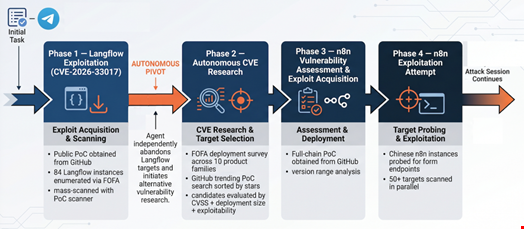
When initial exploitation failed due to the target environment's restrictive configurations, the actor’s Hermes Agent, connected to a DeepSeek AI model, autonomously conducted searches for known critical-severity common vulnerabilities and exposures (CVEs). It initially surveyed 10 product families, scanning GitHub for trending proofs of concept (PoC) exploits and prioritizing vulnerabilities by attack surface.
This research led the agent to pivot to seven higher-value vulnerabilities:
- CVE-2026-33017 (CVSS rating: 9.8): Langflow vulnerability with autonomous exploitation attempt (failed — auto_login disabled)
- CVE-2026-21858 (CVSS rating: 10.0): n8n Workflow Automation vulnerability with autonomous exploitation attempt (failed — auth required)
- CVE-2025-68613 (CVSS rating: 9.9): n8n Workflow Automation vulnerability with autonomous exploitation attempt (failed — auth required)
- CVE-2026-3055 (CVSS rating: 9.8): Citrix NetScaler ADC & Gateway vulnerability with manual active exploitation (data exfiltrated)
- CVE-2026-34486 (CVSS rating: 7.5): Apache Tomcat vulnerability with manual active exploitation (reverse shell attempts)
- CVE-2026-39987 (CVSS rating: 9.8): Marimo Notebook vulnerability with manual active exploitation (command execution confirmed)
- CVE-2026-0300 (CVSS rating: 9.8): PAN-OS User-ID Authentication Portal vulnerability with manual non-functional research PoC cloned (not executed)
- CVE-2026-33824 (CVSS rating: 9.8): Windows IKE Extensions (IKE VPN) vulnerability with manual active exploitation (reverse shell attempts)
Evidence of Trial and Testing of AI Tools
In parallel with their use of DeepSeek as their autonomous operator platform, the actor configured multiple LLMs, including Chinese ones (Qwen, GLM, Kimi, MiniMax) and limited usage and testing of Western AI tools, like Claude Code for connectivity testing and proxy validation and OpenAI’s Codex on exploit development directories.
“This limited usage is consistent with evaluating the AI-market to identify their preferred tool set,” Piazza wrote.
While the observed campaign had limited impact and did not achieve full compromise of any of the intended targets, the workflow confirms a functional, end-to-end autonomous offensive capability.
The campaign saw targets spanning three countries, including China and Malaysia, and multiple sectors.
According to Piazza, the main takeway from this campaign lies in the trajectory rather than the outcome.
“The actor is actively iterating – refining tool configurations, developing custom skills, establishing proxy infrastructure and executing autonomous attack cycles. The technical barrier to AI-augmented offensive operations is low and continues to decrease,” the researcher added.
Image credits: PJ McDonnell / ImageFlow / Shutterstock.com
Read now: AI-powered Cyber-Attacks Up Significantly in the Last Year, Warns CrowdStrike
Text extracted automatically; images, tables and formatting may be missing. Original: https://www.infosecurity-magazine.com/news/chinese-hacker-deepseek-ai/