The Epic Turla Operation
Vulnerabilities mentionedAll →
| CVE | Vulnerability | CVSS | EPSS | Flags | Affected | Exposure | Published |
|---|---|---|---|---|---|---|---|
| CVE-2012-1723 | Remote Arbitrary Code Execution in Oracle Java SE (Hotspot Component) Oracle Java SE's Java Runtime Environment contains an unspecified flaw in its Hotspot component that allows remote attackers to affect confidentiality, integrity, and availability — characterized by CISA as arbitrary code execution. The available data does not document the exact trigger beyond 'unknown vectors related to Hotspot,' but flaws in the JVM's execution engine of this type are typically reached remotely by having the runtime process malicious Java content. A successful attacker gains code execution in the context of the process running the JVM, taking control of the affected host. Any deployment running affected, unpatched Oracle Java SE — particularly legacy JRE installs — is affected. The vulnerability is in CISA's Known Exploited Vulnerabilities catalog (added 2022-03-03) with known ransomware use and a 93.7% EPSS probability of exploitation in the next 30 days, confirming active in-the-wild exploitation, though the reviewed data lists no public PoC. Do: Per CISA's required action, apply updates per vendor instructions: upgrade every Oracle Java SE installation to a currently supported patched release and inventory for legacy JRE builds that predate the 2012 Hotspot fix. Disable or restrict the Java browser plugin where it is not needed, and given known ransomware use, prioritize legacy Java systems for patching and threat-hunting. | — | 94% | KEV ransomware |
| mass≈ millions of endpoints running legacy, unpatched Java (exact count unknown) | |
| CVE-2013-3346 | Memory Corruption RCE in Adobe Reader and Acrobat Adobe Reader and Acrobat contain a memory corruption vulnerability (CWE-119, buffer/pointer handling error) that can allow an attacker to execute arbitrary code or crash the application. The bug is triggered by processing maliciously crafted content, typically when a user opens a booby-trapped PDF document. Successful exploitation yields arbitrary code execution with the privileges of the logged-in user, while failed exploitation can cause a denial of service. Anyone running affected Adobe Reader or Acrobat installations is exposed, with desktop users who open PDFs from email or the web at greatest risk. The flaw has been exploited in the wild: CISA added it to the KEV catalog on 2022-03-03 and it carries a very high EPSS score of 78.6%, although no public proof-of-concept is known. Do: Apply vendor-supplied updates to Adobe Reader and Acrobat immediately, per the Adobe security bulletin and the CISA KEV required action, and retire or upgrade legacy unpatched builds that are past end of support. Because exploitation requires a user to open a crafted PDF, inspect or sandbox PDFs at email and web gateways and hunt for signs of PDF exploit delivery; treat this flaw as actively exploited given the KEV listing and 78.6% EPSS. | — | 79% | KEV |
| massorder of 100M+ users at time of disclosure (Adobe Reader was then the dominant PDF reader); residual unpatched legacy deployments likely still in the millions | |
| CVE-2013-5065 | Local Privilege Escalation in Microsoft Windows Kernel (NDProxy.sys) CVE-2013-5065 is a local privilege escalation flaw caused by improper input validation (CWE-20) in NDProxy.sys, a kernel driver in Microsoft Windows. A local attacker triggers the flaw by sending malformed input that reaches the vulnerable kernel driver, bypassing the usual validation checks. Successful exploitation allows the attacker to run code with elevated (kernel/SYSTEM-level) privileges, typically taking full control of the local machine from a limited-user foothold. Per CISA, Microsoft Windows is affected; no specific version ranges are provided in the source data, so defenders should consult vendor update guidance for scope. The flaw is listed in CISA's Known Exploited Vulnerabilities catalog (added 2022-03-03), indicating it is known to be exploited in the wild, though ransomware use is listed as unknown and no public PoC is catalogued. Do: Apply the Microsoft updates per vendor instructions as required by CISA's KEV listing, prioritizing systems that host interactive users or are entry points in your environment. Because this is a local privilege escalation, focus on limiting local/low-privileged access on Windows hosts and confirm via vendor advisories which Windows versions are in scope and patched. Treat this KEV entry as a patching priority given the confirmed in-the-wild exploitation status. | — | 35% | KEV |
| masswell over 1,000,000 Windows installations potentially affected (kernel driver present across Windows deployments) |
Indicators of compromiseauto-extracted · verify before use · export allAll →
| Type | Indicator | Context |
|---|---|---|
| domain | arshinmalalan.com | e Java exploits has the following C&C hardcoded inside: www.arshinmalalan[.]com/themes/v6/templates/css/in.php This C&C is still online a |
| domain | com.au | a currently suspended page at “ hxxp://busandcoachdirectory.com[.]au “. For a full list of C&C servers, please see the Appendi |
| domain | hadilotfi.com | xxp://homaxcompany[.]com/components/com_sitemap/ hxxp://www.hadilotfi[.]com/wp-content/themes/profile/ A full list with all the C&C s |
| domain | homaxcompany.com | a generic internal ID of 1156fd22-3443-4344-c4ffff : hxxp://homaxcompany[.]com/components/com_sitemap/ hxxp://www.hadilotfi[.]com/wp-con |
| domain | losguayaberos.com | 0db018c320e80865f Note: the command and control servers www.losguayaberos[.]com and thebesttothbrushes[.]com have been sinkholed by Kaspe |
| domain | mfa.tj | try of Foreign Affairs of Tajikistan’s website, at “ hxxp://mfa[.]tj/upload/security.php “. The file is a .NET application tha |
| domain | servehttp.com | recovered from one of the mothership servers (at newsforum.servehttp[.]com/wordpress/wp-includes/css/img/upload.php , MD5: 4dc22c169 |
| domain | thebesttothbrushes.com | the command and control servers www.losguayaberos[.]com and thebesttothbrushes[.]com have been sinkholed by Kaspersky Lab. Other packages deli |
| md5 | 030f5fdb78bfc1ce7b459d3cc2cf1877 | ng to trick the user into running a fake Flash Player (MD5: 030f5fdb78bfc1ce7b459d3cc2cf1877): In at least one case, they tried to trick the user into d |
| md5 | 071d3b60ebec2095165b6879e41211f2 | 08 11:05:35 2012 another example: Size: 218,112 bytes MD5: 071d3b60ebec2095165b6879e41211f2 Compiled: Thu Nov 08 11:04:39 2012 This backdoor is more so |
| md5 | 0f76ef2e6572befdc2ca1ca2ab15e5a1 | victims include: MD5: c7617251d523f3bc4189d53df1985ca9 MD5: 0f76ef2e6572befdc2ca1ca2ab15e5a1 These top level packages deploy both updated Epic backdoors |
| md5 | 1369fee289fe7798a02cde100a5e91d8 | o the victim’s machine is “winrs.exe”: Name: winrs.exe MD5: 1369fee289fe7798a02cde100a5e91d8 This is an UPX packed binary, which contains the genuine “d |
| md5 | 15060a4b998d8e288589d31ccd230f86 | 03c79 allj.jar f41077c4734ef27dec41c89223136cf8 allj64.html 15060a4b998d8e288589d31ccd230f86 allj64.jar e481f5ea90d684e5986e70e6338539b4 lstj.jar 21cbc1 |
| md5 | 21cbc17b28126b88b954b3b123958b46 | 230f86 allj64.jar e481f5ea90d684e5986e70e6338539b4 lstj.jar 21cbc17b28126b88b954b3b123958b46 lstj.html acae4a875cd160c015adfdea57bd62c4 The Java files e |
| md5 | 244505129d96be57134cb00f27d4359c | 0b24d8744ad84d80e8 161 91a5594343b47462ebd6266a9c40abbe 162 244505129d96be57134cb00f27d4359c 164 4ae7e6011b550372d2a73ab3b4d67096 165 The Carbon system |
| md5 | 43e896ede6fe025ee90f7f27c6d376a4 | t: MD5 Resource number 4c1017de62ea4788c7c8058a8f825a2d 101 43e896ede6fe025ee90f7f27c6d376a4 102 e6d1dcc6c2601e592f2b03f35b06fa8f 104 554450c1ecb925693f |
| md5 | 4ae7e6011b550372d2a73ab3b4d67096 | 62ebd6266a9c40abbe 162 244505129d96be57134cb00f27d4359c 164 4ae7e6011b550372d2a73ab3b4d67096 165 The Carbon system is in essence an extensible platform, |
| md5 | 4c1017de62ea4788c7c8058a8f825a2d | following modules, both 32 and 64 bit: MD5 Resource number 4c1017de62ea4788c7c8058a8f825a2d 101 43e896ede6fe025ee90f7f27c6d376a4 102 e6d1dcc6c2601e592f |
| md5 | 4dc22c1695d1f275c3b6e503a1b171f5 | ehttp[.]com/wordpress/wp-includes/css/img/upload.php , MD5: 4dc22c1695d1f275c3b6e503a1b171f5 , Compiled: Thu Sep 06 14:09:55 2012) contains two modules, |
| md5 | 536eca0defc14eff0a38b64c74e03c79 | did manage to obtain the Java exploits: Name MD5 allj.html 536eca0defc14eff0a38b64c74e03c79 allj.jar f41077c4734ef27dec41c89223136cf8 allj64.html 15060 |
| md5 | 554450c1ecb925693fedbb9e56702646 | 5ee90f7f27c6d376a4 102 e6d1dcc6c2601e592f2b03f35b06fa8f 104 554450c1ecb925693fedbb9e56702646 105 df230db9bddf200b24d8744ad84d80e8 161 91a5594343b47462eb |
| md5 | 7731d42b043865559258464fe1c98513 | rypted resource. This drops the malicious file with the MD5 7731d42b043865559258464fe1c98513 . This is an Epic backdoor which connects to the following |
| md5 | 89b0f1a3a667e5cd43f5670e12dba411 | and running a fake Microsoft Security Essentials app (MD5: 89b0f1a3a667e5cd43f5670e12dba411): The fake application is signed by a valid digital certifi |
| md5 | 91a5594343b47462ebd6266a9c40abbe | 693fedbb9e56702646 105 df230db9bddf200b24d8744ad84d80e8 161 91a5594343b47462ebd6266a9c40abbe 162 244505129d96be57134cb00f27d4359c 164 4ae7e6011b550372d2 |
| md5 | a3cbf6179d437909eb532b7319b3dafe | nuProgramsStartupwinsvclg.exe ” is: Name: winsvclg.exe MD5: a3cbf6179d437909eb532b7319b3dafe Compiled: Tue Oct 02 13:51:50 2012 This is a keylogger tool |
| md5 | acae4a875cd160c015adfdea57bd62c4 | 38539b4 lstj.jar 21cbc17b28126b88b954b3b123958b46 lstj.html acae4a875cd160c015adfdea57bd62c4 The Java files exploit a popular vulnerability, CVE-2012-17 |
| md5 | af3e8be26c63c4dd066935629cf9bac8 | ted; the password is checked against an MD5 hash: The MD5 “ af3e8be26c63c4dd066935629cf9bac8 ” has been solved by Kaspersky Lab as the password “kenpach |
| md5 | c0c03b71684eb0545ef9182f5f9928ca | e genuine “dnsquery.exe” tool from Microsoft, unpacked MD5: c0c03b71684eb0545ef9182f5f9928ca . In several cases, an interesting update has been observed |
| md5 | c7617251d523f3bc4189d53df1985ca9 | Lab. Other packages delivered to the victims include: MD5: c7617251d523f3bc4189d53df1985ca9 MD5: 0f76ef2e6572befdc2ca1ca2ab15e5a1 These top level packa |
| md5 | cb1b68d9971c2353c2d6a8119c49b51f | pper from these packages has the following properties: MD5: cb1b68d9971c2353c2d6a8119c49b51f This is called internally by the authors “Carbon System”, p |
| md5 | d7ca9cf72753df7392bfeea834bcf992 | yload dropped by these Java exploits is the following: MD5: d7ca9cf72753df7392bfeea834bcf992 The Java exploit use a special loader that attempts to inje |
| md5 | df230db9bddf200b24d8744ad84d80e8 | 592f2b03f35b06fa8f 104 554450c1ecb925693fedbb9e56702646 105 df230db9bddf200b24d8744ad84d80e8 161 91a5594343b47462ebd6266a9c40abbe 162 244505129d96be5713 |
| md5 | e481f5ea90d684e5986e70e6338539b4 | cf8 allj64.html 15060a4b998d8e288589d31ccd230f86 allj64.jar e481f5ea90d684e5986e70e6338539b4 lstj.jar 21cbc17b28126b88b954b3b123958b46 lstj.html acae4a8 |
| md5 | e6d1dcc6c2601e592f2b03f35b06fa8f | 88c7c8058a8f825a2d 101 43e896ede6fe025ee90f7f27c6d376a4 102 e6d1dcc6c2601e592f2b03f35b06fa8f 104 554450c1ecb925693fedbb9e56702646 105 df230db9bddf200b24 |
| md5 | e9580b6b13822090db018c320e80865f | m a different, yet related family. Size: 275,968 bytes MD5: e9580b6b13822090db018c320e80865f Compiled: Thu Nov 08 11:05:35 2012 another example: Size: 2 |
| md5 | f41077c4734ef27dec41c89223136cf8 | ame MD5 allj.html 536eca0defc14eff0a38b64c74e03c79 allj.jar f41077c4734ef27dec41c89223136cf8 allj64.html 15060a4b998d8e288589d31ccd230f86 allj64.jar e48 |
| url | http://busandcoachdirectory.com[ | nt although it redirects to a currently suspended page at “ hxxp://busandcoachdirectory.com[.]au “. For a full list of C&C servers, please see the Appen |
| url | http://homaxcompany[ | , with a generic internal ID of 1156fd22-3443-4344-c4ffff : hxxp://homaxcompany[.]com/components/com_sitemap/ hxxp://www.hadilotfi[.]com/wp- |
| url | http://mfa[ | e Ministry of Foreign Affairs of Tajikistan’s website, at “ hxxp://mfa[.]tj/upload/security.php “. The file is a .NET application t |
| url | http://www.hadilotfi[ | -c4ffff : hxxp://homaxcompany[.]com/components/com_sitemap/ hxxp://www.hadilotfi[.]com/wp-content/themes/profile/ A full list with all the C& |
Full article2,963 words · extracted from securelist.com · click to collapse
 Technical Appendix with IOCs
Executive Summary
Over the last 10 months, Kaspersky Lab researchers have analyzed a massive cyber-espionage operation which we call “Epic Turla”. The attackers behind Epic Turla have infected several hundred computers in more than 45 countries, including government institutions, embassies, military, education, research and pharmaceutical companies.
The attacks are known to have used at least two zero-day exploits:
- CVE-2013-5065 – Privilege escalation vulnerability in Windows XP and Windows 2003
- CVE-2013-3346 – Arbitrary code-execution vulnerability in Adobe Reader
We also observed exploits against older (patched) vulnerabilities, social engineering techniques and watering hole strategies in these attacks. The primary backdoor used in the Epic attacks is also known as “WorldCupSec”, “TadjMakhal”, “Wipbot” or “Tavdig”.
When G-Data published on Turla/Uroburos back in February, several questions remained unanswered. One big unknown was the infection vector for Turla (aka Snake or Uroburos). Our analysis indicates that victims are infected via a sophisticated multi-stage attack, which begins with the Epic Turla. In time, as the attackers gain confidence, this is upgraded to more sophisticated backdoors, such as the Carbon/Cobra system. Sometimes, both backdoors are run in tandem, and used to “rescue” each other if communications are lost with one of the backdoors.
Once the attackers obtain the necessary credentials without the victim noticing, they deploy the rootkit and other extreme persistence mechanisms.
The attacks are still ongoing as of July 2014, actively targeting users in Europe and the Middle East.
Note: A full analysis of the Epic attacks is available to the Kaspersky Intelligent Services subscribers. Contact: [email protected]
The Epic Turla attacks
The attacks in this campaign fall into several different categories depending on the vector used in the initial compromise:
- Spearphishing e-mails with Adobe PDF exploits (CVE-2013-3346 + CVE-2013-5065)
- Social engineering to trick the user into running malware installers with “.SCR” extension, sometimes packed with RAR
- Watering hole attacks using Java exploits (CVE-2012-1723), Flash exploits (unknown) or Internet Explorer 6,7,8 exploits (unknown)
- Watering hole attacks that rely on social engineering to trick the user into running fake “Flash Player” malware installers
The attackers use both direct spearphishing and watering hole attacks to infect their victims. Watering holes (waterholes) are websites of interest to the victims that have been compromised by the attackers and injected to serve malicious code.
So far we haven’t been able to locate any e-mail used against the victims, only the attachments. The PDF attachments do not show any “lure” to the victim when opened, however, the SCR packages sometime show a clean PDF upon successful installation.
Some of known attachment names used in the spearphishing attacks are:
- ؤتمر جنيف.rar (translation from Arabic: “Geneva conference.rar”)
- NATO position on Syria.scr
- Note_№107-41D.pdf
- Talking Points.scr
- border_security_protocol.rar
- Security protocol.scr
- Program.scr
In some cases, these filenames can provide clues about the type of victims the attackers are targeting.
The watering hole attacks
Currently, the Epic attackers run a vast network of watering holes that target visitors with surgical precision.
Some of the injected websites include:
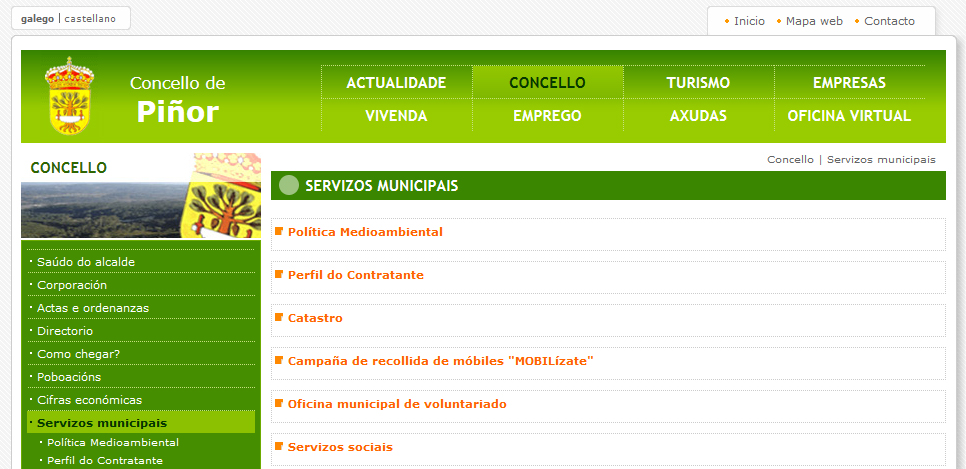
The website of the City Hall of Pinor, Spain

A site promoting entrepreneurship in the border area of Romania

Palestinian Authority Ministry of Foreign Affairs
In total, we observed more than 100 injected websites. Currently, the largest number of injected sites is in Romania.
Here’s a statistic on the injected websites:
The distribution is obviously not random, and it reflects some of the interests of the attackers. For instance, in Romania many of the infected sites are in the Mures region, while many of the Spanish infected sites belong to local governments (City Hall).
Most of the infected sites use the TYPO3 CMS (see: https://typo3.org/), which could indicate the attackers are abusing a specific vulnerability in this publishing platform.
Injected websites load a remote JavaScript into the victim’s browser:
The script “sitenavigatoin.js” is a Pinlady-style browser and plugin detection script, which in turn, redirects to a PHP script sometimes called main.php or wreq.php. Sometimes, the attackers register the .JPG extension with the PHP handler on the server, using “JPG” files to run PHP scripts:

Profiling script
The main exploitation script “wreq.php”, “main.php” or “main.jpg” performs a numbers of tasks. We have located several versions of this script which attempt various exploitation mechanisms.
One version of this script attempts to exploit Internet Explorer versions 6, 7 and 8:

Internet Explorer exploitation script
Unfortunately, the Internet Explorer exploits have not yet been retrieved.
Another more recent version attempts to exploit Oracle Sun Java and Adobe Flash Player:

Java and Flash Player exploitation scripts
Although the Flash Player exploits couldn’t be retrieved, we did manage to obtain the Java exploits:
| Name | MD5 |
| allj.html | 536eca0defc14eff0a38b64c74e03c79 |
| allj.jar | f41077c4734ef27dec41c89223136cf8 |
| allj64.html | 15060a4b998d8e288589d31ccd230f86 |
| allj64.jar | e481f5ea90d684e5986e70e6338539b4 |
| lstj.jar | 21cbc17b28126b88b954b3b123958b46 |
| lstj.html | acae4a875cd160c015adfdea57bd62c4 |
The Java files exploit a popular vulnerability, CVE-2012-1723, in various configurations.
The payload dropped by these Java exploits is the following:
MD5: d7ca9cf72753df7392bfeea834bcf992
The Java exploit use a special loader that attempts to inject the final Epic backdoor payload into explorer.exe. The backdoor extracted from the Java exploits has the following C&C hardcoded inside:
www.arshinmalalan[.]com/themes/v6/templates/css/in.php
This C&C is still online at the moment although it redirects to a currently suspended page at “hxxp://busandcoachdirectory.com[.]au“. For a full list of C&C servers, please see the Appendix.
The Epic Turla attackers are extremely dynamic in using exploits or different methods depending on what is available at the moment. Most recently, we observed them using yet another technique coupled with watering hole attacks. This takes advantage of social engineering to trick the user into running a fake Flash Player (MD5: 030f5fdb78bfc1ce7b459d3cc2cf1877):
In at least one case, they tried to trick the user into downloading and running a fake Microsoft Security Essentials app (MD5: 89b0f1a3a667e5cd43f5670e12dba411):
The fake application is signed by a valid digital certificate from Sysprint AG:
Serial number: 00 c0 a3 9e 33 ec 8b ea 47 72 de 4b dc b7 49 bb 95
Thumbprint: 24 21 58 64 f1 28 97 2b 26 22 17 2d ee 62 82 46 07 99 ca 46

Valid signature from Sysprint AG on Epic dropper
This file was distributed from the Ministry of Foreign Affairs of Tajikistan’s website, at “hxxp://mfa[.]tj/upload/security.php“.
The file is a .NET application that contains an encrypted resource. This drops the malicious file with the MD5 7731d42b043865559258464fe1c98513.
This is an Epic backdoor which connects to the following C&Cs, with a generic internal ID of 1156fd22-3443-4344-c4ffff:
hxxp://homaxcompany[.]com/components/com_sitemap/
hxxp://www.hadilotfi[.]com/wp-content/themes/profile/
A full list with all the C&C server URLs that we recovered from the samples can be found in the technical Appendix.
The Epic command-and-control infrastructure
The Epic backdoors are commanded by a huge network of hacked servers that deliver command and control functionality.
The huge network commanded by the Epic Turla attackers serves multiple purposes. For instance, the motherships function as both exploitation sites and command and control panels for the malware.
Here’s how the big picture looks like:

Epic Turla lifecycle
The first level of command and control proxies generally talk to a second level of proxies, which in turn, talk to the “mothership” server. The mothership server is generally a VPS, which runs the Control panel software used to interact with the victims. The attackers operate the mothership using a network of proxies and VPN servers for anonymity reasons. The mothership also work as the exploitation servers used in the watering hole attacks, delivering Java, IE or fake applications to the victim.
We were able to get a copy of one of the motherships, which provided some insight into the operation.
It runs a control panel which is password protected:

Epic mothership control panel login
Once logged into the Control panel, the attackers can see a general overview of the system including the number of interesting potential targets:

Epic control panel status overview
A very interesting file on the servers is task.css, where the attackers define the IP ranges they are interested in. To change the file, they are using the “Task editor” from the menu. Depending on the “tasks”, they will decide whether to infect the visitors or not. In this case, we found they targeted two ranges belonging to:
- “Country A” – Federal Government Network
- “Country B” – Government Telecommunications and Informatics Services Network
It should be noted though, the fact that the attackers were targeting these ranges doesn’t necessarily mean they also got infected. Some other unknown IPs were also observed in the targeting schedules.
There is also an “except.css” file where attackers log the reasons they didn’t try to exploit certain visitors. There are three possible values:
- TRY
- DON’T TRY -> Version of the browser and OS does not meet the conditions
- DON’T TRY -> (2012-09-19 10:02:04) – checktime < 60
These are the “don’t meet the conditions” reasons observed in the logs:
- Windows 7 or 2008 R2
- MSIE 8.0
- Mozilla/4.0 (compatible; MSIE 8.0; Windows NT 6.1; WOW64; Trident/4.0; SLCC2; .NET CLR 2.0.50727; .NET CLR 3.5.30729; .NET CLR 3.0.30729; .NET CLR 1.1.4322; .NET4.0C; .NET4.0E)
- Adobe Shockwave 11.5.1.601
- Adobe Flash 10.3.181.14
- Adobe Reader 10.1.0.0
- Win Media Player 12.0.7601.17514
- Quick Time null
- MS Word null
- Java null
The Epic / Tavdig / Wipbot backdoor
For this first stage of the attack, the threat actor uses a custom backdoor. In some cases, the backdoor is packaged together with the CVE-2013-5065 EoP exploit and heavily obfuscated. This makes the analysis more difficult.
The CVE-2013-5065 exploit allows the backdoor to achieve administrator privileges on the system and run unrestricted. This exploit only works on unpatched Microsoft Windows XP systems.
Other known detection names for the backdoor is Trojan.Wipbot (Symantec) or Tavdig.
The main backdoor is about 60KB in size and implements a C&C protocol on top of normal HTTP requests. The communication protocol uses  requests in the C&C replies, which the malware decrypts and processes. The replies are sent back to the C&C through the same channel.
The malware behavior is defined by a configuration block. The configuration block usually contains two hard-coded C&C URLs. He have also seen one case where the configuration block contains just one URL. The configuration can also be updated on the fly by the attackers, via the C&C.
The backdoor attempts to identify the following processes and, if found, it will terminate itself:
- tcpdump.exe
- windump.exe
- ethereal.exe
- wireshark.exe
- ettercap.exe
- snoop.exe
- dsniff.exe
It contains an internal unique ID, which is used to identify the victim to the C&C. Most samples, especially old ones, have the ID 1156fd22-3443-4344-c4ffff. Once a victim is confirmed as “interesting”, the attackers upload another Epic backdoor which has a unique ID used to control this specific victim.
During the first C&C call, the backdoor sends a pack with the victim’s system information. All further information sent to the C&C is encrypted with a public key framework, making decryption impossible. The commands from the C&C are encrypted in a simpler manner and can be decrypted if intercepted because the secret key is hardcoded in the malware.
Through monitoring, we were able to capture a large amount of commands sent to the victims by the attackers, providing an unique view into this operation. Here’s a look at one of the encrypted server replies:

Once a victim is infected and “checks in” with the server, the attackers send a template of commands:
Next, the attackers try to move through the victim’s network using pre-defined or collected passwords:
Listing all .doc files recursively is also a common “theme”:

In total, we have decoded several hundreds of these command packages delivered to the victims, providing an unique insight into the inner workings of the attackers.
In addition to generic searches, some very specific lookups have been observed as well. These include searches for:
- *NATO*.msg
- eu energy dialogue*.*
- EU*.msg
- Budapest*.msg
In this case, the attackers were interested to find e-mails related to “NATO”, “Energy Dialogue within European Union” and so on.
For some of the C&C servers, the attackers implemented RSA encryption for the C&C logs, which makes it impossible to decrypt them. This scheme was implemented in April 2014.

Lateral movement and upgrade to more sophisticated backdoors
Once a victim is compromised, the attackers upload several tools that are used for lateral movement.
One such tool observed in the attacks and saved as “C:Documents and SettingsAll usersStart MenuProgramsStartupwinsvclg.exe” is:
Name: winsvclg.exe
MD5: a3cbf6179d437909eb532b7319b3dafe
Compiled: Tue Oct 02 13:51:50 2012
This is a keylogger tool that creates %temp%~DFD3O8.tmp. Note: the filename can change across victims. On one Central Asian government’s Ministry of Foreign Affairs victim system, the filename used was “adobe32updt.exe“.
In addition to these custom tools, we observed the usage of standard administration utilities. For instance, another tool often uploaded by the attackers to the victim’s machine is “winrs.exe”:
Name: winrs.exe
MD5: 1369fee289fe7798a02cde100a5e91d8
This is an UPX packed binary, which contains the genuine “dnsquery.exe” tool from Microsoft, unpacked MD5: c0c03b71684eb0545ef9182f5f9928ca.
In several cases, an interesting update has been observed — a malware from a different, yet related family.
Size: 275,968 bytes
MD5: e9580b6b13822090db018c320e80865f
Compiled: Thu Nov 08 11:05:35 2012
another example:
Size: 218,112 bytes
MD5: 071d3b60ebec2095165b6879e41211f2
Compiled: Thu Nov 08 11:04:39 2012
This backdoor is more sophisticated and belongs to the next level of cyber-espionage tools called the “Carbon system” or Cobra by the Turla attackers. Several plugins for the “Carbon system” are known to exist.

Decoded configuration for e9580b6b13822090db018c320e80865f
Note: the command and control servers www.losguayaberos[.]com and thebesttothbrushes[.]com have been sinkholed by Kaspersky Lab.
Other packages delivered to the victims include:
MD5: c7617251d523f3bc4189d53df1985ca9
MD5: 0f76ef2e6572befdc2ca1ca2ab15e5a1
These top level packages deploy both updated Epic backdoors and Turla Carbon system backdoors to confirmed victims, effectively linking the Epic and Turla Carbon operations together.
The Turla Carbon dropper from these packages has the following properties:
MD5: cb1b68d9971c2353c2d6a8119c49b51f
This is called internally by the authors “Carbon System”, part of the “Cobra” project, as it can be seen from the debug path inside:
This acts as a dropper for the following modules, both 32 and 64 bit:
| MD5 | Resource number |
| 4c1017de62ea4788c7c8058a8f825a2d | 101 |
| 43e896ede6fe025ee90f7f27c6d376a4 | 102 |
| e6d1dcc6c2601e592f2b03f35b06fa8f | 104 |
| 554450c1ecb925693fedbb9e56702646 | 105 |
| df230db9bddf200b24d8744ad84d80e8 | 161 |
| 91a5594343b47462ebd6266a9c40abbe | 162 |
| 244505129d96be57134cb00f27d4359c | 164 |
| 4ae7e6011b550372d2a73ab3b4d67096 | 165 |
The Carbon system is in essence an extensible platform, very similar to other attack platforms such as the Tilded platform or the Flame platform. The plugins for the Carbon system can be easily recognized as they always feature at least two exports named:
- ModuleStart
- ModuleStop
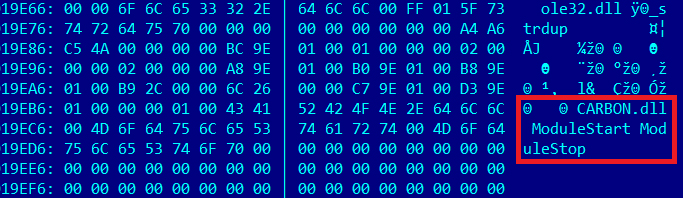
Carbon system plugin with characteristic exports
Several Epic backdoors appear to have been designed to work as Carbon system plugins as well – they require a specialized loader to start in victim systems that do not have the Carbon system deployed.
Some modules have artifacts which indicate the Carbon system is already at version 3.x, although the exact Carbon system version is very rarely seen in samples:
The author of the Carbon module above can be also seen in the code, as “gilg”, which also authored several other Turla modules.
We are planning to cover the Turla Carbon system with more details in a future report.
Language artifacts
The payload recovered from one of the mothership servers (at newsforum.servehttp[.]com/wordpress/wp-includes/css/img/upload.php, MD5: 4dc22c1695d1f275c3b6e503a1b171f5, Compiled: Thu Sep 06 14:09:55 2012) contains two modules, a loader/injector and a backdoor. Internally, the backdoor is named “Zagruzchik.dll”:

The word “Zagruzchik” means “boot loader” in Russian.
The Control panel for the Epic motherships also sets the language to codepage “1251”:

Codepage 1251 is commonly used to render Cyrillic characters.
There are other indications that the attackers are not native English language speakers:
- Password it´s wrong!
- Count successful more MAX
- File is not exists
- File is exists for edit
The sample e9580b6b13822090db018c320e80865f that was delivered to several Epic victims as an upgraded backdoor, has the compilation code page language set to “LANG_RUSSIAN”.
The threat actor behind the “Epic” operation uses mainly hacked servers to host their proxies. The hacked servers are controlled through the use of a PHP webshell. This shell is password protected; the password is checked against an MD5 hash:
The MD5 “af3e8be26c63c4dd066935629cf9bac8” has been solved by Kaspersky Lab as the password “kenpachi”. In February 2014 we observed the Miniduke threat actor using the same backdoor on their hacked servers, although using a much stronger password.
Once again, it is also interesting to point out the usage of Codepage 1251 in the webshell, which is used to render Cyrillic characters.
There appears to be several links between Turla and Miniduke, but we will leave that for a future blogpost.
Victim statistics
On some of the C&C servers used in the Epic attacks, we were able to identify detailed victim statistics, which were saved for debugging purposes by the attackers.
This is the country distribution for the top 20 affected countries by victim’s IP:
According to the public information available for the victims’ IPs, targets of “Epic” belong to the following categories:
- Government
- Ministry of interior (EU country)
- Ministry of trade and commerce (EU country)
- Ministry of foreign/external affairs (Asian country, EU country)
- Intelligence (Middle East, EU Country)
- Embassies
- Military (EU country)
- Education
- Research (Middle East)
- Pharmaceutical companies
- Unknown (impossible to determine based on IP/existing data)
Summary
When G-Data published their Turla paper, there were few details publicly available on how victims get infected with this malware campaign. Our analysis indicates this is a sophisticated multi-stage infection; which begins with Epic Turla. This is used to gain a foothold and validate the high profile victim. If the victim is interesting, they get upgraded to the Turla Carbon system.
Most recently, we observed this attack against a Kaspersky Lab user on August 5, 2014, indicating the operation remains fresh and ongoing.
Note: A full analysis of the Epic attacks is available to the Kaspersky Intelligent Services customers. Contact: [email protected]
We would like to add the following at the end of the blogpost, right before the detection names:
Further reading
If you’d like to read more about Turla/Uroburos, here’s a few recommendations:
- G-Data’s paper “Uroburos Highly complex espionage software with Russian roots”
- BAE Systems analysis of “The Snake campaign”
- “Uroburos: the snake rootkit”, technical analysis by deresz and tecamac
- “TR-25 Analysis – Turla / Pfinet / Snake/ Uroburos” by CIRCL.LU
Kaspersky products’ detection names for all the malware samples described in this post:
- Backdoor.Win32.Turla.an
- Backdoor.Win32.Turla.ao
- Exploit.JS.CVE-2013-2729.a
- Exploit.JS.Pdfka.gkx
- Exploit.Java.CVE-2012-1723.eh
- Exploit.Java.CVE-2012-1723.ou
- Exploit.Java.CVE-2012-1723.ov
- Exploit.Java.CVE-2012-1723.ow
- Exploit.Java.CVE-2012-4681.at
- Exploit.Java.CVE-2012-4681.au
- Exploit.MSExcel.CVE-2009-3129.u
- HEUR:Exploit.Java.CVE-2012-1723.gen
- HEUR:Exploit.Java.CVE-2012-4681.gen
- HEUR:Exploit.Java.Generic
- HEUR:Exploit.Script.Generic
- HEUR:Trojan.Script.Generic
- HEUR:Trojan.Win32.Epiccosplay.gen
- HEUR:Trojan.Win32.Generic
- HackTool.Win32.Agent.vhs
- HackTool.Win64.Agent.b
- Rootkit.Win32.Turla.d
- Trojan-Dropper.Win32.Dapato.dwua
- Trojan-Dropper.Win32.Demp.rib
- Trojan-Dropper.Win32.Injector.jtxs
- Trojan-Dropper.Win32.Injector.jtxt
- Trojan-Dropper.Win32.Injector.jznj
- Trojan-Dropper.Win32.Injector.jznk
- Trojan-Dropper.Win32.Injector.khqw
- Trojan-Dropper.Win32.Injector.kkkc
- Trojan-Dropper.Win32.Turla.b
- Trojan-Dropper.Win32.Turla.d
- Trojan.HTML.Epiccosplay.a
- Trojan.Win32.Agent.iber
- Trojan.Win32.Agent.ibgm
- Trojan.Win32.Agentb.adzu
- Trojan.Win32.Inject.iujx
- Trojan.Win32.Nus.g
- Trojan.Win32.Nus.h
Text extracted automatically; images, tables and formatting may be missing. Original: https://securelist.com/the-epic-turla-operation/65545/