Cybercriminals scale up, government sector hit hardest
Vulnerabilities mentionedAll →
| CVE | Vulnerability | CVSS | EPSS | Flags | Affected | Exposure | Published |
|---|---|---|---|---|---|---|---|
| CVE-2014-8361 | Improper Input Validation in Realtek SDK miniigd SOAP Service Enables Remote RCE The Realtek SDK, a software development kit embedded in routers, gateways, and similar network equipment sold under many OEM brands, contains an improper input validation flaw (CWE-20) in its miniigd UPnP SOAP service. A remote, unauthenticated attacker can trigger it by sending a crafted NewInternalClient request to the vulnerable SOAP interface, causing execution of malicious code on the device. Successful exploitation gives attackers control of affected devices, which can be used for botnet recruitment, staging further attacks, or ransomware operations. Affected parties are owners of devices built on the Realtek SDK, particularly routers and gateways with the UPnP service exposed to the internet. Exploitation is ongoing: CISA added the flaw to the Known Exploited Vulnerabilities catalog on 2023-09-18 and EPSS assigns it a 100% probability of exploitation within 30 days, though ransomware use is not confirmed. Do: Inventory devices that use the Realtek SDK and check whether the miniigd UPnP/SOAP service is reachable from untrusted networks; apply firmware updates from your device vendor as soon as available, or per CISA's required action, disable UPnP or block the service from internet exposure if mitigations are unavailable. No patch level is published in this dataset, so verify fix status against OEM advisories and review device logs for crafted NewInternalClient SOAP requests. | — | 100% | KEV |
| mass≈1,000,000+ devices (hundreds of thousands of internet-exposed hosts observed in public scans; SDK embedded in many OEM routers) | |
| CVE-2017-17215 | Huawei HG532 with some customized versions has a remote code execution vulnerability. Huawei HG532 with some customized versions has a remote code execution vulnerability. An authenticated attacker could send malicious packets to port 37215 to launch attacks. Successful exploit could lead to the remote execution of arbitrary code. NVD description · AI analysis pending | 8.8 | 78% |
| — | ||
| CVE-2017-9841 | Unauthenticated Remote Code Execution in PHPUnit eval-stdin.php PHPUnit ships a utility script (eval-stdin.php under /vendor/phpunit/phpunit/src/Util/PHP/) that reads HTTP POST data and evaluates it as PHP code with no authentication. The flaw is triggered when a site's /vendor folder is web-accessible and an attacker sends a POST request whose body begins with '<?php ' directly to that URI. Doing so lets the attacker execute arbitrary PHP code on the server under the web server account, giving unauthenticated remote code execution (CWE-94 code injection). Anyone running a PHP application installed with Composer, where PHPUnit is present in the vendor tree and that directory is reachable over HTTP, is affected. The flaw is under active exploitation: CISA added it to the Known Exploited Vulnerabilities catalog on 2022-02-15 and its EPSS probability of exploitation is 100% (top percentile). Do: Apply the CISA KEV required action by updating PHPUnit per vendor instructions, which in practice means updating the CMS/framework or running a Composer update that pulls a patched PHPUnit release. Until patched, block web access to the /vendor directory (e.g., deny /vendor/ or at least /vendor/phpunit/phpunit/src/Util/PHP/eval-stdin.php in your web server configuration) and verify the endpoint is no longer reachable. Check access logs for POST requests to eval-stdin.php and investigate affected servers for webshells or other signs of compromise. | 9.8 | 100% | KEV |
| masshundreds of thousands of PHP sites/servers potentially exposed (order-of-magnitude estimate; unknown precise count) | |
| CVE-2023-1389 | Command Injection in TP-Link Archer AX21 Router Allows Remote Code Execution CVE-2023-1389 is a command injection flaw (CWE-77) in TP-Link's Archer AX21 Wi-Fi 6 router that lets an attacker execute arbitrary operating-system commands on the device. It is triggered by sending crafted input to a remotely reachable service on the router, which passes attacker-controlled values to the device's shell without proper sanitization; the source data does not specify the vulnerable endpoint or exact affected firmware ranges. Successful exploitation yields remote code execution on the router, giving the attacker a foothold in the network where the router sits, from which they can pivot or abuse the device further. Any household or organization running an Archer AX21 router is affected, with the highest risk where the router's management interface is exposed to the internet. The flaw was added to CISA's KEV catalog on 2023-05-01, confirming exploitation in the wild; EPSS assigns a ~100% probability of exploitation within 30 days (top percentile), while no public proof-of-concept or ransomware association is documented in the source data. Do: Update the Archer AX21 to the latest firmware available from TP-Link per the vendor's instructions (fixed firmware is published on the product's TP-Link support page). If updating is not immediately possible, disable WAN-side/remote management and restrict the router's web interface to the local network. Because exploitation is confirmed in the wild, also review exposed routers for signs of compromise, such as unexplained configuration changes or unexpected outbound traffic. | 8.8 | 100% | KEV PoC ×2 |
| masslikely hundreds of thousands of routers deployed, with >100k plausibly internet-exposed | |
| CVE-2023-26801 | LB-LINK BL-AC1900_2.0 v1.0.1, LB-LINK BL-WR9000 v2.4.9, LB-LINK BL-X26 v1.2.5, and LB-LINK BL-LTE300 v1.0.8 were discovered to contain a command injection vulne LB-LINK BL-AC1900_2.0 v1.0.1, LB-LINK BL-WR9000 v2.4.9, LB-LINK BL-X26 v1.2.5, and LB-LINK BL-LTE300 v1.0.8 were discovered to contain a command injection vulnerability via the mac, time1, and time2 parameters at /goform/set_LimitClient_cfg. NVD description · AI analysis pending | 9.8 | 70% | PoC |
| — |
Full article372 words · extracted from helpnetsecurity.com · click to collapse
Government agencies faced the highest volume of cyberattack campaigns in 2025, according to new findings from HPE Threat Labs, which tracked 1,186 active campaigns over the course of the year. The data covers activity observed between January 1 and December 31, 2025, and reflects a broad mix of sectors and attack types.
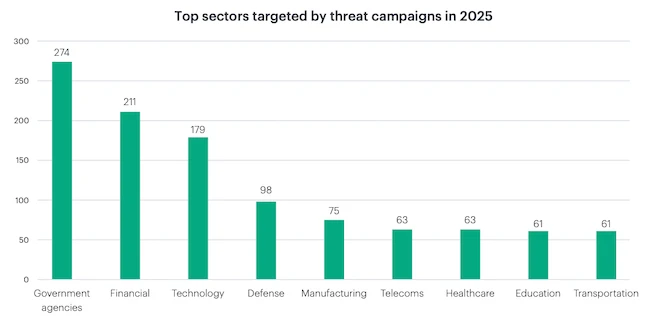
Top sectors targeted by threat campaigns in 2025 (Source: HPE)
AI and automation drive faster, more powerful cyberattacks
Government agencies were targeted in 274 campaigns, the largest share among all industries. Financial services followed with 211 campaigns, while technology companies accounted for 179. Defense saw 98 campaigns, and manufacturing recorded 75. Telecommunications and healthcare each logged 63 campaigns, while education and transportation each recorded 61.
The activity was spread across industries that handle sensitive data, critical infrastructure, or large-scale operations.
Attackers have also introduced new methods to boost speed and impact. Some campaigns relied on automated, assembly line workflows, often coordinated through platforms like Telegram, to extract stolen data in real time.
Others used GenAI to create synthetic voices and deepfake videos for targeted vishing attacks and executive impersonation scams. In one case, an extortion group even conducted market research on VPN vulnerabilities to refine its intrusion tactics.
Ransomware leads threat activity
Ransomware accounted for 22% of campaign types. Infostealer activity represented 19%, followed by phishing at 17%. Remote Access Trojans (RAT) made up 11%, while malware accounted for 9%.
Researchers identified 147,087 malicious domains and 65,464 malicious URLs, along with 57,956 malicious files and 47,760 IP addresses tied to threat activity. Attackers also exploited 549 distinct vulnerabilities during the year.
Telemetry from a global deception network recorded 44.5 million connection attempts from 372,800 unique source IP addresses. Of those, 36,600 requests matched known attack signatures, originating from 8,200 distinct source IPs and targeting five destination IPs.
Attack pattern data showed a focus on exposed services and known weaknesses. Digital video recorder (DVR) Shell remote code executions (RCEs) appeared 4700 times, followed by Huawei router exploits at 3490 and Docker application programming interface (API) abuses at 3400.
PHP unit and TP-Link command injections accounted for 3100, while Printer enumeration (IPP) and Realtek UPnP abuses appeared 2700 times.
The most frequently exploited vulnerabilities included CVE-2017-17215, CVE-2023-1389, CVE-2014-8361, CVE-2017-9841, and CVE-2023-26801.
Text extracted automatically; images, tables and formatting may be missing. Original: https://www.helpnetsecurity.com/2026/03/18/government-agencies-cyberattack-campaigns-volume/