New Ivanti Vulnerability Observed as Widespread Security Concerns Grow
Vulnerabilities mentionedAll →
| CVE | Vulnerability | CVSS | EPSS | Flags | Affected | Exposure | Published |
|---|---|---|---|---|---|---|---|
| CVE-2024-21887 +1 in the same advisory: …46805 | Command Injection RCE in Ivanti Connect Secure and Policy Secure Ivanti Connect Secure (formerly Pulse Connect Secure) and Ivanti Policy Secure appliances contain a command injection flaw (CWE-77) in their web components, triggered when an authenticated administrator sends crafted requests to the appliance. The bug can be chained with the separate authentication bypass CVE-2023-46805, allowing an unauthenticated attacker to achieve the same result. Successful exploitation lets an attacker execute arbitrary commands and code on the appliance, providing a foothold into the networks behind the VPN or network access control gateway. Any organization running these appliances, typically enterprises and government agencies often deployed directly on the internet perimeter, is affected. Exploitation is confirmed in the wild: the flaw was added to CISA's Known Exploited Vulnerabilities catalog on 2024-01-10 with known ransomware use and EPSS assigns a 100% probability of exploitation within 30 days, although no public proof-of-concept is available. Do: Apply Ivanti's mitigations or patched builds immediately per vendor instructions, addressing the chained authentication bypass CVE-2023-46805 at the same time, and discontinue or restrict use of any appliance for which mitigations are unavailable, especially if it is internet-facing. Because exploitation with ransomware use is known, assume compromise is possible: review appliance web logs for suspicious requests and run Ivanti's integrity-checking guidance to verify appliance images before and after remediation. Where feasible, restrict direct internet exposure of the appliance web interface and monitor for further vendor advisories. | 9.1 group max | 100% | KEV ransomware PoC |
| largetens of thousands of appliances (roughly 20,000-30,000 internet-exposed ICS gateways at disclosure; total deployed base likely higher) | |
| CVE-2024-21888 | A privilege escalation vulnerability in web component of Ivanti Connect Secure (9.x, 22.x) and Ivanti Policy Secure (9.x, 22.x) allows a user to elevate privile A privilege escalation vulnerability in web component of Ivanti Connect Secure (9.x, 22.x) and Ivanti Policy Secure (9.x, 22.x) allows a user to elevate privileges to that of an administrator. NVD description · AI analysis pending | 8.8 | 87% |
| — | ||
| CVE-2024-21893 | SSRF in Ivanti Connect Secure, Policy Secure, and Neurons SAML Component CVE-2024-21893 is a server-side request forgery (SSRF) vulnerability in the SAML component of Ivanti Connect Secure (formerly Pulse Connect Secure), Ivanti Policy Secure, and Ivanti Neurons. A remote attacker can trigger the flaw with crafted unauthenticated requests to the SAML component, causing the appliance to make requests to otherwise restricted resources. Successful exploitation allows the attacker to access certain restricted resources without any credentials, and CISA notes the flaw has been used in ransomware operations. Any organization running an affected Ivanti Connect Secure, Policy Secure, or Neurons deployment is exposed, particularly where the appliance is reachable from the internet. The vulnerability is confirmed exploited in the wild: it was added to CISA's Known Exploited Vulnerabilities catalog on 2024-01-31, carries an EPSS probability of 100%, and no public proof-of-concept is known. Do: Apply Ivanti's released patches or the vendor-issued mitigations immediately per vendor instructions, or discontinue use of the product if mitigations are unavailable, as required by CISA. Because ransomware use is documented, review SAML-related logs and appliance audit trails for signs of exploitation and follow-on compromise, and check for indicators of post-exploitation activity. Monitor Ivanti advisories for patched version numbers and updated mitigation guidance, since specific fixed versions are not yet specified in the available data. | 8.2 | 100% | KEV ransomware |
| largetens of thousands of internet-exposed appliances (with total user counts likely in the hundreds of thousands) | |
| CVE-2024-22024 | An XML external entity or XXE vulnerability in the SAML component of Ivanti Connect Secure (9.x, 22.x), Ivanti Policy Secure (9.x, 22.x) and ZTA gateways which An XML external entity or XXE vulnerability in the SAML component of Ivanti Connect Secure (9.x, 22.x), Ivanti Policy Secure (9.x, 22.x) and ZTA gateways which allows an attacker to access certain restricted resources without authentication. NVD description · AI analysis pending | 8.3 | 95% |
| — |
Full article1,006 words · extracted from infosecurity-magazine.com · click to collapse
Read more on Ivanti vulnerabilities:
- Two Ivanti Zero-Days Actively Exploited in the Wild
- Ivanti Zero-Days Exploited By Multiple Actors Globally
- Rust Payloads Exploiting Ivanti Zero-Days Linked to Sophisticated Sliver
- Ivanti Releases Zero-Day Patches and Reveals Two New Bugs
- Latest Ivanti Zero Day Exploited By Scores of IPs
Bad news continues to pile up for Utah-based IT software provider Ivanti as a new vulnerability has been discovered in its products.
On February 8, Ivanti disclosed a new authentication bypass vulnerability impacting its Connect Secure, Policy Secure, and ZTA gateways.
This new vulnerability, identified as CVE-2024-22024, is the latest of a series of vulnerabilities discovered in several Ivanti products since mid-January 2024 – namely, in order of discovery, CVE-2023-46805, CVE-2024-21887, CVE-2024-21888 and CVE-2024-21893.
The vulnerability is due to a flaw in Ivanti’s gateways' Security Assertion Markup Language (SAML) component, the part of the gateway software that handles this communication and helps ensure secure authentication.
By exploiting this flaw, remote attackers can gain access to restricted resources on unpatched appliances without requiring any user interaction or authentication.
Although the company claimed the vulnerability was not being actively exploited, it urged its users to implement the mitigation processes the company released in another advisory.
On February 14, content delivery network (CDN) provider Akamai published a report in which it observed malicious activity targeting this new vulnerability.
Akamai said it saw a peak of 240,000 requests and 80 IPs attempting to send payloads on February 11.
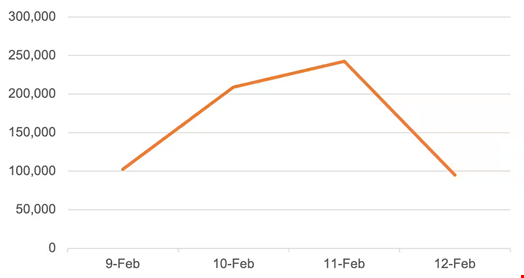
Akamai commented: “So far, we have only been seeing payloads similar to the original proof-of-concept (PoC) [exploit] published by watchTowr.”
WatchTowr, a red teaming firm, conducted a proof-of-concept experiment to see how threat actors could exploit CVE-2024-22024. The company published its result on February 9.
On the same day, the Shadowserver Foundation said it observed over 3900 Ivanti endpoints vulnerable to CVE-2024-22024.
— Shadowserver (@Shadowserver) February 14, 2024
Ivanti Denies CVE-2024-22024 Exploitation
In an FAQ blog post also published on February 14, Ivanti insisted that it hasn’t seen any exploitation of the newest vulnerability, CVE-2024-22024.
“It is unfortunate that media reports continue to cover statements and unverified numbers from third parties that are incorrect or inflated,” the company said in the blog post.
Ivanti assessed that there has been confusion between the exploitation of CVE-2024-21893 and CVE-2024-22024 because both vulnerabilities are “in the same section of code.”
“We previously confirmed the initial vulnerabilities disclosed on 10 January were exploited by threat actors. While the initial impact was very limited, we saw a sharp increase in threat actor activity and security researcher scans following public disclosure of the issue, indicating global customer impact due to CVE-2023-46805, CVE-2024-21888 and CVE-2024-21893,” the Ivanti spokesperson added.
Sean Wright, head of application security at Featurespace, criticized Ivanti’s response on social media.
Wright said on X that Ivanti should have given substantial evidence “backing up how they came to [the] conclusion how the information was incorrect.”
Ivanti Pulse Secure Accused of Running on an Outdated OS
On February 15, supply chain security provider Eclypsiusm shared the result of reverse engineering work it conducted after acquiring an Ivanti Pulse Secure firmware version 9.1.18.2-24467.1.
Eclypsium’s objective was to leverage a PoC exploit for CVE-2024-21893 that was released by Rapid7 on February 2 to obtain a reverse shell to the PSA3000 appliance, subsequently exporting the device image for follow-on analysis using the EMBA firmware security analyzer.
The firm concluded: “Pulse Secure runs an 11-year-old version of Linux which hasn't been supported since November 2020."
Concerns Over Legacy Software Running in Critical Infrastructure
Speaking to Infosecurity, Jamie Boote, associate principal software security consultant at the Synopsys Software Integrity Group, commented: "The big scary sounding zero days get the vast majority of the media attention. The reality, however, is that the boring problem of unpatched vulnerabilities and legacy software silently running in critical infrastructure represents a much larger risk waiting to be uncovered by an enterprising attacker.
He explained that security practitioners meet many hurdles when they want to modernize their organization’s technical stack, and these projects can be pushed back for months, if not years.
“Firmware is even more tricky because IT teams and Ops may not have a good view into network appliances like routers, boundary devices, and security appliances, so without proactive investigation into those devices, IT may not even realize that these appliances have silently reached their end-of-life."
In its FAQ blog post, Ivanti denied this claim: “The Ivanti Connect Secure product is not vulnerable due to older versions of open source code.
“Ivanti provides protection by developing and releasing patches to make this code secure within the 9.x version of the product. The hardware for the 9.x version does not have enough CPU to run a newer Linux kernel and as such the kernel limitations requires this older open source code to used. The newer 22.x version of Ivanti Connect Secure is built on a new Linux kernel and does not have the older versions of open source code in it. We officially released an End of Life Notification for the 9.x hardware and software product in July 2022.”
Ivanti Denies CISA Takedown Requirement
Finally, Ivanti denied claims that the US Cybersecurity and Infrastructure Agency (CISA) had told US federal agencies to replace Ivanti products.
“CISA’s directive was misinterpreted by media who only reported on the first step of the instructions,” the company said. “CISA made updates to their directive to correct this, and then further updated last week to make absolutely clear that you can turn the product on after patching.”
The CISAs full instructions are consistent with Ivanti’s own instructions and recommendations for its customers from 31 January.
“We support the Emergency Directive issued by CISA on 9 February and worked with CISA to develop the content,” the Ivanti said.
The instructions are as follows:
- Take the solution out of production and look for signs that the threat actor took additional action;
- Factory reset, upgrade and patch;
- Put the appliance back into production.
Text extracted automatically; images, tables and formatting may be missing. Original: https://www.infosecurity-magazine.com/news/new-ivanti-vulnerability-security/