China-Linked Hackers Exploit Sogou One-Click RCE to Deploy GRAYRABBIT Backdoor
China-linked UNC3569 exploited CVE-2026-51990 in Sogou Input Method to deploy the GRAYRABBIT backdoor in active espionage intrusions.
Gen Threat Labs discovered UNC3569 exploiting CVE-2026-51990, a one-click RCE in Tencent's Sogou Input Method for Windows that chains an insecure sgbiz: protocol handler with an unsandboxed Chromium 80 CEF webview. The chain weaponizes CVE-2021-38003 (V8 type confusion) to run shellcode that DLL-sideloads via 7z.exe/7z.dll and deploys the GRAYRABBIT backdoor, which beacons over RC4-encrypted raw TCP 443 to mail.uaiubifas[.]top. Tencent patched the issue in version 16.3.0.3498, released via automatic updates on April 21, 2026. UNC3569 is a PRC-nexus espionage actor targeting government, education, technology, and financial sectors across East and Southeast Asia.
- CVE-2026-51990 chains sgbiz: protocol handler with sandbox-disabled Chromium 80 webview.
- Exploit reuses CVE-2021-38003 V8 type confusion against the embedded browser engine.
- GRAYRABBIT delivered via DLL sideloading using 7z.exe and malicious 7z.dll.
- Backdoor C2: mail.uaiubifas[.]top over raw TCP 443 with RC4 encryption.
- Patch in Sogou Input Method 16.3.0.3498; verify all installations are updated.
Vulnerabilities mentionedAll →
| CVE | Vulnerability | CVSS | EPSS | Flags | Affected | Exposure | Published |
|---|---|---|---|---|---|---|---|
| CVE-2021-38003 | Memory Corruption in Chromium V8 JSON.stringify Affects Chrome, Edge, Opera CVE-2021-38003 is a memory corruption flaw in the V8 JavaScript engine used by Chromium, in which the engine's internal 'TheHole' sentinel value can leak into script-visible data during JSON.stringify processing (a heap-corruption condition tracked as CWE-122 and CWE-755). It is triggered when crafted JavaScript causes JSON.stringify to expose this internal value to script code. An attacker who can induce a victim to load malicious web content can leverage the resulting corruption, typically chained with further techniques, to execute code within the browser renderer or crash it. All users of Chromium-based browsers — explicitly including Google Chrome, Microsoft Edge, and Opera, and by extension other Chromium derivatives — are affected. Exploitation is confirmed in the wild: the flaw was added to CISA KEV on 2021-11-03, carries a 38.6% EPSS probability of exploitation within 30 days (98th percentile), and no public proof-of-concept is known. Do: Update all Chromium-based browsers (Chrome, Edge, Opera, and any Chromium-embedded or Electron-style applications in your estate) to the latest vendor-patched releases, per the CISA KEV required action to apply updates per vendor instructions. Verify remediated browser versions via enterprise update management and browser version reporting, prioritizing user workstations and externally reachable systems. Because exploitation is confirmed in the wild, treat unpatched Chromium browsers as an active exposure rather than a theoretical risk. | 8.8 | 39% | KEV PoC |
| mass≈3 billion users (combined Chromium-based browser install base, Chrome alone accounting for the large majority) | |
| CVE-2026-51990 | NVD description · AI analysis pending | — | — | PoC | — | — | — |
Indicators of compromiseauto-extracted · verify before use · export allAll →
| Type | Indicator | Context |
|---|---|---|
| domain | noht1ng.top | ryption RC4-encrypted communications Exploit-hosting domain noht1ng[.]top Staging-server IP address 8.218.50[.]207 Staging-server p |
| domain | uaiubifas.top | re. In this campaign, the payload reportedly contacted mail.uaiubifas[.]top over raw TCP port 443 and encrypted fixed-size 4,096-byte |
| sha256 | 29c7ee41d0cc9e07d981e451df56d0c3d37c41ac4ec10c7b516cc033ee397a63 | involving 7-Zip binaries. IOCs Indicator Value SHA-256 hash 29c7ee41d0cc9e07d981e451df56d0c3d37c41ac4ec10c7b516cc033ee397a63 Associated file 7zp.dll File description Trojanized DLL loa |
| sha256 | 749160a2f20f82744026719cf72e483595c6aad718efa74d675a98662e02422e | on Trojanized DLL loader Internal name boy.dll SHA-256 hash 749160a2f20f82744026719cf72e483595c6aad718efa74d675a98662e02422e Associated file p File description Encrypted PE loader shel |
| sha256 | d7a3c7eb94edc0e020f74c678743d71d61e944634aade4a67a96c3589e828b3a | File description Encrypted PE loader shellcode SHA-256 hash d7a3c7eb94edc0e020f74c678743d71d61e944634aade4a67a96c3589e828b3a Associated malware GRAYRABBIT backdoor Internal name core.d |
Full article868 words · extracted from gbhackers.com · click to collapse
China-linked threat actors tracked as UNC3569 have exploited a critical one-click remote code execution vulnerability in Tencent’s Sogou Input Method for Windows to deploy the GRAYRABBIT backdoor on targeted systems.
Tracked as CVE-2026-51990, the vulnerability chains an insecure custom protocol handler, unrestricted embedded-browser navigation, and an obsolete Chromium build running without sandbox protections.
Tencent addressed the vulnerable link-handling behavior in Sogou Input Method version 16.3.0.3498, released through automatic updates on April 21.
Organizations and users running earlier Windows versions should ensure the IME is updated immediately.
Sogou Input Method is a widely deployed Chinese-language input method editor with hundreds of millions of installations.
Its Windows application registers the sgbiz: custom URI scheme, allowing webpages and local applications to invoke internal Sogou components through biz_helper.exe.
The exploit begins with a crafted sgbiz: URL. Although biz_helper.exe validates the executable specified in the module parameter, researchers found that it did not validate the param field before passing it as command-line input to trusted Sogou binaries.
This enabled attackers to launch the legitimate SGMyInput.exe configuration program with malicious arguments.
UNC3569 used those arguments to open the application’s skincenter interface and supply an attacker-controlled URL.
Unlike other Sogou configuration pages, the skin marketplace initializes a Chromium Embedded Framework webview.
The affected code path accepted the supplied URL without applying an origin allowlist or effectively restricting the scheme, allowing adversary-controlled content to load inside the trusted application context.
The impact became critical because the bundled webview used Chromium 80, a browser version released in 2020 and missing years of security updates.
Researchers also found that Sogou’s CEF configuration disabled the Chromium sandbox and turned off web security controls.
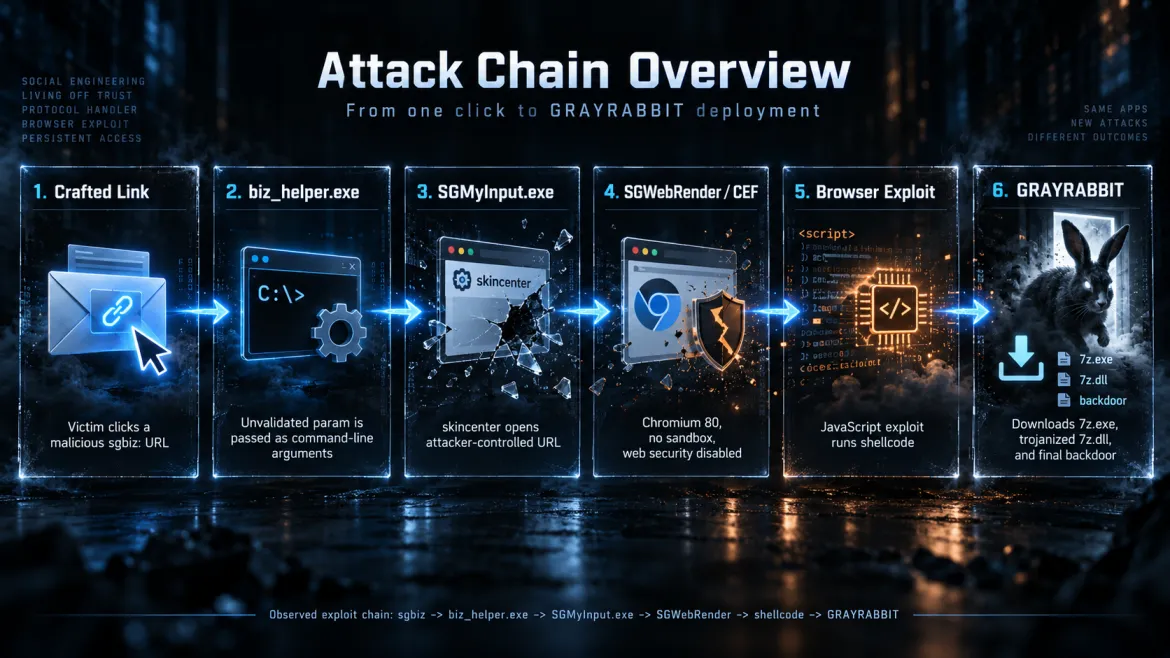
As a result, a browser renderer exploit could escape the normal browser containment boundary and execute code with the privileges of the logged-in Windows user.
Gen Threat Labs discovered the issue, while investigating an active UNC3569 intrusion and reported it to Tencent on April 9, 2026.
GRAYRABBIT Backdoor
In the observed campaign, UNC3569 used a malicious sgbiz: link to direct Sogou’s webview to an attacker-operated exploit page.
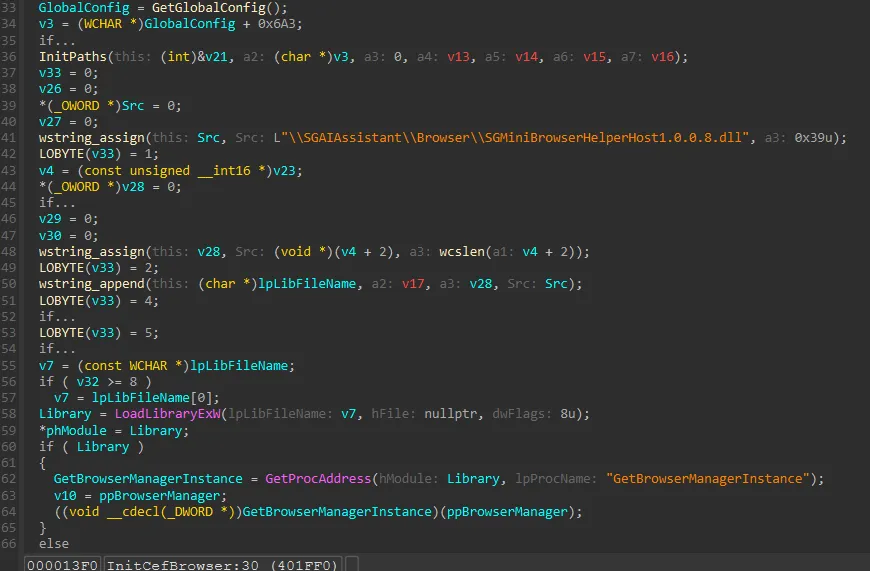
WinMain constructs the path to SGMiniBrowserHelperHost1.0.0.8.dll, loads it via LoadLibraryExW, and resolves the GetBrowserManagerInstance export.
The page weaponized CVE-2021-38003, a V8 type-confusion vulnerability affecting Chromium versions before 95.0.4638.69. Because Sogou shipped Chromium 80, the exploit remained viable against the embedded browser engine.
The JavaScript exploit achieved arbitrary memory read and write in V8, then used WebAssembly-backed executable memory to run embedded shellcode.
That shellcode downloaded three files into C:\Users\Public\Documents\: a legitimate 7z.exe binary, a malicious DLL saved as 7z.dll, and an encrypted payload blob.
The attackers then launched 7z.exe to trigger DLL sideloading. Windows loaded the malicious 7z.dll from the application directory, allowing the loader to decrypt and execute the final GRAYRABBIT implant.
The technique blends a legitimate signed-looking utility with a malicious same-directory DLL, reducing the need to directly execute a suspicious standalone payload.
GRAYRABBIT is a lightweight modular backdoor repeatedly associated with UNC3569.
It provides remote command execution, interactive shell access, system reconnaissance, file upload and download functionality, and support for loading additional plugins from command-and-control infrastructure.
In this campaign, the payload reportedly contacted mail.uaiubifas[.]top over raw TCP port 443 and encrypted fixed-size 4,096-byte communications with RC4.
The backdoor’s system-information beacon can collect the victim’s IP address, hostname, username, executable name, and process ID before operators issue follow-on commands.
UNC3569 has been characterized as a PRC-nexus espionage actor with a history of targeting government, education, technology, and financial-sector organizations, particularly across East and Southeast Asia.
Google threat researchers have previously linked the group’s operations to GRAYRABBIT and documented its use of proprietary tooling, public cloud infrastructure, and n-day exploitation.
Security teams should verify that Sogou Input Method for Windows is running version 16.3.0.3498 or later, the release Tencent used to remediate the vulnerable protocol-handler behavior.
The patch reportedly validates URL arguments, restricts navigation to HTTPS, and limits allowed destinations to approved Sogou and Tencent domains.
Defenders should additionally monitor for suspicious sgbiz: URI invocations, unexpected launches of SGMyInput.exe with -page=skincenter and -url= parameters, and anomalous creation of 7z.exe, 7z.dll, or encrypted files under C:\Users\Public\Documents\.
Network teams should investigate connections to mail.uaiubifas[.]top and the reported staging IP 8.218.50[.]207, while endpoint telemetry should flag DLL sideloading behavior involving 7-Zip binaries.
IOCs
| Indicator | Value |
|---|---|
| SHA-256 hash | 29c7ee41d0cc9e07d981e451df56d0c3d37c41ac4ec10c7b516cc033ee397a63 |
| Associated file | 7zp.dll |
| File description | Trojanized DLL loader |
| Internal name | boy.dll |
| SHA-256 hash | 749160a2f20f82744026719cf72e483595c6aad718efa74d675a98662e02422e |
| Associated file | p |
| File description | Encrypted PE loader shellcode |
| SHA-256 hash | d7a3c7eb94edc0e020f74c678743d71d61e944634aade4a67a96c3589e828b3a |
| Associated malware | GRAYRABBIT backdoor |
| Internal name | core.dll |
| C2 domain | mail.uaiubifas[.]top |
| C2 protocol/port | Raw TCP over port 443 |
| C2 encryption | RC4-encrypted communications |
| Exploit-hosting domain | noht1ng[.]top |
| Staging-server IP address | 8.218.50[.]207 |
| Staging-server provider/location | Alibaba Cloud, Hong Kong |
Note: IP addresses and domains are intentionally defanged (e.g., [.]) to prevent accidental resolution or hyperlinking. Re-fang only within controlled threat intelligence platforms such as MISP, VirusTotal, or your SIEM.
★ Learn 7 Metric-Gated AI SOC Deployment Phases – Download Free AI SOC Deployment Playbook 2026.
Mayura Kathirhttps://gbhackers.com/
Mayura Kathir is a cybersecurity reporter at GBHackers News, covering daily incidents including data breaches, malware attacks, cybercrime, vulnerabilities, zero-day exploits, and more.
Text extracted automatically; images, tables and formatting may be missing. Original: https://gbhackers.com/grayrabbit-backdoor/