Traps Prevents Adobe Flash Player Zero
Vulnerabilities mentionedAll →
| CVE | Vulnerability | CVSS | EPSS | Flags | Affected | Exposure | Published |
|---|---|---|---|---|---|---|---|
| CVE-2018-4878 | Use-After-Free RCE in Adobe Flash Player before 28.0.0.161 CVE-2018-4878 is a use-after-free (CWE-416) in Adobe Flash Player before 28.0.0.161, caused by a dangling pointer in the Primetime SDK's media-player handling of listener objects. An attacker triggers it by persuading a user to open attacker-controlled Flash content — typically a malicious SWF delivered via email, Office documents, or malvertising/exploit kits — because the CVSS vector (AV:L, UI:R) requires local user interaction. Successful exploitation yields arbitrary code execution with the privileges of the user running Flash. Anyone running a vulnerable Flash Player was exposed, including Red Hat Enterprise Linux Desktop/Server/Workstation users running Red Hat's packaged Flash plugin. The flaw was exploited as a zero-day in January–February 2018 (documented by McAfee and distributed alongside the Fallout exploit kit), and it remains in CISA's KEV with known ransomware use. Do: Upgrade Adobe Flash Player to 28.0.0.161 or later, including Red Hat's flash-plugin package on RHEL Desktop/Server/Workstation. Because Flash is now end-of-life, CISA's required KEV action is to remove or disconnect Flash entirely where still in use — audit browsers, Office configurations, and legacy RHEL hosts for residual Flash installs, and block SWF content delivered via email and the web. Given confirmed in-the-wild exploitation, known ransomware use, and 89.5% EPSS, prioritize this in remediation tracking. | 7.8 | 90% | KEV ransomware PoC ×2 |
| mass≈ hundreds of millions of desktop installs at time of disclosure; residual unmigrated installs now unknown (Flash is end-of-life) |
Full article278 words · extracted from unit42.paloaltonetworks.com · click to collapse
On January 31 the Korean CERT published a security advisory regarding a new Adobe Flash Player zero-day vulnerability (CVE-2018-4878) which was observed being exploited in the wild. Adobe released a patch and security bulletin on February 6th to address this vulnerability. The vulnerability is a Use-After-Free (UAF) bug in Adobe tvsdk. The final goal is allegedly to download and execute a malware known as DogCall (aka ROKRAT) – an information stealing backdoor. DogCall is often delivered via malicious Hangul Word Processor (HWP) files, which is a popular application used in South Korea.
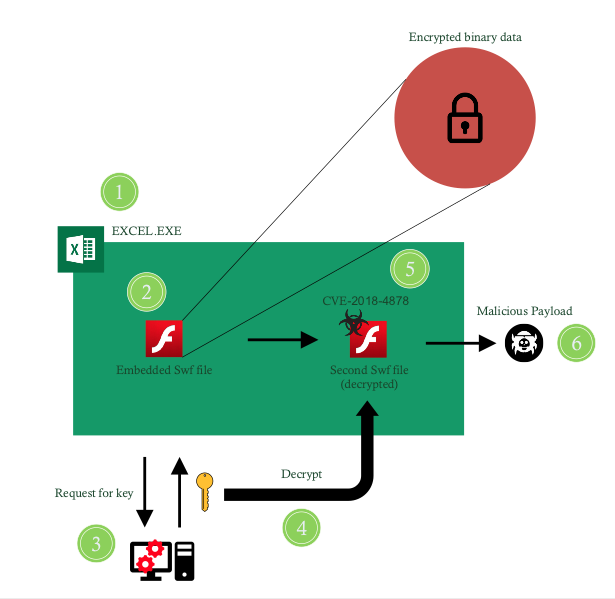
Figure 1 – The attack flow as observed in the malicious sample
In Figure 1 we show the attack flow as observed in the malicious sample. First, the malicious XLS spreadsheet file is opened by the victim. Then, the document executes an embedded Adobe Flash file which contains an encrypted binary data blob. Next, the Adobe Flash file connects to a remote server and requests a decryption key for the binary blob. The binary blob is then decrypted and loaded as a second Adobe Flash file dynamically. This Adobe Flash file is in fact the one that contains the zero-day exploit for CVE-2018-4878. Upon successful exploitation, a shellcode is executed which retrieves and runs the malicious payload.
How Traps prevents this threat
Palo Alto Networks Traps advanced endpoint protection offers multiple methods of malware and exploit prevention to protect against such complex threats. For this threat, Traps prevents the malicious shellcode running in Excel.exe using Traps exploit prevention capabilities. In addition, Traps local analysis via machine learning prevents the malicious payload from executing.
AutoFocus customers can track this activity via the DogCall tag.
Text extracted automatically; images, tables and formatting may be missing. Original: https://unit42.paloaltonetworks.com/unit42-traps-prevents-adobe-flash-player-zero-day/