Microsoft Targeted by 8 of 10 Top Vulnerabilities in 2018
Vulnerabilities mentionedAll →
| CVE | Vulnerability | CVSS | EPSS | Flags | Affected | Exposure | Published |
|---|---|---|---|---|---|---|---|
| CVE-2012-0158 | Remote Code Execution in Microsoft MSCOMCTL.OCX (Windows Common Controls) CVE-2012-0158 is a remote code execution flaw in Microsoft's MSCOMCTL.OCX, the Windows Common Controls ActiveX component, where improper handling of crafted input allows memory corruption and code execution. It is typically triggered when an application that uses the control (most commonly Microsoft Office) processes specially crafted content, such as a malicious document or file, meaning a victim usually has to open attacker-supplied content. Successful exploitation lets an attacker run arbitrary code and take complete control of the affected system with the privileges of the current user. Any Windows system carrying a vulnerable copy of MSCOMCTL.OCX — including systems where the control was redistributed by legacy applications — is affected, which makes the potential population very large. Exploitation is confirmed and ongoing: the flaw is in CISA's Known Exploited Vulnerabilities catalog (added 2021-11-03) with known ransomware use, and EPSS assigns it the maximum reported probability of exploitation within 30 days. Do: Apply the Microsoft security update for MSCOMCTL.OCX (per vendor instructions, per CISA's required action) on all systems, prioritizing endpoints and servers that open Office documents. Because exploitation commonly arrives via malicious documents, treat unsolicited Office/RTF attachments with suspicion and verify that applications that redistribute MSCOMCTL.OCX have installed a patched copy. Scan the estate for the presence and version of MSCOMCTL.OCX, especially on legacy Windows/Office installations that may be missed by routine patching. | — | 100% | KEV ransomware |
| masshundreds of millions of Windows systems potentially affected | |
| CVE-2015-7645 | Arbitrary Code Execution in Adobe Flash Player via Crafted SWF Files CVE-2015-7645 is a code execution vulnerability in Adobe Flash Player in which a remote attacker can execute arbitrary code by having the player process a maliciously crafted SWF (Flash) file. Triggering requires only that a user load attacker-supplied Flash content, for example by visiting a compromised or malicious website, opening a document that embeds Flash content, or receiving an SWF payload delivered through an exploit kit. Successful exploitation lets the attacker run arbitrary code in the context of the Flash process, typically enabling malware or ransomware installation and compromise of the user's account and data. Anyone running Adobe Flash Player when the flaw was disclosed in 2015 was affected, and because Flash has since reached end-of-life, any installations that remain in use are unpatched. Exploitation is confirmed in the wild: the flaw is in CISA's Known Exploited Vulnerabilities catalog (added 2022-03-03) with known ransomware use, and its EPSS score of 65.6% (99th percentile) indicates a high probability of exploitation. Do: Remove or disable Adobe Flash Player entirely, consistent with CISA's required action, which notes the product is end-of-life and should be disconnected if still in use; audit for legacy Flash instances in intranet applications, bundled enterprise software, and older browser configurations. If Flash cannot be removed, install the latest patched release available from Adobe for this vulnerability and ensure browsers block or sandbox SWF content. Given the confirmed ransomware use, prioritize hunting for exploitation on any systems where Flash remains installed. | — | 66% | KEV ransomware |
| mass≈1 billion+ users/devices at the time of disclosure (Flash then ran on nearly all desktops); the number of leftover unpatched installs today is unknown | |
| CVE-2016-0189 | Memory Corruption RCE in Microsoft IE Scripting Engines (JScript/VBScript) CVE-2016-0189 is a memory corruption flaw (out-of-bounds write, per CWE-787) in Microsoft's JScript 5.8 and VBScript 5.7/5.8 scripting engines, as used in Internet Explorer 9 through 11 and other products that embed those engines. It is triggered remotely when a user is lured into viewing a crafted website that mishandles script, corrupting memory in the browser process. A successful attacker gains arbitrary code execution in the context of the current user (or can crash the browser, causing denial of service), with no authentication required but user interaction needed. Anyone running Internet Explorer 9-11 on Windows, or other products using the affected scripting engines, was exposed. Exploitation is well established: public write-ups document its use in drive-by exploit kit attacks and subsequent 'God Mode' local privilege-escalation variants, it is listed in CISA KEV (added 2022-03-28) with known ransomware use, and EPSS assigns a 94.1% probability of exploitation within 30 days. Do: Apply the vendor-supplied Microsoft security updates for Internet Explorer and the JScript/VBScript scripting engines per CISA's required action, prioritizing endpoints used for web browsing and email since this is delivered via drive-by website attacks and is known to be used by ransomware operators. Systems that no longer receive updates for IE 9-11 should be migrated to a supported browser or OS. Check your environment against CISA KEV to confirm remediation status. | 7.5 | 94% | KEV ransomware PoC |
| masshundreds of millions of Windows endpoints at disclosure (IE 9-11 shipped as the default Windows browser); residual exposure on legacy/enterprise Windows… | |
| CVE-2017-0199 | Remote Code Execution in Microsoft Office and WordPad via crafted document files CVE-2017-0199 is a remote code execution vulnerability in Microsoft Office and WordPad that stems from improper parsing of specially crafted files. Attackers trigger it by getting a user to open a malicious document, after which attacker-controlled code executes with the privileges of the logged-in user. Anyone running the affected Microsoft Office or WordPad software is exposed, and CISA notes the flaw has been leveraged in ransomware campaigns; no CVSS score is available in the source data. The flaw was added to CISA's Known Exploited Vulnerabilities catalog on 2021-11-03, and EPSS assigns a 99.9% probability of exploitation within 30 days (100th percentile), indicating active, ongoing exploitation. Do: Apply Microsoft's security updates for Office and Windows per vendor instructions, as required by CISA's KEV catalog; the flaw was publicly reported as fixed in Microsoft's April 2017 security updates. Until patched, treat unsolicited Office documents and email attachments as high-risk, since exploitation requires a user to open a crafted file. Verify that all Office and WordPad installations across the estate—especially endpoints that handle untrusted documents—have received the update. | 7.8 | 100% | KEV ransomware PoC ×6 |
| masshundreds of millions of Office installations worldwide (exact count unknown) | |
| CVE-2017-11882 | Memory Corruption RCE in Microsoft Office via Legacy Equation Editor CVE-2017-11882 is a memory corruption vulnerability (CWE-119) in Microsoft Office, residing in the legacy Microsoft Equation Editor component (EQNEDT32.EXE), that allows remote code execution in the context of the current user. Attackers trigger it by persuading a user to open a crafted document, most commonly an RTF file or other Office document carrying a malicious embedded equation object, which overflows a buffer while the equation content is parsed. Successful exploitation lets the attacker run arbitrary code with the privileges of the signed-in user, a typical foothold for malware delivery and, per CISA, for ransomware operations. Any environment running affected Microsoft Office builds is exposed; the source data does not enumerate specific affected version ranges. The flaw is confirmed exploited in the wild: it was added to the CISA Known Exploited Vulnerabilities catalog on 2021-11-03 with known ransomware use and holds a 99.9% EPSS score (percentile 100), though the source data lists no public PoC. Do: Apply Microsoft's Office security updates (November 2017 or later) across all endpoints, prioritizing this KEV-listed flaw given its known ransomware use. On systems that cannot yet be patched, disable or unregister the legacy Equation Editor (EQNEDT32.EXE) and consider blocking or warning on RTF attachments as interim mitigations. Check for indicators of abuse such as EQNEDT32.EXE spawning unexpected child processes after document opens. | 7.8 | 100% | KEV ransomware PoC ×10 |
| masshundreds of millions of users/installations (Office is near-ubiquitous on Windows and in enterprises; the share still unpatched is unknown) | |
| CVE-2017-8570 | Remote Code Execution in Microsoft Office via Malicious PPSX Files (CVE-2017-8570) CVE-2017-8570 is a remote code execution vulnerability in Microsoft Office caused by improper handling of embedded OLE objects (composite monikers) in memory, and it is tracked separately from the related CVE-2017-0243. An attacker triggers it by embedding a crafted moniker object in a document, most commonly a PowerPoint .ppsx slide-show file, and persuading a user to open it; the CVSS vector confirms user interaction is required. Successful exploitation lets the attacker run arbitrary code with the victim's privileges, enabling malware delivery, data theft, and follow-on activity. Any user or organization running affected Office builds that open untrusted documents is in scope, and public reporting ties the bug to high-volume maldoc toolkits (e.g., EtterSilent, ThreadKit) and targeted attacks, including one against Ukrainian organizations. Exploitation is confirmed in the wild: CISA added it to the KEV catalog on 2022-02-25, EPSS puts the 30-day exploitation probability at 89.9% (100th percentile), and public PoCs exist. Do: Apply Microsoft's June 2017 (or later) security updates to all Office installations and audit the estate for outdated builds, since CISA KEV and EPSS data show this bug is still exploited years after the patch. As an interim mitigation, block or sandbox .ppsx (PowerPoint Show) email attachments, which are the primary delivery vector, and warn users about Office files triggering embedded object content. Prioritize remediation per CISA's KEV required action: apply updates per vendor instructions. | 7.8 | 90% | KEV PoC ×2 |
| masshundreds of millions of users potentially affected (Office install base exceeds 1 billion; practical exposure limited to systems not updated since mid-2017) | |
| CVE-2017-8750 | Internet Explorer in Microsoft Windows 7 SP1, Windows Server 2008 R2 SP1, Windows 8.1 and Windows RT 8.1, Windows Server 2012 R2, and Microsoft Edge and Interne Internet Explorer in Microsoft Windows 7 SP1, Windows Server 2008 R2 SP1, Windows 8.1 and Windows RT 8.1, Windows Server 2012 R2, and Microsoft Edge and Internet Explorer in Windows 10 Gold, 1511, 1607, 1703, and Windows Server 2016 allow an attacker to execute arbitrary code in the context of the current user due to the way that Microsoft browsers access objects in memory, aka "Microsoft Browser Memory Corruption Vulnerability". NVD description · AI analysis pending | 7.5 | 9% |
| — | ||
| CVE-2018-4878 | Use-After-Free RCE in Adobe Flash Player before 28.0.0.161 CVE-2018-4878 is a use-after-free (CWE-416) in Adobe Flash Player before 28.0.0.161, caused by a dangling pointer in the Primetime SDK's media-player handling of listener objects. An attacker triggers it by persuading a user to open attacker-controlled Flash content — typically a malicious SWF delivered via email, Office documents, or malvertising/exploit kits — because the CVSS vector (AV:L, UI:R) requires local user interaction. Successful exploitation yields arbitrary code execution with the privileges of the user running Flash. Anyone running a vulnerable Flash Player was exposed, including Red Hat Enterprise Linux Desktop/Server/Workstation users running Red Hat's packaged Flash plugin. The flaw was exploited as a zero-day in January–February 2018 (documented by McAfee and distributed alongside the Fallout exploit kit), and it remains in CISA's KEV with known ransomware use. Do: Upgrade Adobe Flash Player to 28.0.0.161 or later, including Red Hat's flash-plugin package on RHEL Desktop/Server/Workstation. Because Flash is now end-of-life, CISA's required KEV action is to remove or disconnect Flash entirely where still in use — audit browsers, Office configurations, and legacy RHEL hosts for residual Flash installs, and block SWF content delivered via email and the web. Given confirmed in-the-wild exploitation, known ransomware use, and 89.5% EPSS, prioritize this in remediation tracking. | 7.8 | 90% | KEV ransomware PoC ×2 |
| mass≈ hundreds of millions of desktop installs at time of disclosure; residual unmigrated installs now unknown (Flash is end-of-life) | |
| CVE-2018-8174 | Out-of-Bounds Write RCE in Microsoft Windows VBScript Engine CVE-2018-8174 is an out-of-bounds write (CWE-787) in the Microsoft Windows VBScript engine, caused by the way it handles objects in memory. An attacker triggers it by convincing a user to visit a specially crafted website or open crafted content that invokes the VBScript engine (for example via Internet Explorer or a document preview), requiring user interaction. Successful exploitation yields remote code execution with the privileges of the logged-on user, enabling program installation, data theft and account takeover. All listed Windows client and server releases are affected: Windows 7, 8.1, RT 8.1, Windows 10 (1607-1803), and Windows Server 2008/2008 R2, 2012/2012 R2, 2016. Exploitation is in the wild: the flaw was fixed in the May 2018 Patch Tuesday, is listed in CISA KEV with known ransomware use, and public PoCs (0patch, ExploitDB 44741) and exploit kit usage have been documented; EPSS puts its 30-day exploitation probability at 88.5%. Do: Apply Microsoft's May 2018 security updates (and any later cumulative or Extended Security Updates) to every listed Windows client and server release, as required by the CISA KEV listing, prioritizing internet-reachable and user-facing systems given known ransomware use. Upgrade out-of-support platforms (Windows 7/8.1/RT 8.1, Server 2008/2008 R2, 2012/2012 R2) to supported builds or ensure ESU coverage. As interim mitigation, block VBScript execution in Internet Explorer web zones using Microsoft's documented Group Policy/registry settings, and hunt for prior exploitation on legacy systems. | 7.5 | 88% | KEV ransomware PoC ×2 |
| masshundreds of millions of Windows PCs and servers (affected desktop releases dominated the ~1B+ device Windows install base at disclosure) | |
| CVE-2018-8373 | Memory Corruption RCE in Microsoft Internet Explorer Scripting Engine CVE-2018-8373 is an out-of-bounds write (CWE-787) in the Microsoft scripting engine's handling of objects in memory, which can corrupt memory and enable remote code execution in Internet Explorer 9, 10, and 11. It is triggered when a user is lured to an attacker-crafted web page or script in IE, with no privileges required but user interaction and relatively high attack complexity per the CVSS vector (AV:N/AC:H/UI:R). A successful attacker gains arbitrary code execution in the context of the current user, compromising that workstation's data and credentials. Any Windows system whose users browse with Internet Explorer 9, 10, or 11 was affected, and Microsoft fixed the flaw in its August 2018 Patch Tuesday release. The flaw was exploited as a zero-day in the wild at the time of patching — press coverage describes an in-the-wild VBScript zero-day blocked by endpoint protection — and it was added to CISA's Known Exploited Vulnerabilities catalog on 2022-03-25; EPSS places the 30-day exploitation probability at 61.9% (99th percentile). Do: Apply Microsoft's August 2018 security updates for Internet Explorer on all supported Windows versions — the required action listed in the CISA KEV — and verify patch deployment via WSUS/SCCM/Intune across end-user workstations and RDS/browsing hosts. As interim mitigation, consider Microsoft's documented workaround of disabling VBScript execution in IE via feature-control keys and steer users away from IE for web browsing. Finally, migrate any remaining IE9/10/11 usage to Microsoft Edge (using IE mode for legacy sites), since IE11 is retired and this flaw is confirmed exploited in the wild. | 7.5 | 62% | KEV |
| masshundreds of millions of Windows devices (IE9–11 shipped with Windows; IE11 present by default on Windows 7/8.1/10) |
Full article2,196 words · extracted from recordedfuture.com · click to collapse
Click here to download the complete analysis as a PDF.
This analysis focuses on an exploit kit, phishing attack, or remote access trojan co-occurrence with a vulnerability from January 1, 2018 to December 31, 2018. We analyzed thousands of sources, including code repositories, deep web forum postings, and dark web sites. This is a follow-up to our 2017 report, and the intended audience includes information security practitioners, especially those supporting vulnerability risk assessments.
Executive Summary
Many vulnerability management practitioners face the daunting task of prioritizing vulnerabilities without adequate insight into which vulnerabilities are actively exploited by cybercriminals. Here, we’ll attempt to shed light on this by determining the top 10 vulnerabilities from 2018. It is imperative that security professionals have insight into those vulnerabilities that impact a company’s technology stack and are included in exploit kits, used to distribute a remote access trojan (RAT), or are currently being used in phishing attacks.
In 2018, we observed more exploits targeting Microsoft products than Adobe ones. Eight out of 10 vulnerabilities exploited via phishing attacks, exploit kits, or RATs targeted Microsoft products, and only one Adobe Flash vulnerability made the top 10, likely due to a combination of better patching and Flash Player’s impending demise in 2020.
Like in past years, the development of new exploit kits has continued to drop amid the shift to more targeted attacks and less availability of zero-day vulnerabilities. Exploit kits in previous years took advantage of Adobe product vulnerabilities, which have continued to dwindle.
Key Judgments
- For the second year in a row, Microsoft was consistently targeted the most, with eight of the top 10 vulnerabilities impacting its products. In 2017, seven of the top 10 vulnerabilities also affected Microsoft. Conversely, the majority of 2016 and 2015’s top vulnerabilities targeted Adobe Flash Player.
- Like 2017’s report, only a few vulnerabilities from past reports remained in the top exploited vulnerabilities. CVE-2017-0199, last year’s top exploited vulnerability, which impacted Microsoft Office, moved to fifth place, with its continued inclusion in the ThreadKit exploit kit. CVE-2016-0189, the top vulnerability in 2016 and ranked second in 2017, was still associated with five different exploit kits. On average, vulnerabilities have an average life expectancy of nearly seven years, per a 2017 RAND report.
- The number of new exploit kits continued to drop in 2018 by 50 percent, with only five new exploit kits, compared to 10 the year before. Two of these exploit kits were associated with 2018’s top exploited vulnerabilities: Fallout and LCG Kit. As in previous years, similar trends continue to impact the downward trend of exploit kits, including shifts to more secure browsers and specific victim targeting.
- With this year’s inclusion of RATs, 35 new RATs were released in 2018, versus 47 in 2017. Only one of these new RATs, Sisfader, was associated with a top vulnerability: CVE-2017-8750, a Microsoft Office exploit.
- One exploit kit, ThreadKit, stood out for its number of references on the dark web compared to other exploit kits. As of December 31, 2018, ThreadKit contained four of the top 10 vulnerabilities and was last selling on the dark web for $400.
Cyber Vulnerability
References
Company
CVE-2018-8174
567
Microsoft
CVE-2018-4878
387
Adobe
CVE-2017-11882
223
Microsoft
CVE-2017-8750
192
Microsoft
CVE-2017-0199
91
Microsoft
CVE-2016-0189
78
Microsoft
CVE-2017-8570
68
Microsoft
CVE-2018-8373
66
Microsoft
CVE-2012-0158
55
Microsoft
CVE-2015-1805
49
Google Android
Background
Recorded Future continued to expand the breadth of its annual list of top 10 vulnerabilities by adding RATs, in addition to co-occurrence with exploits or phishing attacks, which were added in 2017. Like other years, the goal of this list is to highlight the vulnerabilities most exploited by the criminal underground. While the leak of nation state-related exploits made headlines in 2018, Recorded Future did not see evidence that these exploits were highly used by the criminal underground and thus are not a focus in this analysis.
The list continued to analyze occurrences of vulnerabilities with exploit kits, as done in the past three years’ reports. Since the emergence of exploit kits in 2006, cybercriminals require less coding experience to take advantage of this straightforward crimeware-as-a-service channel.
The inclusion of RATs provides an additional malware category to determine which vulnerabilities were the most frequent in 2018. RATs have been a mainstay for cybercriminals, as they can provide the attacker with complete control over a victim’s computer.
Methodology and Sources
Recorded Future utilized a list of 167 exploit kits as one of the parameters to determine the top referenced and exploited vulnerabilities of 2018. Only five new exploit kits were created in 2018, compared to 10 in 2017.
Exploit kit category in Recorded Future containing dozens of exploits.
This year’s report also included RATs when determining the top exploited vulnerabilities. Recorded Future used its repository of 492 RATs. RATs were added in part because of the increase in their usage due to their role as a multipurpose malware.
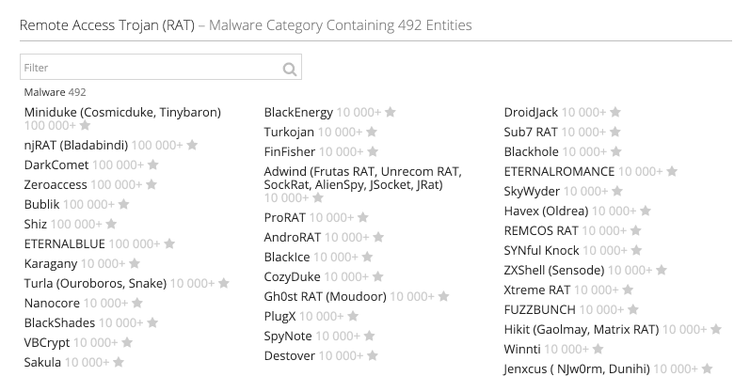 RAT malware category in Recorded Future.
A few vulnerabilities were not included in the top 10 due to adoption by nation-state actors as opposed to use by the criminal underground: ETERNALBLUE and Spectre/Meltdown. The ETERNALBLUE exploit (which used MS17-010), while often mentioned, was not used by the criminal underground or offered for sale as a part of other exploit kits. Spectre, while noted in a few phishing attacks, was also not heavily used by cybercriminals. One possible reason why is that these exploits are more sophisticated and difficult to use versus typical exploit kits, which were once prolific due to their ease of use. However, as shown by Recorded Future’s previous research on top vulnerabilities, the emergence of new exploit kits continues to decrease.
As this annual list is based off metadata analysis of available information from open, deep, and dark web sources, Recorded Future did not reverse-engineer any malware mentioned in this piece. Instead, the aim of this report is to showcase the most exploited vulnerabilities.
Last Year’s Top Exploited Vulnerabilities
The top exploited vulnerability on the list, CVE-2018-8174, a Microsoft Internet Explorer vulnerability nicknamed “Double Kill,” was included in four exploit kits (RIG, Fallout, KaiXin, and Magnitude). Exploit kits associated with this vulnerability were noted to spread the malware Trickbot through phishing attacks. The Magnitude exploit kit delivered Magniber ransomware, which primarily targeted users in Asia where computer default languages were in Korean, Chinese, or Malay.
CVE-2018-4878 was the second most commonly observed vulnerability and is the only Adobe Flash Player vulnerability on this year’s top 10. Like CVE-2018-8174, this vulnerability was included in multiple exploit kits, most notably the Fallout exploit kit, which was used to distribute GandCrab ransomware. Fallout took its name and URI patterns from the now defunct Nuclear exploit kit, which had been associated with CVE-2015-7645, one of 2016’s top 10 vulnerabilities. In 2018, Fallout was last selling for $300 a week and $1,100 a month, as seen below.
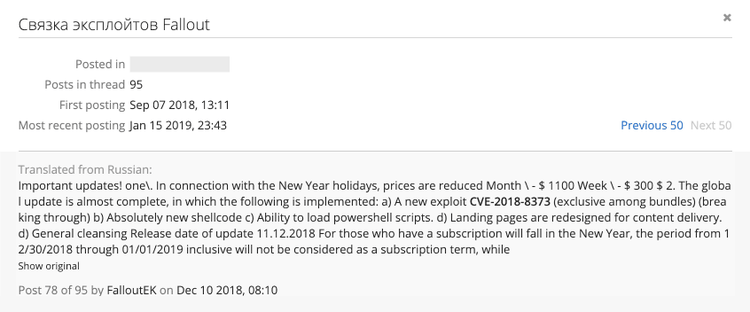 Last price update for the Fallout exploit kit by FalloutEK.
For the first time, a vulnerability has made the top 10 vulnerability list three years in a row — CVE-2016-0189. Why has this vulnerability persisted? For starters, CVE-2016-0189 is not dependent on one version of Internet Explorer (it impacts IE 9 through 11), resulting in a more reliable vulnerability to exploit. Because of this versatility, the vulnerability has been successfully incorporated into a variety of various exploit kits over the years, as many as five in 2018 (Underminer, Magnitude, Grandsoft, KaiXin, and RIG). Additionally, there are no mitigating factors available to prevent CVE-2016-0189 — the only workarounds are restricting access to two common dynamic-linked library files: VBScript.dll and JScript.dll.
Two vulnerabilities were associated with numerous pieces of malware: CVE-2017-11882 and CVE-2017-0199. These vulnerabilities were associated with 10 and eight pieces of malware, respectively. Both were used in Trillium’s Security Multisploit Tool, which included four of the top 10 vulnerabilities. This tool was heavily discussed and advertised on Hack Forums and Nulled Forum, and received positive reviews. CVE-2017-0199 was notably used by Gorgon Group, a threat group operating out of Pakistan which targeted government organizations in the U.K. and United States, among others, through targeted spearphishing attacks.
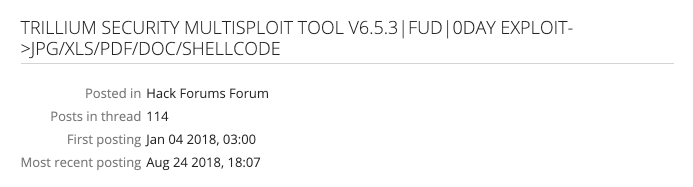 Post on Trillium’s Security Multisplit Tool as seen on numerous dark web forums.
Cyber Vulnerability
Malware Count
CVE-2018-8174
7
CVE-2018-4878
4
CVE-2017-11882
10
CVE-2017-8750
4
CVE-2017-0199
8
CVE-2016-0189
5
CVE-2017-8570
4
CVE-2018-8373
1
CVE-2012-0158
1
CVE-2015-1805
1
Cyber Vulnerability
Company
Product
Associated Malware
CVSS
Recorded Future Risk Score
CVE-2018-8174
Microsoft
Internet Explorer
Fallout Exploit Kit, KaiXin Exploit Kit, LCG Kit Exploit Kit, Magnitude Exploit Kit, RIG Exploit Kit, Trickbot, Underminer Exploit Kit
7.6
89
CVE-2018-4878
Adobe
Flash Player
Fallout Exploit Kit, GreenFlash Exploit Kit, Hermes Ransomware, Sundown Exploit Kit, Threadkit Exploit Kit
7.5
89
CVE-2017-11882
Microsoft
Office
AgentTesla, Andromeda, BONDUPDATER, HAWKEYE, LCG Kit, Loki, POWRUNNER, QuasarRAT, REMCOS RAT, ThreadKit Exploit Kit
9.3
99
CVE-2017-8750
Microsoft
Office
Formbook, Loki, QuasarRAT
7.6
89
CVE-2017-0199
Microsoft
Office
DMShell++, njRAT, Pony, QuasarRAT, REMCOS RAT, SHUTTERSPEED, Silent Doc Exploit Kit, Threadkit Exploit Kit
9.3
99
CVE-2016-0189
Microsoft
Internet Explorer
Grandsoft Exploit Kit, KaiXin Exploit Kit, Magnitude Exploit Kit, RIG Exploit Kit, Underminer Exploit Kit
7.6
89
CVE-2017-8570
Microsoft
Office
Formbook, QuasarRAT, Sisfader RAT, Threadkit Exploit Kit, Trickbot
9.3
99
CVE-2018-8373
Microsoft
Internet Explorer
Quasar RAT
7.6
89
CVE-2012-0158
Microsoft
Office
Silent Doc Exploit, PlugX
9.3
89
CVE-2015-1805
Android
AndroRAT
7.2
89
Development of Exploit Kits Continues to Decrease
As observed in prior reports, the development of new exploit kits continued to decrease. Only five new exploit kits emerged in 2018, compared with 10 in 2017, and 62 in 2016. Of those five, two were associated with a top 10 vulnerability: Fallout and LCG Kit. Starting in March, LCG Kit incorporated CVE-2017-11882, but later that year also incorporated 2018’s top vulnerability, CVE 2018-8174. Although LCG Kit has been associated with a number of malicious attachments, including the spreading of RATs such as REMCOS and QuasarRAT, there were no direct references to this exploit kit for sale on the dark web in 2018 using the LCG Kit name. New exploit kits developed in 2018 include:
- Best Pack Exploit Kit
- Creep Exploit Kit
- Darknet Angler
- Fallout Exploit Kit
- LCG Kit
Exploit Kits That Continued to Make Their Mark
Among exploit kits associated with the top vulnerabilities, ThreadKit was the most discussed on dark web sources in 2018. ThreadKit incorporated four of the top 10 vulnerabilities (CVE-2018-4878, CVE-2017-11882, CVE-2017-0199, and CVE-2017-8570). ThreadKit’s notoriety increased when the Cobalt Hacking Group (or Cobalt Group) added another stage to the macro exploit by including its signature CobInt trojan. The group typically attacks financial institutions, although the group’s activity has lessened due to the arrests of some of its members.
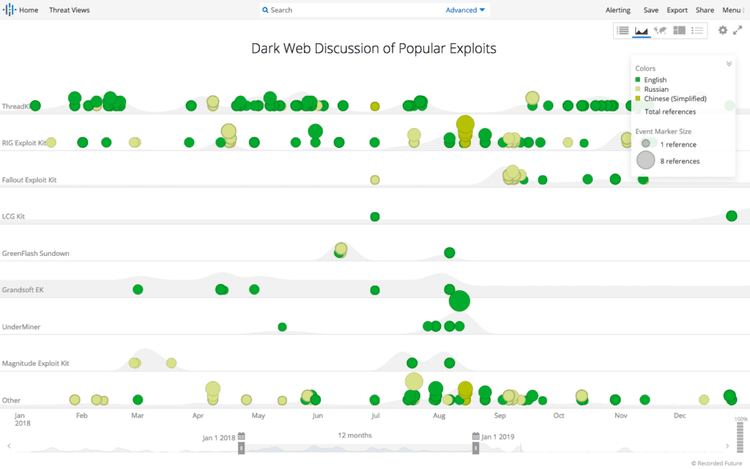 Dark web discussion of exploits associated with 2018’s top vulnerabilities.
In 2018, ThreadKit was last updated on December 28 by mrbass, a user on a dark web forum, to include vulnerability CVE-2018-15982 (a more recent Adobe zero-day vulnerability), which continued to be sold for $400, as seen below.
Last update in 2018 for the ThreadKit exploit kit by mrbass on a dark web forum.
UnderMiner, which exploited two of 2018’s top vulnerabilities — CVE-2016-0189 and CVE-2018-4878 — made a resurgence in the latter part of 2018. Like ThreadKit, UnderMiner took advantage of, and was the first to exploit, the zero-day vulnerability CVE-2018-15982 in late December 2018.
RATs in Focus
Sisfader is the only RAT that first emerged in 2018 and was associated with a top vulnerability, with its exploit of CVE-2017-8570. The RAT maintains persistence by installing itself as a service when launched from malicious RTF files. According to available sources, there was no evidence of Sisfader for sale.
RATs
Cyber Vulnerability Count
QuasarRAT
5
REMCOS RAT
2
HAWKEYE
1
njRAT
1
PlugX
1
AndroRAT
1
QuasarRAT was associated with the most vulnerabilities, including, most notably, those in Trillium’s Security Multisploit Tool. This RAT, which has been active since 2011, continues to show its viability in a variety of attacks, including spearphishing attacks on government organizations.
Outlook and Recommended Actions
Official vulnerability databases, and even scanning tools, cannot arm organizations with one key metric: the overlap between the vulnerabilities in the systems you use and the ones that are being actively exploited by threat actors. The goal of this annual list is to provide an account of the most widely adopted vulnerability exploits, in addition to some recommended actions:
- Prioritize patching of all the vulnerabilities identified in this post.
- Do not forget to patch older vulnerabilities — the average vulnerability stays alive for nearly seven years.
- Remove the affected software if it does not impact key business processes.
- Consider Google Chrome as a primary browser.
- While Flash Player is going away and more sites increasing have removed this technology from its site, continue to heed caution with websites that don’t.
- Utilize browser ad-blockers to prevent exploitation via malvertising.
- Frequently back up systems, particularly those with shared files, which are regular ransomware targets.
- Users and organizations should conduct or maintain phishing security awareness to mitigate attacks.
- Companies should deliver user training to encourage skepticism of emails requesting additional information or prompting clicks on any links or attachments. Companies will not generally ask customers for personal or financial data, but when in doubt, contact the company directly by phone and confirm if they actually need the information.
Text extracted automatically; images, tables and formatting may be missing. Original: https://www.recordedfuture.com/blog/top-vulnerabilities-2018