Hackers Are Probing PaperCut Servers, and 47% Still Have No Patch
PaperCut pre-auth RCE CVE-2026-81578 actively exploited; 47% of tracked installs unpatched and exposed to remote code execution.
Huntress confirmed active exploitation of a pre-authentication RCE flaw in PaperCut (CVE-2026-81578), chainable with CVE-2026-82078 to achieve SYSTEM-level code execution via PaperCut's Application Server. Observed attacks focused on short reconnaissance (whoami, ver, tasklist) with no persistence, but a malicious Java class dropping into the installation directory leaves the jdbc:derby:memory:pwn breadcrumb. Roughly 47% of ~2,500 tracked installations run version 23 or earlier with no patch yet available.
- Pre-auth RCE chain (CVE-2026-81578 + CVE-2026-82078) reproduced by Huntress against PaperCut NG 25.0.11.75758
- 47% of ~2,500 tracked PaperCut installs still run version 23 or earlier, with no fix yet for those versions
- Derby log entry jdbc:derby:memory:pwn is a high-confidence indicator of compromise
- Defenders advised to remove PaperCut Application Server from the public internet until patched
Vulnerabilities mentionedAll →
| CVE | Vulnerability | CVSS | EPSS | Flags | Affected | Exposure | Published |
|---|---|---|---|---|---|---|---|
| CVE-2026-82078 +1 in the same advisory: …81578 | Unsafe Reflection RCE in PaperCut NG/MF, Chained with Auth Bypass in Attacks CVE-2026-82078 is an unsafe dynamic class loading flaw (unsafe reflection, CWE-470) in the database connection utilities of PaperCut NG and PaperCut MF: the software instantiates a database driver class based on a configurable driver name without validating it against an allowlist of approved drivers. An attacker who can manipulate system configuration parameters can point that setting at classes of their choosing, causing the server to execute arbitrary Java bytecode residing on the application classpath in the security context of the PaperCut server process. On its own the issue is rated 9.4 (Critical) with high privileges required, but when chained with the companion authentication bypass CVE-2026-81578 it yields unauthenticated remote code execution on the print-management server. All PaperCut NG and MF deployments are in scope; affected version ranges were not specified in the available data, so administrators should consult PaperCut's advisory for fixed versions. The flaw is confirmed exploited in the wild as a zero-day: it was added to CISA's KEV catalog on 2026-08-31, and public reporting describes an AI-orchestrated campaign that compromised PaperCut servers at roughly 395 organizations (~440 servers), with EPSS currently at 1.7% (76th percentile). Do: Upgrade PaperCut NG and MF to the patched release specified in PaperCut's security advisory (exact fixed versions were not provided in this data), prioritizing internet-exposed print servers; the KEV listing means agencies must remediate per CISA BOD 26-04 or discontinue/mitigate per its cloud-service guidance. Restrict the PaperCut web interface from direct internet exposure (VPN/allowlist), review administrator accounts and database driver configuration for tampering, and hunt for post-exploitation activity, since this flaw is being actively chained with the authentication bypass CVE-2026-81578. | 9.4 group max | 2% | KEV |
| mass≈100,000+ organizations / plausibly millions of end users (vendor-cited install base); tens of thousands of on-prem servers with a smaller but significant… |
Full article796 words · extracted from securityaffairs.com · click to collapse

PaperCut servers are under active attack, while 47% of tracked installations still run unpatched versions vulnerable to remote code execution.
PaperCut, the print management software running in schools, hospitals, and offices worldwide, confirmed on August 27 that a pre-authentication remote code execution flaw is being actively exploited against real customers. Researchers at Huntress found evidence of exploitation in two customer environments, and the security firm went further, reproducing the entire attack chain from scratch against a clean, unpatched install.
“Observed activity focused on system discovery. We have not observed secondary malware, further command-and-control traffic, or additional persistence or post-exploitation from the recovered payload.” reads the report published by Hutress.
“Huntress reproduced a full pre-authentication RCE chain against a vanilla PaperCut NG 25.0.11.75758 server. We have reached out to PaperCut to coordinate with them on continued vulnerability analysis.”
The vulnerability starts with a simple authorization mistake in PaperCut. An attacker can send a specially crafted request that makes the server display one page while actually running an action from another page.
PaperCut checks the permissions for the page it displays instead of the action it actually performs. This flaw, tracked as CVE-2026-81578, can let an attacker change the server’s configuration without logging in.
That access can then be combined with a second flaw, CVE-2026-82078. The issue in PaperCut’s database utilities can load unsafe Java classes, allowing the attacker to run arbitrary Java code on the server.
The real-world attacks Huntress observed were almost quaint compared to the severity of the bug itself. One incident lasted under two minutes total, with the attacker running nothing more aggressive than whoami and ver, basic commands to identify the compromised account and Windows version. A second incident added tasklist to the mix, checking what processes were running, but neither case showed evidence of deeper persistence, secondary malware, or follow-up command-and-control traffic.
The activities observed by Huntress read like reconnaissance rather than a finished operation, the kind of activity that usually precedes something worse.
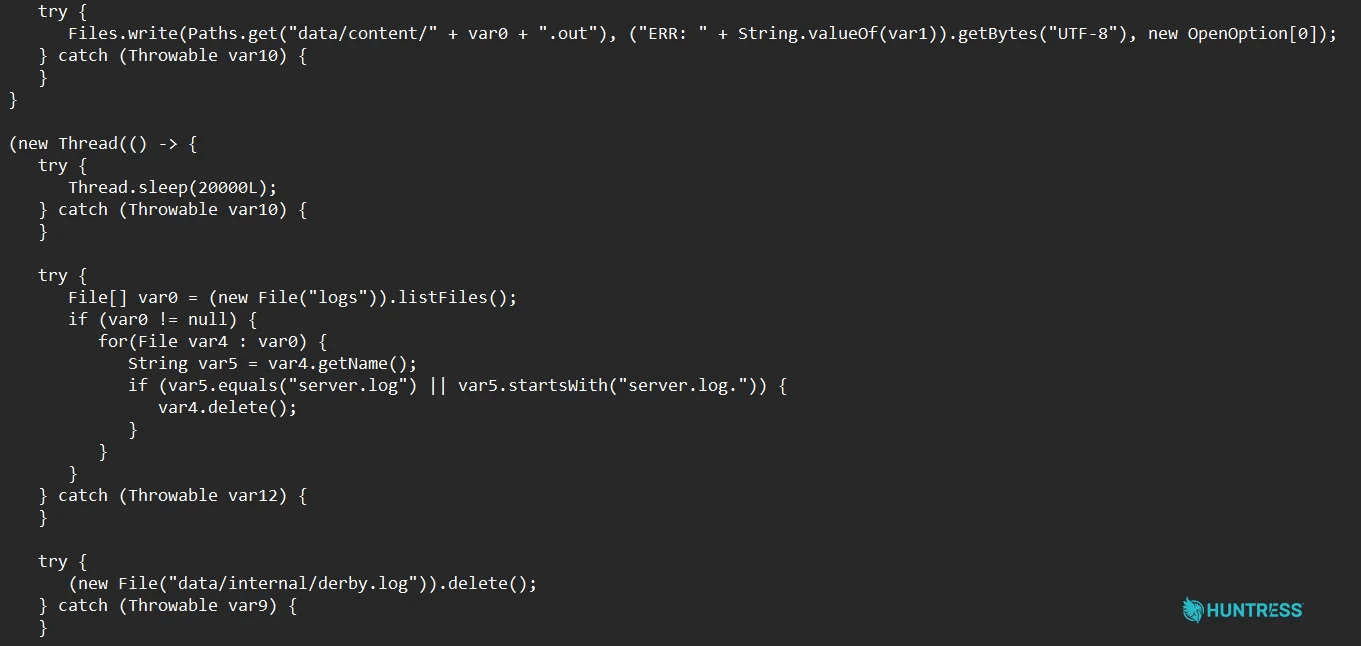
The forensic trail attackers left behind is genuinely useful for defenders, and it’s worth understanding exactly what it looks like. Investigators found a malicious Java class file dropped directly into PaperCut’s own installation directory, capable of running commands, writing results to a temporary file, and then deleting both the output and the server’s own log file to cover its tracks. One artifact survived that cleanup regardless: a Derby database log entry reading memory:...\pwn, an oddly named database directory that PaperCut’s own investigation guidance now flags as a high-confidence indicator of compromise.
“After exploitation, the .class file deletes its own Udydn.out file, as well as the server’s server.log file. The server.log file recorded the execution of this code in a log line that contains the string DB URL: jdbc:derby:memory:pwn that immediately followed the large encoded data blob’s appearance in the log.” continues the report. “We observed /data/internal/derby.log was not deleted, and it contains one insightful breadcrumb”
PaperCut’s patching process is more complicated than simply installing an update. The company released an emergency patch first, then issued another update less than 24 hours later after additional testing. Fixes for version 24 were still being developed when the report was published.
The timing is important because the second confirmed attack targeted a server running version 24, before the fix for that version was available.
Huntress successfully recreated the exploit chain in a test environment. From a remote system, the researchers were able to trigger code execution without authentication. The attack caused PaperCut’s pc-app.exe Application Server to launch charmap.exe with SYSTEM privileges, confirming that the vulnerability can lead to code execution at the highest Windows privilege level.
The bigger concern involves older versions. Huntress found that about 47% of the roughly 2,500 PaperCut installations it tracks still run version 23 or earlier, and there is currently no patch for those versions.
Huntress is working with PaperCut to analyze the vulnerability and coordinate the response.
If your organization runs one of these older versions, the safest option for now is to remove the PaperCut Application Server from the public internet. Restrict access through a VPN or a trusted internal network until a proper fix becomes available.
If your PaperCut server has been publicly accessible recently, installing the patch should not be the end of your response. It should be the start of an investigation.
Before restarting the server, save its logs and configuration files so you don’t lose important evidence. Check whether pc-app.exe has launched a command shell or tools such as tasklist, and look for unexpected .class files in the server’s lib directory.
Even a short two-minute reconnaissance attempt could be an early sign of a more serious attack.
Follow me on Twitter: @securityaffairs and Facebook and Mastodon
(SecurityAffairs – hacking, Philippine nuclear and naval targets)
Text extracted automatically; images, tables and formatting may be missing. Original: https://securityaffairs.com/198107/security/hackers-are-probing-papercut-servers-and-47-still-have-no-patch.html