CISA: Spyware and RATs used to target WhatsApp and Signal Users
Vulnerabilities mentionedAll →
| CVE | Vulnerability | CVSS | EPSS | Flags | Affected | Exposure | Published |
|---|---|---|---|---|---|---|---|
| CVE-2025-21042 | Out-of-Bounds Write RCE in Samsung Mobile Image Codec (libimagecodec.quram.so) CVE-2025-21042 is an out-of-bounds write (CWE-787) in libimagecodec.quram.so, the Quram image codec library in the image-processing stack of Samsung mobile devices. A remote attacker can trigger the flaw by getting a vulnerable device to decode a crafted image or media file, corrupting memory and potentially executing arbitrary code (the advisory does not specify the exact delivery vector, such as messaging or web content). Successful exploitation allows the attacker to run code on the device, though whether execution is confined to the decoding application or achieves broader privileges is not stated. Any Samsung mobile device using the affected codec is potentially at risk; CISA lists the product only as 'Samsung Mobile Devices' without model or version detail. The flaw is confirmed to be exploited in the wild: CISA added it to the KEV catalog on 2025-11-10 (ransomware use unknown), no public PoC is known, and EPSS assigns a 33.2% probability of exploitation within 30 days (98th percentile). Do: Install the latest Samsung security maintenance release (SMR) / monthly security update on all Samsung mobile devices and verify each device's Android security patch level includes the fix for this CVE; per CISA's KEV required action, apply the vendor's mitigations, and federal civilian agencies must follow BOD 22-01 or discontinue use of affected products. Until the update is confirmed, treat untrusted image/media files (e.g., received via messaging or web) as a risk vector on Samsung devices and monitor Samsung's security advisories for the affected-model list. | 9.8 | 33% | KEV |
| masshundreds of millions to roughly a billion Samsung mobile devices in use worldwide (order of magnitude 10^8-10^9) | |
| CVE-2025-43300 | Actively Exploited Out-of-Bounds Write in Apple iOS/iPadOS/macOS Image I/O CVE-2025-43300 is an out-of-bounds write (CWE-787) in the Image I/O (ImageIO) framework used by Apple iOS, iPadOS, and macOS. It can be triggered when a device processes a specially crafted image file, corrupting memory in the image-parsing process. Successful exploitation may cause application crashes or allow arbitrary code execution with the privileges of the application handling the image. Because ImageIO is a core system component on essentially every Apple device, virtually all users of iPhones, iPads, and Macs are exposed. The flaw is being exploited in the wild — CISA added it to the KEV catalog on 2025-08-21, mandating patching per BOD 22-01 for federal agencies — and EPSS estimates a 22% probability of exploitation in the next 30 days (98th percentile); no public PoC is known and ransomware use is unconfirmed. Do: Apply Apple's security updates for iOS, iPadOS, and macOS issued in August 2025 (e.g., iOS 18.6.1 / iPadOS 18.6.1 and macOS Sequoia 15.6.1) on all devices, prioritizing user-facing fleets and agencies bound by BOD 22-01 deadlines. Until devices are patched, exercise caution with images from untrusted sources (email, messaging, web content), since no compensating mitigations are specified. Note that the source data does not enumerate exact affected builds, so verify coverage against Apple's advisory and CISA KEV required actions. | 10.0 | 22% | KEV PoC |
| mass>1 billion active Apple devices (ImageIO is a core framework on all iOS/iPadOS/macOS devices; Apple's active device base exceeds 2 billion) | |
| CVE-2025-55177 | Incorrect Authorization in WhatsApp Linked-Device Sync Used in Targeted Spyware Attacks CVE-2025-55177 is an incorrect authorization flaw (CWE-863) in how WhatsApp for iOS, WhatsApp Business for iOS, and WhatsApp for Mac validate linked device synchronization messages, allowing an unrelated user to trigger processing of content from an arbitrary URL on a target's device. An attacker can reach a vulnerable client through the messaging channel without normal authorization checks, causing the app to fetch or process attacker-chosen content. On its own the flaw carries only partial confidentiality and integrity impact (CVSS 5.4), but Meta assesses it was chained with an Apple OS vulnerability (CVE-2025-43300) in a sophisticated attack against specific, targeted users. Users running WhatsApp for iOS before 2.25.21.73, WhatsApp Business for iOS before 2.25.21.78, or WhatsApp for Mac before 2.25.21.78 are affected. The flaw was added to CISA's KEV catalog on 2025-09-02 amid reports of highly targeted zero-day attacks, though no public proof-of-concept is known and use in ransomware campaigns has not been reported. Do: Update WhatsApp for iOS to v2.25.21.73 or later, WhatsApp Business for iOS to v2.25.21.78 or later, and WhatsApp for Mac to v2.25.21.78 or later. Also apply Apple's backported OS fix for CVE-2025-43300, since the two flaws were combined in the observed attack chain. Review and re-link WhatsApp companion devices if compromise is suspected; federal agencies must follow BOD 22-01 required-action deadlines per the KEV listing. | 5.4 | 4% | KEV |
| masshundreds of millions of users (WhatsApp's multi-billion user base includes a very large iOS/macOS install base) |
Full article286 words · extracted from securityaffairs.com · click to collapse
 Pierluigi Paganini
 November 25, 2025

CISA warns that threat actors are actively using commercial spyware and RATs to target users of mobile messaging apps WhatsApp and Signal.
The U.S. Cybersecurity and Infrastructure Security Agency (CISA) is warning of threat actors using commercial spyware and remote access trojans (RATs) to target users of popular instant messaging applications, including WhatsApp and Signal.
“CISA is aware of multiple cyber threat actors actively leveraging commercial spyware to target users of mobile messaging applications (apps).” reads the advisory published by CISA. “These cyber actors use sophisticated targeting and social engineering techniques to deliver spyware and gain unauthorized access to a victim’s messaging app, facilitating the deployment of additional malicious payloads that can further compromise the victim’s mobile device.”
Attackers attempt to infect victims through phishing messages, malicious QR codes, zero-click exploits, and impersonation of apps like Signal and WhatsApp. Targeting appears opportunistic but often focuses on high-value figures (e.g. Government, military, and political officials) and members of civil society across the U.S., Middle East, and Europe.
CISA urges users to consult its updated Mobile Communications Best Practices and the Mitigating Cyber Threats with Limited Resources guidance to protect messaging apps and reduce spyware risks.
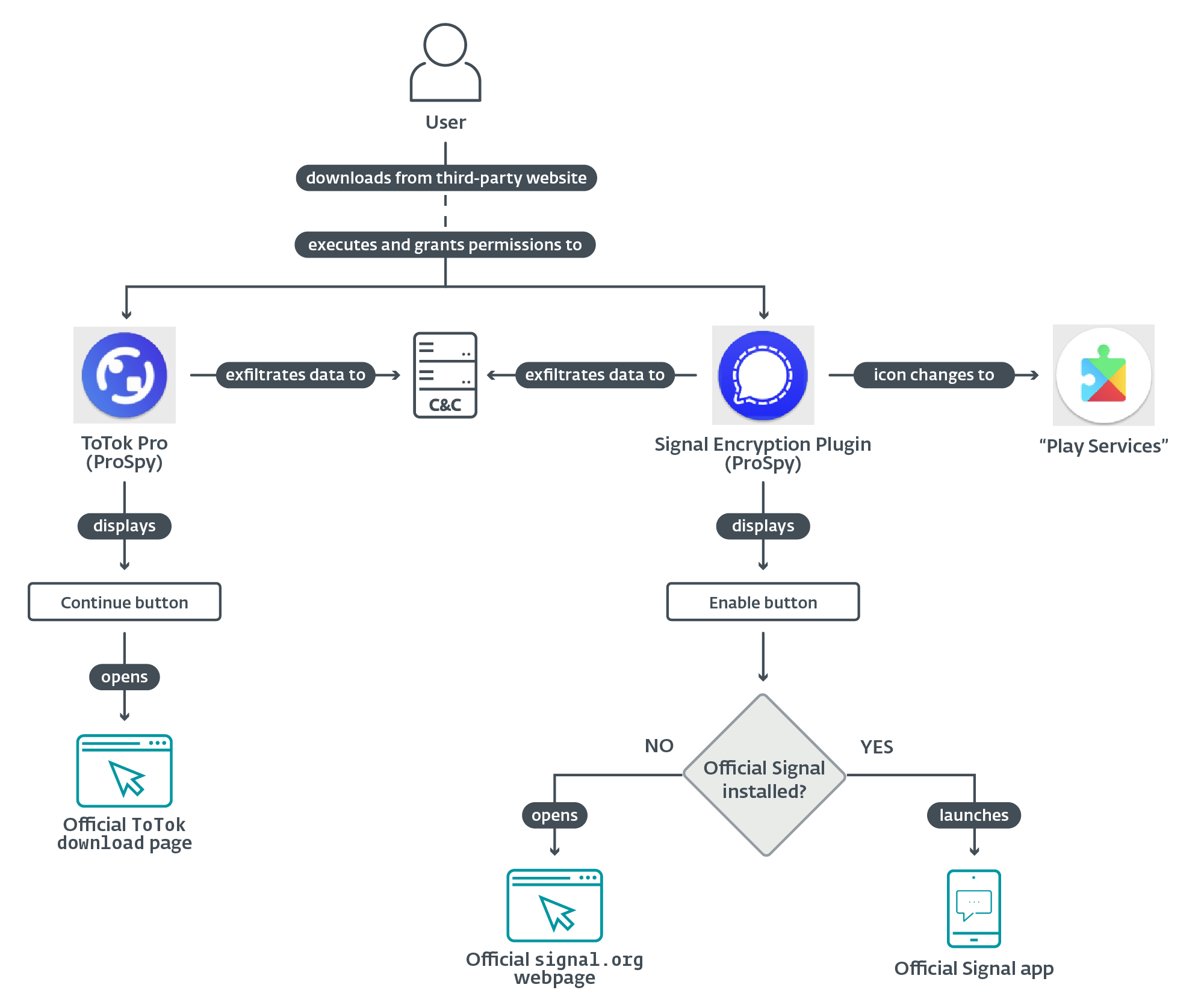
CISA highlighted several recent campaigns, including Russia-aligned actors abusing Signal’s linked-device feature, Android spyware like ProSpy and ToSpy impersonating Signal and ToTok in the UAE, and ClayRat spreading via Telegram and fake WhatsApp/Google/TikTok apps in Russia. Other attacks chained iOS and WhatsApp flaws (CVE-2025-43300, CVE-2025-55177) against under 200 users, and a Samsung bug (CVE-2025-21042) to deploy LANDFALL spyware to Galaxy devices in the Middle East.
Follow me on Twitter: @securityaffairs and Facebook and Mastodon
(SecurityAffairs – hacking, commercial spyware)
Text extracted automatically; images, tables and formatting may be missing. Original: https://securityaffairs.com/185047/malware/cisa-spyware-and-rats-used-to-target-whatsapp-and-signal-users.html