Android apps can now check security patches down to individual device components
Google shipped stable AndroidX Security State libraries letting Android apps check per-component patch levels and CVE patch status via OSV data.
Security State v1.1.0 and Security State Provider v1.0.0 expose three patch levels per device component: installed (DSPL), published in Android Security Bulletins (PSPL), and available to download (ASPL), covering the OS, Play system modules, and the Linux kernel. Apps can verify specific CVE fixes, for example NFC or Bluetooth patches before enabling tap-to-pay, and the libraries integrate with the Open Source Vulnerabilities database for CVE-level auditing. Google Play system updates and GOTA already adopt the framework, and Android 17 lets manufacturers declare backported fixes beyond the stated patch level.
- DSPL, PSPL, and ASPL provide granular per-component patch visibility, including kernel versions
- Banking and enterprise apps can gate high-value actions on verified patch state
- OSV integration enables CVE-level auditing with device-specific vulnerability reports
Full article427 words · extracted from helpnetsecurity.com · click to collapse
New AndroidX Security State libraries provide a more granular way to determine how securely patched an Android device is. The stable Security State v1.1.0 and Security State Provider v1.0.0 libraries allow developers to check the security status of individual device components and determine whether security updates are ready to be downloaded and installed on a specific device.
For phone manufacturers and developers who build over-the-air (OTA) update systems, the androidx.security.state.provider library provides a standard way to let apps know when an update is available for a device.
Three levels of security patch information
“As Android has evolved to deliver rapid, independent component updates through modular systems like Google Play system updates, relying on a single SPL build property is no longer the best way to determine a device’s true security posture,” Google engineers explained.
Instead, the Security State libraries let developers check three patch levels for individual parts of a device.
The Device Security Patch Level (DSPL) shows what is currently installed and running on the device. The Published Security Patch Level (PSPL) shows the latest patches the company has officially published in the Android Security Bulletin, while the Available Security Patch Level (ASPL) shows what is available for that particular device to download and install.
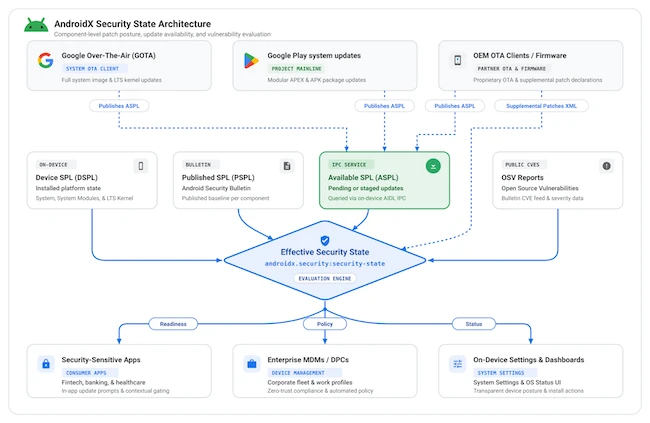
Source: Google
The checks cover the core Android operating system, system modules updated through Google Play system updates, and the Linux kernel. Kernel security levels use version numbers, such as 5.15.159 or 6.1.91, instead of monthly security patch dates.
CVE-level security checks
This more detailed information can help security-sensitive apps decide whether to allow certain actions. For example, banking or enterprise apps could check installed patches and available updates before allowing high-value payments or credential enrollment.
Developers can also check whether specific high-risk vulnerabilities, tracked as CVEs, have been patched. Google said this could be used to verify that critical NFC or Bluetooth fixes are installed before enabling features such as tap-to-pay or proximity-based data sharing.
The libraries integrate with the Open Source Vulnerabilities (OSV) database to obtain Android Security Bulletin data and can download device-specific vulnerability reports for CVE-level auditing, providing a more detailed view of a device’s security state.
Android 17 also allows manufacturers to declare individual security fixes applied beyond a device’s stated security patch level, including fixes backported to older software.
Google Play system updates already provide ASPL information on Android devices with Google Mobile Services (GMS), while Google Over-The-Air (GOTA) has also adopted the framework. The company said it is working with device manufacturers to bring their OTA update clients to the standardized system.
Text extracted automatically; images, tables and formatting may be missing. Original: https://www.helpnetsecurity.com/2026/09/18/google-androidx-security-state-libraries/