Attackers are handing off access in 22 seconds, Mandiant finds
Vulnerabilities mentionedAll →
| CVE | Vulnerability | CVSS | EPSS | Flags | Affected | Exposure | Published |
|---|---|---|---|---|---|---|---|
| CVE-2025-31324 | Unauthenticated File Upload RCE in SAP NetWeaver Visual Composer CVE-2025-31324 is a critical (CVSS 9.8) unrestricted file upload flaw (CWE-434) in the Visual Composer Metadata Uploader component of SAP NetWeaver, which lacks proper authorization. An unauthenticated attacker can send crafted upload requests over the network to the Metadata Uploader endpoint and plant malicious executable binaries, such as webshells, on the host. Executing the uploaded files yields remote code execution with full impact on confidentiality, integrity, and availability, enabling system compromise, lateral movement, and ransomware deployment. Any organization running the affected SAP NetWeaver component is at risk, with the greatest exposure for instances reachable from the internet. Exploitation is confirmed in the wild: the flaw was added to CISA KEV on 2025-04-29, a public PoC exists, and researchers and media report active attacks, including by Chinese-linked actors deploying Golang-based implants on Linux systems and known ransomware use, often chained with CVE-2025-42999. Do: Apply SAP's patch for CVE-2025-31324 (released in the April 2025 security updates) and follow the vendor mitigation instructions per CISA KEV/BOD 22-01 requirements. As interim mitigation, restrict or disable the Visual Composer Metadata Uploader endpoint and ensure it is not reachable from the internet; also patch the related CVE-2025-42999 since the flaws are being chained. Check affected hosts for uploaded webshells, Golang-based implants, and signs of ransomware activity. | 9.8 | 100% | KEV ransomware PoC |
| largetens of thousands of enterprise deployments worldwide, with several thousand instances directly internet-exposed | |
| CVE-2025-53770 | Unauthenticated Deserialization RCE in Microsoft SharePoint Server on-premises CVE-2025-53770 is a deserialization of untrusted data vulnerability (CWE-502) in Microsoft SharePoint Server on-premises that allows an unauthorized attacker to execute code over a network. It is triggered when the server deserializes attacker-controlled data, can be chained with CVE-2025-53771, and it bypasses the fixes issued for CVE-2025-49704, meaning the earlier patches are insufficient. Successful exploitation yields remote code execution on the SharePoint server, and ransomware operators are known to be using it. Any organization running SharePoint Server on-premises is affected, particularly internet-facing deployments and end-of-life versions such as SharePoint Server 2013 and earlier that can no longer be patched. The flaw is being actively exploited — it was added to CISA's KEV on 2025-07-20 with known ransomware use — and EPSS assigns it a 100% probability of exploitation within 30 days. Do: Apply Microsoft's updated SharePoint Server security updates that fix CVE-2025-53770 — these include more robust protection than the earlier CVE-2025-49704 updates — and ensure the companion CVE-2025-53771 is also addressed, following CISA and vendor mitigation instructions for supported versions. Disconnect public-facing SharePoint Server 2013 or earlier (EOL/EOS) instances, minimize internet exposure of supported servers, and hunt for signs of compromise given the known ransomware exploitation. | 9.8 | 100% | KEV ransomware PoC ×3 |
| mass≈25,000–100,000 internet-exposed on-premises SharePoint servers (public internet-wide scans); total on-prem installed base plausibly >1M users | |
| CVE-2025-53771 | Improper Authentication in Microsoft SharePoint Server Enables Network Spoofing CVE-2025-53771 is an improper authentication flaw (CWE-287) in Microsoft's on-premises SharePoint Server that allows an unauthenticated remote attacker to conduct spoofing over the network. Per the CVSS vector, exploitation requires no privileges and no user interaction, so an attacker who can reach the SharePoint server over the network can trigger it directly. Successful exploitation lets the attacker impersonate an authenticated user or component, producing limited but real impact on confidentiality and integrity (CVSS 6.5, medium). Any organization running on-premises SharePoint Server is affected, particularly those exposing it to the internet; no specific version numbers are provided in the source data, so defenders should consult Microsoft's advisory for their edition. No public PoC exists and it is not yet in CISA's KEV, but exploitation likelihood is near-certain (EPSS 99.7%, 100th percentile), and Microsoft has confirmed active China-linked nation-state exploitation of the closely related SharePoint ToolShell vulnerability chain, which has hit roughly 400 organizations including U.S. federal agencies. Do: Apply Microsoft's SharePoint Server security updates that ship this fix as soon as possible, prioritizing internet-facing servers, and treat this as urgent because it was patched alongside the actively exploited ToolShell chain. While patching, review authentication and web-server logs on SharePoint hosts for unexpected successful logons or anomalous requests that could indicate spoofing or compromise, and restrict network access to SharePoint (VPN, firewall rules, segmentation) if patching must be delayed. | 6.5 | 100% |
| largeTens of thousands of internet-facing SharePoint Server deployments, with a total on-prem installed base plausibly in the hundreds of thousands (estimate) | ||
| CVE-2025-61882 | Unauthenticated Takeover of Oracle E-Business Suite Concurrent Processing CVE-2025-61882 is a critical (CVSS 9.8) authentication flaw (CWE-287) in the BI Publisher Integration component of the Oracle Concurrent Processing product within Oracle E-Business Suite. An unauthenticated attacker with network access over HTTP can exploit it remotely with no credentials and no user interaction, achieving a takeover of Oracle Concurrent Processing with high confidentiality, integrity, and availability impact. Any organization running Oracle E-Business Suite 12.2.3 through 12.2.14 is affected, especially instances reachable from the internet. The flaw is being actively exploited in the wild: the Cl0p data-theft group has used it to breach dozens of organizations (including Harvard University, with 1.3 TB of data leaked), CISA added it to the Known Exploited Vulnerabilities catalog on 2025-10-06 with known ransomware use, and EPSS puts its 30-day exploitation probability at 99.7%. Do: Apply Oracle's released patch or mitigations for CVE-2025-61882 to affected E-Business Suite 12.2.3-12.2.14 deployments as instructed by the vendor; per CISA KEV requirements, federal agencies must follow BOD 22-01 guidance or discontinue use if mitigations are unavailable. Until patched, limit internet exposure of EBS and its BI Publisher/Concurrent Processing HTTP endpoints, and review web and application logs for unauthenticated access and signs of Cl0p-style data theft or follow-on ransomware. | 9.8 | 100% | KEV ransomware |
| largetens of thousands of EBS environments worldwide across an estimated ~5,000+ customer organizations (est.) |
Full article1,449 words · extracted from helpnetsecurity.com · click to collapse
Exploits remain the leading entry point for attackers for the sixth consecutive year, according to Mandiant’s M-Trends 2026 report, which draws on more than 500,000 hours of incident response work conducted in 2025. The data shows attackers speeding up their internal hand-offs, shifting away from email phishing, and targeting backup and virtualization infrastructure with greater precision.
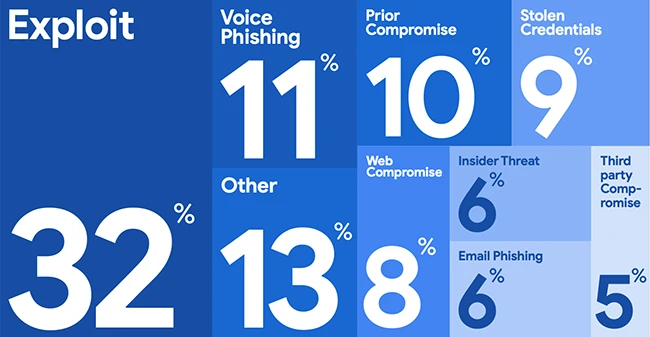
Initial infection vector 2025 (Source: Mandiant)
Voice phishing surges as email phishing continues to decline
Voice phishing climbed to the second-most common initial infection vector in 2025, appearing in 11% of Mandiant investigations where a vector could be identified. Exploits remained first at 32%. Email phishing, which was the dominant social engineering vector just a few years ago, has seen a sustained decline and now represents a fraction of its former share.
The distinction matters for defenders: interactive social engineering methods require live human engagement and are significantly more resistant to automated technical controls than volume-based email campaigns. Different detection strategies are required.
In one campaign spanning the first half of 2025, UNC6040 used voice phishing to convince targets to hand over credentials and authorize attacker-controlled versions of legitimate SaaS applications. Victims later received ShinyHunters-branded extortion notes. UNC3944, a financially motivated cluster with overlap with publicly reported Scattered Spider activity, continued targeting help desk staff by impersonating employees requesting password resets and multi-factor authentication changes.
The access hand-off is getting faster
A growing share of Mandiant investigations followed a division-of-labor model in which one threat cluster gains initial access and transfers it to a separate group for follow-on operations. This pattern appeared in 9% of 2025 investigations, up from 4% in 2022. The time between initial compromise and the hand-off has collapsed.
In 2022, the median time between initial access and hand-off was more than eight hours. In 2025, that figure fell to 22 seconds. Initial access partners now commonly deliver malware directly on behalf of secondary groups, bypassing underground forum sales and compressing the window defenders have to act.
One documented case involved UNC1543, which distributes the FAKEUPDATES JavaScript downloader through drive-by downloads, and UNC2165, a financially motivated cluster with significant overlap with the group publicly reported as Evil Corp. In a 2025 investigation, roughly 70 minutes elapsed between the FAKEUPDATES infection and UNC2165’s earliest interactive activity. UNC2165 ultimately destroyed backups and deployed RansomHub ransomware across Windows and virtual management servers.
Organizations focused exclusively on detecting high-impact tactics may lack detections for the low-impact techniques initial access partners use. Stopping a compromise at the single-system stage is significantly easier than recovering from follow-on activity.
Global dwell time rises to 14 days
Global median dwell time was 14 days in 2025, up from 11 days in 2024, driven largely by long-term espionage intrusions and North Korean IT worker operations. Both categories had a median dwell time of 122 days, or roughly four months.
More incidents went undiscovered for intermediate periods (one week to six months) compared to 2024, a shift the report attributes to groups that limit their tooling to what is available in the targeted environment, mimic legitimate administrative behavior, and remove forensic artifacts.
Organizations that detected intrusions internally did so in about nine days. External notification cases took substantially longer — a median of 25 days in 2025, up from 11 days in 2024. Just over half of organizations detected evidence of malicious activity internally in 2025, a meaningful improvement over the prior year.
Ransomware operators target recovery infrastructure
Ransomware-related intrusions accounted for 13% of Mandiant investigations in 2025. Operators have moved beyond dual-threat encryption-and-theft operations toward systematically denying organizations the ability to recover, targeting identity services, virtualization management planes, and backup infrastructure.
Mandiant investigated multiple breaches in which threat actors exploited misconfigured Active Directory Certificate Services (AD CS) templates to create administrator accounts exempt from multi-factor authentication. In other cases, attackers extracted dozens of high-privilege credentials in a single session from enterprise credential vaults, then forced password changes on privileged accounts, locking defenders out of emergency access during a crisis.
Attackers also compressed and archived Virtual Hard Disks directly on hypervisors, bypassing data loss prevention controls running inside guest operating systems, then deployed ransomware at the hypervisor level by encrypting datastore files. In one documented case, attackers compromised backup management servers, extracted credentials from configuration databases, and wiped millions of backup objects from cloud storage alongside dozens of local system backups.
Prior compromise was the top confirmed initial infection vector for ransomware-related incidents, nearly doubling from the prior year to 30%. The most commonly observed ransomware variant was REDBIKE, known publicly as Akira, followed by AGENDA, known as Qilin. Qilin became the single-most prolific ransomware brand by data leak site volume in 2025.
Three vulnerabilities drove widespread exploitation
The most frequently exploited vulnerabilities in 2025 Mandiant investigations were all zero-days targeting internet-facing enterprise application servers.
CVE-2025-31324, an improper authorization flaw in SAP NetWeaver’s Visual Composer component, allowed unauthenticated file uploads. Multiple threat clusters exploited it as a zero-day before SAP patched it in April 2025, and several suspected PRC-nexus espionage groups exploited it afterward. Post-compromise activity centered on web shell installation and reconnaissance.
CVE-2025-61882, an improper authentication vulnerability in Oracle E-Business Suite, allowed unauthenticated remote code execution. A threat cluster claiming CL0P affiliation sent extortion emails in September 2025 claiming to have stolen documents from Oracle EBS customers. Mandiant identified evidence of successful exploitation as early as August 2025 and attributes the activity to a suspected FIN11 cluster, based on use of the CL0P data leak site and the Java-based GOLDVEIN.JAVA downloader.
CVE-2025-53770, a deserialization vulnerability in Microsoft SharePoint Server, could be chained with CVE-2025-53771 in an exploit known as ToolShell. At least two clusters exploited it as a zero-day, and three more did so after patches shipped in late July. The financially motivated cluster UNC6357 used the SharePoint vulnerabilities to deploy LOCKBIT.WARLOCK ransomware.
GOLDVEIN.JAVA was the most frequently observed malware family across all 2025 investigations. Cobalt Strike BEACON fell to fourth after five consecutive years at the top, its share of observed malware families having shrunk from more than a quarter of investigations in 2021 to just 2% in 2025.
Edge and core network devices are a growing target
The mean time to exploit vulnerabilities has turned negative. GTIG measured an average TTE of 63 days in 2018; by 2024 it had reached -1 day, and in 2025 it is estimated at -7 days, meaning exploitation, on average, begins before a patch is available.
Edge and core network devices have become primary targets for sustained campaigns. These devices often run proprietary operating systems incompatible with enterprise endpoint detection and response tools, creating visibility gaps that sophisticated actors exploit to perform reconnaissance, lateral movement, privilege escalation, and data collection from the device itself.
UNC5807, whose activity is generally consistent with the publicly discussed Salt Typhoon actor, targeted telecommunications organizations by using device-native packet capture functionality to collect credentials from cleartext network protocols, then moving deeper into targeted environments. UNC5221 exploited two separate zero-day vulnerabilities in the same VPN product over a three-month period, deployed in-memory malware to minimize disk artifacts, and tunneled command and control traffic through legitimate third-party services to bypass standard network filtering.
AI in attacks remains incremental
Threat clusters are incorporating AI tools to accelerate reconnaissance, social engineering, and malware development. Mandiant investigated a supply chain compromise involving the QUIETVAULT credential stealer, which checks for AI command-line tools on compromised machines and, if found, executes prompts to locate configuration files and harvest developer tokens.
Malware families including PROMPTFLUX and PROMPTSTEAL actively query large language models during execution to support evasion. State-sponsored and financially motivated actors are using LLMs to shift from mass email campaigns toward personalized, rapport-building social engineering.
The report’s overall assessment: 2025 was not the year where breaches were the direct result of AI. Most successful intrusions continued to stem from human and systemic failures.
Scale: threat clusters and malware families keep growing
The high-tech sector led all industries in share of Mandiant investigations in 2025, surpassing financial services, which had led for the two prior years. Healthcare and business services also appeared consistently near the top.
GTIG began tracking 714 new malware families in 2025, bringing the total to more than 6,000. More than 660 new threat clusters were tracked, pushing the overall total past 5,000. Financially motivated groups made up the largest share of clusters observed in Mandiant investigations, at roughly two-fifths of the total. Cyber espionage groups doubled their share compared to 2024, rising to 16% of observed clusters.
North Korean IT workers using false identities to carry out employment fraud remained a significant and persistent insider threat, with a median dwell time of 122 days and, in several cases, undetected presence lasting more than a year.
Text extracted automatically; images, tables and formatting may be missing. Original: https://www.helpnetsecurity.com/2026/03/24/mandiant-m-trends-2026-report/