Exploitation of the CVE-2021
Vulnerabilities mentionedAll →
| CVE | Vulnerability | CVSS | EPSS | Flags | Affected | Exposure | Published |
|---|---|---|---|---|---|---|---|
| CVE-2021-40444 | Remote Code Execution via MSHTML Rendering Engine in Microsoft Windows/Office (CVE-2021-40444) CVE-2021-40444 is a remote code execution vulnerability in the Microsoft MSHTML browser rendering engine, which Microsoft Office documents can load on Windows systems. It is triggered when a user is convinced to open a specially crafted Office document containing a malicious ActiveX control hosted by the MSHTML engine (tracked as a path-traversal-class issue, CWE-22). A successful attacker gains the ability to run arbitrary code in the context of the logged-on user, with greater impact when that user has administrative rights. Any Windows system that can open Office documents is exposed, spanning Windows 7, 8.1, RT 8.1, Windows 10 (1507 through 21H1) and Windows Server 2004/2008. Exploitation is confirmed in the wild: Microsoft observed targeted attacks at disclosure, the flaw is in CISA's KEV with known ransomware use, and Microsoft released security updates on September 14, 2021. Do: Apply Microsoft's security updates released September 14, 2021 for your Windows version immediately; this is a CISA KEV item with known ransomware use, so patching is treated as mandatory. As interim protection, keep Microsoft Defender Antivirus/Defender for Endpoint signatures current (enterprise detection build 1.349.22.0 or newer, with alerts appearing as 'Suspicious Cpl File Execution') and avoid opening untrusted Office documents, since exploitation requires user interaction with a crafted file. | 8.8 | 97% | KEV ransomware PoC ×2 |
| masshundreds of millions of Windows PCs and servers (nearly all Windows desktop/laptop installs on affected versions at disclosure) |
Indicators of compromiseauto-extracted · verify before use · export allAll →
| Type | Indicator | Context |
|---|---|---|
| domain | hidusi.com | 88508de7c15a35e2553b86 e89dbc1097cfb8591430ff93d9952260 URL hidusi[.]com 103.231.14[.]134 Latest Webinars Reports Kaspersky resear |
| md5 | e58b75e1f588508de7c15a35e2553b86 | their final goal. IoC MD5 ef32824c7388a848c263deb4c360fd64 e58b75e1f588508de7c15a35e2553b86 e89dbc1097cfb8591430ff93d9952260 URL hidusi[.]com 103.231.1 |
| md5 | e89dbc1097cfb8591430ff93d9952260 | 4c7388a848c263deb4c360fd64 e58b75e1f588508de7c15a35e2553b86 e89dbc1097cfb8591430ff93d9952260 URL hidusi[.]com 103.231.14[.]134 Latest Webinars Reports K |
| md5 | ef32824c7388a848c263deb4c360fd64 | tage before the attackers achieve their final goal. IoC MD5 ef32824c7388a848c263deb4c360fd64 e58b75e1f588508de7c15a35e2553b86 e89dbc1097cfb8591430ff93d9 |
Full article593 words · extracted from securelist.com · click to collapse



Summary
Last week, Microsoft reported the remote code execution vulnerability CVE-2021-40444 in the MSHTML browser engine. According to the company, this vulnerability has already been used in targeted attacks against Microsoft Office users. In attempt to exploit this vulnerability, attackers create a document with a specially-crafted object. If a user opens the document, MS Office will download and execute a malicious script.
According to our data, the same attacks are still happening all over the world. We are currently seeing attempts to exploit the CVE-2021-40444 vulnerability targeting companies in the research and development sector, the energy sector and large industrial sectors, banking and medical technology development sectors, as well as telecommunications and the IT sector. Due to its ease of exploitation and the few published Proof-of-Concept (PoC), we expect to see an increase in attacks using this vulnerability.
Geography of CVE-2021-40444 exploitation attempts
Kaspersky is aware of targeted attacks using CVE-2021-40444, and our products protect against attacks leveraging the vulnerability. Possible detection names are:
- HEUR:Exploit.MSOffice.CVE-2021-40444.a
- HEUR:Trojan.MSOffice.Agent.gen
- PDM:Exploit.Win32.Generic
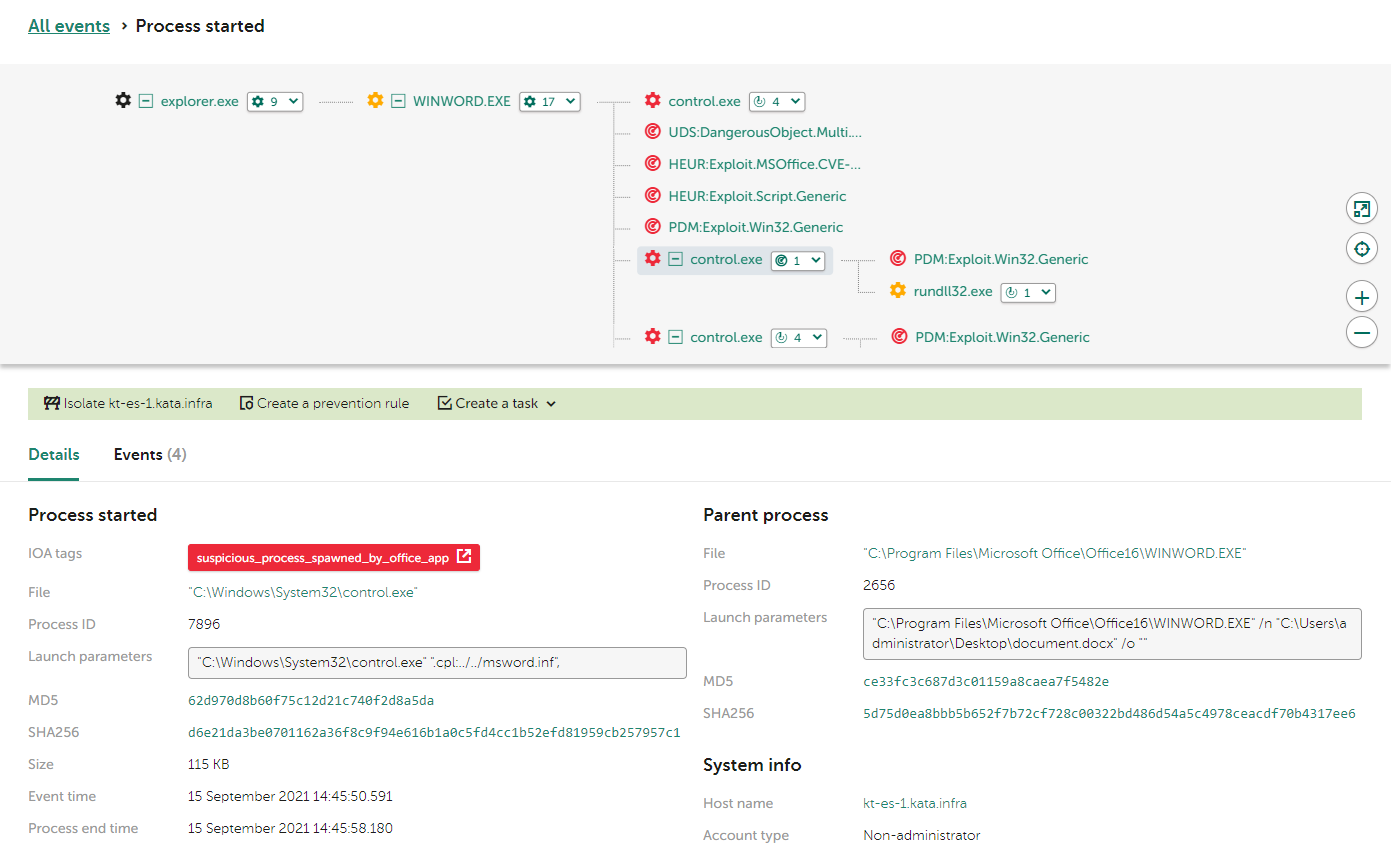
Killchain generated by KEDR during execution of CVE-2021-40444 Proof-of-Concept
Experts at Kaspersky are monitoring the situation closely and improving mechanisms to detect this vulnerability using Behavior Detection and Exploit Prevention components. Within our Managed Detection and Response service, our SOC experts are able to detect when this vulnerability is expoited, investigate such attacks and notify customers.
Technical details
The remote code execution vulnerability CVE-2021-40444 was found in MSHTML, the Internet Explorer browser engine which is a component of modern Windows systems, both user and server. Moreover, the engine is often used by other programs to work with web content (e.g. MS Word or MS PowerPoint).
In order to exploit the vulnerability, attackers embed a special object in a Microsoft Office document containing an URL for a malicious script. If a victim opens the document, Microsoft Office will download the malicious script from the URL and run it using the MSHTML engine. Then the script can use ActiveX controls to perform malicious actions on the victim’s computer. For example, the original zero-day exploit which was used in targeted attacks at the time of detection used ActiveX controls to download and execute a Cobalt Strike payload. We are currently seeing various types of malware, mostly backdoors, which are delivered by exploiting the CVE-2021-40444 vulnerability.
Mitigations
- Follow Microsoft security update guidelines.
- Use the latest Threat Intelligence information to keep up to date with TTPs used by threat actors.
- Businesses should use a security solution that provides vulnerability, patch management and exploit prevention components, such as the Automatic Exploit Prevention component in Kaspersky Endpoint Security for Business. The component monitors suspicious actions in applications and blocks malicious file execution.
- Use solutions like Kaspersky Endpoint Detection and Response and Kaspersky Managed Detection and Response service, which help identify and stop an attack at an early stage before the attackers achieve their final goal.
IoC
MD5
ef32824c7388a848c263deb4c360fd64
e58b75e1f588508de7c15a35e2553b86
e89dbc1097cfb8591430ff93d9952260
Latest Webinars
Reports
Kaspersky researchers have discovered new Mirage Kitten attacks using previously undocumented malware families: NodeRabbit in Node.js and PollCat in JavaScript.
Our experts discovered a new CoolClient backdoor variant with a kernel-mode rootkit driver that hides malicious processes, files, and network connections from security tools and threat analysts.
Kaspersky experts break down a new Armored Likho campaign that poses as a fundraising efforts and delivers a new Still Toolkit aimed at stealing Telegram data and eavesdropping on victims.
Kaspersky researchers reveal previously undocumented malware attributed to Mirage Kitten (UNC1549, Smoke Sandstorm, Nimbus Manticore): NightLedger backdoor, ArcBridge, and BridgeHead tunneling tools.
Text extracted automatically; images, tables and formatting may be missing. Original: https://securelist.com/exploitation-of-the-cve-2021-40444-vulnerability-in-mshtml/104218/