Lazarus hackers pair fake job offers with Windows zero-day exploit
Lazarus' Operation Dream Job targets the defense sector with fake job offers, a Windows LPE zero-day (CVE-2026-68820), and new Troy and RelayShell backdoors.
Check Point documented two parallel infection chains in Lazarus' Operation Dream Job: a digitally signed PDF viewer with DLL sideloading delivering the MISTPEN in-memory downloader, and a trojanized SecurityPDF viewer, distributed via fake Enveil websites, installing the newly documented Troy backdoor. A component exploits CVE-2026-68820, a local privilege escalation zero-day in the Windows AFD.sys driver used since at least early July, which Microsoft patched on August 11, 2026, enabling deployment of the FudModule kernel-mode rootkit. Lazarus also compromised Roundcube webmail servers vulnerable to CVE-2025-49113 to deploy the RelayShell PHP web shell and relay C2 traffic, targeting defense-sector organizations primarily in Western Europe and India. Separately, CERT-UA documented Sandworm's UAC-0145 using fake job offers against IT professionals since May 2026.
- Operation Dream Job targets defense-sector organizations in Western Europe and India with job offers, one decoy imitating Lockheed Martin.
- CVE-2026-68820 is a Windows AFD.sys LPE zero-day, exploited since early July and patched by Microsoft on August 11, 2026.
- New Troy backdoor and RelayShell PHP web shell expand Lazarus tooling; FudModule rootkit deployed after SYSTEM escalation.
- Compromised Roundcube servers (CVE-2025-49113) relay C2 traffic; Enveil-impersonating websites distribute trojanized SecurityPDF.
Vulnerabilities mentionedAll →
| CVE | Vulnerability | CVSS | EPSS | Flags | Affected | Exposure | Published |
|---|---|---|---|---|---|---|---|
| CVE-2025-49113 | Authenticated PHP Object Deserialization RCE in Roundcube Webmail Roundcube Webmail before 1.5.10 and 1.6.x before 1.6.11 contains a PHP object deserialization flaw (CWE-502) that allows remote code execution by authenticated users. The bug is in program/actions/settings/upload.php, where the _from URL parameter is not validated before deserialization, so any logged-in user can trigger it with a crafted URL to the settings upload action, with no user interaction required. Successful exploitation gives the attacker code execution on the web server with high confidentiality, integrity, and availability impact (CVSS 3.1 8.8). All deployments running affected versions are exposed, including Roundcube packages shipped with Debian Linux. The flaw reportedly existed for roughly a decade before disclosure, carries a 98.9% EPSS score (top percentile), and was added to CISA's KEV catalog on 2026-02-20, confirming exploitation in the wild. Do: Upgrade to Roundcube 1.6.11 or 1.5.10 (or later); Debian administrators should install the fixed roundcube package via security updates. Hunt for compromise by reviewing web access logs for requests to the settings upload action with unusual or crafted _from parameters, and check the web server runtime for unexpected processes, files, or webshells. Federal agencies must apply mitigations per vendor instructions under BOD 22-01 or discontinue use of the product if mitigations are unavailable. | 8.8 | 99% | KEV PoC ×2 |
| masslikely tens of thousands of internet-exposed Roundcube instances serving millions of mailboxes | |
| CVE-2026-68820 | Use-After-Free Local Privilege Escalation in Microsoft Windows WinSock AFD Driver CVE-2026-68820 is a use-after-free (CWE-416) in the Windows Ancillary Function Driver for WinSock (afd.sys), the kernel component that handles Winsock socket operations. A local, authenticated attacker can trigger the memory corruption through crafted socket activity, and the high attack-complexity score (AV:L/AC:H/PR:L) indicates exploitation requires a specific, likely race-sensitive sequence of operations. Successful exploitation elevates privileges to SYSTEM, giving the attacker full control of the host, and public reporting describes deployment of a backdoor after privilege escalation. Virtually every Windows 10, Windows 11, and Windows Server (2012-2022) installation ships this driver, so the affected population is essentially the entire supported Windows installed base. The flaw is being exploited in the wild: CISA added it to the KEV on 2026-08-11, Microsoft fixed it in the August 2026 Patch Tuesday release, and reporting ties active exploitation to North Korea's Lazarus group, who paired the zero-day with fake job-offer lures. Do: Apply Microsoft's August 2026 security updates for all listed Windows 10, Windows 11, and Windows Server versions as a priority; CISA KEV (added 2026-08-11) requires federal agencies to patch within two weeks in accordance with BOD 26-04. Because observed attacks used fake job-offer social engineering to reach local code execution, prioritize user workstations and review endpoints for unexplained SYSTEM-level process activity, newly installed services, or backdoor persistence artifacts. Where patching is deferred, restrict execution of untrusted local code on affected hosts and monitor for privilege-escalation events. | 7.0 | 6% | KEV |
| masshundreds of millions to over 1 billion Windows devices and servers (essentially all endpoints running the listed Windows 10/11/Server versions) |
Full article740 words · extracted from helpnetsecurity.com · click to collapse
The North Korea-linked Lazarus group is using fake job offers, trojanized PDF software and a Windows zero-day in attacks aimed primarily at the defense sector, Check Point researchers have found.
The activity is part of Operation Dream Job, a long-running campaign in which attackers pose as recruiters and lure targets with job opportunities at well-known companies. One of the decoy documents uncovered during the investigation used a Lockheed Martin job description.
Check Point was unable to determine how victims were first approached. Based on earlier Dream Job operations, they assess that Lazarus likely contacted targets through professional networking platforms such as LinkedIn or through messaging applications.
“Posing as recruiters, the attackers present enticing job opportunities and ultimately direct victims to download malicious files,” the researchers noted.
Lazarus exploits Windows zero-day to gain SYSTEM privileges
Researchers identified two infection chains running in parallel. In the first, the victim is convinced to download an encrypted ZIP archive containing three files:
- A legitimate, digitally signed PDF viewer executable
- A malicious DLL loaded through DLL sideloading
- An encrypted payload with a PDF extension
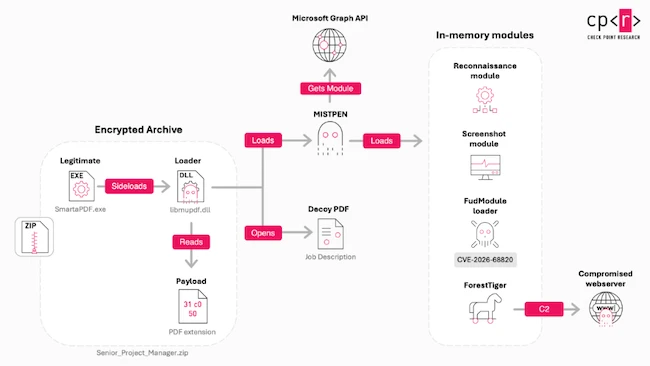
High-level overview of the DLL sideloading infection chain (Source: Check Point)
“When the victim launches the executable, the malicious DLL libmupdf.dll is loaded via DLL sideloading. The DLL extracts a decoy PDF document from the encrypted payload and displays it to the user, while simultaneously extracting, decrypting, and executing an embedded payload directly in memory,” the researchers explained.
The malware then runs MISTPEN, an in-memory downloader that profiles the compromised system and retrieves additional components.
One of those components exploits CVE-2026-68820, a local privilege escalation vulnerability in the Windows AFD.sys driver. Successful exploitation gives the attackers SYSTEM privileges and lets them deploy FudModule, a Lazarus kernel-mode rootkit built to interfere with security monitoring.
Researchers tested the exploit against an updated Windows 11 system and determined that it targeted a previously unknown vulnerability that had been exploited in Operation Dream Job since at least early July.
Check Point reported the vulnerability to Microsoft, which patched it on August 11, 2026, as part of its Patch Tuesday updates.
Trojanized PDF viewer delivers new backdoor
A second infection chain, detected in July, shares characteristics with Operation Dream Job activity documented by ESET in 2025.
In this chain, the attackers sent fraudulent job offers impersonating privacy technology company Enveil and instructed targets to download SecurityPDF, a modified version of an open-source PDF viewer.
When an attacker-prepared PDF is opened with SecurityPDF, the application extracts and executes an embedded payload. The payload installs Troy, a newly documented backdoor that gives the attackers remote access to the compromised system.
The attackers created at least three websites impersonating Enveil to distribute SecurityPDF. Some ranked high in search results, including as the top result for relevant searches, according to Check Point, who found no indication that Enveil itself was targeted or compromised.
“Although we did not directly observe how the threat actor incorporated these websites into the phishing campaign, we assess that they were likely used to separate the delivery of the trojanized PDF viewer from the delivery of the crafted PDF document,” they added.
“In this scenario, victims would first receive the malicious PDF file through a phishing message and later be instructed to download the PDF viewer from what appears to be the vendor’s legitimate website.”
Compromised servers used for attacker traffic
Lazarus also compromised Roundcube webmail and other web servers and used them to relay command-and-control traffic.
Researchers found that several compromised Roundcube servers were running versions vulnerable to CVE-2025-49113. They assess that stolen credentials may have been used to authenticate to the servers before exploiting the vulnerability and deploying RelayShell, a previously undocumented PHP web shell.
Operation Dream Job expands worldwide
The campaign focused primarily on organizations in Western Europe and India, with activity extending to South America.
In at least one case, the attackers compromised an organization headquartered in France and used it to send spear-phishing messages to additional targets.
“The latest Operation Dream Job campaign demonstrates that Lazarus continues to evolve both its malware capabilities and operational tradecraft,” Check Point concluded.
Sandworm hackers target IT professionals
Another state-sponsored threat actor is also after job seekers. Ukraine’s CERT-UA has separately documented a similar tactic used by UAC-0145, a subcluster of the Russian state-linked Sandworm group, also tracked as APT44 and Seashell Blizzard. In that campaign, active since at least May 2026, attackers target system administrators and IT professionals through fake job offers.
Text extracted automatically; images, tables and formatting may be missing. Original: https://www.helpnetsecurity.com/2026/08/12/north-korea-lazarus-fake-job-offers/