New Hacking Group Leaks Configuration of 15,000 Fortinet Firewalls
Vulnerabilities mentionedAll →
| CVE | Vulnerability | CVSS | EPSS | Flags | Affected | Exposure | Published |
|---|---|---|---|---|---|---|---|
| CVE-2022-40684 | Admin-Interface Auth Bypass in Fortinet FortiOS, FortiProxy & FortiSwitchManager Fortinet's FortiOS, FortiProxy, and FortiSwitchManager contain an authentication bypass vulnerability (CWE-288) that lets an unauthenticated remote attacker gain access to the administrative interface. It is triggered by sending specially crafted HTTP or HTTPS requests directly to the admin interface, with no credentials or exploit code required. By bypassing authentication, an attacker can perform administrative operations on the device, such as modifying configuration or creating privileged accounts. Any organization running the affected products is exposed, particularly where the management interface is reachable from the internet. The flaw is being actively exploited: it was added to CISA's Known Exploited Vulnerabilities catalog on 2022-10-11 with known ransomware use, and EPSS assigns it roughly a 100% probability of exploitation within 30 days, although no public PoC is known. Do: Upgrade FortiOS, FortiProxy, and FortiSwitchManager to the fixed releases identified in Fortinet's advisory per the KEV required action. As mitigation, restrict access to the admin interface (e.g., disable WAN-facing management and use local-in policies or allow-lists for management IPs). Review admin logs and device configuration for signs of unauthorized access, such as unexpected admin accounts, added SSH keys, or config changes. | 9.8 | 100% | KEV ransomware PoC ×2 |
| massHundreds of thousands of internet-exposed Fortinet admin interfaces (~300k+ exposed FortiGate/FortiProxy management interfaces observed in public scans around… | |
| CVE-2024-55591 | Unauthenticated Super-Admin Bypass in Fortinet FortiOS and FortiProxy CVE-2024-55591 is an authentication bypass (CWE-288) in the Node.js websocket module of Fortinet FortiOS and FortiProxy that lets a remote, unauthenticated attacker gain super-admin privileges via crafted websocket requests. It affects FortiOS 7.0.0 through 7.0.16 and FortiProxy 7.0.0 through 7.0.19 and 7.2.0 through 7.2.12, and is trivially triggerable from the network with no user interaction given network access to the management/websocket interface. Successful exploitation gives full super-admin control of the appliance, which attackers can use to pivot, create persistent access, and deploy ransomware. Any organization running the affected FortiOS or FortiProxy versions, especially with admin interfaces reachable from the internet, is affected. Exploitation is confirmed in the wild: CISA added it to the Known Exploited Vulnerabilities catalog on 2025-01-14, and multiple ransomware crews (reported as Gunra, SuperBlack, and Mora_001) are actively exploiting it. Do: Upgrade all affected systems beyond the vulnerable ranges — FortiOS later than 7.0.16 and FortiProxy later than 7.0.19 / 7.2.12 — following Fortinet's advisory, or apply the vendor's mitigations where upgrades are not possible (per CISA KEV instructions). Restrict access to the admin/websocket interface from the internet, and hunt for unauthorized super-admin accounts and suspicious websocket connections, since ransomware operators are actively exploiting this flaw. Verify device versions and audit logs for signs of compromise before and after patching. | 9.8 | 98% | KEV ransomware |
| large≈48,000+ internet-exposed Fortinet devices per public scans, out of an installed base in the hundreds of thousands |
Full article677 words · extracted from infosecurity-magazine.com · click to collapse
Written by
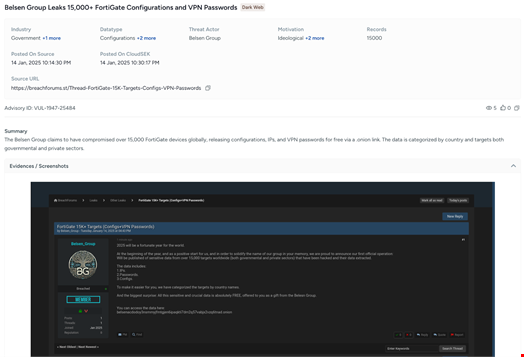
A new threat actor has leaked configuration files and virtual private network (VPN) information for 15,000 firewall devices provided by security vendor Fortinet.
On January 15, Kevin Beaumont, an independent security researcher, revealed on Mastodon that sensitive information from the FortiGate devices had been made available for free on the dark web.
Beaumont said a new hacking group dubbed ‘Belsen Group’ was responsible for the leak.
Security provider CloudSEK confirmed Beaumont’s findings in a new report published on January 16.
The firm said the data dump included FortiGate usernames, passwords (some in plain text), device management digital certificates and firewall rules.
Beaumont and CloudSEK researcher, Koushik Pal, said most exposed devices run Fortigate 7.0.x and 7.2.x versions.
Belsen Group, which first appeared on social media and cybercrime forums in January 2025, has leaked the data on a Tor website.
A CloudSEK spokesperson told Infosecurity that the threat group has likely been around for a couple of years and the exploitation campaign probably occurred in 2022.
“Belsen Group may seem new to the forums, but based on the data leaked by them, we can ascertain with high confidence that they’ve been around for at least three years now. They were likely part of a threat group that exploited a zero-day in 2022, although direct affiliations have not been established yet,” CloudSEK noted in its report.
Beaumont came to the same conclusions in a blog post he published on January 16.
“The data appears to have been assembled in October 2022, as a zero-day vulnerability. For some reason, the data dump of config has been released today, just over two years later,” Beaumont said.
Belsen Group’s Leaked Data Likely Legitimate
Elements in the data dump indicate that at least some of the data leaked by Belsen Group is legitimate, according to Beaumont.
For instance, the researcher said he was able to match up devices’ IP addresses and configurations and observed some exposed devices on the security search engine Shodan.
“I've confirmed one of the usernames and passwords with one of the victims a friend works at. Impacted organizations are going to need to change local SSL VPN passwords, admin passwords etc,” Beaumont added. “It looks like a very serious cyber incident is going to play out.”
Post by @[email protected]
View on Mastodon
A Fortinet Vulnerability Behind the Leak
CloudSEK and Beaumont said the threat group probably exploited a vulnerability disclosed by Fortinet in 2022, CVE-2022-40684.
This flaw is an authentication bypass using an alternate path or channel in Fortinet FortiOS version 7.2.0 through 7.2.1 and 7.0.0 through 7.0.6, FortiProxy version 7.2.0 and version 7.0.0 through 7.0.6 and FortiSwitchManager version 7.2.0 and 7.0.0.
When exploited it allows an unauthenticated attacker to perform operations on the administrative interface via specially crafted HTTP or HTTPS requests.
The US National Vulnerability Database entry for this vulnerability was modified in November 2024 and is awaiting reanalysis by the NVD staff.
New Authentication Bypass Zero-Day in FortiGate
The dark web data leak comes days after Fortinet disclosed a new zero-day vulnerability, CVE-2024-55591.
This zero-day affects FortiGate firewall devices running FortiOS versions 7.0.0 through 7.0.16 and FortiProxy versions 7.0.0 through 7.0.19 and versions 7.2.0 through 7.2.12.
While the new vulnerability is unrelated to the one exploited by the Belsen Group, CloudSEK’s Pal told Infosecurity, the threat actors that exploited the zero-day in 2022 will likely plan on exploiting this vulnerability too, making them imperative to patch.
Pal explained this is because both the CVEs are authentication bypass vulnerabilities of the same kind and can be exploited using an alternate path or channel.
Separately, security provider Arctic Wolf recently revealed a massive exploitation campaign affecting FortiGate firewall devices with management interfaces exposed on the public internet since December 2024.
It is unclear if this campaign is linked to the Belsen Group data dump.
Fortinet and Arctic Wolf have been contacted by Infosecurity for comment but have not responded at the time of publication.
Photo credits: Lutsenko_Oleksandr/T. Schneider/Shutterstock
Text extracted automatically; images, tables and formatting may be missing. Original: https://www.infosecurity-magazine.com/news/hacking-group-leaks-config-15k/