Legit Security extends automated fixes to vulnerable open-source dependencies
Legit Security now uses its agent to patch vulnerable open-source dependencies and open verified pull requests.
Legit Security expanded Agentic Remediation from first-party static-analysis findings to vulnerabilities in open-source dependencies, including transitive packages. The agent identifies the vulnerable package, applies the smallest upgrade that stays in the current major version when possible, updates the lockfile, and re-scans before opening a pull request. When a fix requires a major-version jump, an AI layer proposes repository-specific code adaptations, which the company says are assessed rather than independently verified and are flagged in the pull request.
- Agent now remediates known flaws in direct and transitive open-source dependencies.
- It applies the smallest safe upgrade, regenerates lockfiles, and re-scans.
- Verified fixes ship as pull requests with vulnerability details attached.
- Major-version code adaptations are AI-assessed and flagged for human review.
Full article448 words · extracted from helpnetsecurity.com · click to collapse
Legit Security has announced an expansion of its Agentic Remediation capability to cover vulnerabilities found in open-source dependencies, not just first-party code, enabling development teams to move from vulnerability detection to a verified fix without manual triage.
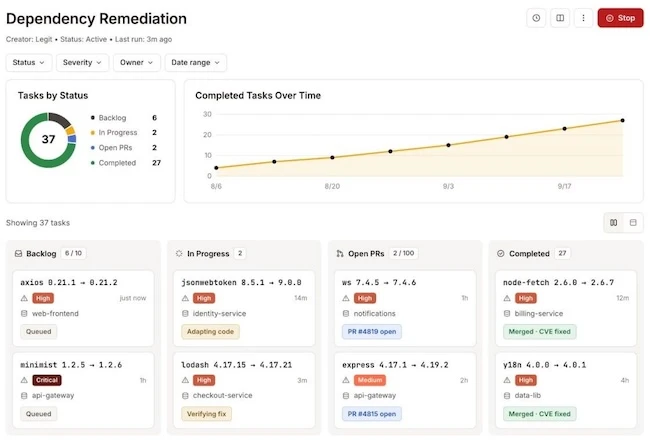
The expansion addresses a growing gap in application security: as AI-generated code accelerates software delivery, most modern codebases are made up largely of open-source dependencies, and every new package introduces potential exposure to known vulnerabilities. Traditional find-it, fix-it AppSec workflows, which rely on human teams working down a backlog, can’t keep pace with that volume, particularly when the vulnerable code isn’t in a company’s own codebase but several layers deep in a third-party package.
Legit’s Agentic Remediation previously focused on fixing static analysis findings in code written by a company’s own engineers. With this release, the same agent now takes on vulnerabilities introduced through dependencies, extending verified remediation to the other major source of vulnerabilities in modern software.
“The real challenge isn’t finding vulnerabilities anymore – it’s getting from finding to fix fast enough,” the company said, noting that AI-generated code has multiplied the volume of software shipping daily while attackers increasingly use AI to find and exploit those vulnerabilities faster than defenders can respond.
How it works
When pointed at a vulnerable dependency, the agent:
- Identifies the dependency – the vulnerable package, its current version, and whether it’s a direct or indirect (transitive) dependency.
- Finds the safest upgrade – the smallest version bump that resolves the issue, staying within the current major version where possible to avoid breaking changes.
- Applies the fix – updates the dependency configuration and regenerates the lockfile, including any other instances of the vulnerable version elsewhere in the dependency tree.
- Verifies the fix – re-scans the dependency before and after the change to confirm the vulnerability is resolved and no new issue was introduced.
- Opens a pull request – delivering a ready-to-review PR with the fix and vulnerability details attached.
Every fix is re-scanned before a PR is opened, so developers receive a change that has already been verified rather than a suggested version to try.
Handling major version upgrades
When a fix requires crossing a major version boundary, where breaking API changes become a risk, the agent adds an AI-assisted analysis layer that evaluates how the specific repository uses the package and proposes the source code adaptations needed, validated against the real repository and package data.
The dependency fix itself is verified through re-scanning, like any other remediation, while the code adaptation for a major version jump is AI-assessed rather than independently verified. The company said the PR flags this distinction explicitly, so developers know what’s been verified and what warrants closer review before merging.