The Spring Dragon APT
Vulnerabilities mentionedAll →
| CVE | Vulnerability | CVSS | EPSS | Flags | Affected | Exposure | Published |
|---|---|---|---|---|---|---|---|
| CVE-2010-2883 | Stack-Based Buffer Overflow in Adobe Acrobat and Reader Allows RCE CVE-2010-2883 is a stack-based buffer overflow (CWE-119) in Adobe Acrobat and Adobe Reader that can be triggered remotely, for example by opening attacker-supplied PDF content. Successful exploitation allows a remote attacker to execute arbitrary code with the privileges of the local user, or to crash the application and cause a denial of service. Anyone running a vulnerable build of Adobe Acrobat or Reader is affected, and this flaw is one of the long-lived 'old Adobe flaws' that malware campaigns have been observed leveraging, as reflected in related reporting on an Asruex Trojan variant and the Spring Dragon APT. Exploitation status is significant for a vulnerability of this age: it is listed in CISA's Known Exploited Vulnerabilities catalog (added 2022-06-08, required action: apply updates per vendor instructions), EPSS assigns an 82.5% probability of exploitation within 30 days (100th percentile), and no public proof-of-concept is currently cataloged; ransomware use is unknown. Do: Apply vendor updates per Adobe's instructions, as required by CISA's KEV listing, and upgrade all Acrobat and Reader installations to a currently patched release. Inventory endpoints for legacy or unsupported Adobe Reader/Acrobat builds and prioritize patching for users who routinely handle untrusted PDFs. Until patched, treat unsolicited PDF attachments with caution and verify sender authenticity; no public PoC is known, but active exploitation is cataloged. | — | 82% | KEV |
| masshundreds of millions of desktop installs (Adobe Reader/Acrobat historically ubiquitous on enterprise and consumer systems) | |
| CVE-2012-0158 | Remote Code Execution in Microsoft MSCOMCTL.OCX (Windows Common Controls) CVE-2012-0158 is a remote code execution flaw in Microsoft's MSCOMCTL.OCX, the Windows Common Controls ActiveX component, where improper handling of crafted input allows memory corruption and code execution. It is typically triggered when an application that uses the control (most commonly Microsoft Office) processes specially crafted content, such as a malicious document or file, meaning a victim usually has to open attacker-supplied content. Successful exploitation lets an attacker run arbitrary code and take complete control of the affected system with the privileges of the current user. Any Windows system carrying a vulnerable copy of MSCOMCTL.OCX — including systems where the control was redistributed by legacy applications — is affected, which makes the potential population very large. Exploitation is confirmed and ongoing: the flaw is in CISA's Known Exploited Vulnerabilities catalog (added 2021-11-03) with known ransomware use, and EPSS assigns it the maximum reported probability of exploitation within 30 days. Do: Apply the Microsoft security update for MSCOMCTL.OCX (per vendor instructions, per CISA's required action) on all systems, prioritizing endpoints and servers that open Office documents. Because exploitation commonly arrives via malicious documents, treat unsolicited Office/RTF attachments with suspicion and verify that applications that redistribute MSCOMCTL.OCX have installed a patched copy. Scan the estate for the presence and version of MSCOMCTL.OCX, especially on legacy Windows/Office installations that may be missed by routine patching. | — | 100% | KEV ransomware |
| masshundreds of millions of Windows systems potentially affected | |
| CVE-2014-6332 | Remote Code Execution via Array Bounds Flaw in Microsoft Windows OLE Automation CVE-2014-6332 is a memory-corruption flaw (CWE-119) in OleAut32.dll, the OLE Automation component shipped with Microsoft Windows, in which OLE automation arrays are mishandled, allowing out-of-bounds memory access. A remote attacker triggers it by luring a user to a crafted website whose script (typically executed through Internet Explorer) calls into the vulnerable OLE Automation code, corrupting memory on the victim machine. Successful exploitation yields remote code execution with the privileges of the logged-on user, generally giving the attacker full control of the workstation. Because OleAut32.dll is a core OS component, essentially every Windows client and server in circulation at the time was affected; Microsoft addressed it in the November 2014 security updates (MS14-064). The flaw is listed in CISA's Known Exploited Vulnerabilities catalog (added 2022-03-25), indicating known in-the-wild exploitation, and EPSS assigns a 95% probability of exploitation within 30 days (100th percentile); no public PoC is tracked in the source data. Do: Apply Microsoft's November 2014 Windows/OLE security updates (MS14-064) across all Windows clients and servers, prioritizing internet-facing systems and workstations used for web browsing, and confirm the patched OleAut32.dll is present via patch-management or vulnerability-scanner checks. Because the flaw is KEV-listed and exploitable in a drive-by web-attack scenario, treat any remaining unpatched Windows host as high risk and isolate legacy systems that cannot be updated. | — | 95% | KEV |
| mass≈1 billion+ Windows installations (OleAut32.dll ships with every Windows client and server) |
Indicators of compromiseauto-extracted · verify before use · export allAll →
| Type | Indicator | Context |
|---|---|---|
| md5 | a42c966e26f3577534d03248551232f3 | veral backdoor components, including an Elise “wincex.dll” (a42c966e26f3577534d03248551232f3, detected as Backdoor.Win32.Agent.delp). It beacons out wit |
| url | http://96.47.234.246/support/flashplayer/install_flashplayer.exe | 2010.net/support/flashplayer/downloads.html → redirected to hxxp://96.47.234.246/support/flashplayer/install_flashplayer.exe (Trojan-Dropper.Win32.Agent.ilbq) While this particular act |
| url | http://www.bkav2010.net/support/flashplayer/downloads.html | and its usual “GET /14111121/page_321111234.html HTTP/1.0”. hxxp://www.bkav2010.net/support/flashplayer/downloads.html → redirected to hxxp://96.47.234.246/support/flashplayer/in |
Full article635 words · extracted from securelist.com · click to collapse



More Intrusion Techniques Rolled In
Let’s examine a couple of interesting delivery techniques from an APT active for the past several years, the Spring Dragon APT. A paper released today by our colleagues at Palo Alto Networks presented a portion of data on this crew under the label “the Lotus Blossom Operation“, likely named for the debug string present in much of the “Elise” codebase since at least 2012: “d:\lstudio\projects\lotus\…”.
The group’s capabilities are more than the much discussed CVE-2012-0158 exploits over the past few years. Instead, the group is known to have employed half day spearphish exploits, strategic web compromises, and watering holes employing fake Flash player update re-directions. The group’s spearphish toolset includes PDF exploits, Adobe Flash Player exploits, and the common CVE-2012-0158 Word exploits including those generated from the infamous “Tran Duy Linh” kit. While ongoing attacks by the Spring Dragon APT take us back to a focus on Vietnam, they appear to have rolled out a steady mix of exploits against defense subcontractors around the world and government related organizations in VN, TW, PH, and other locations over the past few years. Let’s take a quick look at a couple more examples of their intrusion capabilities that haven’t been mentioned elsewhere.
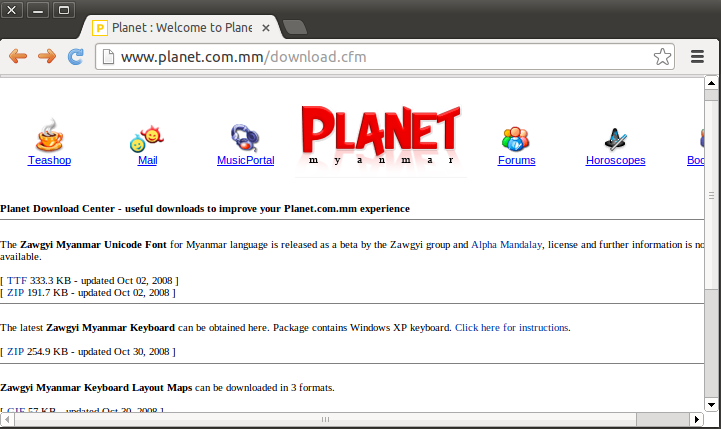
Organizations located in Myanmar and targeted by Spring Dragon have gone unmentioned. But Spring Dragon’s infiltration techniques there were not simply 0158 spearphish, they also compromised sites. In one case, they replaced specialized font installers needed to render Myanma font. You can see an image here of the “Planet Myanmar” website in late 2012 distributing such a package. All of the zip links were redirected to a poisoned installer zip file. The download name was “Zawgyi_Keyboard_L.zip”, and it dropped a “setup.exe” that contained several backdoor components, including an Elise “wincex.dll” (a42c966e26f3577534d03248551232f3, detected as Backdoor.Win32.Agent.delp). It beacons out with the typical Elise GET request “GET /%x/page_%02d%02d%02d%02d.html”, as documented in the Lotus Blossom paper.
Another APT later abused this exact site to deliver malicious VBS (CVE-2014-6332) exploits in November of 2014 with a Lurid variant payload. And that same group also served a malicious PDF exploit (CVE-2010-2883) from this site in June 2012 as “Zawgyi Unicode Keyboard.pdf”. Even earlier than that, they spearphished with that same PDF exploit object later hosted on the website under different file names. In November 2011, they used filenames appropriate for their spearphishing targets with this exploit like “台灣安保協會「亞太區域安全與台海和平」國際研討會邀 請 函_20110907.pdf” (“Taiwan Security Association International Seminar Invitation – the Asia-Pacific regional security and peace in the Taiwan Strait”), “china-central_asia.pdf”, “hydroelectric sector.pdf”, and various governmental related proposals. In this case, there was unexpected overlap from two APT.
Another interesting technique that we observed in use against government targets was a campaign that lured recipients to a site redirecting users to a spoofed Flash installer site.
This site in turn redirected users to a Flash installer bundled with the common Elise backdoor, eventually communicating with 210.175.53.24 and its usual “GET /14111121/page_321111234.html HTTP/1.0”.
hxxp://www.bkav2010.net/support/flashplayer/downloads.html → redirected to
hxxp://96.47.234.246/support/flashplayer/install_flashplayer.exe (Trojan-Dropper.Win32.Agent.ilbq)
While this particular actor effectively used their almost worn out CVE-2012-0158 exploits in the past, Spring Dragon employs more involved and creative intrusive activity as well.
Latest Webinars
Reports
Kaspersky researchers have discovered new Mirage Kitten attacks using previously undocumented malware families: NodeRabbit in Node.js and PollCat in JavaScript.
Our experts discovered a new CoolClient backdoor variant with a kernel-mode rootkit driver that hides malicious processes, files, and network connections from security tools and threat analysts.
Kaspersky experts break down a new Armored Likho campaign that poses as a fundraising efforts and delivers a new Still Toolkit aimed at stealing Telegram data and eavesdropping on victims.
Kaspersky researchers reveal previously undocumented malware attributed to Mirage Kitten (UNC1549, Smoke Sandstorm, Nimbus Manticore): NightLedger backdoor, ArcBridge, and BridgeHead tunneling tools.
Text extracted automatically; images, tables and formatting may be missing. Original: https://securelist.com/the-spring-dragon-apt/70726/