Threat Brief: Atlassian Confluence Remote Code Execution Vulnerability (CVE-2022
Unauthenticated Confluence RCE CVE-2022-26134 was exploited in the wild; Volexity observed intrusions and Cerber ransomware on unpatched servers.
Volexity identified exploitation of CVE-2022-26134, an unauthenticated remote code execution vulnerability in Atlassian Confluence Server and Data Center, during Memorial Day weekend 2022, with Atlassian issuing a patch. Cortex Xpanse found 19,707 potentially affected Confluence instances, concentrated in the US, Germany, China, and Russia, plus 1,251 end-of-life versions exposed. Unit 42 and Cortex Managed Threat Hunting observed successful exploitation leading to reconnaissance commands and a Cerber ransomware deployment that was blocked by Cortex XDR. A public PoC has increased exploitation risk.
- CVE-2022-26134 is unauthenticated RCE allowing auth bypass and arbitrary code execution
- Volexity first observed exploitation over Memorial Day weekend 2022
- Xpanse counted 19,707 potentially vulnerable Confluence servers exposed worldwide
- Successful exploitation led to Cerber ransomware, blocked by Cortex XDR
- Public PoC available; Atlassian patch released and immediate patching advised
Vulnerabilities mentionedAll →
| CVE | Vulnerability | CVSS | EPSS | Flags | Affected | Exposure | Published |
|---|---|---|---|---|---|---|---|
| CVE-2022-26134 | Unauthenticated OGNL Injection RCE in Atlassian Confluence Server/Data Center Atlassian Confluence Server and Data Center contain an unauthenticated remote code execution flaw caused by improper neutralization of expression-language (OGNL) input (CWE-917): an attacker with network access to the application can submit a crafted request that is evaluated as an expression and executed by the server. Successful exploitation lets a remote, unauthenticated attacker run arbitrary code with the privileges of the Confluence process, without any credentials. All organizations running self-managed Confluence Server or Data Center are affected, particularly instances exposed to the internet; Confluence Cloud is not listed among the affected products. Exploitation is confirmed in the wild: the flaw was added to CISA's KEV on 2022-06-02 with ransomware use marked as known, and EPSS assigns a 100% probability of exploitation within 30 days (100th percentile). CVSS has not yet been scored in this data, but the KEV listing and known ransomware use make unpatched, internet-facing instances a top-priority patching target. Do: Immediately upgrade to the patched Confluence release specified in Atlassian's 2022-06-02 security advisory, and until patched follow the CISA required action to block all internet traffic to and from affected instances. Because in-the-wild exploitation and ransomware use are confirmed, also hunt for compromise indicators on both patched and unpatched hosts, such as webshells, unexpected child processes of the Confluence service, and unusual outbound connections. | 9.8 | 100% | KEV ransomware PoC ×2 |
| largetens of thousands of internet-exposed instances (public scan counts of roughly 60,000-90,000 Confluence Server/Data Center hosts around the June 2022… |
Indicators of compromiseauto-extracted · verify before use · export allAll →
| Type | Indicator | Context |
|---|---|---|
| ipv4 | 172.104.31.117 | iginated from the following IP addresses: IoC Type IoC Ipv4 172.104.31.117 Ipv4 191.37.248.120 Ipv4 84.17.48.94 Ipv4 193.106.191.71 Ip |
| ipv4 | 191.37.248.120 | llowing IP addresses: IoC Type IoC Ipv4 172.104.31.117 Ipv4 191.37.248.120 Ipv4 84.17.48.94 Ipv4 193.106.191.71 Ipv4 18.216.140.250 Ip |
| ipv4 | 84.17.48.94 | : IoC Type IoC Ipv4 172.104.31.117 Ipv4 191.37.248.120 Ipv4 84.17.48.94 Ipv4 193.106.191.71 Ipv4 18.216.140.250 Ipv4 18.221.234.103 |
Full article1,124 words · extracted from unit42.paloaltonetworks.com · click to collapse
Executive Summary
On June 2, Volexity reported that over Memorial Day weekend, they identified suspicious activity on two internet-facing servers running Atlassian’s Confluence Server application. After analysis of the compromise, Volexity determined the initial foothold was the result of a remote code execution vulnerability in Confluence Server and Data Center. The details were reported to Atlassian on May 31, and Atlassian has since assigned the issue to CVE-2022-26134.
Based on the security advisory issued by Atlassian, it appears that the exploit is indeed an unauthenticated, remote code execution vulnerability. If the vulnerability is exploited, threat actors could bypass authentication and run arbitrary code on unpatched systems. At the time of publication, the Palo Alto Networks attack surface management solution Cortex Xpanse identified 19,707 instances of Confluence Servers that are potentially affected by this CVE.
A patch resolving the issue has been posted by Atlassian. Palo Alto Networks strongly advises organizations to patch immediately.
Updated June 7 to add additional in-the-wild observations.
| Vulnerabilities Discussed | CVE-2022-26134 |
Vulnerable Systems
The Palo Alto Networks attack surface management solution Cortex Xpanse found 19,707 instances of Confluence Servers that are potentially affected by this CVE. The majority of these instances were discovered to reside within the United States, Germany, China and Russia.
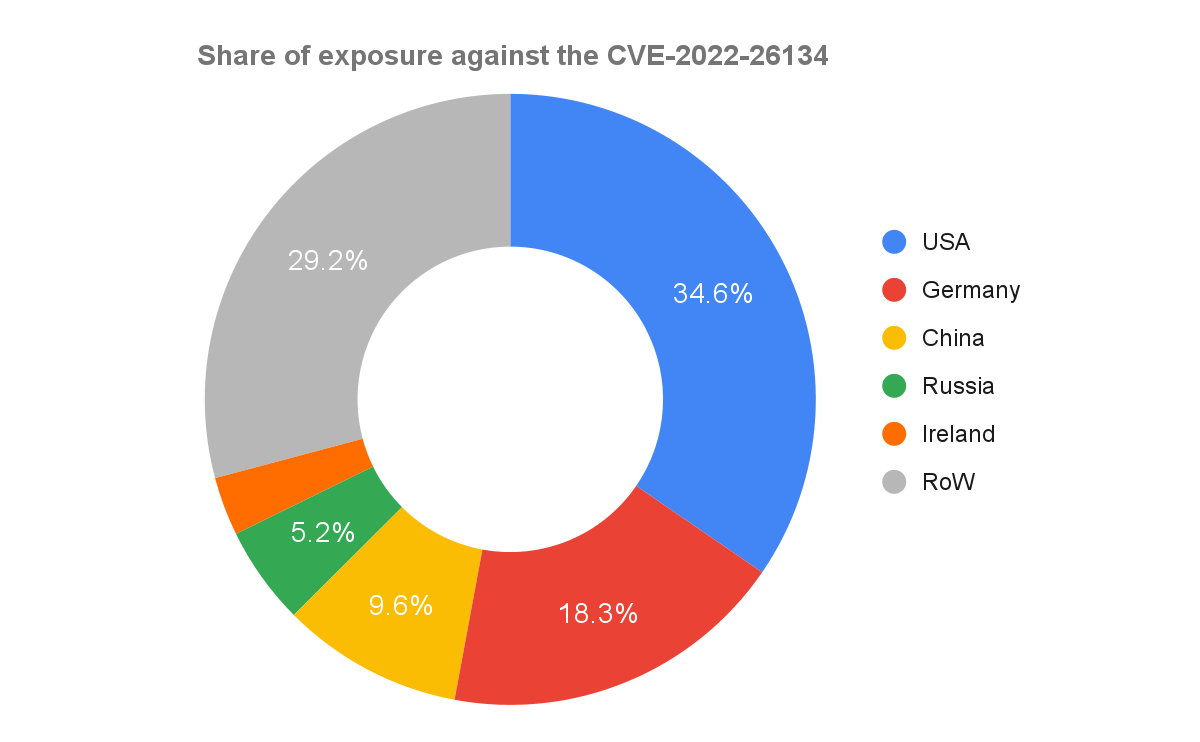
Additionally, the Xpanse research team also found 1,251 end-of-life versions of the Confluence Server exposed on the public internet. Assets running end-of-life software should never be internet-facing. If an asset cannot be updated to secure versions of software, it should be isolated or decommissioned altogether. To learn more about the ubiquitous problem of end-of-life software, please refer to the 2022 Cortex Xpanse Attack Surface Threat Report.
CVE-2022-26134 in the Wild
Thus far, Unit 42 has noted historical scans being performed by the IP addresses publicly shared by Volexity. These scans date back as early as May 26, 2022, and target organizations in various industries.
Additionally, a purported proof of concept (PoC) has reached the public domain, increasing the threat this particular vulnerability poses.
Cortex Managed Threat Hunting Detections of CVE-2022-26134
The Cortex Managed Threat Hunting team has detected several exploitation attempts. Among the attempts, we found successful exploitation, which resulted in the Cerber Ransomware attack.
The ransomware was blocked by the Cortex XDR agent. The Managed Threat Hunting team immediately reported this incident to the customer and continues to monitor our customers using the XQL queries in the following section. Cortex XDR also includes multiple detections for post-exploitation activities.
Below are details of what was seen in the attempt.
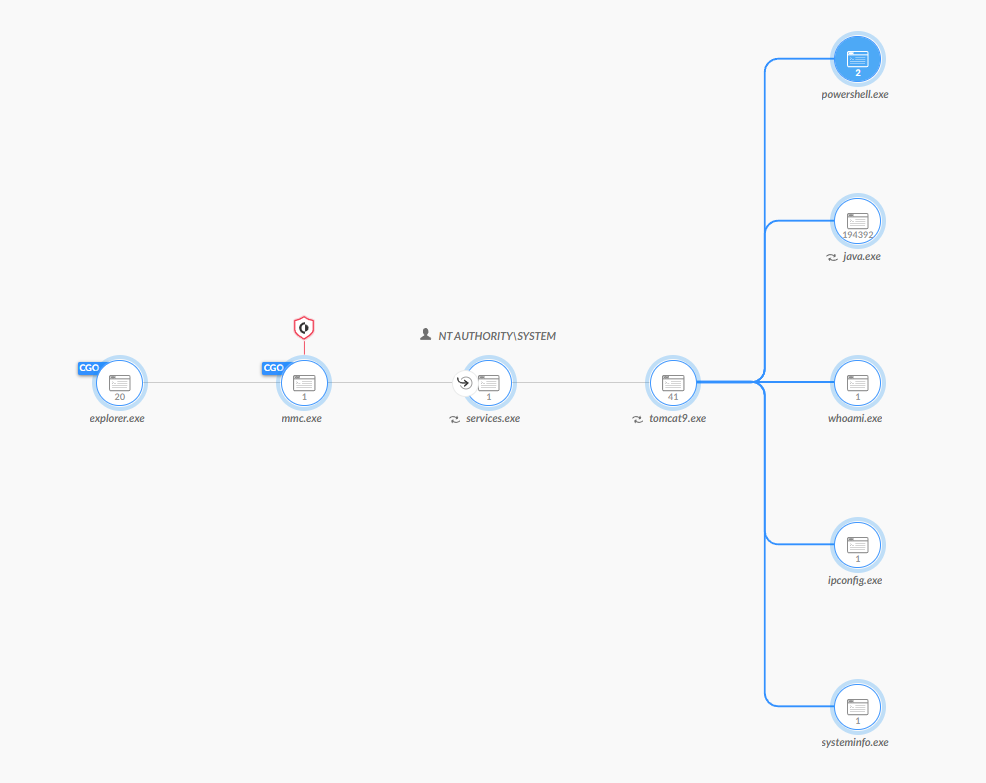
In this case, the process tomcat.exe spawned multiple reconnaissance commands such as: whoami, systeminfo, arp, ipconfig, etc. On top of that, a Base64-encoded PowerShell command was executed and retrieved a ransomware binary.

In order to confirm the assumption that the above activity is related to CVE-2022-26134, we looked into the Confluence Apache access logs (atlassian-confluence.log) and found the PowerShell execution.

Hunting Queries
The Cortex Managed Threat Hunting team continues to track any attempts to exploit CVE-2022-26134 across our customers, using Cortex XDR and the XQL queries below.
|
1 2 3 4 5 6 7 8 9 10 11 12 13 14 15 16 17 18 19 20 21 22 23 24 25 26 27 28 29 30 31 32 33 34 35 36 37 |
// Description: Detect child processes of Atlassian JIRA/Confluence server processes config case_sensitive=false |dataset=xdr_data |filter event_type=PROCESS andevent_sub_type=ENUM.PROCESS_START |filter((actor_process_image_path contains"confluence"oractor_process_image_path contains"jira")and(actor_process_image_path contains"atlassian"oractor_process_image_path contains"tomcat"))or (actor_process_command_line contains"//RS//Confluence"oractor_process_command_line contains"//RS//jira") |filter actor_process_image_path notcontains"desktop-companion" |filter action_process_image_command_line!="bash -c ulimit -u"// False Positive |alter is_suspicious_child_proc=if(action_process_image_name contains"bash"or action_process_image_name contains"python"or action_process_image_name contains"cmd"or action_process_image_name contains"powershell"or action_process_image_name contains"whoami"or action_process_image_name contains"arp"or action_process_image_name contains"ipconfig"or action_process_image_name contains"taskkill"or action_process_image_name contains"systeminfo","true","false") |alter is_child_of_main_tomcat_process=if(actor_process_command_line contains"//RS//Confluence"oractor_process_command_line contains"//RS//jira","true","false") |fields event_type,event_sub_type,agent_hostname,actor_effective_username,actor_process_image_name,actor_process_image_path,actor_process_command_line,is_suspicious_child_proc,is_child_of_main_tomcat_process,action_process_image_name,action_process_image_command_line // Description: Detect Atlassian Confluence CVE-2022-26134 command execution in URI config case_sensitive=false |dataset=panw_ngfw_url_raw |filter uri contains"org.apache.commons.io.IOUtils@toString(@java.lang.Runtime@getRuntime().exec" //Filter out connections from rfc 1918 |alter rfc1918_172=incidr(source_ip,"172.16.0.0/12") |alter rfc1918_10=incidr(source_ip,"10.0.0.0/8") |alter rfc1918_192=incidr(source_ip,"192.168.0.0/16") |filter rfc1918_172=falseANDrfc1918_10=falseANDrfc1918_192=false |fields uri,dest_ip,source_ip |
Conclusion
Palo Alto Networks provides protection against the exploitation of this vulnerability in the following ways:
- Next-Generation Firewalls (PA-Series, VM-Series and CN-Series) or Prisma Access with a Threat Prevention security subscription can automatically block sessions related to this vulnerability using Threat ID 92632 (Application and Threat content update 8577).
- Cortex XDR for Linux helps block CVE-2022-26134 attacks out of the box. Cortex XDR helps protect against post-exploitation activities on all OSes.
- Prisma Cloud Web Application and API Security (WAAS) customers can use the OGNL Evaluation Injectioncustom rule in order to detect and block exploitation attempts.
Additionally, Xpanse has the ability to identify and detect Atlassian Confluence Servers that may be a part of your attack surface or the attack surface of third-party partners connected to your organization. Xpanse is even able to classify those servers which have not been upgraded to the most recent version. These abilities will be updated to detect additional instances or versions that are insecure against this CVE.
Existing Xpanse customers can log into Expander and identify their enumerated Atlassian Confluence devices by filtering by “Atlassian Confluence Server” in the Services tab.
As further information emerges or additional detections and protections are put into place, Palo Alto Networks will update this publication accordingly.
Indicators of Compromise
During the hunting process, we encountered exploitation attempts that originated from the following IP addresses:
| IoC Type | IoC |
| Ipv4 | 172.104.31.117 |
| Ipv4 | 191.37.248.120 |
| Ipv4 | 84.17.48.94 |
| Ipv4 | 193.106.191.71 |
| Ipv4 | 18.216.140.250 |
| Ipv4 | 18.221.234.103 |
| Ipv4 | 89.187.170.129 |
| Ipv4 | 2.56.11.65 |
| Ipv4 | 87.249.135.167 |
| Ipv4 | 192.99.152.200 |
| Ipv4 | 31.13.191.157 |
| Ipv4 | 27.1.1.34 |
| Ipv4 | 167.99.57.116 |
(Table updated Sept. 22, 2022, to remove an IP address that is being used in legitimate scanning.)
Updated Sept. 22, 2022, at 11:30 a.m. PT.
Text extracted automatically; images, tables and formatting may be missing. Original: https://unit42.paloaltonetworks.com/cve-2022-26134-atlassian-code-execution-vulnerability/