Daily Malicious Files Soar 3% in 2023, Kaspersky Finds
Vulnerabilities mentionedAll →
| CVE | Vulnerability | CVSS | EPSS | Flags | Affected | Exposure | Published |
|---|---|---|---|---|---|---|---|
| CVE-2023-23397 | Zero-Click Elevation of Privilege in Microsoft Outlook (Forced NTLM Credential Leak) CVE-2023-23397 is an elevation of privilege vulnerability in Microsoft Outlook caused by improper input validation (CWE-20) combined with authentication bypass via spoofed authentication data on the channel (CWE-294), allowing an attacker to force Outlook to authenticate to an attacker-controlled SMB/WebDAV server. It is triggered when Outlook processes a crafted email or calendar object — for example a meeting or task reminder whose sound property points to an attacker-supplied UNC path — and requires no user interaction. That authentication exchange leaks the victim's NTLM credential hash, which the attacker can crack offline or relay to authenticate as the victim and access resources such as Exchange mailboxes, effectively escalating privileges. Affected software spans Microsoft 365 Apps, Microsoft Office (including the Long Term Servicing Channel), and Microsoft Outlook, which are deployed across enterprises, governments, and militaries worldwide. It is actively exploited in the wild — added to CISA's Known Exploited Vulnerabilities catalog on 2023-03-14 with a 97.4% EPSS — and Microsoft has warned of exploitation by Russia-aligned threat actors in campaigns against government and military mail servers, with patches shipped in Microsoft's March 2023 security updates. Do: Apply Microsoft's March 2023 security updates to Microsoft 365 Apps, Office/LTSC, and Outlook immediately, per CISA's required action. As interim mitigation, enable Extended Protection for Authentication or add accounts to the Protected Users group to block the NTLM credential leak, and audit calendar and task reminder sound properties for UNC paths (Microsoft published an audit/cleanup script for this) while watching for unexpected outbound SMB/WebDAV connections from hosts running Outlook. | 9.8 | 97% | KEV |
| masson the order of hundreds of millions of users (Outlook ships with Microsoft Office/Microsoft 365, the dominant enterprise and government email suite) | |
| CVE-2023-34362 | Unauthenticated SQL Injection in Progress MOVEit Transfer CVE-2023-34362 is an unauthenticated SQL injection flaw (CWE-89) in Progress MOVEit Transfer that allows an attacker with no credentials to gain unauthorized access to the product's database. It is triggered remotely via crafted input submitted to the MOVEit Transfer web application, with the impact varying by the backend database engine in use (MySQL, Microsoft SQL Server, or Azure SQL). A successful attacker can infer the structure and contents of the database and, depending on the engine, execute SQL statements that alter or delete database elements, exposing data handled by the file-transfer service. Any organization running an internet-reachable MOVEit Transfer instance is affected; public internet-exposure scans around disclosure identified on the order of a few thousand servers, each typically serving enterprise or government user bases. Exploitation is confirmed in the wild: the flaw was added to CISA KEV on 2023-06-02 with known ransomware use and an EPSS exploitation probability of 99.9% (100th percentile), while no public PoC is known. Do: Apply the vendor's updates immediately, per Progress instructions and CISA's required action. Until patched, restrict internet exposure of MOVEit Transfer and check the backend database for unexpected structure or content changes and deletions. Because in-the-wild exploitation and ransomware use are confirmed, treat any unpatched, internet-facing instance as potentially compromised and review stored transfer data and access logs for anomalies. | 9.8 | 100% | KEV ransomware PoC |
| large≈2,000-3,000 internet-exposed MOVEit Transfer servers (public internet-exposure scans) | |
| CVE-2023-35036 | In Progress MOVEit Transfer before 2021.0.7 (13.0.7), 2021.1.5 (13.1.5), 2022.0.5 (14.0.5), 2022.1.6 (14.1.6), and 2023.0.2 (15.0.2), SQL injection vulnerabilit In Progress MOVEit Transfer before 2021.0.7 (13.0.7), 2021.1.5 (13.1.5), 2022.0.5 (14.0.5), 2022.1.6 (14.1.6), and 2023.0.2 (15.0.2), SQL injection vulnerabilities have been found in the MOVEit Transfer web application that could allow an unauthenticated attacker to gain unauthorized access to MOVEit Transfer's database. An attacker could submit a crafted payload to a MOVEit Transfer application endpoint that could result in modification and disclosure of MOVEit database content. NVD description · AI analysis pending | 9.1 | 13% |
| — | ||
| CVE-2023-35708 | In Progress MOVEit Transfer before 2021.0.8 (13.0.8), 2021.1.6 (13.1.6), 2022.0.6 (14.0.6), 2022.1.7 (14.1.7), and 2023.0.3 (15.0.3), a SQL injection vulnerabil In Progress MOVEit Transfer before 2021.0.8 (13.0.8), 2021.1.6 (13.1.6), 2022.0.6 (14.0.6), 2022.1.7 (14.1.7), and 2023.0.3 (15.0.3), a SQL injection vulnerability has been identified in the MOVEit Transfer web application that could allow an unauthenticated attacker to gain unauthorized access to MOVEit Transfer's database. An attacker could submit a crafted payload to a MOVEit Transfer application endpoint that could result in modification and disclosure of MOVEit database content. These are fixed versions of the DLL drop-in: 2020.1.10 (12.1.10), 2021.0.8 (13.0.8), 2021.1.6 (13.1.6), 2022.0.6 (14.0.6), 2022.1.7 (14.1.7), and 2023.0.3 (15.0.3). NVD description · AI analysis pending | 9.8 | 97% |
| — |
Full article514 words · extracted from infosecurity-magazine.com · click to collapse
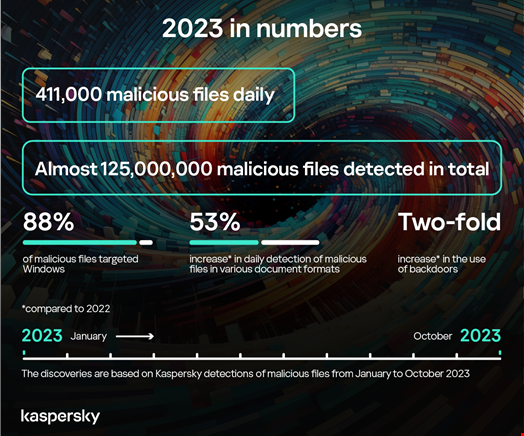
Cybercriminals unleashed an average of 411,000 malicious files every day in 2023, representing a 3% increase from the previous year, according to Kaspersky.
The firm’s Security Bulletin: Statistics of the Year Report, published on December 14, 2023, showed that particular types of threats also escalated.
One example is the use of malicious desktop files (Microsoft Office, PDF…) to spread malware. Out of the 125 million files detected by Kaspersky in 2023, 24,000 were such documents – representing a 53% increase from 2022.
“The growth may be linked to a rise in attacks utilizing phishing PDF files, designed to pilfer data from potential victims,” the report reads.
Uptick in Backdoor Use
Microsoft Windows remained the primary target for cyber-attacks, accounting for 88% of all malware-filled data detected daily. However, the firm observed a few interesting samples of macOS malware, especially in France, China and Italy.
Many of the malicious files targeting macOS systems were disguised as adware.
The most widespread type of malware continues to be Trojans, with a notable uptick in the use of backdoors, registering a growth from 15,000 detected files per day in 2022 to 40,000 in 2023.
“Backdoors stand out as one of the most hazardous types of Trojans, providing attackers with remote control over a victim’s system to carry out tasks such as sending, receiving, executing, and deleting files, as well as harvesting confidential data and logging computer activity,” Kaspersky researchers wrote.
Magniber, WannaCry and Stop/Djvu were among the ten Trojan families most detected by Kaspersky.
Bangladesh, Yemen, and Taiwan were the top three countries most targeted by ransomware Trojans.
Microsoft Office Vulnerabilities Favored
Cybercriminals particularly favored Microsoft Office services’ vulnerabilities. They represented 69.10% of all exploited vulnerabilities.
“The reporting period was remembered for a number of dangerous vulnerabilities in business applications, like CVE-2023-34362, CVE-2023-35036 and CVE-2023-35708 in MOVEit Transfer or CVE-2023-23397 in Microsoft Outlook,” noted the researchers.
Read more: MOVEit Exploitation Fallout Drives Record Ransomware Attacks
LockBit, BlackCat and Clop Most Prolific
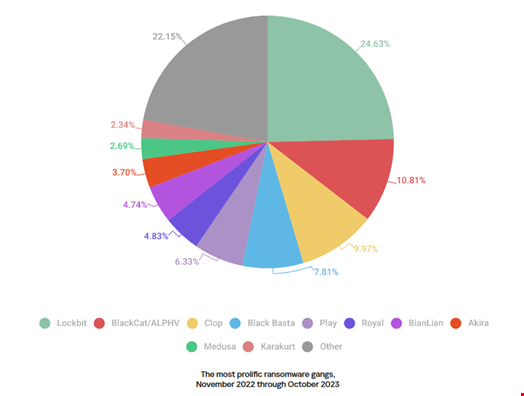
According to Kaspersky’s telemetry, the most prolific ransomware group was LockBit, which claimed a 24.63% share in the total number of victims published on all the groups' data leak sites.
LockBit was followed by ALPHV/BlackCat (10.81%) and Clop (9.97%).
Read more: ALPHV Second Most Prominent Ransomware Strain Before Reported Downtime
Vladimir Kuskov, Head of Anti-Malware Research at Kaspersky, commented: “Adversaries continue to develop new malware, techniques and methods to attack organizations and individuals. The number of vulnerabilities reported is also growing annually, and threat actors, including ransomware gangs, use them without hesitating.”
“Furthermore, the entry barrier into cybercrime is now being lowered due to the proliferation of AI, which attackers use, for example, to create phishing messages with more convincing texts. In these times, it is essential both for large organizations and for every regular user to embrace reliable security solutions.”
All figures in the report, which covers the period from November 2022 through October 2023, come from the Kaspersky Security Network (KSN) global cloud service. Data was obtained from users who had consented to it being sent to KSN.

Text extracted automatically; images, tables and formatting may be missing. Original: https://www.infosecurity-magazine.com/news/daily-malicious-files-soar-3-2023/