Realtek SDK flaw CVE-2021
Vulnerabilities mentionedAll →
| CVE | Vulnerability | CVSS | EPSS | Flags | Affected | Exposure | Published |
|---|---|---|---|---|---|---|---|
| CVE-2021-35394 | Remote Code Execution via Memory Corruption in Realtek Jungle SDK Realtek's Jungle SDK, a software development kit used to build firmware for a wide range of consumer and small-office networking devices (most notably routers), contains multiple memory corruption vulnerabilities that can be triggered remotely over the network; public disclosure tied the flaws to unauthenticated network-facing components bundled with the SDK, such as its UPnP and DHCP handling. An attacker who sends crafted packets to a vulnerable device can corrupt memory and, per the associated weakness types (CWE-78 command injection, CWE-138 improper neutralization), end up executing arbitrary code or operating-system commands with the privileges of the vulnerable service, effectively taking over the device. Because the SDK is licensed into many vendors' products rather than sold as a standalone application, exposure spans numerous router and embedded-device vendors, and end users may not even know their device relies on it. Exact affected SDK version ranges and per-vendor firmware lists were not specified in the available data, so defenders should rely on the latest vendor advisories. The vulnerability was added to CISA's Known Exploited Vulnerabilities catalog on 2021-12-10, indicating confirmed exploitation in the wild; ransomware use is unknown and no public proof-of-concept is flagged in the available data. Do: Per CISA's required action, apply firmware updates per your device vendor's instructions, since patches are distributed by the vendors that build on the SDK rather than by Realtek directly. Identify whether your router or embedded device uses Realtek Jungle SDK-based firmware (check the vendor's model/advisory pages) and prioritize updating internet-facing devices. Where patched firmware is not yet available, restrict direct internet exposure (firewall the WAN side) and disable or limit UPnP/DHCP-related exposed services if the vendor supports doing so, while monitoring vendor advisories. | 9.8 | 100% | KEV PoC |
| mass≈ millions of devices (SDK embedded in consumer router/IoT firmware across many vendors; at least ~100,000 likely internet-exposed) |
Full article494 words · extracted from securityaffairs.com · click to collapse

Experts warn of a spike in the attacks that between August and October 2022 attempted to exploit a Realtek Jungle SDK RCE (CVE-2021-35394).
Palo Alto Networks researchers reported that between August and October 2022 the number of attacks that attempted to exploit a Realtek Jungle SDK RCE (CVE-2021-35394) (CVSS score 9.8) accounted for more than 40% of the total number of attacks.
“Realtek Jungle SDK version v2.x up to v3.4.14B provides a diagnostic tool called ‘MP Daemon’ that is usually compiled as ‘UDPServer’ binary. The binary is affected by multiple memory corruption vulnerabilities and an arbitrary command injection vulnerability that can be exploited by remote unauthenticated attackers.” reads the description for this flaw.
As of December 2022, experts observed 134 million exploit attempts in total leveraging this flaw, and about 97% of these attacks occurred after the start of August 2022.
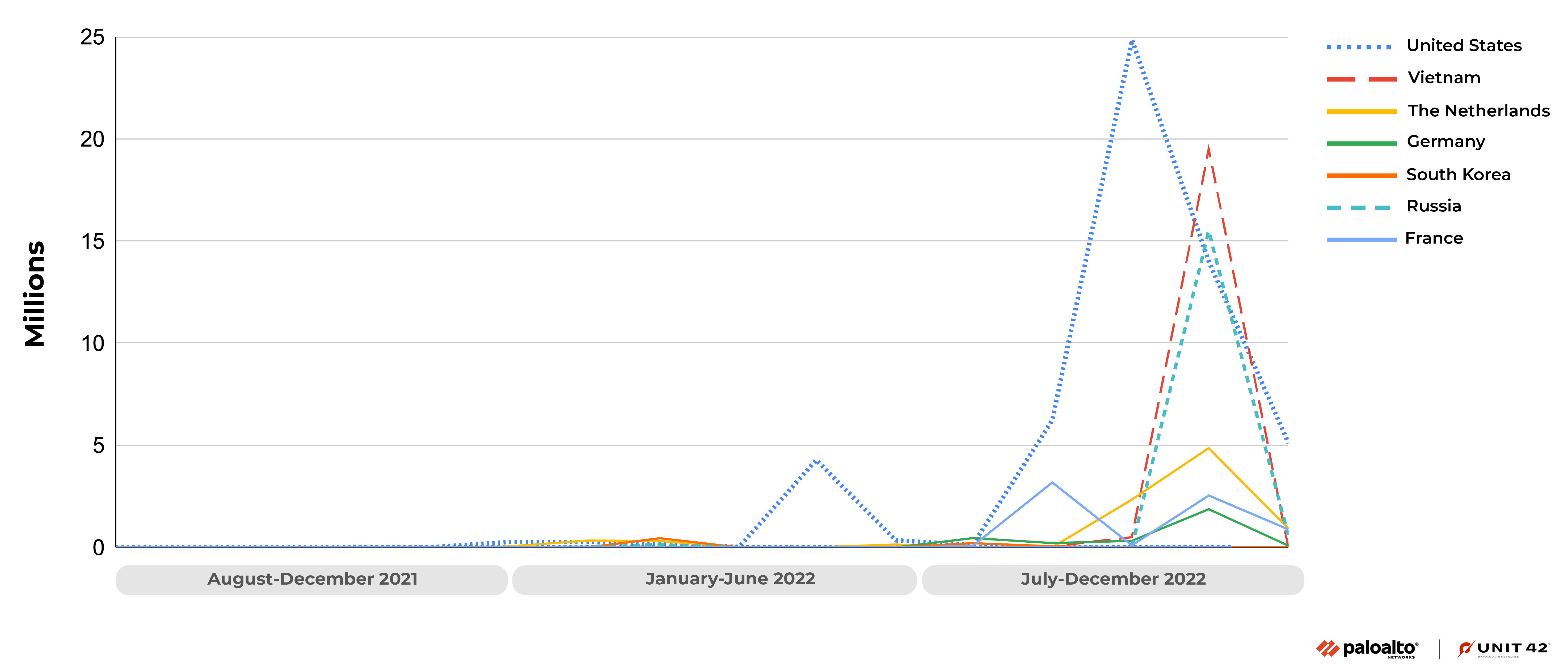
The experts warned that the attacks conducted by multiple threat actors are still ongoing.
A large number of these attacks attempted to deliver malware to vulnerable IoT devices. Most of the malware samples analyzed by the researchers belong to Mirai, Gafgyt and Mozi families. Palo Alto Networks also observed a new distributed IoT denial-of-service (DDoS) botnet developed in Golang, tracked as RedGoBot. The RedGoBot botnet was involved in multiple campaigns, the first one observed in early September 2022, when the threat actor tried to deliver a shell script znet.sh downloader from 185.216.71[.]157 utilizing wget.
A second RedGoBot campaign was observed in November 2022, when the threat actor used a shell script with wget and curl to download the following botnet clients from 185.246.221[.]220.
The RedGoBot can perform DDoS attacks on HTTP, ICMP, TCP, UDP, VSE and OpenVPN protocols.
It has been estimated that the flaw CVE-2021-35394 affects almost 190 models of devices from 66 different manufacturers.
The analysis of the attacks in the wild revealed the use of the following three types of payloads:
- A script executes a shell command on the targeted server (mostly from the Mirai).
- An injected command directly writes the binary payload to a file and then executes it.
- An injected command directly reboots the targeted server to trigger a denial of service condition.
The analysis of the origin of the attacks revealed that the United States is the main source of attacks (48.3% of the total), followed by Vietnam (17.8%) and Russia (14.6%).
However, we have to consider that the attackers might have used proxy servers and VPNs located in those countries to hide their actual physical locations.
“The surge of attacks leveraging CVE-2021-35394 shows that threat actors are very interested in supply chain vulnerabilities, which can be difficult for the average user to identify and remediate. These issues can make it difficult for the affected user to identify the specific downstream products that are being exploited.” concludes the report.
Follow me on Twitter: @securityaffairs and Facebook and Mastodon
| [adrotate banner=”9″] | [adrotate banner=”12″] |
(SecurityAffairs – hacking, CVE-2021-35394)
[adrotate banner=”5″]
[adrotate banner=”13″]
Text extracted automatically; images, tables and formatting may be missing. Original: https://securityaffairs.com/141359/hacking/realtek-sdk-flaw-cve-2021-35394-botnets.html