SOCRadar and Torq announced an integration to automate response to external threat intelligence alerts.
SOCRadar announced an integration with Torq intended to turn external threat intelligence into automated response. The post uses a dark-web credential listing as an example of an alert that otherwise waits in a manual queue for account checks, ticketing, and password rotation. It is a vendor product announcement rather than a report of a specific attack.
SOCRadar and Torq integration aims to automate response to external threat intelligence.
Example scenario is dark-web employee credentials sitting in a manual queue.
This is a product partnership announcement, not an incident.
Turn External Threat Intelligence into Machine-Speed Response with SOCRadar and Torq
Oct 12, 2026
6 Mins Read
Summarize with:
Turn External Threat Intelligence into Machine-Speed Response with SOCRadar and Torq
Your Dark Web monitoring just flagged a set of employee credentials for sale. The alarm is accurate, it is timely, and it is now sitting in a queue. Someone has to read it, confirm the accounts are real, check whether the sessions are active, open a ticket and chase the identity team to rotate the password. By the time that happens, the listing has had buyers for days. The intelligence was fast. Why wasn’t the response?
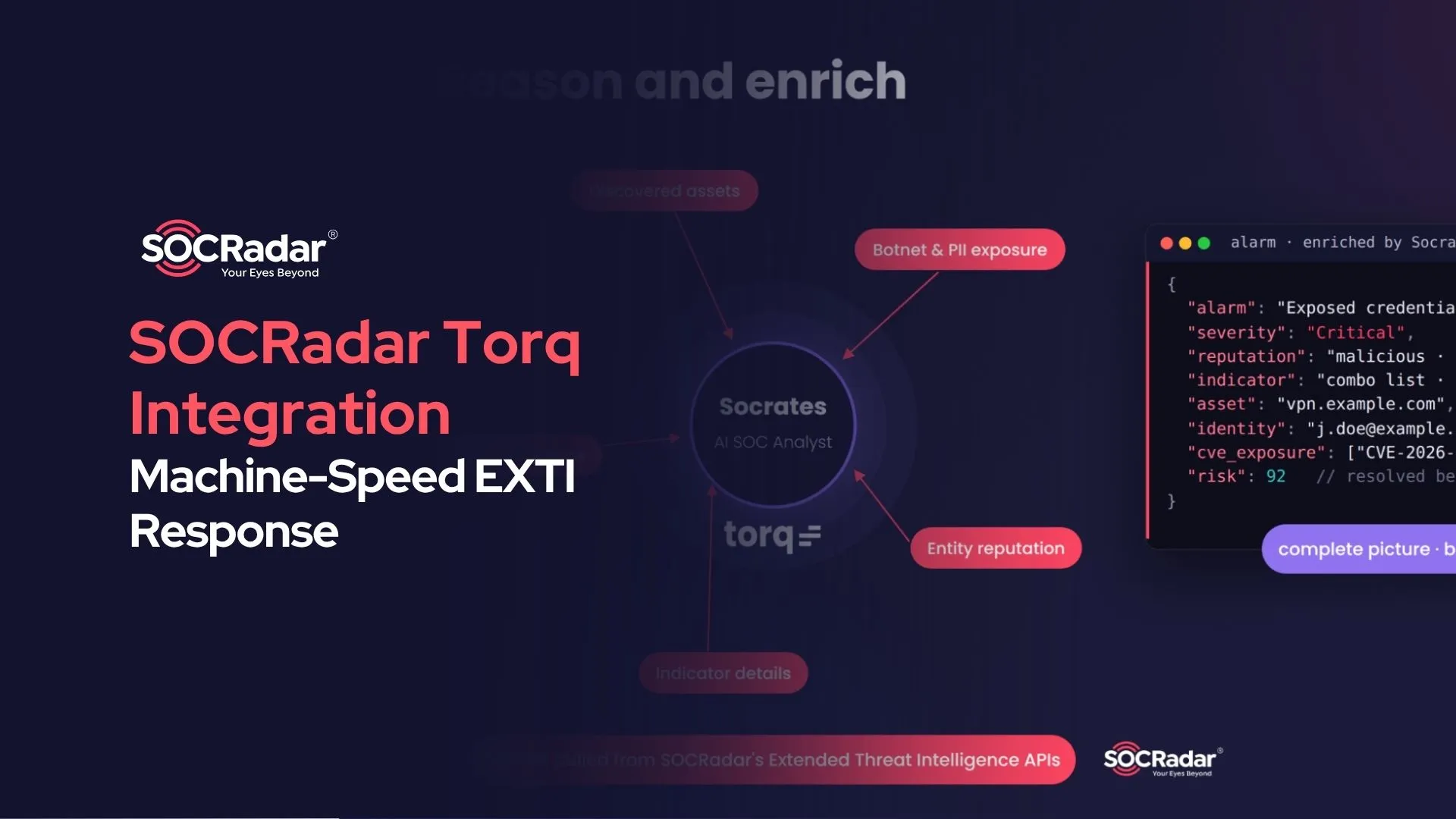
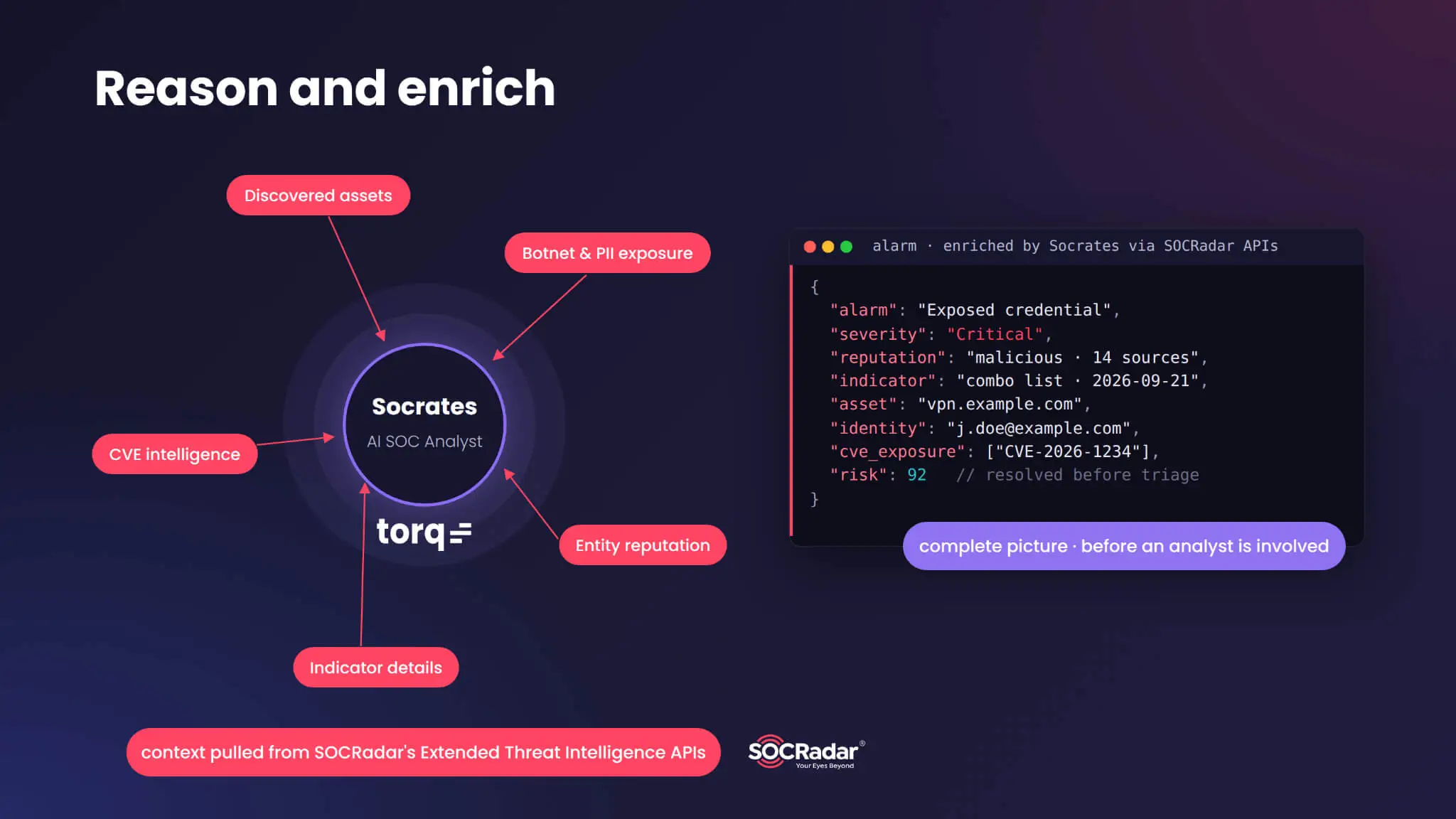
Socrates, Torq’s AI SOC Analyst, enriches every SOCRadar alarm with reputation, indicator, CVE and discovered-asset context before an analyst is involved.
External Threat Intelligence Has an Action Problem
Threat intelligence platforms are good at surfacing what is happening outside the perimeter: exposed credentials, impersonating domains, botnet infections and newly weaponized CVEs that touch real assets. What they hand over is a finding, and a finding still needs a human to decide what it means and what to do about it.
In practice that means an analyst reads the alarm, pivots into two or three other consoles to confirm it matters, and files a ticket for someone else to act on. A leaked credential stays unrotated while it is actively being sold. A phishing domain collects victims for a week before a takedown is requested. Each step is reasonable on its own; together they turn early warning into late response.
Context Is Scattered Across the Stack
The second problem is that the context needed to triage an external alarm rarely lives in one place. Reputation for the indicator is in one tool, the CVE details in another, the question of whether the affected host is actually yours in an asset inventory somewhere else. Your analysts spend their time assembling a picture before they can make a decision, and the picture is often still partial when they do.
The SOCRadar Capability Behind This Integration
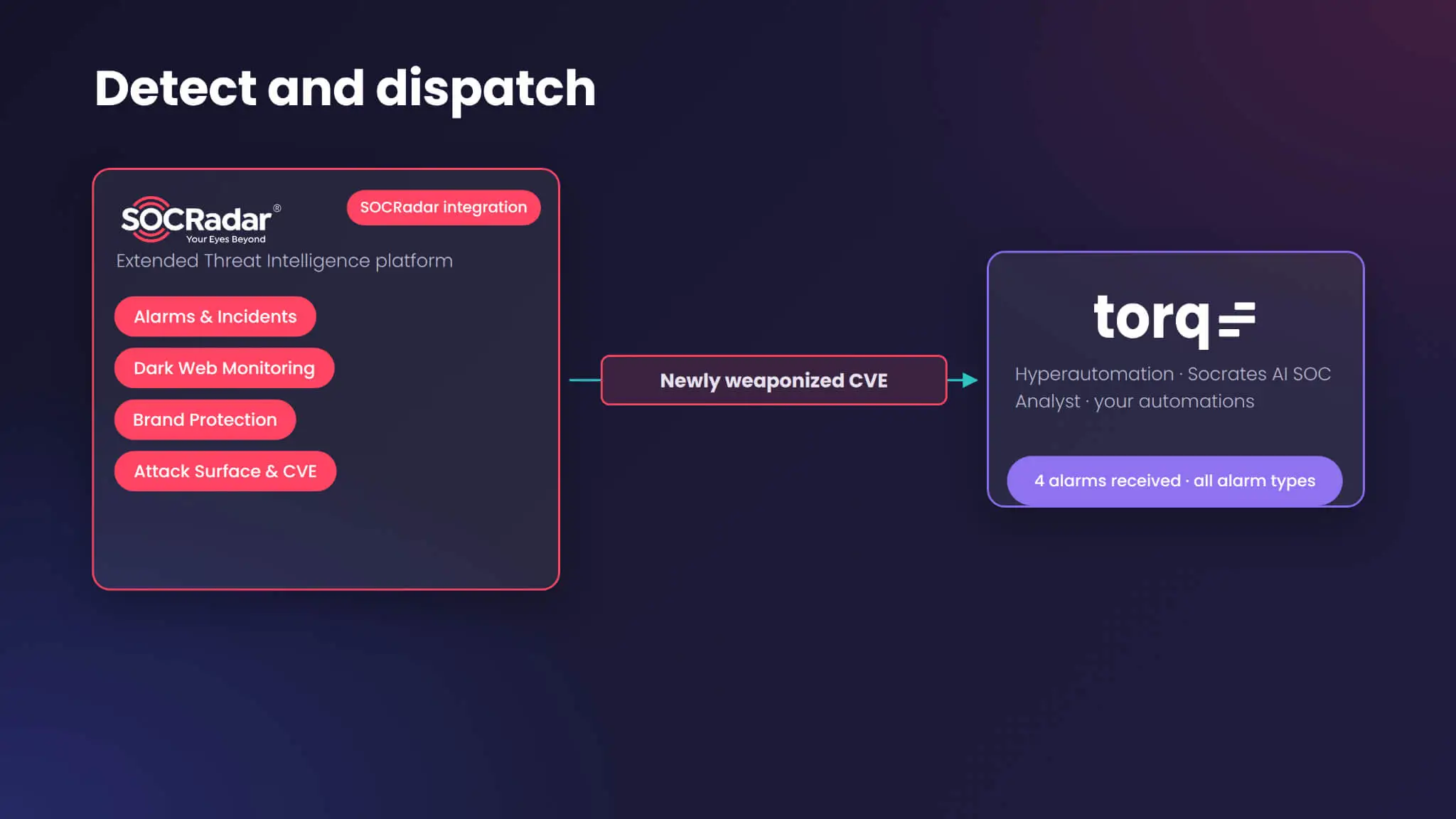
SOCRadar Extended Threat Intelligence continuously monitors the Surface, Deep and Dark Web alongside your organization’s external attack surface, correlating findings into prioritized alarms and incidents. The modules feeding this integration include Cyber Threat Intelligence, Dark Web Monitoring, Brand Protection and External Attack Surface Management. Use cases covered include:
Exposed credentials and PII discovered on Dark Web markets and leak sites
Impersonating domains and brand abuse campaigns
Botnet-infected accounts and devices tied to your organization
Newly disclosed CVEs matched against your discovered external assets
Suspicious indicators that need reputation and context before enforcement
Integration with Torq
SOCRadar correlates Surface, Deep and Dark Web findings into prioritized alarms and pushes them straight into Torq.
The SOCRadar integration is now available in Torq, the AI SOC and hyperautomation platform.
What flows from SOCRadar into Torq: When an alarm or incident fires, SOCRadar pushes it directly into Torq to trigger investigation and response workflows. Every alarm is sent; which cases Torq acts on is defined by the workflows your team configures.
AI-powered enrichment: Inside Torq, Socrates, Torq’s AI SOC Analyst, uses SOCRadar APIs to add entity reputation, indicator details, CVE intelligence and discovered-asset context to the investigation before an analyst is involved. Enrichment capabilities depend on the customer’s SOCRadar API entitlements.
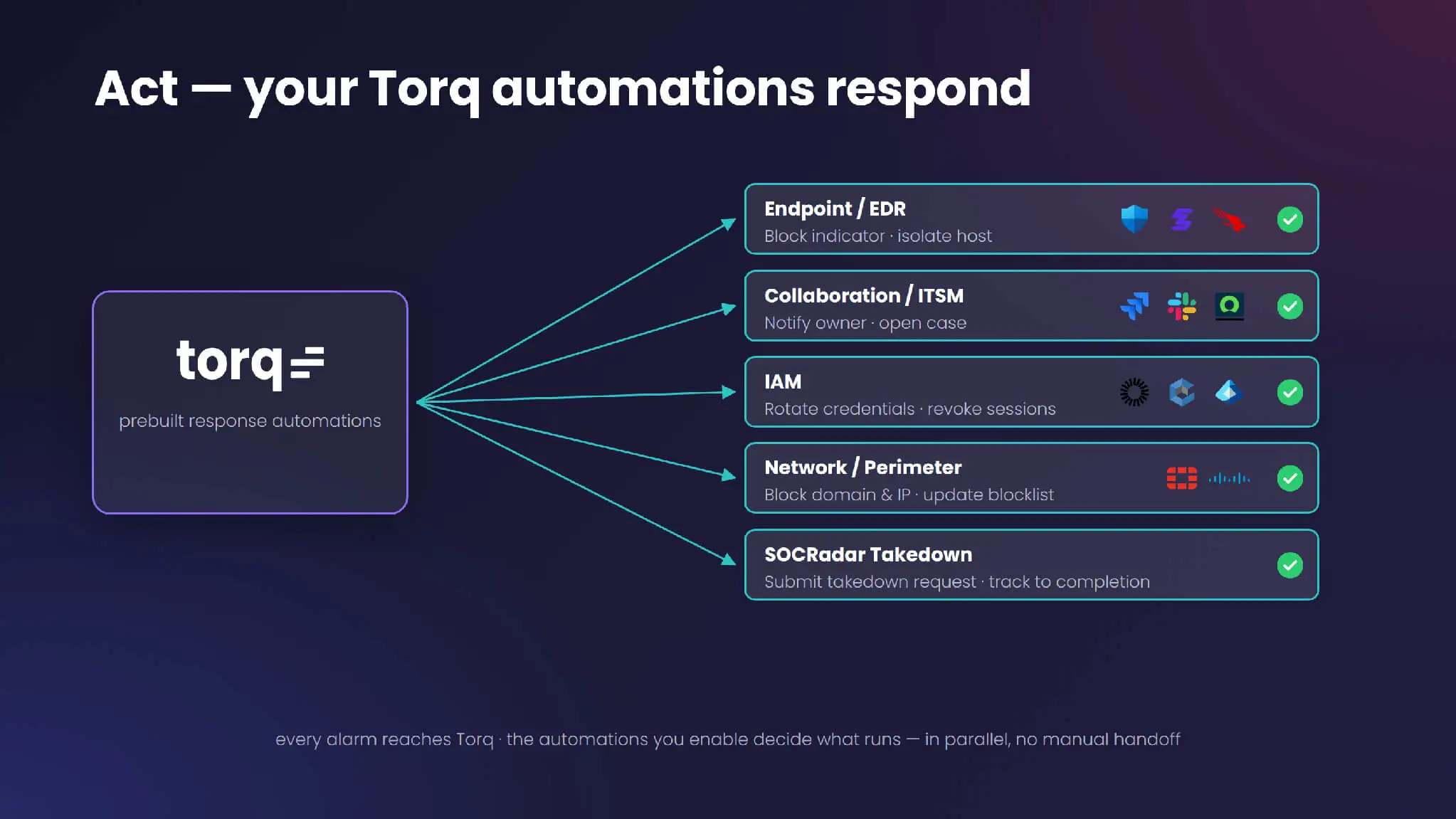
Automated response: Configured Torq workflows then act across the stack: rotate credentials, revoke sessions, block indicators at the endpoint and perimeter, submit takedown requests and open cases, running as independent parallel branches where needed.
Torq workflows act in parallel: rotate credentials, revoke sessions, block indicators, file takedowns, open cases.
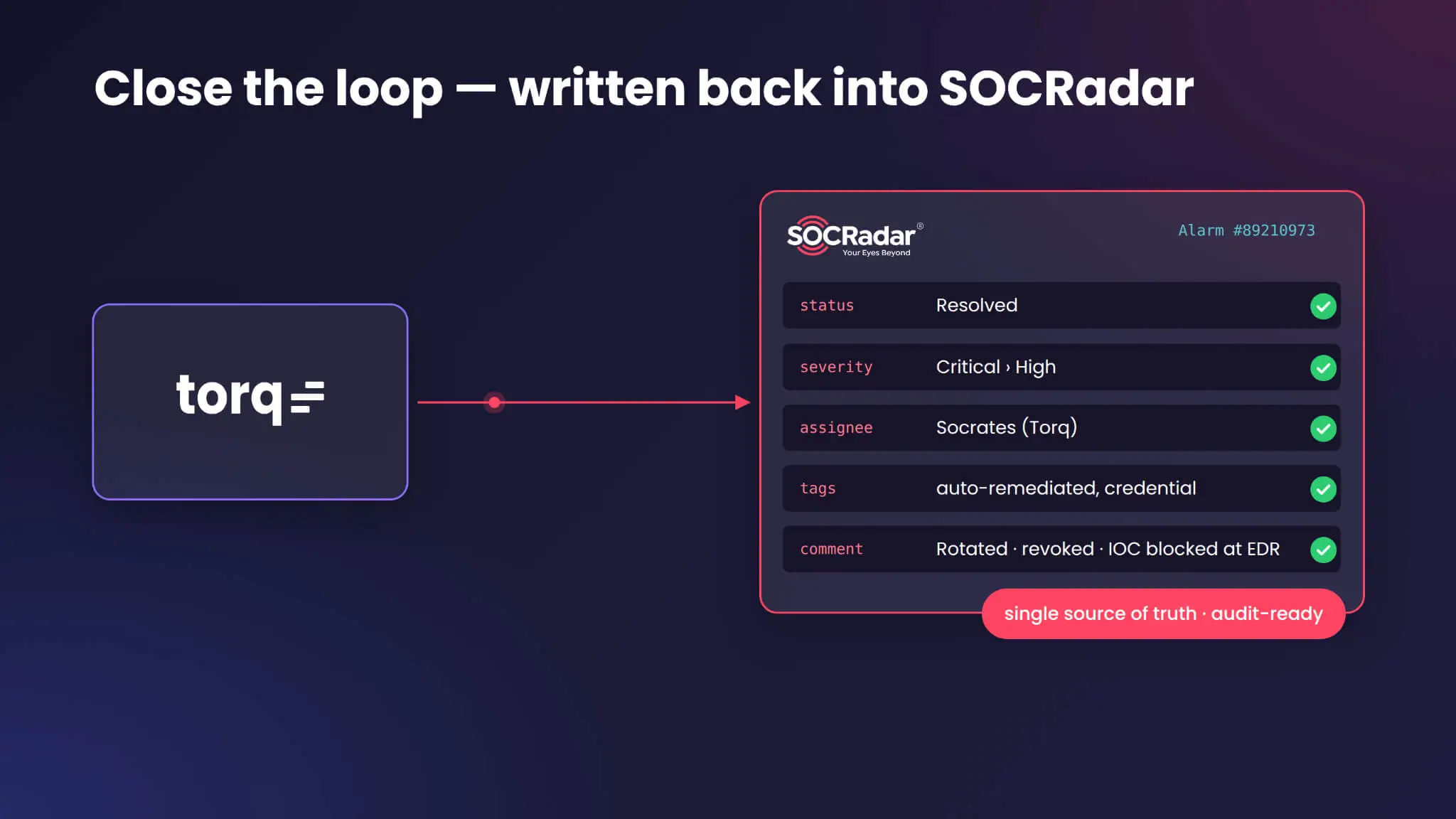
Bidirectional updates: Alarm status, severity, assignee, tags and comments are written back into SOCRadar directly from Torq, so SOCRadar remains the authoritative record of what was found and what was done about it.
Status, severity, assignee, tags and comments are written back into SOCRadar, keeping it the single source of truth.
Key Use Cases
Credential and PII exposure: trigger response workflows for exposed identity data and compromised credentials, rotating credentials and revoking sessions the moment Dark Web monitoring surfaces them
Phishing and brand abuse: validate impersonating domains, initiate takedown workflows and track progress to resolution
Indicator enrichment and blocking: enrich suspicious indicators against reputation intelligence and push verdicts to enforcement points
Vulnerability triage: combine CVE intelligence with discovered-asset context so remediation targets exposed systems first
How It Works in Practice
A SOCRadar alarm fires: a batch of credentials for your domain has appeared on a Dark Web market. The alarm goes straight into Torq. Socrates pulls the entity and indicator context from SOCRadar, cross-references the accounts against your identity provider, and confirms two of them belong to active employees with live sessions.
The workflow branches. One branch forces a password reset and revokes the sessions. Another opens a case and notifies the account owners’ manager. A third updates the SOCRadar alarm: status set to Investigating, assignee set to the on-call responder, a comment recording what was done and when. By the time you open SOCRadar to review the morning’s alarms, this one already shows who handled it and how, and the credentials that were for sale no longer work.
Take the Next Step
For mutual customers, the value is straightforward: SOCRadar supplies validated, prioritized external alarms, and Torq turns them into enriched, automated response while keeping SOCRadar’s record complete and audit-ready.
To get started, enable the SOCRadar integration in Torq and connect it with your SOCRadar API credentials; your SOCRadar customer success manager can confirm which API entitlements your enrichment workflows will need. Not yet a customer of either platform? Request a demo and we will walk through the joint workflow with you.
Frequently Asked Questions
Which SOCRadar alarms are sent to Torq?
SOCRadar pushes every alarm and incident into Torq. The workflows your team configures in Torq define which cases are acted on.
What does Socrates add to a SOCRadar alarm?
Socrates, Torq’s AI SOC Analyst, uses SOCRadar APIs to add entity reputation, indicator details, CVE intelligence and discovered-asset context to the investigation. Available enrichment depends on the customer’s SOCRadar API entitlements.
What does Torq write back to SOCRadar?
Alarm status, severity, assignee, tags and comments, so SOCRadar remains the authoritative record of what was found and what was done about it.
How do I enable the integration?
Enable the SOCRadar integration in Torq and connect it with your SOCRadar API credentials. Your SOCRadar customer success manager can confirm which API entitlements your enrichment workflows need.
PROTECTION OF PERSONAL DATA****COOKIE POLICY FOR THE INTERNET SITE
Protecting your personal data is one of the core principles of our organization, SOCRadar, which operates the internet site (www.socradar.com). This Cookie Usage Policy (“Policy”) explains the types of cookies used and the conditions under which they are used to all website visitors and users.
Cookies are small text files stored on your computer or mobile device by the websites you visit.
Cookies are commonly used to provide you with a personalized experience while using a website, enhance the services offered, and improve your overall browsing experience, contributing to ease of use while navigating a website. If you prefer not to use cookies, you can delete or block them through your browser settings. However, please be aware that this may affect your usage of our website. Unless you change your cookie settings in your browser, we will assume that you accept the use of cookies on this site.
1. WHAT KIND OF DATA IS PROCESSED IN COOKIES?
Cookies on websites collect data related to your browsing and usage preferences on the device you use to visit the site, depending on their type. This data includes information about the pages you access, the services and products you explore, your preferred language choice, and other preferences.
2. WHAT ARE COOKIES AND WHAT ARE THEIR PURPOSES?
Cookies are small text files stored on your device or web server by the websites you visit through your browsers. These small text files, containing your preferred language and other settings, help us remember your preferences on your next visit and assist us in making improvements to our services to enhance your experience on the site. This way, you can have a better and more personalized user experience on your next visit.
The main purposes of using cookies on our Internet Site are as follows:
Improve the functionality and performance of the website to enhance the services provided to you,
Enhance and introduce new features to the Internet Site and customize the provided features based on your preferences,
Ensure legal and commercial security for the Internet Site, yourself, and the Organization, and prevent fraudulent transactions through the Site,
Fulfill legal and contractual obligations, including those arising from Law No. 5651 on the Regulation of Publications on the Internet and the Fight Against Crimes Committed Through These Publications, as well as the Regulation on the Procedures and Principles Regarding the Regulation of Publications on the Internet.
3. TYPES OF COOKIES USED ON OUR INTERNET SITE****3.1. Session Cookies
Session cookies ensure the smooth operation of the internet site during your visit. They are used for purposes such as ensuring the security and continuity of our sites and your visits. Session cookies are temporary cookies and are deleted when you close your browser; they are not permanent.
3.2. Persistent Cookies
These cookies are used to remember your preferences and are stored on your device through browsers. Persistent cookies remain stored on your device even after you close your browser or restart your computer. These cookies are stored in your browser’s subfolders until deleted from your browser’s settings. Some types of persistent cookies can be used to provide personalized recommendations based on your usage purposes.
With persistent cookies, when you revisit our website with the same device, the website checks if a cookie created by our website exists on your device. If so, it is understood that you have visited the site before, and the content to be presented to you is determined accordingly, offering you a better service.
3.3. Mandatory/Technical Cookies
Mandatory cookies are essential for the proper functioning of the visited internet site. The purpose of these cookies is to provide necessary services by ensuring the operation of the site. For example, they allow access to secure sections of the internet site, use of its features, and navigation.
3.4. Analytical Cookies
These cookies gather information about how the website is used, the frequency and number of visits, and show how visitors navigate to the site. The purpose of using these cookies is to improve the operation of the site, increase its performance, and determine general trend directions. They do not contain data that can identify visitors. For example, they show the number of error messages displayed or the most visited pages.
3.5. Functional Cookies
Functional cookies remember the choices made by visitors within the site and recall them during the next visit. The purpose of these cookies is to provide ease of use to visitors. For example, they prevent the need to re-enter the user’s password on each page visited by the site user.
3.6. Targeting/Advertising Cookies
They measure the effectiveness of advertisements shown to visitors and calculate how many times ads are displayed. The purpose of these cookies is to present personalized advertisements to visitors based on their interests.
Similarly, they determine the specific interests of visitors’ navigation and present appropriate content. For example, they prevent the same advertisement from being shown again to the visitor in a short period.
4. HOW TO MANAGE COOKIE PREFERENCES?
To change your preferences regarding the use of cookies, block or delete cookies, you only need to change your browser settings.
Many browsers offer options to accept or reject cookies, only accept certain types of cookies, or receive notifications from the browser when a website requests to store cookies on your device.
Also, it is possible to delete previously saved cookies from your browser.
If you disable or reject cookies, you may need to manually adjust some preferences, and certain features and services on the website may not work properly as we will not be able to recognize and associate with your account. You can change your browser settings by clicking on the relevant link from the table below.
5. EFFECTIVE DATE OF THE INTERNET SITE PRIVACY POLICY
The Internet Site Privacy Policy is dated The effective date of the Policy will be updated if the entire Policy or specific sections are renewed. The Privacy Policy is published on the Organization’s website (www.socradar.com) and made accessible to relevant individuals upon request.
SOCRadar
Address: 651 N Broad St, Suite 205 Middletown, DE 19709 USA
Phone: +1 (571) 249-4598
Email: info@socradar.io
Website: www.socradar.com


 Extended Threat Intelligence Threat intelligence enriched with External Attack Surface Management, Brand Protection, and Dark Web Radar. Explore XTIAgentic Threat Intelligence Stay ahead of cybercriminals with AI agents that autonomously think, adapt, and act. Explore ATI Advanced Dark Web Monitoring
 Dark Web Report