New Ransomware Group BianLian Activity Exploding
Vulnerabilities mentionedAll →
| CVE | Vulnerability | CVSS | EPSS | Flags | Affected | Exposure | Published |
|---|---|---|---|---|---|---|---|
| CVE-2021-31207 | Security feature bypass in Microsoft Exchange Server (ProxyShell) enables webshell RCE CVE-2021-31207 is a security feature bypass in Microsoft Exchange Server, classified as an unrestricted file-write issue (CWE-434) that lets an attacker bypass intended restrictions and write files of their choosing to the server. It is the final bug in the ProxyShell chain: chained with the autodiscover SSRF and PowerShell backend elevation flaws, it allows an unauthenticated attacker to reach the Exchange PowerShell API, write arbitrary files such as an ASPX webshell, and execute code with SYSTEM privileges. A successful attacker gains full control of the on-premises Exchange server, including mailbox access, stolen credentials, and a foothold for lateral movement; the bug has been used to deploy ransomware and keyloggers. On-premises deployments of Microsoft Exchange Server (2013, 2016, and 2019 per vendor advisories) are affected, while Exchange Online/cloud mailboxes are not. Exploitation is essentially certain and ongoing: the flaw is in CISA's KEV (added 2021-11-03) with known ransomware use, public ProxyShell PoC/exploit code is available, and EPSS puts the 30-day exploitation probability at 99.8%. Do: Apply Microsoft's July 2021 security updates for Exchange Server 2013, 2016, and 2019 (or any later security/cumulative update) per vendor instructions, and restrict untrusted access to Exchange's autodiscover and PowerShell endpoints. Hunt for ASPX webshells under the Exchange FrontEnd directories and review IIS logs for autodiscover.json requests chaining PowerShell, since many servers were compromised before patching. Given known ransomware use and KEV listing, treat any server that was unpatched or internet-exposed during the exploitation window as potentially compromised. | 6.6 | 100% | KEV ransomware PoC |
| massHundreds of thousands of on-premises Exchange servers (public scans around the July 2021 ProxyShell disclosure showed roughly 400,000-600,000 internet-exposed… | |
| CVE-2021-34473 +1 in the same advisory: …34523 | SSRF (CWE-918) in Microsoft Exchange Server Enabling RCE (ProxyShell) Microsoft Exchange Server contains a server-side request forgery (SSRF, CWE-918) in the Autodiscover service that unauthenticated remote attackers can reach over HTTP. This flaw is the first stage of the widely documented 'ProxyShell' chain, in which the SSRF is combined with privilege escalation and an arbitrary file write in the Exchange PowerShell backend to achieve unauthenticated remote code execution on the server. An attacker who successfully exploits it gains the ability to run code on the Exchange server, and ransomware operators (e.g., Cuba ransomware) leveraged this chain to deploy payloads. Organizations running on-premises Microsoft Exchange Server (2013, 2016, and 2019 per the vendor's advisories) are affected; hosted Exchange Online is a separately managed cloud service. Exploitation is confirmed in the wild: CISA added the flaw to the KEV catalog on 2021-11-03 with known ransomware use, and EPSS assigns it a 100% probability of exploitation within 30 days (100th percentile). Do: Apply Microsoft's July 2021 (or later) Exchange Server security updates, which include the ProxyShell fixes, to all on-premises servers. If patching is delayed, restrict internet access to the Autodiscover/EWS frontend endpoints and consider the URL Rewrite mitigation Microsoft published for ProxyShell. Given the KEV listing and known ransomware use, treat internet-facing, unpatched Exchange servers as potentially compromised and hunt for webshells, unusual Exchange processes, and suspicious account or mailbox activity. | 9.1 group max | 100% | KEV ransomware PoC |
| masshundreds of thousands of on-prem Exchange servers; public internet scans at the time of disclosure showed roughly 400,000+ internet-exposed Exchange instances,… |
Indicators of compromiseauto-extracted · verify before use · export allAll →
| Type | Indicator | Context |
|---|---|---|
| sha256 | eaf5e26c5e73f3db82cd07ea45e4d244ccb3ec3397ab5263a1a74add7bbcb6e2 | em,” warns the advisory . A BianLian x64 ransomware sample: eaf5e26c5e73f3db82cd07ea45e4d244ccb3ec3397ab5263a1a74add7bbcb6e2 So it is another Go ransomware. 😂 "jack/Projects/project1/ |
Full article461 words · extracted from infosecurity-magazine.com · click to collapse
Written by
A new ransomware group operating under the name BianLian emerged in late 2021 and has become increasingly active since.
The threat actor already has twenty alleged victims across several industries (insurance, medicine, law and engineering), according to a research paper from US cybersecurity firm Redacted, published on September 1, 2022.
The majority of the victim organizations have been based in Australia, North America and the UK.
The research team has given no attribution yet but believes the threat actor “represents a group of individuals who are very skilled in network penetration but are relatively new to the extortion/ransomware business.”
BianLian uses a custom toolkit, including homemade encryptors and encryption backdoors. Both, as well as the command-and-control (C&C) software the hackers use, are written in Go, an increasingly popular programming language among ransomware threat actors.
Troublingly, the Redacted team of researchers has found evidence that BianLian is likely now trying to up their game.
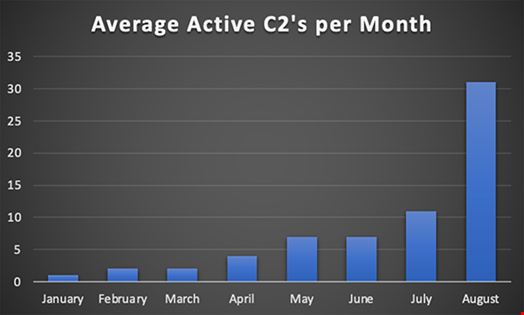
“Starting in August, we observed what appeared to be a somewhat troubling explosion in the rate by which BianLian was bringing new [C&C] servers online. […] While we lack the insight to know the exact cause for this sudden explosion in growth, this may signal that they are ready to increase their operational tempo, though whatever the reason, there is little good that comes from a ransomware operator having more resources available to them,” warns the advisory.
A BianLian x64 ransomware sample: eaf5e26c5e73f3db82cd07ea45e4d244ccb3ec3397ab5263a1a74add7bbcb6e2
— MalwareHunterTeam (@malwrhunterteam) August 11, 2022
So it is another Go ransomware.
😂
"jack/Projects/project1/crypt28" pic.twitter.com/5mb8GScvGO
To gain initial access into victim networks, BianLian typically targets the ProxyShell vulnerability chain (CVE-2021-34473, CVE-2021-34523, CVE-2021-31207), unpatched SonicWall VPN devices, or servers that provide remote network access via solutions such as Remote Desktop,
“After exploitation, they deployed either a webshell or a lightweight remote access solution such as ngrok as the follow-on payload,” the research paper reads.
Once in the network, BianLian can take up to six weeks to start the encryption process.
“As BianLian would initially spread throughout a network, hunting for the most valuable data to steal and identify the most critical machines to encrypt, they appeared to take steps to minimize observable events, [using] living off the land (LOL) methodology to move laterally,” said Redacted.
This faculty to quickly adapt is another sign that BianLian members have a high skill level in network penetration.
“Even in the final hours prior to encryption, we observed the actor taking care to avoid detection, […] and aggressively work[ing] to counter endpoint detection & response (EDR) protections,” the advisory said.
Redacted recommended a layered approach to mitigating the threat posed by ransomware actors such as BianLian.
What’s Hot on Infosecurity Magazine?
Text extracted automatically; images, tables and formatting may be missing. Original: https://www.infosecurity-magazine.com/news/new-ransomware-group-bianlian/