Vulnerability landscape analysis for Q1 2025
Vulnerabilities mentionedAll →
| CVE | Vulnerability | CVSS | EPSS | Flags | Affected | Exposure | Published |
|---|---|---|---|---|---|---|---|
| CVE-2017-0199 | Remote Code Execution in Microsoft Office and WordPad via crafted document files CVE-2017-0199 is a remote code execution vulnerability in Microsoft Office and WordPad that stems from improper parsing of specially crafted files. Attackers trigger it by getting a user to open a malicious document, after which attacker-controlled code executes with the privileges of the logged-in user. Anyone running the affected Microsoft Office or WordPad software is exposed, and CISA notes the flaw has been leveraged in ransomware campaigns; no CVSS score is available in the source data. The flaw was added to CISA's Known Exploited Vulnerabilities catalog on 2021-11-03, and EPSS assigns a 99.9% probability of exploitation within 30 days (100th percentile), indicating active, ongoing exploitation. Do: Apply Microsoft's security updates for Office and Windows per vendor instructions, as required by CISA's KEV catalog; the flaw was publicly reported as fixed in Microsoft's April 2017 security updates. Until patched, treat unsolicited Office documents and email attachments as high-risk, since exploitation requires a user to open a crafted file. Verify that all Office and WordPad installations across the estate—especially endpoints that handle untrusted documents—have received the update. | 7.8 | 100% | KEV ransomware PoC ×6 |
| masshundreds of millions of Office installations worldwide (exact count unknown) | |
| CVE-2017-11882 | Memory Corruption RCE in Microsoft Office via Legacy Equation Editor CVE-2017-11882 is a memory corruption vulnerability (CWE-119) in Microsoft Office, residing in the legacy Microsoft Equation Editor component (EQNEDT32.EXE), that allows remote code execution in the context of the current user. Attackers trigger it by persuading a user to open a crafted document, most commonly an RTF file or other Office document carrying a malicious embedded equation object, which overflows a buffer while the equation content is parsed. Successful exploitation lets the attacker run arbitrary code with the privileges of the signed-in user, a typical foothold for malware delivery and, per CISA, for ransomware operations. Any environment running affected Microsoft Office builds is exposed; the source data does not enumerate specific affected version ranges. The flaw is confirmed exploited in the wild: it was added to the CISA Known Exploited Vulnerabilities catalog on 2021-11-03 with known ransomware use and holds a 99.9% EPSS score (percentile 100), though the source data lists no public PoC. Do: Apply Microsoft's Office security updates (November 2017 or later) across all endpoints, prioritizing this KEV-listed flaw given its known ransomware use. On systems that cannot yet be patched, disable or unregister the legacy Equation Editor (EQNEDT32.EXE) and consider blocking or warning on RTF attachments as interim mitigations. Check for indicators of abuse such as EQNEDT32.EXE spawning unexpected child processes after document opens. | 7.8 | 100% | KEV ransomware PoC ×10 |
| masshundreds of millions of users/installations (Office is near-ubiquitous on Windows and in enterprises; the share still unpatched is unknown) | |
| CVE-2018-0802 | Memory Corruption RCE in Microsoft Office Equation Editor A memory-corruption flaw (out-of-bounds write, CWE-787) in the legacy Equation Editor component (EQNEDT32.EXE) shipped with Microsoft Office 2007, 2010, 2013, and 2016 allows remote code execution due to improper handling of objects in memory. An attacker triggers it by persuading a user to open a specially crafted document (for example an RTF or DOCX containing a malformed embedded equation object), causing the Equation Editor process to corrupt memory when the file is opened in Word; the user-interaction requirement is reflected in the CVSS 3.1 vector (AV:L/UI:R). Successful exploitation gives the attacker code execution in the context of the current user, with high impact on confidentiality, integrity, and availability (CVSS 3.1 score 7.8, High). Any user of the affected Office versions, the Office Compatibility Pack, or Word on an unpatched system is affected. Exploitation is confirmed in the wild: the flaw is in CISA's Known Exploited Vulnerabilities catalog (added 2021-11-03) with known ransomware use, carries a 93.3% EPSS probability of exploitation within 30 days, and multiple public analyses and proof-of-concepts exist. Do: Apply Microsoft's January 2018 security updates for Office 2007, 2010, 2013, and 2016 and the Office Compatibility Pack, and verify the legacy Equation Editor executable (EQNEDT32.EXE) on endpoints has been patched or removed (Microsoft later retired the component). Because the flaw is exploited in the wild and used in ransomware campaigns, prioritize remediation per CISA KEV required action and hunt for Word spawning EQNEDT32.EXE or unexpected child processes when documents are opened. Until patched, open untrusted documents in Protected View and treat email-delivered RTF/DOCX attachments as untrusted. | 7.8 | 93% | KEV ransomware PoC ×3 |
| masshundreds of millions of Office users at time of disclosure (vulnerable Equation Editor shipped by default with Office 2007-2016); largely patched today, with… | |
| CVE-2019-13272 | Local Privilege Escalation to Root in Linux Kernel ptrace (pkexec PTRACE_TRACEME) CVE-2019-13272 is an improper privilege management flaw in the Linux kernel's ptrace_link function (kernel/ptrace.c), present in kernels before 5.1.17, in which the credentials of a process requesting a ptrace relationship are mishandled. A local attacker triggers it by stepping into a parent-child process chain where a privileged parent drops privileges and calls execve, typically by abusing Polkit's pkexec helper with PTRACE_TRACEME; contributing factors include an object lifetime issue and incorrect marking of the ptrace relationship as privileged. Successful exploitation grants the attacker full root-level privileges on the host, and the object lifetime bug can in some cases cause a system panic. Any Linux system running an unpatched kernel is affected, spanning the upstream kernel and distributions such as Debian, Fedora, Ubuntu, Red Hat Enterprise Linux and its variants, as well as NetApp AFF A700s firmware. The flaw is in CISA's Known Exploited Vulnerabilities catalog (added 2021-12-10), has multiple public proof-of-concept exploits, and carries a high exploitation probability (EPSS ~52%), so defenders should treat it as an active exploitation risk. Do: Upgrade the Linux kernel to 5.1.17 or later, or install the backported kernel update from your distribution (Debian, Ubuntu, Fedora, Red Hat) and NetApp's fixed firmware for AFF A700s, per CISA's required action to apply vendor updates. Where patching is delayed, SELinux with deny_ptrace may serve as a usable mitigation in some environments. Prioritize hosts that expose local shells to untrusted users and that have Polkit's pkexec installed, and verify the running kernel version (not just the installed package) on each system. | 7.8 | 52% | KEV PoC ×5 |
| masstens of millions of installations (Linux hosts on unpatched kernels across servers, cloud instances, desktops and embedded devices) | |
| CVE-2021-3156 | Heap-Based Buffer Overflow in Sudo Enables Local Privilege Escalation (CVE-2021-3156) CVE-2021-3156 is an off-by-one error (CWE-193) in the Unix Sudo utility that causes a heap-based buffer overflow (CWE-122) in Sudo's handling of command-line arguments. It is triggered locally when an unprivileged user invokes Sudo with specially crafted arguments, requiring no special privileges or non-default configuration. A successful exploit allows the attacker to execute arbitrary code as root, achieving full local privilege escalation on the host. Any Linux, Unix, or other system running a vulnerable version of Sudo is affected, and because Sudo ships by default on virtually all such systems the potential footprint is enormous. The flaw is listed in CISA's Known Exploited Vulnerabilities catalog (added 2022-04-06) and carries a 100% EPSS probability of exploitation within 30 days, indicating active in-the-wild exploitation, though specific ransomware use is unknown. Do: Upgrade Sudo to a patched release (1.9.5p2 or later, or the vendor-supplied update for your distribution) per vendor instructions, as required by the CISA KEV listing. Audit all Unix-like hosts by checking the installed Sudo version through your package manager and prioritize patching multi-user and internet-facing servers. Restricting local shell access and monitoring for anomalous Sudo invocations can reduce risk while patching completes. | 7.8 | 100% | KEV PoC ×12 |
| masstens of millions of Linux/Unix servers, workstations and devices (Sudo is preinstalled on virtually all Linux distributions) | |
| CVE-2022-0847 | Local Privilege Escalation ('Dirty Pipe') in the Linux Kernel CVE-2022-0847, widely known as 'Dirty Pipe,' is a privilege escalation flaw in the Linux kernel caused by improper initialization of the 'flags' member of the new pipe buffer structure in the copy_page_to_iter_pipe and push_pipe functions, allowing stale flag values to persist (CWE-665). An unprivileged local user can trigger the flaw by writing through a pipe into the page cache of files they can read, overwriting the contents of otherwise read-only files. This enables tampering with privileged files — for example, hijacking SUID binaries per the public proof-of-concepts — to escalate privileges to root on the local system. Affected products include the Linux kernel as tracked by CISA, with downstream distribution and appliance vendors Fedora, Red Hat Enterprise Linux (including EUS, IBM Z, Power little-endian, and Real Time/NFV variants), oVirt, NetApp, Siemens, and SonicWall. Exploitation is confirmed in the wild: the flaw is on CISA's Known Exploited Vulnerabilities catalog (added 2022-04-25), carries an 89.7% EPSS probability of exploitation within 30 days, and multiple public proof-of-concept exploits are available. Do: Apply vendor-supplied fixed kernel updates immediately per the CISA KEV required action, including patches from Fedora and Red Hat Enterprise Linux (all listed variants) and from oVirt, NetApp, Siemens, and SonicWall appliances or products that embed affected kernels; verify the running kernel version on hosts, container hosts, and appliances and reboot into the patched kernel. There is no complete workaround — the kernel itself must be patched — so prioritize multi-user servers, systems running untrusted code or containers, and internet-exposed appliances, since any local account can gain root. | 7.8 | 90% | KEV PoC ×4 |
| mass≈1 billion+ Linux-based systems (servers, cloud VMs, Android/embedded devices) potentially vulnerable on unpatched kernels | |
| CVE-2022-3699 | A privilege escalation vulnerability was reported in the Lenovo HardwareScanPlugin prior to version 1.3.1.2 and Lenovo Diagnostics prior to version 4.45 that co A privilege escalation vulnerability was reported in the Lenovo HardwareScanPlugin prior to version 1.3.1.2 and Lenovo Diagnostics prior to version 4.45 that could allow a local user to execute code with elevated privileges. NVD description · AI analysis pending | 7.8 | 4% |
| — | ||
| CVE-2023-38831 | Code Execution in RARLAB WinRAR via Crafted ZIP File/Folder Name Confusion RARLAB WinRAR before 6.23 mishandles ZIP archives that contain a benign file (such as a JPG) alongside a folder with the same name, causing the folder's contents - which can include malicious executable files - to be processed when the user merely attempts to view the benign file. By sending a crafted ZIP archive, an attacker gains arbitrary code execution on the victim's machine with the user's privileges. Because the flaw is local (AV:L) and requires user interaction, risk is limited to Windows systems running an unpatched copy of WinRAR, while machines without the tool are unaffected. The bug was actively exploited in the wild from April through October 2023, including by government-backed actors (APT28), SideCopy attacks on Indian government entities, ransomware operations, and trading-account theft campaigns, and it was added to CISA's Known Exploited Vulnerabilities catalog on 2023-08-24. Do: Upgrade all Windows systems running WinRAR to version 6.23 or later, which fixes this flaw; if patching is not immediately possible, treat ZIP files from untrusted sources with caution and check archives for duplicate file/folder names before opening. Given KEV listing with known ransomware use and public proof-of-concept exploits, hunt for compromise by reviewing whether unexpected executables or scripts ran when ZIP archives were opened, and apply vendor mitigations per CISA's required action or discontinue use if mitigations are unavailable. | 7.8 | 98% | KEV ransomware PoC ×4 |
| masshundreds of millions of users/installations worldwide (WinRAR is one of the most widely installed Windows archive utilities) | |
| CVE-2024-35250 | Local Privilege Escalation in Microsoft Windows Kernel-Mode Driver CVE-2024-35250 is an untrusted pointer dereference flaw (CWE-822) in a Microsoft Windows kernel-mode driver, where a pointer supplied by untrusted code is mishandled. A local attacker who can already execute code on a vulnerable Windows system can trigger the flaw to run code in kernel context. Successful exploitation yields elevation of privilege, typically to SYSTEM-level rights, which can be chained with other weaknesses for fuller system compromise. Practically all Windows installations are potentially affected, though the bug is not remotely exploitable and requires an attacker to first gain local access. The flaw is being actively exploited: CISA added it to the Known Exploited Vulnerabilities catalog on 2024-12-16, EPSS assigns a 25% probability of exploitation within 30 days (98th percentile), and no public PoC is known. Do: Apply Microsoft's security updates immediately — the flaw was fixed in Microsoft's June 2024 Patch Tuesday release, so confirm affected hosts are at or beyond that patch level using Microsoft's advisory and your patch telemetry. Because exploitation requires a local foothold, prioritize multi-user servers, shared workstations, and RDS/VDI hosts, and treat this bug as an escalation vector when hunting post-compromise activity. CISA KEV requires applying vendor mitigations (or discontinuing use) by the stated deadline; ransomware use is currently unknown. | 7.8 | 25% | KEV |
| mass≈1 billion+ Windows devices (Windows exceeds one billion active devices worldwide) |
Full article1,847 words · extracted from securelist.com · click to collapse
The first quarter of 2025 saw the continued publication of vulnerabilities discovered and fixed in 2024, as some researchers were previously unable to disclose the details. This partially shifted the focus away from vulnerabilities that received new CVE-2025-NNNNN identifiers. The nature of the CVE assignment process can result in a notable delay between problem investigation and patch release, which is mitigated by reserving a CVE ID early in the process. As for trends in vulnerability exploitation, we are seeing increasing rates of attacks targeting older operating system versions. This is mainly driven by two factors: users not installing updates promptly, and the ongoing rollout of new OS versions that include improved protections against the exploitation of vulnerabilities in certain subsystems.
Statistics on registered vulnerabilities
This section contains statistics on registered vulnerabilities. The data is taken from cve.org.
Total number of registered vulnerabilities and number of critical ones, Q1 2024 and Q1 2025 (download)
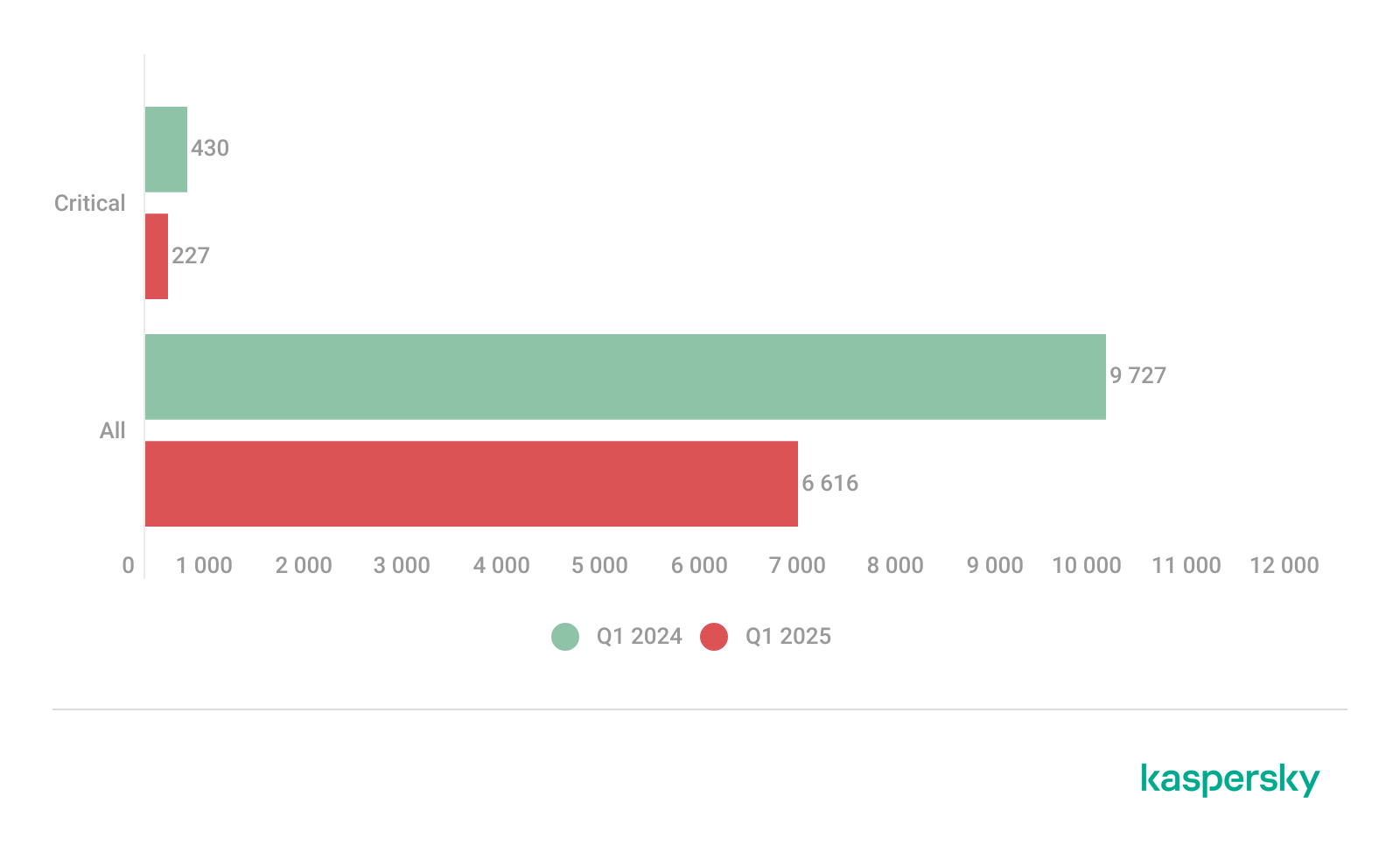
The first quarter of 2025, like previous ones, demonstrates a significant number of newly documented vulnerabilities. The trend largely mirrors previous years, so we will focus on new data that can be collected for the most popular platforms. This report examines the characteristics of vulnerabilities in the Linux operating system and Microsoft software, specifically the Windows OS. Given that the Linux kernel developers have obtained the status of a CVE Numbering Authority (CNA) and they can independently assign CVE identifiers to newly discovered security issues, all information about vulnerabilities can now be obtained firsthand.
Let us look at the Linux kernel vulnerabilities registered in the first quarter of 2025 and categorized according to their Common Weakness Enumeration (CWE) types.
Top 10 CWEs for Linux kernel vulnerabilities registered in Q1 2025 (download)
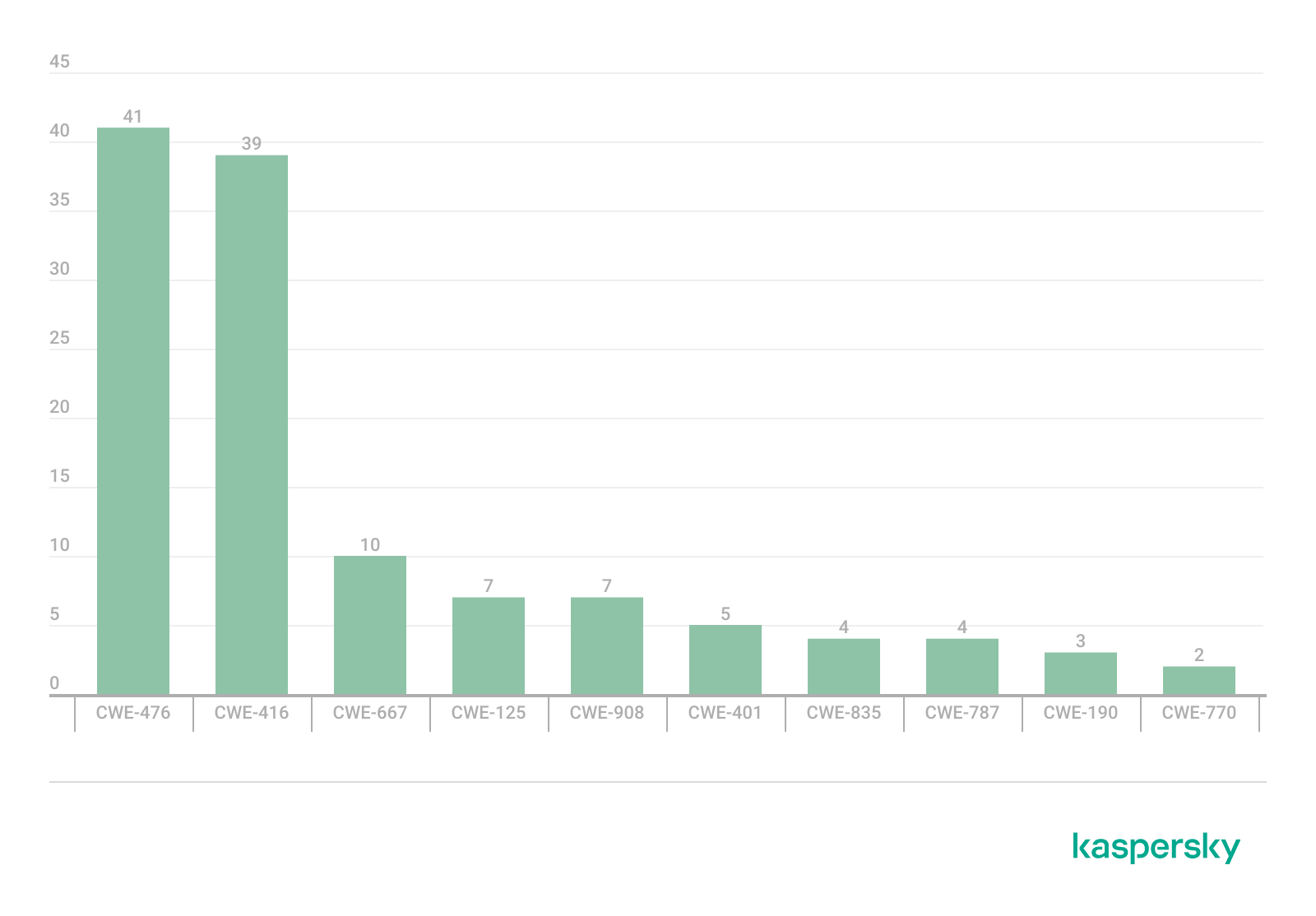
For Linux, the most common CWEs are those with the following identifiers:
- CWE-476: Null Pointer Dereference
- CWE-416: Use after Free
- CWE-667: Improper Locking
- CWE-125: Out-of-bounds Read
- CWE-908: Use of Uninitialized Resource, most often referring to regions of system memory
This set of vulnerability types is fairly common for system software. That said, exploiting vulnerabilities in these CWEs often demands complex read-and-write capabilities from attackers, due to Linux’s robust exploit mitigations such as kernel address space layout randomization (KASLR).
Let us examine similar statistics for Microsoft software. Given the developer’s extensive product lineup, a variety of security issues have been identified. As a result, we will limit our analysis to the most common CWEs for vulnerabilities disclosed during the first quarter of 2025.
TOP 10 CWEs for Microsoft product vulnerabilities registered in Q1 2025 (download)
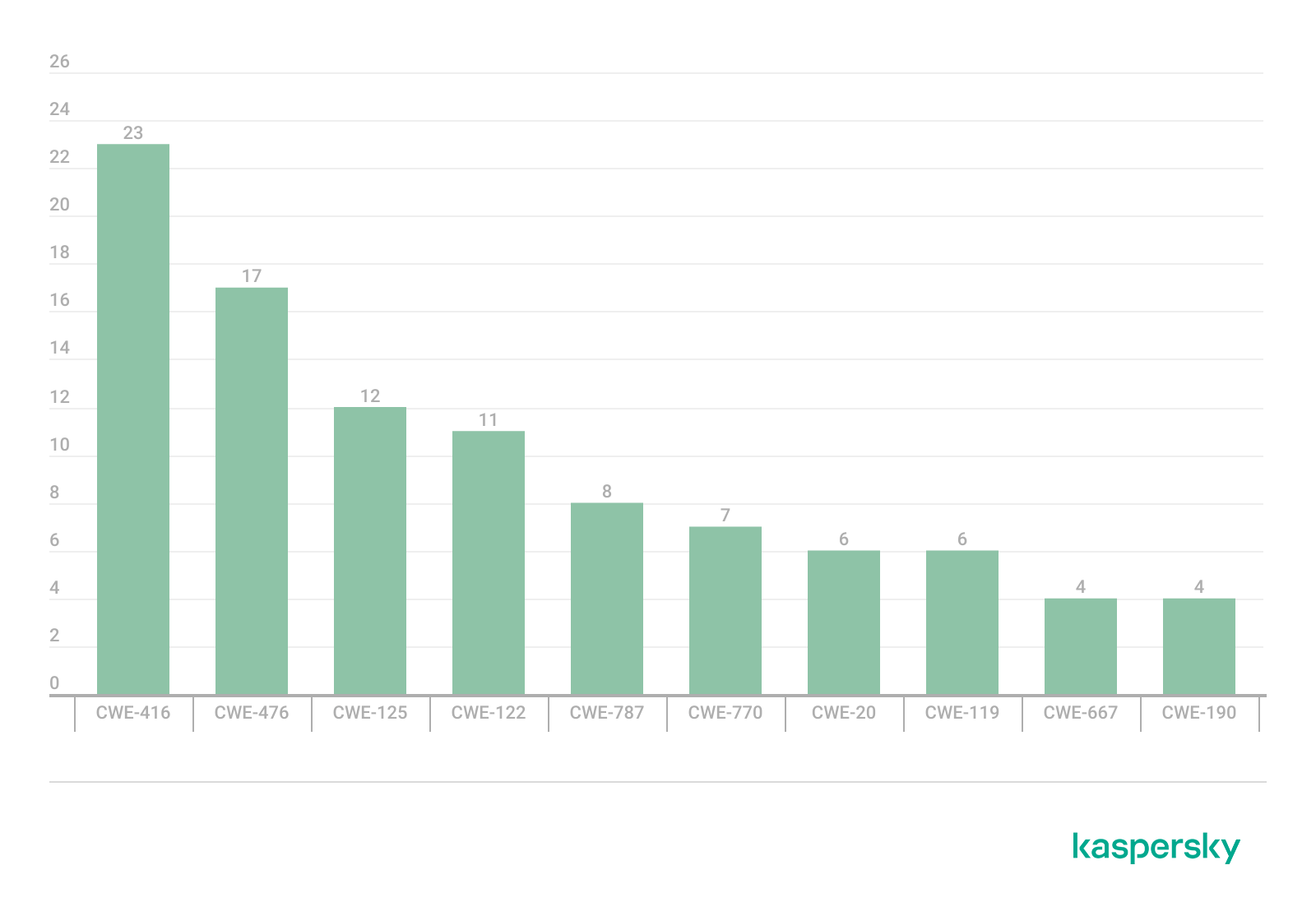
In addition to the CWEs described above, the following types of vulnerabilities were also frequently reported in the first quarter:
In general, the TOP 10 CWEs for Microsoft products and the Linux kernel tend to be similar or overlap, which means the vulnerabilities are rooted in comparable principles. As a result, we often see attack techniques being “ported” from Linux to Windows and vice versa, with attackers modifying existing exploits to target a different operating system. This method is likewise applied to multiple products of the same software type.
These CWEs have remained an issue for some time, in spite of ongoing efforts from the research and development community. Knowing the most frequently encountered vulnerabilities on a given platform provides insight into which tools attackers are likely to use to compromise it.
Exploitation statistics
This section presents statistics on vulnerability exploitation for the first quarter of 2025. The data draws on open sources and our telemetry.
Windows and Linux vulnerability exploitation
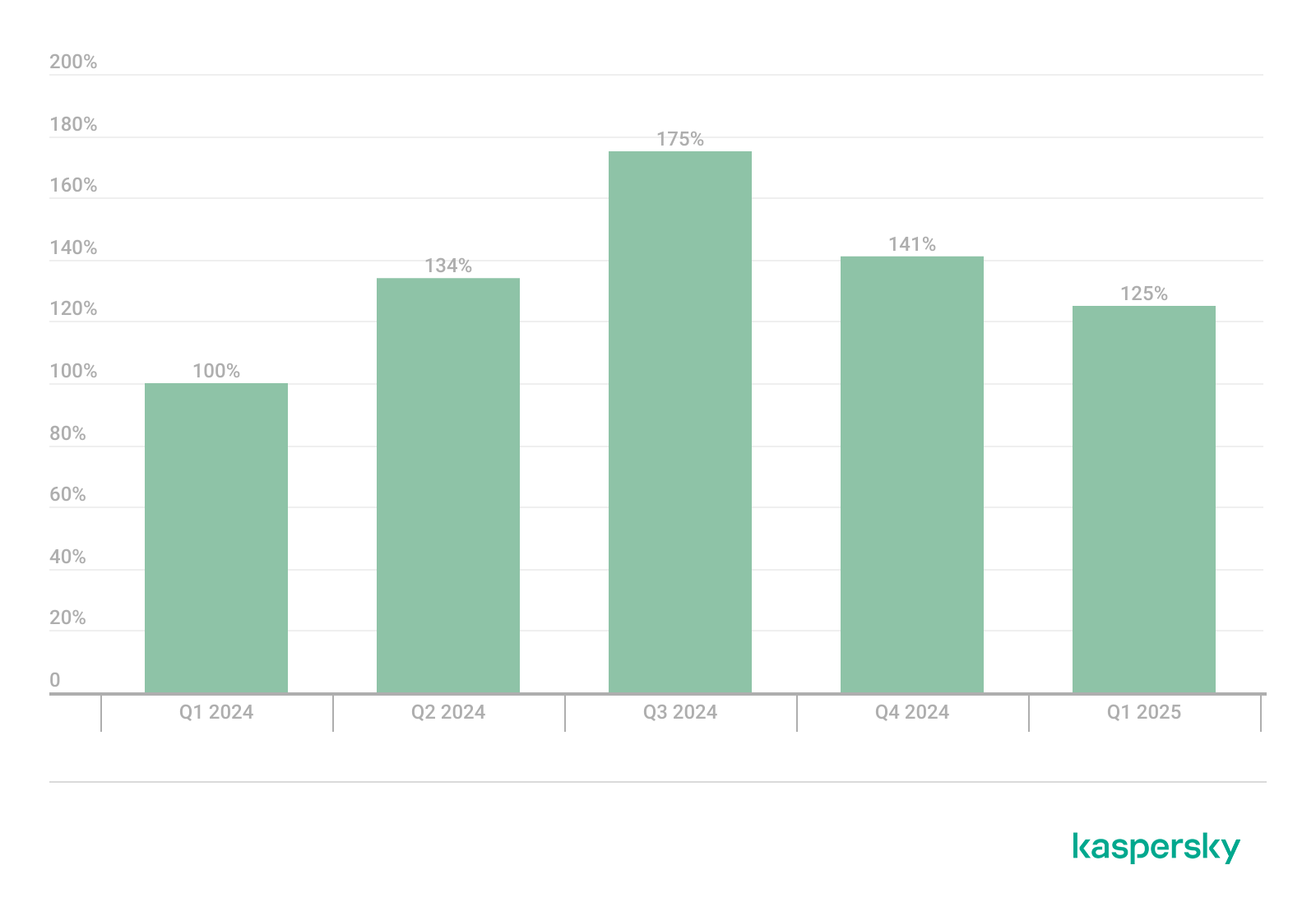
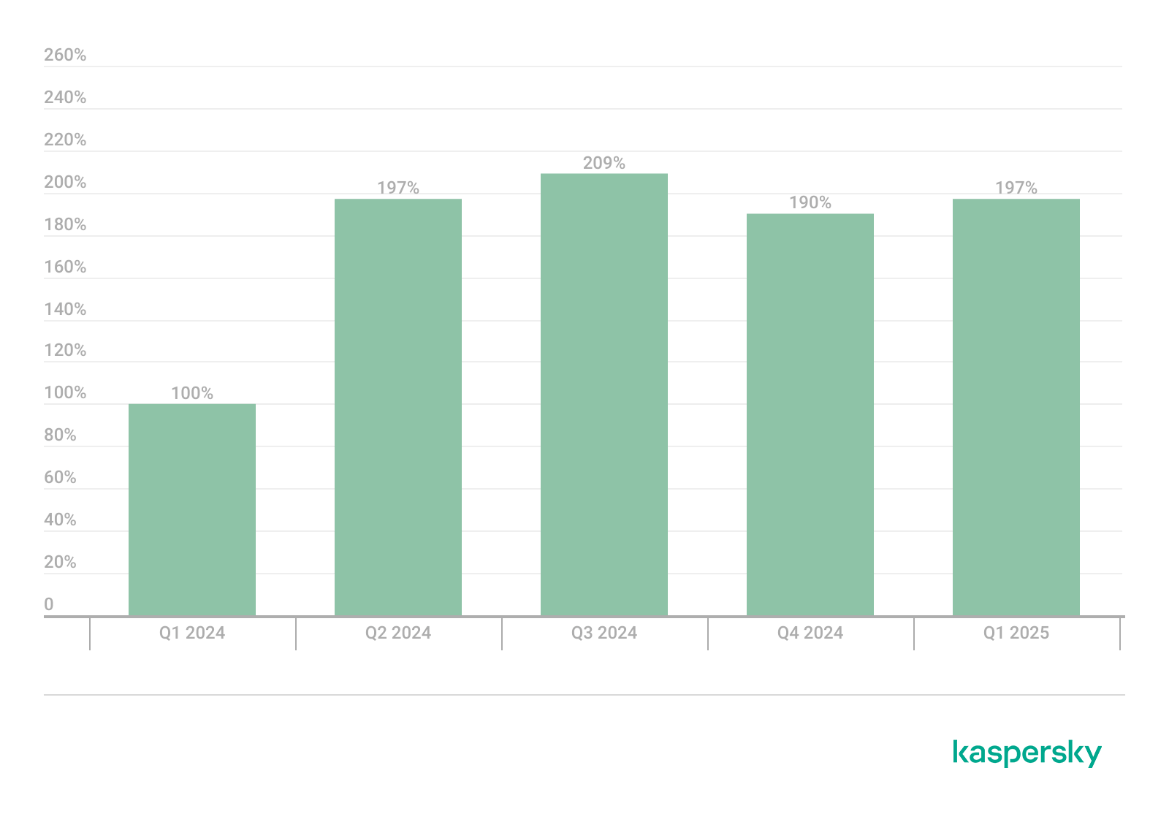
The first quarter of 2025 saw a year-over-year increase in attacks using Windows exploits. As before, the vast majority of detected exploits targeted Microsoft Office products. Even though office suite applications are now widely available as cloud services, vulnerable local versions remain popular with users.
Historically, Kaspersky products have most often detected exploits targeting the Windows platform that leverage the following older vulnerabilities:
- CVE-2018-0802: a remote code execution vulnerability in the Equation Editor component
- CVE-2017-11882: another remote code execution vulnerability, also affecting Equation Editor
- CVE-2017-0199: a vulnerability in Microsoft Office and WordPad allowing an attacker to gain control over the system
These three vulnerabilities were the most prevalent throughout 2024, and we expect this trend to continue.
Following the top three vulnerabilities, other commonly exploited issues include vulnerabilities in WinRAR and in the Windows operating system itself, such as:
- CVE-2023-38831: a vulnerability in WinRAR involving improper handling of files within archive contents
- CVE-2024-35250: a vulnerability in the
ks.sysdriver that stems from dereferencing an untrusted pointer, which can allow an attacker to execute arbitrary code - CVE-2022-3699: a vulnerability in the Lenovo Diagnostics Driver that allows improper issuance of IOCTL commands, enabling the attackers to read from or write to arbitrary kernel memory
All of the vulnerabilities listed above can be used for privilege escalation, and those affecting the kernel and drivers can result in full system compromise. For this reason, we strongly recommend regularly installing updates for the relevant software.
Dynamics of the number of Windows users encountering exploits, Q1 2024—Q1 2025. The number of users who encountered exploits in Q1 2024 is taken as 100% (download)
For the Linux operating system, the most frequently exploited vulnerabilities in early 2025 targeted the following issues:
- CVE-2022-0847, also known as Dirty Pipe: a widespread vulnerability that allows privilege escalation and enables attackers to take control of running applications
- CVE-2019-13272: a vulnerability caused by improper handling of privilege inheritance, which can be exploited to achieve privilege escalation
- CVE-2021-3156: a heap overflow vulnerability in the
sudoutility that allows attackers to escalate privileges to root
Dynamics of the number of Linux users encountering exploits, Q1 2024—Q1 2025. The number of users who encountered exploits in Q1 2024 is taken as 100% (download)
It is essential to keep your operating system and software up to date by promptly installing all available patches and updates. However, updates for the Linux kernel and applications included with most distributions are critical, as a single vulnerability can lead to full system compromise.
Most common published exploits
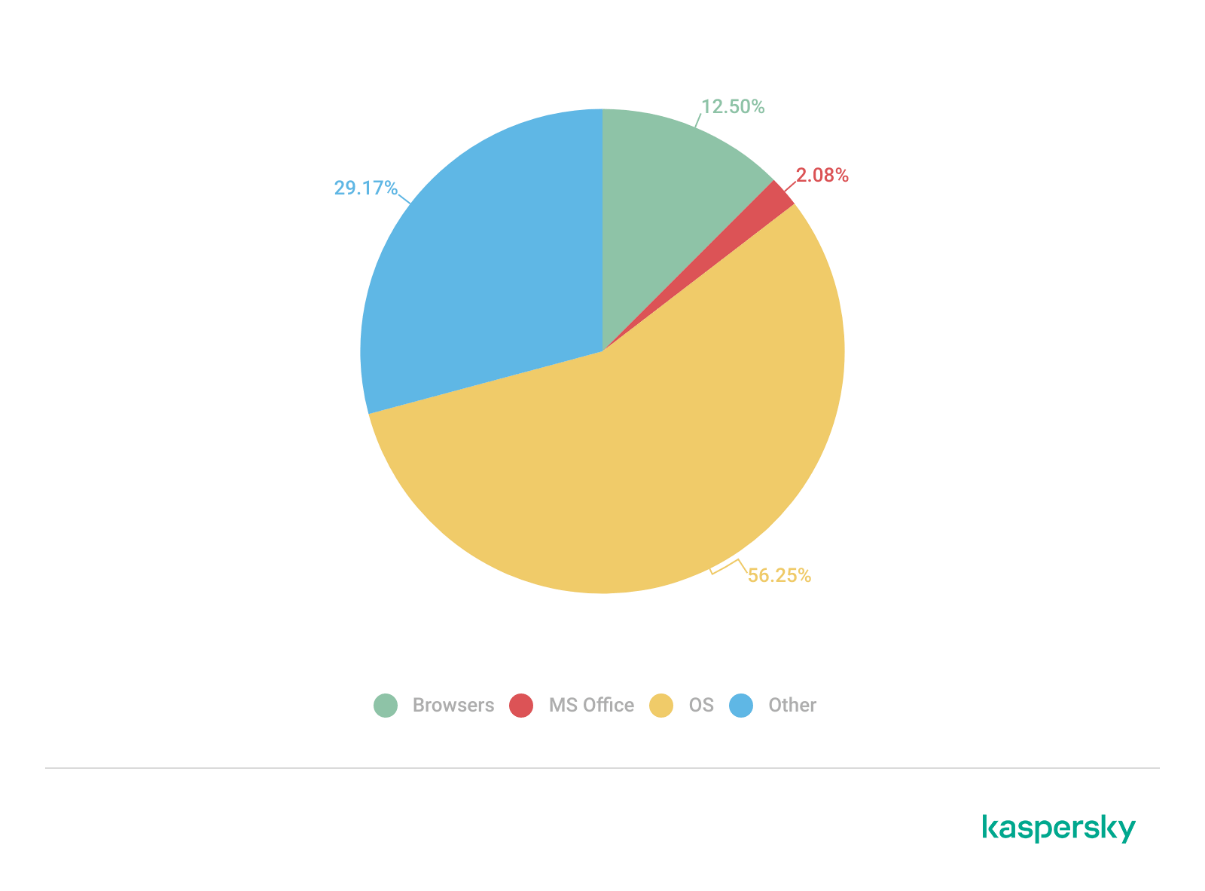
Distribution of published exploits by platform, Q4 2024 (download)
Distribution of published exploits by platform, Q1 2025 (download)
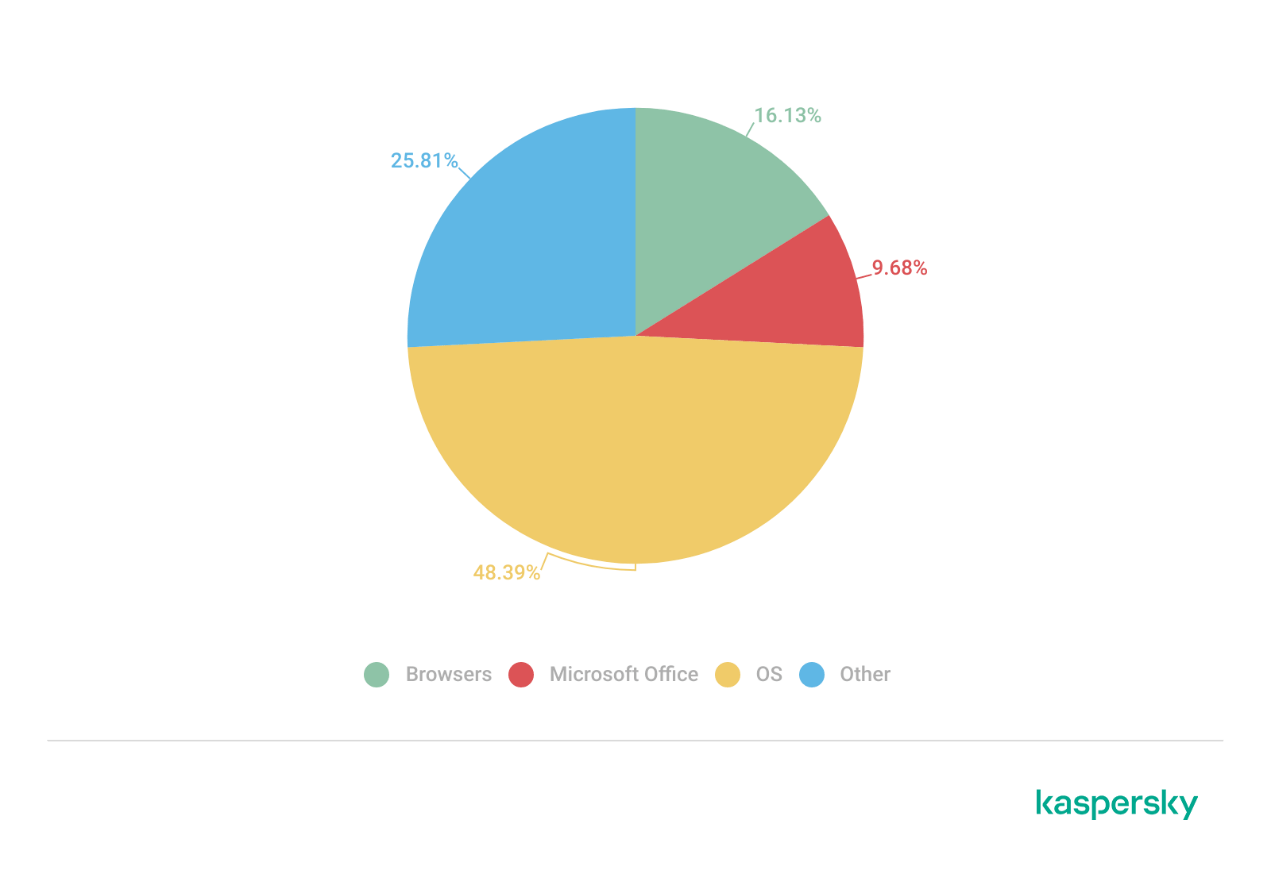
In the first quarter of 2025, operating systems – among the most complex types of software – continued to account for the highest number of published exploits. This is due to the large codebase and numerous OS components, as well as the operating system’s critical role in device functionality. Furthermore, we are seeing a steady rise in the number of browser exploits, a trend that continued throughout the past year. The proportion of exploits targeting vulnerabilities in Microsoft Office products has also increased.
Vulnerability exploitation in APT attacks
We analyzed data on attacks carried out by APT groups and identified which vulnerabilities they most frequently exploited during the first quarter of 2025. The following rankings are informed by our telemetry, research, and open-source data.
Top 10 vulnerabilities exploited in APT attacks, Q1 2025 (download)
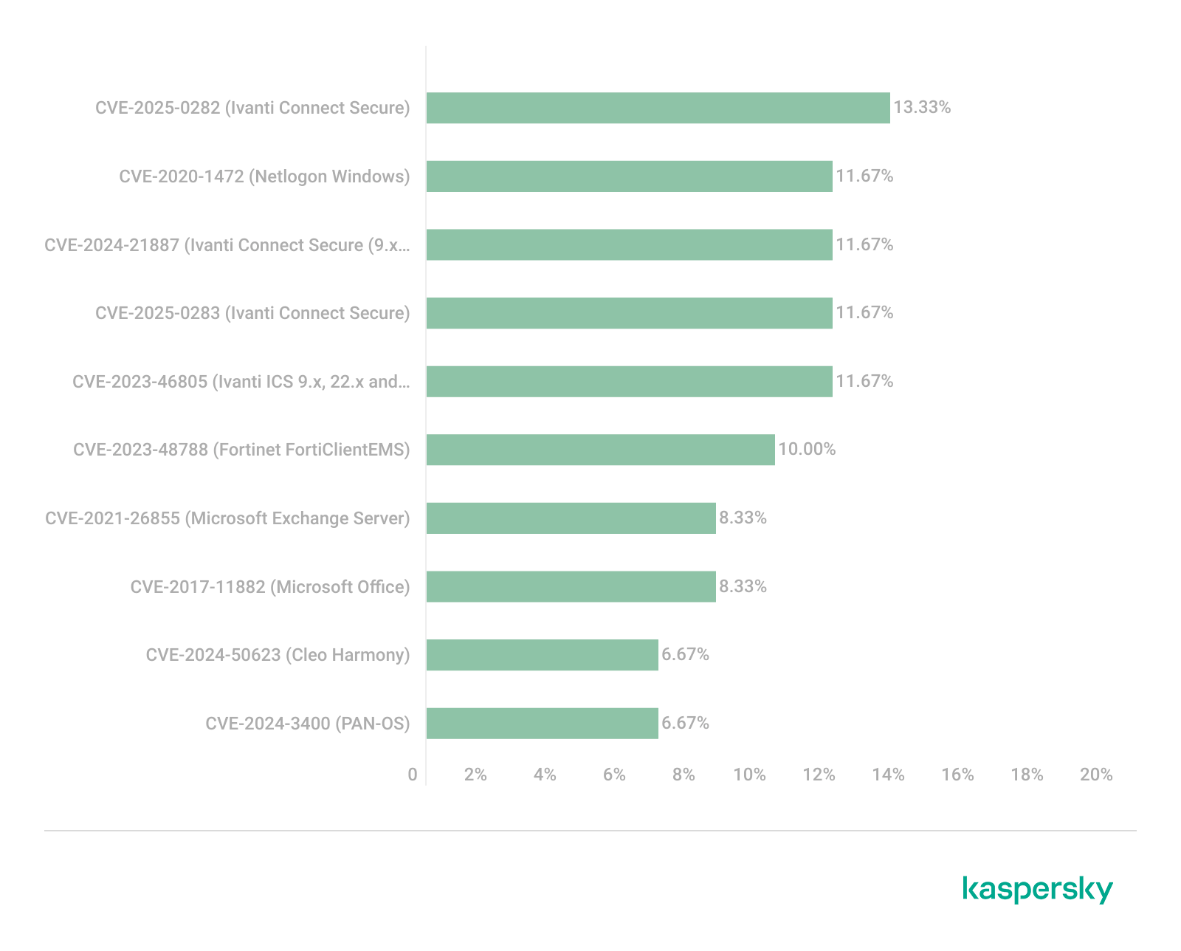
Most attacker techniques are designed to gain access to the victim’s local network. As a result, the most commonly targeted vulnerabilities are typically found in perimeter devices and software that can function as server. Notably, the well-known critical Zerologon vulnerability, which allows attackers to take over a domain controller, has reappeared in the TOP 10 most exploited vulnerabilities.
The only exception to this trend is software used for accessing information, such as text editors and file-sharing applications.
Interesting vulnerabilities
This section covers the most noteworthy vulnerabilities published in the first quarter of 2025.
ZDI-CAN-25373: a vulnerability in Windows that affects how LNK files are displayed
The first vulnerability to make our list has been actively exploited against users for some time, yet it still lacks a CVE identifier. It affects LNK files in the Windows operating system. The main issue is that File Explorer does not fully display the data specified as parameters in application shortcuts. In the Target field, attackers add extra characters, such as spaces or line breaks, after a legitimate-looking path, followed by malicious commands that can compromise the system. At the same time, only the first part of the path is shown in the shortcut’s properties:
Example of shortcut properties with additional characters that are not fully displayed in File Explorer
Opening a shortcut like this executes commands that are hidden from the user. For example, the Target field might include arguments at the end of the line that trigger a request to download a payload using powershell.exe. It is important to consider the psychological aspect of this vulnerability: a file with hidden malicious activity like this can mislead users, since they cannot see the main actions that will be performed when the file is opened.
CVE-2025-21333: a heap buffer overflow vulnerability in the vkrnlintvsp.sys driver
This is a buffer overflow vulnerability in the kernel’s paged pool memory allocation that was actively exploited in zero-day attacks against end-user systems. The vulnerable vkrnlintvsp.sys driver, designed for Hyper-V, improperly handles pointers to kernel pool structures. This results in a paged pool overflow, allowing attackers to execute arbitrary code or escalate their privileges.
Notably, this vulnerability can be exploited during process creation within Windows Sandbox. The name of the vulnerable function, VkiRootAdjustSecurityDescriptorForVmwp, suggests that providing a security descriptor that exceeds the allowed size is sufficient to trigger the vulnerability. In this scenario, the memory counter responsible for calculating the security descriptor’s length will overflow, enabling arbitrary read/write operations of 0xffff bytes and ultimately allowing attackers to escape the sandbox environment.
CVE-2025-24071: a NetNTLM hash leakage vulnerability in the file system indexer
A built-in feature of File Explorer in all Windows operating systems has become a common tool for stealing NetNTLM hashes. Attackers distributed a malicious file with a .library-ms extension that contained a specially crafted directory path. The appearance of this file in the victim’s file system triggers the indexing mechanism. It opens a specified directory, and the operating system automatically performs NTLM authentication in the background without notifying the user, which results in the disclosure of NetNTLM hashes.
Conclusion and advice
The number of vulnerabilities registered in the first quarter of 2025 might appear misleading. One possible reason for the decrease is that security research findings or vulnerability descriptions are sometimes published well after the vulnerabilities are initially discovered. Therefore, it is critically important to update all software and devices as soon as updates become available.
To stay safe, it is essential to respond promptly to changes in the threat landscape. It is also recommended to ensure the following:
- Maintain continuous, around-the-clock monitoring of your infrastructure, with particular attention to perimeter defenses.
- Implement strong patch management process and apply security fixes without delay. Solutions like Kaspersky Vulnerability and Patch Management and Kaspersky Vulnerability Data Feed can be used to configure and automate vulnerability and patch management.
- Use robust solutions that can detect and block malware on corporate devices, and comprehensive tools that include incident response plans, employee training programs, and an up-to-date cyberthreat database.
Text extracted automatically; images, tables and formatting may be missing. Original: https://securelist.com/vulnerabilities-and-exploits-in-q1-2025/116624/