Threat actors continue to exploit Log4j flaws, Microsoft Warns
Vulnerabilities mentionedAll →
| CVE | Vulnerability | CVSS | EPSS | Flags | Affected | Exposure | Published |
|---|---|---|---|---|---|---|---|
| CVE-2021-4104 | JMSAppender in Log4j 1.2 is vulnerable to deserialization of untrusted data when the attacker has write access to the Log4j configuration. JMSAppender in Log4j 1.2 is vulnerable to deserialization of untrusted data when the attacker has write access to the Log4j configuration. The attacker can provide TopicBindingName and TopicConnectionFactoryBindingName configurations causing JMSAppender to perform JNDI requests that result in remote code execution in a similar fashion to CVE-2021-44228. Note this issue only affects Log4j 1.2 when specifically configured to use JMSAppender, which is not the default. Apache Log4j 1.2 reached end of life in August 2015. Users should upgrade to Log4j 2 as it addresses numerous other issues from the previous versions. NVD description · AI analysis pending | 7.5 | 81% |
| — | ||
| CVE-2021-44228 | JNDI Injection Remote Code Execution in Apache Log4j2 (Log4Shell) Apache Log4j2, an extremely widely used Java logging library, fails to protect its JNDI lookup feature against attacker-controlled JNDI-related endpoints (CWE-20, CWE-502), so crafted text processed by the logger causes the Java runtime to fetch and load attacker-supplied objects, leading to remote code execution. The flaw is triggered whenever attacker-controlled input reaches the logging API and is parsed for JNDI lookups, a pattern common in web servers and enterprise Java applications that log user-supplied fields such as headers or form values. Successful exploitation yields arbitrary code execution under the privileges of the affected application, giving attackers a foothold for lateral movement, data theft, and ransomware deployment. Any Java application or product that ships or bundles an affected Apache Log4j2 release is exposed, making this one of the most broadly deployed vulnerabilities ever disclosed. Exploitation is confirmed in the wild: CISA added it to the Known Exploited Vulnerabilities catalog on 2021-12-10 with known ransomware use, and EPSS assigns a 100% probability of exploitation within 30 days. Do: Inventory all Java applications and dependencies for Apache Log4j2 and apply the vendor's patched updates, or remove affected assets from the network, as required by CISA's KEV catalog. Where updates are not yet available, use the temporary mitigations in CISA's ED-22-02 recommended-mitigation guidance, such as disabling message lookups, only until patches are applied. Prioritize internet-facing and business-critical systems and hunt for exploitation activity given known ransomware use. | 10.0 | 100% | KEV ransomware PoC ×9 |
| masshundreds of millions of Java applications/devices, with hundreds of thousands of internet-exposed services | |
| CVE-2021-44832 | Apache Log4j2 versions 2.0-beta7 through 2.17.0 (excluding security fix releases 2.3.2 and 2.12.4) are vulnerable to a remote code execution (RCE) attack when a Apache Log4j2 versions 2.0-beta7 through 2.17.0 (excluding security fix releases 2.3.2 and 2.12.4) are vulnerable to a remote code execution (RCE) attack when a configuration uses a JDBC Appender with a JNDI LDAP data source URI when an attacker has control of the target LDAP server. This issue is fixed by limiting JNDI data source names to the java protocol in Log4j2 versions 2.17.1, 2.12.4, and 2.3.2. NVD description · AI analysis pending | 6.6 | 98% |
| — | ||
| CVE-2021-45046 | Remote Code Execution in Apache Log4j2 via Incomplete Log4Shell Fix CVE-2021-45046 is a remote code execution and information disclosure flaw in Apache Log4j2 (CWE-917) that resulted from an incomplete fix to CVE-2021-44228 (Log4Shell), leaving the Thread Context Lookup Pattern vulnerable in certain non-default configurations. It is triggered when an application logs attacker-controlled data using layouts or patterns that perform Thread Context (MDC) lookups, allowing crafted lookup expressions to be evaluated against untrusted input. A successful attacker can achieve remote code execution, or potentially information disclosure, on the affected service. Any deployment of Apache Log4j2 that relies on the affected non-default lookup configurations is exposed, which given Log4j2's ubiquity in Java applications and embedded products means a very large installed base. Exploitation is confirmed: the flaw is in CISA KEV (added 2023-05-01) with known ransomware use, and EPSS assigns a 100% probability of exploitation within 30 days. Do: Upgrade Log4j2 to 2.17.0 or later per vendor instructions (or 2.12.3/2.3.1 for the legacy 2.12/2.3 branches), since the 2.16.0 fix was itself incomplete in some non-default configurations. Where upgrading is not immediately possible, remove the JndiLookup class from the Log4j2 jar or disable lookup processing, and audit applications and dependencies that bundle Log4j2 while following the CISA KEV required action to apply vendor updates. | 9.0 | 100% | KEV ransomware |
| massmillions of Java deployments worldwide, with hundreds of thousands of internet-exposed services observed in public scans during the Log4Shell campaign | |
| CVE-2021-45105 | Apache Log4j2 versions 2.0-alpha1 through 2.16.0 (excluding 2.12.3 and 2.3.1) did not protect from uncontrolled recursion from self-referential lookups. Apache Log4j2 versions 2.0-alpha1 through 2.16.0 (excluding 2.12.3 and 2.3.1) did not protect from uncontrolled recursion from self-referential lookups. This allows an attacker with control over Thread Context Map data to cause a denial of service when a crafted string is interpreted. This issue was fixed in Log4j 2.17.0, 2.12.3, and 2.3.1. NVD description · AI analysis pending | 5.9 | 100% |
| — |
Full article577 words · extracted from securityaffairs.com · click to collapse

Threat actors continue to attempt to exploit Apache Log4J vulnerabilities in their campaigns to deploy malware on target systems, Microsoft warns.
Microsoft is warning of continuing attempts by nation-state actors and cybercriminals to exploit recently discovered vulnerabilities in the Apache Log4j library to deploy malware on vulnerable systems.
Microsoft recommends customers review their infrastructure looking for vulnerable installations, according to the experts, organizations may not realize their environments may already be compromised.
“Exploitation attempts and testing have remained high during the last weeks of December. We have observed many existing attackers adding exploits of these vulnerabilities in their existing malware kits and tactics, from coin miners to hands-on-keyboard attacks.” reads the post published by Microsoft Threat Intelligence Center (MSTIC).
Immediately after the disclosure of the first vulnerability, Microsoft warned of nation-state actors attempting to exploit the Log4Shell vulnerability in Log4j, and in the successive days, other flaws (CVE-2021-45046, CVE-2021-45105, CVE-2021-4104, and CVE-2021-44832) were discovered in the library that were exploited by threat actors in the wild.
Most of the attacks observed by the researchers are mass-scanning, coin mining, establishing remote shells, and red-team activity,
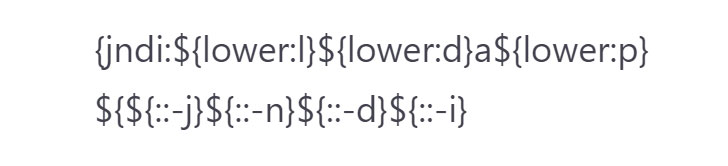
A common pattern of attack would appear in a web request log with strings like the following:
The above string can be easily identified by analyzing its components such as the presence of “jndi” (the Java Naming and Directory Interface), “ldap”, “ldaps”, “rmi”, “dns”, “iiop”, or “http.” However, attackers are adding obfuscation to these requests to evade the detection based on request analysis.
Even as the mass scanning attempts are showing no signs of letting up, efforts are underway to evade string-matching detections by obfuscating the malicious HTTP requests orchestrated to generate a web request log using Log4j that leverages JNDI to perform a request to the attacker-controlled site.
Microsoft warns of a rapid uptake of the flaw into existing botnets like Mirai and Tsunami, the company also continued to observe malicious activity performing data leakage via the vulnerability without dropping a payload.
“Microsoft has observed rapid uptake of the vulnerability into existing botnets like Mirai, existing campaigns previously targeting vulnerable Elasticsearch systems to deploy cryptocurrency miners, and activity deploying the Tsunami backdoor to Linux systems. Many of these campaigns are running concurrent scanning and exploitation activities for both Windows and Linux systems, using Base64 commands included in the JDNI:ldap:// request to launch bash commands on Linux and PowerShell on Windows.” continues Microsoft.
“Microsoft has also continued to observe malicious activity performing data leakage via the vulnerability without dropping a payload. This attack scenario could be especially impactful against network devices that have SSL termination, where the actor could leak secrets and data.”
The experts also reported the dropping of additional RATs and reverse shells by exploiting the CVE-2021-44228 in human-operated attacks. The researchers observed the use of the Cobalt Strike and PowerShell reverse shells, along with Meterpreter, njRAT (aka Bladabindi), and HabitsRAT.
The IT giant also confirmed that Webtoos DDoS malware was also deployed via the Log4Shell vulnerability.
“customers should assume broad availability of exploit code and scanning capabilities to be a real and present danger to their environments. Due to the many software and services that are impacted and given the pace of updates, this is expected to have a long tail for remediation, requiring ongoing, sustainable vigilance.” Microsoft concludes.
Follow me on Twitter: @securityaffairs and Facebook
| [adrotate banner=”9″] | [adrotate banner=”12″] |
(SecurityAffairs – hacking, Log4j)
[adrotate banner=”5″]
[adrotate banner=”13″]
Text extracted automatically; images, tables and formatting may be missing. Original: https://securityaffairs.com/126333/breaking-news/log4j-flaws-attacks.html