Product showcase: AI Paper Trail shows the privacy cost of talking to AI
Proton launched AI Paper Trail, a free tool that analyzes ChatGPT or Claude exports and reports what personal data can be inferred from AI conversations.
Proton released AI Paper Trail, a free web tool that analyzes the 200 most recent prompts from exported ChatGPT or Claude conversation histories and generates a privacy report with an AI Exposure Score, inferred personal data categories, and an estimated advertising value. In a hands-on test it identified 47 data points, returned a 58/100 exposure score, estimated $185 in advertising value, and flagged five red flags spanning location, interests, finances, and relationships. Proton states that uploaded data is deleted after analysis and is not stored on its Lumo servers.
- Analyzes the 200 most recent prompts from exported ChatGPT or Claude histories
- Produces an AI Exposure Score, inferred personal data categories, and an estimated advertising value
- Proton states uploads are deleted after analysis and are not stored on Lumo servers
Full article432 words · extracted from helpnetsecurity.com · click to collapse
Proton’s AI Paper Trail is a free tool designed to make the information accumulated across AI conversations easier to see. It analyzes exported ChatGPT or Claude conversation data and produces a personal privacy report showing what can be inferred from those conversations. Proton says the uploaded data is deleted after analysis and is not stored on Lumo’s servers.
AI conversations can reveal a surprising amount about their users over time. Individual questions may seem harmless, but months or years of interactions can contain information about work, relationships, habits, interests, purchases, travel plans, and other personal details.
I decided to try it using my personal ChatGPT history on the free plan to see what it “knows” about me. ChatGPT is the only AI assistant I use on my iPhone, where I also have antivirus, a VPN, and scam protection.
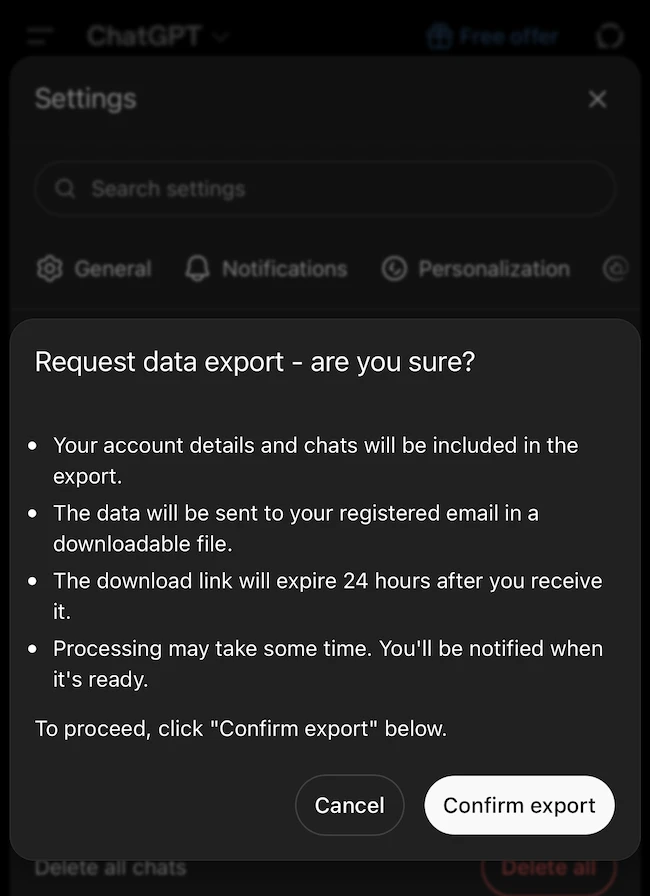
To generate a report, I exported my ChatGPT data, downloaded the resulting ZIP file to my iPhone, and uploaded it to AI Paper Trail through Safari.
What the report reveals
AI Paper Trail analyzes the 200 most recent prompts and generates several views of the information it finds. These include a privacy type, an AI Exposure Score, personal information revealed through conversations, and an estimate of the value of that data.
It identified 47 data points and gave me an AI Exposure Score of 58/100, putting me in the “Leaving receipts” category. The report estimated my advertising value at $185 and identified five red flags.
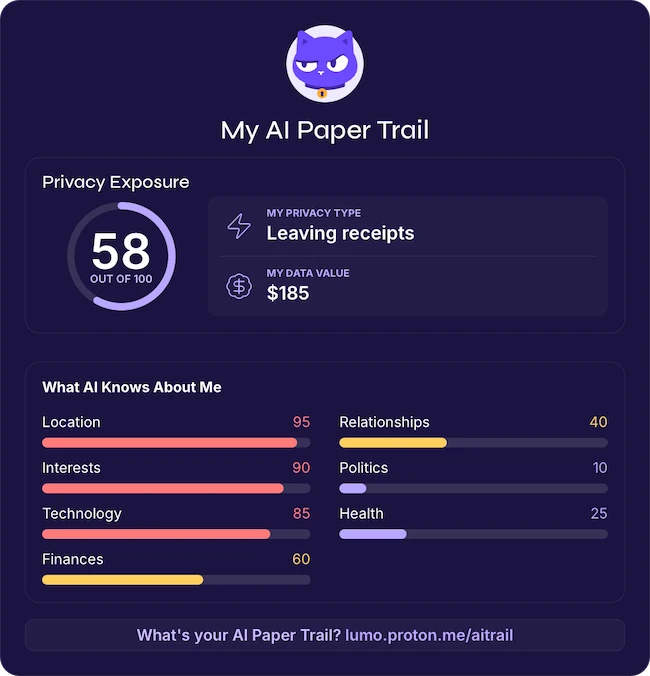
What stood out was not so much the score itself, but how much Paper Trail could piece together from ordinary conversations. It found data across areas such as location, interests, technology use, finances, and relationships, with location, interests, and technology showing the greatest exposure.
Some of the prompts it considered revealing were questions I would not normally think of as particularly sensitive. Individually, they disclosed little. Combined with other conversations they helped build a much more detailed profile.
The results should not necessarily be treated as facts. Paper Trail makes inferences from conversations, and researching a location, product, or subject does not automatically mean it relates to the person asking about it. Even so, seeing what could be inferred from my own conversation history showed how quickly seemingly unrelated information can accumulate.
Final thoughts
AI Paper Trail makes an otherwise abstract privacy issue easy to understand. Seeing travel destinations, purchasing habits, technology preferences, hobbies, family context, and other details reconstructed from ordinary questions changes the way those conversations look in retrospect. It also shows just how much can be pieced together from the trail of prompts left behind.
Text extracted automatically; images, tables and formatting may be missing. Original: https://www.helpnetsecurity.com/2026/08/24/product-showcase-ai-paper-trail/