SAP Flaw Exploited by Ransomware Groups and Chinese
Vulnerabilities mentionedAll →
| CVE | Vulnerability | CVSS | EPSS | Flags | Affected | Exposure | Published |
|---|---|---|---|---|---|---|---|
| CVE-2025-31324 | Unauthenticated File Upload RCE in SAP NetWeaver Visual Composer CVE-2025-31324 is a critical (CVSS 9.8) unrestricted file upload flaw (CWE-434) in the Visual Composer Metadata Uploader component of SAP NetWeaver, which lacks proper authorization. An unauthenticated attacker can send crafted upload requests over the network to the Metadata Uploader endpoint and plant malicious executable binaries, such as webshells, on the host. Executing the uploaded files yields remote code execution with full impact on confidentiality, integrity, and availability, enabling system compromise, lateral movement, and ransomware deployment. Any organization running the affected SAP NetWeaver component is at risk, with the greatest exposure for instances reachable from the internet. Exploitation is confirmed in the wild: the flaw was added to CISA KEV on 2025-04-29, a public PoC exists, and researchers and media report active attacks, including by Chinese-linked actors deploying Golang-based implants on Linux systems and known ransomware use, often chained with CVE-2025-42999. Do: Apply SAP's patch for CVE-2025-31324 (released in the April 2025 security updates) and follow the vendor mitigation instructions per CISA KEV/BOD 22-01 requirements. As interim mitigation, restrict or disable the Visual Composer Metadata Uploader endpoint and ensure it is not reachable from the internet; also patch the related CVE-2025-42999 since the flaws are being chained. Check affected hosts for uploaded webshells, Golang-based implants, and signs of ransomware activity. | 9.8 | 100% | KEV ransomware PoC |
| largetens of thousands of enterprise deployments worldwide, with several thousand instances directly internet-exposed | |
| CVE-2025-42999 | Insecure Deserialization in SAP NetWeaver Visual Composer Metadata Uploader CVE-2025-42999 is an insecure deserialization flaw (CWE-502) in the Visual Composer Metadata Uploader component of SAP NetWeaver. It is triggered when a privileged user uploads untrusted or malicious content to the Metadata Uploader, which the application then deserializes; on its own the flaw requires high-privilege access, but attackers commonly chain it with the separately tracked unauthenticated upload flaw CVE-2025-31324 in the same component. Successful exploitation can yield remote code execution and full compromise of the host's confidentiality, integrity, and availability, with impact beyond the vulnerable component (CVSS scope changed, 9.1 critical). Any organization running SAP NetWeaver with the Visual Composer Metadata Uploader enabled, especially internet-facing application servers, is affected. Exploitation is confirmed in the wild: CISA added it to the Known Exploited Vulnerabilities catalog on 2025-05-15 with known ransomware use, and reporting links active attacks to ransomware groups (BianLian and RansomExx deploying the PipeMagic trojan) and to Chinese-linked APTs exploiting the sibling CVE-2025-31324. Do: Apply SAP's security patches addressing CVE-2025-42999 together with the companion CVE-2025-31324 in the same Visual Composer Metadata Uploader, per vendor instructions, or restrict/disable access to the Metadata Uploader endpoint if patching is delayed. Given confirmed ransomware use (BianLian, RansomExx) and PipeMagic trojan deployments, review upload and authentication logs on NetWeaver servers and hunt for signs of compromise and post-exploitation activity. U.S. federal agencies must follow CISA BOD 22-01 guidance: apply mitigations by the KEV remediation due date or discontinue use of affected instances. | 9.1 | 14% | KEV ransomware PoC |
| moderatelow thousands of internet-exposed SAP NetWeaver servers (≈1k–10k systems), with a substantially larger internal install base |
Indicators of compromiseauto-extracted · verify before use · export allAll →
| Type | Indicator | Context |
|---|---|---|
| domain | aaaaabbbbbbb.eastus.cloudapp.azure.com | methodology, with sandbox analysis confirming beaconing to aaaaabbbbbbb[.]eastus[.]cloudapp[.]azure[.]com, a domain tied to both PipeMagic and RansomEXX,” sa |
Full article692 words · extracted from infosecurity-magazine.com · click to collapse
Cybersecurity researchers are piling up evidence that a critical vulnerability affecting German software company SAP’s NetWeaver Visual Composer development server is being exploited in the wild by a range of threat actors.
These include ransomware groups BianLian and RansomwEXX, as well as at least one Chinese nation-state actor known as Chaya_004.
Strong Evidence of Exploitation
The flaw, tracked as CVE-2025-31324, is an unauthenticated file upload vulnerability in the Metadata Uploader component of the SAP NetWeaver Visual Composer Framework version 7.50. It has been allocated the highest severity score by SAP, 10.0 (CVSS v3.1).
When exploited, it allows an unauthenticated attacker to upload potentially malicious executable binaries that could severely harm the host system.
First detected by ReliaQuest on April 22, the vulnerability was publicly disclosed by SAP two days later in a security advisory in which the software maker also released a patch. The advisory is only available to SAP customers.
Evidence of exploitation began to appear quickly. Notably, the Shadowserver Foundation found that over 400 NetWeaver servers were openly exposed to the internet.
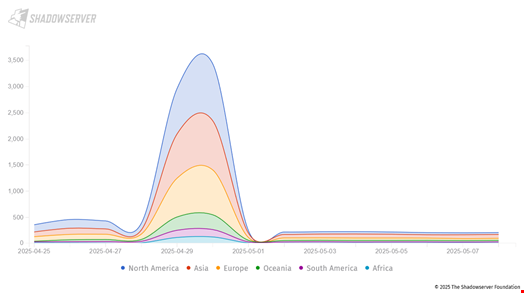
Other private security companies, including Onapsis and WatchTowr, have found further proof of in-the-wild exploitation of CVE-2025-31324, stating that the attackers were uploading web shell backdoors on unpatched instances exposed online.
On April 27, Onapsis, in collaboration with Google Cloud-owned Mandiant, released an open-source tool to identify indicators of compromise on potentially affected SAP systems.
On April 29, the US Cybersecurity and Infrastructure Security Agency (CISA) added CVE-2025-31324 to its Known Exploited Vulnerabilities (KEV) catalog.
SAP also publicly disclosed another flaw, CVE-2025-42999, on May 13. This critical flaw (CVSS v3.1 base score of 9.1) is linked to CVE-2025-31324 and affects SAP NetWeaver Visual Composer.
Private vulnerability intelligence firm VulnCheck had previously added CVE-2025-42999 to its own KEV list.
Chinese Nation-State Exploit CVE-2025-31324
Researchers from Forescout’s Federe Labs published a report on May 8 stating that they had uncovered evidence indicating that a Chinese nation-state threat actor was likely involved in malicious campaigns exploiting CVE-2025-31324.
“We uncovered malicious infrastructure likely belonging to a Chinese threat actor, which we are currently tracking as Chaya_004. The infrastructure includes a network of servers hosting Supershell backdoors, often deployed on Chinese cloud providers, and various pen testing tools, many of Chinese origin,” said the report.
Attacks detected by Federe Labs were launched from IP addresses that utilized anomalous self-signed certificates impersonating Cloudflare. Many of these IP addresses belonged to Chinese cloud providers, including Alibaba, Shenzhen Tencent, Huawei Cloud Service and China Unicom.
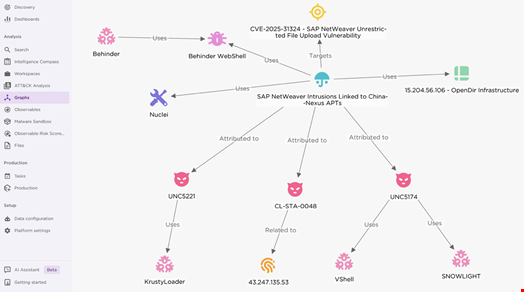
Another company, EclectiIQ, confirmed in a May 13 report that its analysts have assessed “with high confidence” that some observed SAP NetWeaver intrusions are linked to Chinese cyber-espionage units, including UNC5221, UNC5174 and CL-STA-0048, based on threat actor tradecraft patterns.
According to Mandiant and Palo Alto, these groups are associated with China's Ministry of State Security (MSS) or affiliated private entities.
Ransomware Groups Exploit CVE-2025-31324
Alongside the Chinese threat actor, ReliaQuest stated in a May 14 update that it had observed two ransomware groups associated with malicious exploitation campaigns.
ReliaQuest researchers assessed “with moderate confidence” that BianLian was involved in at least one incident where CVE-2025-31324 exploitation was evident.
“We identified a server at 184[.]174[.]96[.]74 hosting reverse proxy services initiated by the rs64.exe executable. This server is related to another IP, 184[.]174[.]96[.]70, operated by the same hosting provider. The second IP had previously been flagged as a command-and-control (C2) server associated with BianLian, sharing identical certificates and ports,” the researchers explained.
Additionally, they observed a separate incident in which attackers exploited the SAP NetWeaver vulnerability and deployed ‘PipeMagic,’ a modular backdoor linked to RansomEXX (tracked by Microsoft as Storm-2460).
“Delivered through MSBuild abuse, PipeMagic uses the EnumCalendarA API callback methodology, with sandbox analysis confirming beaconing to aaaaabbbbbbb[.]eastus[.]cloudapp[.]azure[.]com, a domain tied to both PipeMagic and RansomEXX,” said the ReliaQuest report.
The involvement of groups like BianLian and RansomEXX reflects the growing interest in weaponizing high-profile vulnerabilities for financial gain.
These developments emphasize the urgent need for organizations to immediately apply patches, monitor suspicious activity and strengthen defenses.
Photo credits: Kittyfly/Shutterstock
Text extracted automatically; images, tables and formatting may be missing. Original: https://www.infosecurity-magazine.com/news/sap-netweaver-vulnerability/