Hackers breach F5 BIG-IP APM devices to deploy Linux rootkit
Sophos analyzed a Linux rootkit on F5 BIG-IP APM devices that injects a fileless PHP web shell, likely after CVE-2025-53521 exploitation.
Sophos analyzed a Linux rootkit targeting F5 BIG-IP APM environments, also tracked by ESET as PoisonedRefresh, which hijacks Apache's apr_dso_load module loader to inject a fileless PHP web shell into memory. The implant intercepts __libc_start_main, hides strings with RC4, creates a password-protected local UNIX socket backdoor for interactive Bash access, and persists across BIG-IP upgrade images while modifying SELinux configuration. It is likely a second-stage payload following exploitation of CVE-2025-53521, a critical RCE flaw F5 reclassified from a DoS issue in March. The ShadowServer Foundation tracked 795 F5 BIG-IP APM endpoints exposed online.
- Web shell triggers on magic POST requests, executes eval() payloads, and returns HTTP 201 responses disguised as CSS.
- Implant delays backdoor creation during Apache startup to blend with normal runtime behavior.
- Defenders should watch for Apache workers reading /proc/self/maps and creation of /run/bigtlog.pipe.
- On-disk PHP files remain unchanged, shrinking the detection surface.
Vulnerabilities mentionedAll →
| CVE | Vulnerability | CVSS | EPSS | Flags | Affected | Exposure | Published |
|---|---|---|---|---|---|---|---|
| CVE-2025-53521 | Stack-Based Buffer Overflow in F5 BIG-IP APM Enables Unauthenticated RCE CVE-2025-53521 is a stack-based buffer overflow (CWE-121) in F5 BIG-IP's Access Policy Manager (APM) that allows remote code execution. The flaw is triggered when a virtual server is configured with an APM access policy and receives specific malicious network traffic; no authentication or user interaction is required per the CVSS 4.0 vector. An attacker who exploits it gains remote code execution on the BIG-IP device, and in observed intrusions attackers have deployed a fileless Linux rootkit (dubbed 'PoisonedRefresh') that injects a PHP web shell into server memory to evade disk-based scanning. Any F5 BIG-IP deployment with an APM access policy configured on a virtual server is potentially affected; versions that have reached End of Technical Support are not evaluated by the vendor. The vulnerability is being actively exploited in the wild — it was added to CISA's Known Exploited Vulnerabilities catalog on 2026-03-27, with active exploitation and in-memory malware campaigns confirmed in press reports, though ransomware use is unknown. Do: Patch immediately by upgrading affected BIG-IP systems to fixed releases per F5's security advisory (note that versions in End of Technical Support will not be fixed and should be upgraded or retired), prioritizing internet-facing virtual servers with APM access policies. Because observed attacks deploy a memory-resident PHP web shell via the PoisonedRefresh Linux rootkit, disk-only scans may miss compromise — inspect running processes and memory, and hunt for suspicious PHP or rootkit activity on BIG-IP APM devices. Federal agencies must follow the required action in CISA KEV/BOD 22-01: apply vendor mitigations or discontinue use of the product if mitigations are unavailable. | 9.3 | 2% | KEV |
| large≈14,000+ internet-exposed F5 BIG-IP devices (per public scan figures cited in press coverage) |
Full article582 words · extracted from bleepingcomputer.com · click to collapse

A Linux rootkit targeting devices in F5 BIG-IP APM environments can intercept PHP file loading and inject a fileless web shell directly into memory, avoiding the need to write malicious code to disk.
The malware shows signs of being a second-stage payload that was likely deployed after exploiting CVE-2025-53521, a critical remote code execution (RCE) flaw that F5 Networks reclassified from a DoS problem in March.
Sophos researchers analyzed a sample and noted that, while it enables “on-demand server-side code execution” typically associated with webshells, it achieves this through “deeper Linux- and Apache-specific tradecraft.”
During the research, Sophos learned that the same malware was analyzed by ESET, who identifies it as ‘PoisonedRefresh.’
In technical analysis published this week, Sophos says that the payload was deployed by a distinct installer or propagation component that had infected the Apache /usr/sbin/httpd executable used on BIG-IP APM systems.
The malicious installer also modified SELinux configurations and achieved persistence across BIG-IP upgrade images, Sophos researchers say.
"The second-stage sample hides key operational strings with RC4, gains execution before the host application main() function is invoked by intercepting __libc_start_main, targets Apache’s PHP module by hooking the Apache Portable Runtime (APR) module loader (apr_dso_load), and injects a PHP web shell into memory."
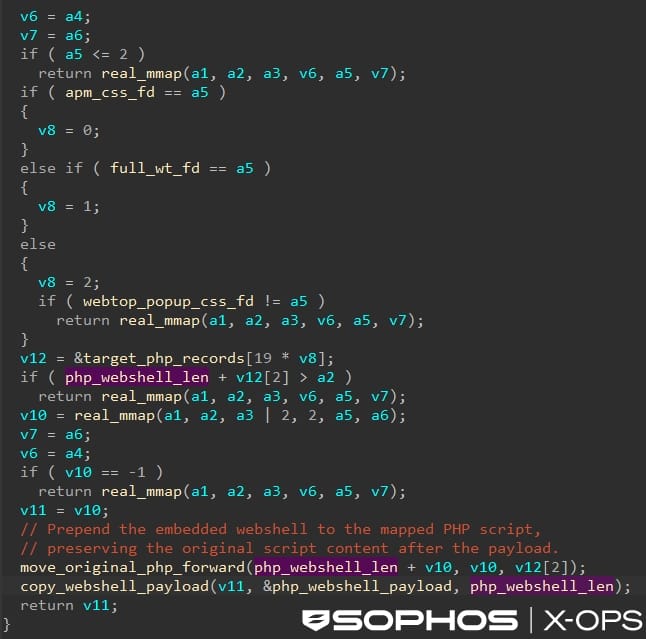
The rootkit starts with Apache, with the second-stage implant intercepting PHP file operations and modifying them in memory to hide a web shell in legitimate scripts (e.g., apm_css.php3, full_wt.php3, and webtop_popup_css.php3).
Sophos notes that the scripts were likely targeted because they are present in BIG-IP APM webtop environments and are less likely to trigger security alerts. Additionally, the PHP files on disk remain unchanged, significantly reducing the detection surface.
The injected webshell accepts specially formatted (“magic”) requests, decrypts their contents, executes them through PHP’s eval() function, and returns an HTTP 201 response disguised as CSS content.
Source: Sophos
Sophos highlights a protection mechanism that delays the creation of the local backdoor when Apache starts, reducing the risk of service disruption and detection.
“When the Apache process begins making routine time calls, the implant spawns and detaches the worker thread responsible for creating the local UNIX socket backdoor,” Sophos explains.
“This timing minimizes the risk of destabilizing the service and helps the implant blend into normal runtime behavior.”
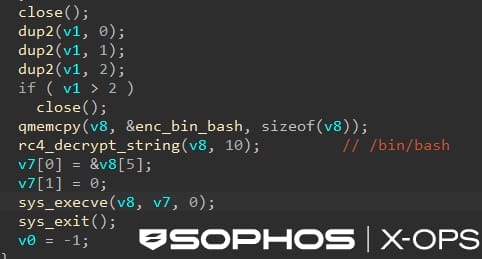
The rootkit also creates a password-protected local communication socket that can launch an interactive Bash shell without opening a TCP listening port.
The socket isn’t directly exposed to the internet, so attackers would need another foothold on the device to access it; however, Sophos did not identify the component used to interact with it.
Source: Sophos
The security firm shared a set of signals for malicious activity linked to the malware, which include Apache workers reading /proc/self/maps, changing libphp memory protections, creating /run/bigtlog.pipe, or launching /bin/bash.
Defenders are also advised to investigate unusual POST requests to the targeted .php3 endpoints and PHP responses combining HTTP 201 with a text/css content type.
The ShadowServer Foundation, which offers a tracker for F5 BIG-IP APM systems vulnerable to CVE-2025-53521, reports that 795 endpoints were exposed online yesterday.
Once attackers have valid credentials, only 37% of their actions are blocked
Overall prevention scores can hide what happens after initial access. Once attackers are using valid credentials, prevention drops sharply.
The Blue Report 2026 measures defenses technique by technique across 338 million simulations run in customer production environments.
Text extracted automatically; images, tables and formatting may be missing. Original: https://www.bleepingcomputer.com/news/security/hackers-breach-f5-big-ip-apm-devices-to-deploy-linux-rootkit/