Cyble sensors logged exploitation attempts against about 20 flaws as CISA issued 14 ICS advisories.
Cyble's weekly report says its global sensors recorded exploitation attempts against about 20 vulnerabilities, including new flaws in WordPress, Apache Solr, and Langflow and older bugs in GPON routers and embedded TCP/IP stacks. Named issues include WordPress CVE-2026-63030, Solr hardcoded-credential flaw CVE-2026-44825, Langflow CVE-2026-9198, and n8n RCE CVE-2025-68613; CVE-2020-11899 was the most attempted. CISA published 14 ICS advisories covering 54 vulnerabilities, 13 rated critical. Sensors also captured CoinMiner, WannaCry, Mirai and related malware, phishing, brute force, and a MacSync macOS infostealer campaign aimed at crypto users.
| CVE | Vulnerability | CVSS | EPSS | Flags | Affected | Exposure | Published |
|---|---|---|---|---|---|---|---|
| CVE-2017-0147 | Information Disclosure in Microsoft Windows SMBv1 Server (CVE-2017-0147) CVE-2017-0147 is an information disclosure flaw in the SMBv1 server component of Windows: an unauthenticated remote attacker sends specially crafted SMBv1 packets that cause the server to leak sensitive contents of process memory. It belongs to the SMBv1 'Eternal' family of flaws patched in Microsoft's March 2017 MS17-010 bulletin, whose exploit tooling later surfaced in the Shadow Brokers leak and is associated with DOUBLEPULSAR implant activity on TCP 445. The attacker gains read access to process memory (confidentiality-only impact reflected in the CVSS 7.5 score), which can expose sensitive data or assist follow-on attacks, though this CVE alone does not grant code execution. Anyone running the affected Windows releases with the SMBv1 server enabled is exposed, including legacy desktops and servers and Siemens ACUSON P300/P500 ultrasound systems, particularly hosts with TCP 445 reachable from untrusted networks. Exploitation is in the wild: CISA added it to the Known Exploited Vulnerabilities catalog on 2022-05-24 with known ransomware use, and EPSS assigns a ~99.7% probability of exploitation activity in any 30-day window. Do: Apply Microsoft's MS17-010 security update (March 2017) or later cumulative updates on every affected Windows host, per the vendor's instructions, and update Siemens ACUSON P300/P500 firmware per Siemens' guidance. Where patching is impractical, disable SMBv1 (e.g., via Group Policy or Set-SmbServerConfiguration -EnableSMB1Protocol $false) and restrict inbound TCP 445 to trusted networks only. Audit exposed and legacy hosts for DOUBLEPULSAR-style SMB implants and unnecessary SMBv1 exposure. | 7.5 | 100% |
| Type | Indicator | Context |
|---|---|---|
| ipv4 | 2.6.0.4 | laws affect Lantronix G520 Series cellular gateways running 2.6.0.4R6_stable. CVE-2026-91191 is an improper cryptographic signa |
This Cyble Research & Intelligence Labs (CRIL) weekly vulnerability report covers two views of risk: what attackers tried against Cyble’s global honeypot sensors, and what the Cybersecurity and Infrastructure Security Agency (CISA) disclosed for industrial control systems (ICS).
The Cyble Global Sensor Intelligence (CGSI) network observed exploitation attempts against about 20 known vulnerabilities. They range from newly disclosed flaws in WordPress, Apache Solr, and Langflow to years-old bugs in GPON home routers and embedded TCP/IP stacks.
On the industrial side, CISA issued 14 ICS advisories covering 54 vulnerabilities. Of these, 13 were rated critical, 18 high, 18 medium, and five low.
Affected vendors include Toptech Systems, Lantronix, VIVOTEK, MikroTik, Armatura, Monta, Anjvision, and, unusually, CISA itself.
Cyble sensors also recorded active malware campaigns, phishing emails, and brute-force attacks against internet-exposed services.
Attackers moved quickly against newly disclosed flaws in web platforms and AI tooling, while older IoT and embedded-device bugs continued to draw steady traffic.
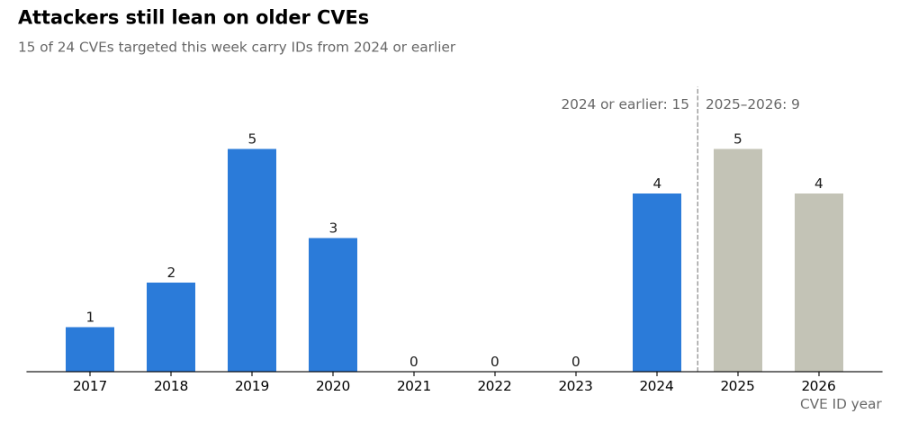
CVE-2026-63030 is a route-confusion flaw in a WordPress REST API batch endpoint. It affects WordPress 6.9.x before 6.9.5 and 7.0.x before 7.0.2.
Attackers can chain it with CVE-2026-60137 to achieve SQL injection and potentially remote code execution (RCE).
CVE-2026-44825 is a hardcoded credential in the Basic Authentication setup tool of Apache Solr 9.4.0 through 9.10.1 and 10.0.0.
Remote attackers can use it to access a Solr cluster with administrative privileges.
CVE-2026-9198 affects IBM Langflow OSS 1.0.0 through 1.10.0. Unauthenticated attackers can chain two API endpoints to obtain superuser tokens and execute arbitrary code.
Sensors also caught attempts against an older Langflow code injection flaw, CVE-2025-3248. Repeated targeting of the same AI workflow platform signals sustained attacker interest.
CVE-2025-68613 is a critical RCE flaw in the n8n workflow automation platform. Expressions supplied by authenticated users can run in an insufficiently isolated context, enabling full system compromise.
Fixes are available in versions 1.120.4, 1.121.1, and 1.122.0.
CVE-2026-4020 affects the Gravity SMTP WordPress plugin, versions 2.1.4 and earlier. An exposed REST API endpoint lets unauthenticated users pull system reports containing server details, database metadata, and configured API keys or tokens.
CVE-2024-6587 is a server-side request forgery (SSRF) flaw in LiteLLM. Exploitation can expose OpenAI API keys.
Cyble sensors also logged exploitation attempts against:
A Mirai variant is also targeting Dasan GPON home routers by chaining CVE-2018-10561 and CVE-2018-10562. Together, the two flaws let an unauthenticated remote attacker run commands on the device.
CVE-2020-11899, an IPv6 out-of-bounds read in the Treck TCP/IP stack, drew far more exploitation attempts than any other CVE this week. The rest of the top five, in order:
Most of these flaws sit in networking code embedded in IoT and industrial devices, which often go unpatched for years.
Files collected from Cyble sensors were linked to several malware families:
CRIL also observed Hajime, Gafgyt, and Wacatac activity.
CRIL is also tracking a new version of MacSync, a macOS infostealer sold as malware-as-a-service. Kaspersky’s Securelist reported that the latest campaign targets cryptocurrency users and developers.
According to Securelist, attackers distribute MacSync through malicious disk images posing as a fake crypto wallet app. In one case, they abused a public iCloud calendar event to deliver commands.
The malware steals browser data, saved credentials, crypto wallet data, Keychain files, and SSH, AWS, Kubernetes, and Git configurations. It also installs a backdoor disguised as Finder that persists through a LaunchAgent, shell profile changes, and Git hooks.
Security teams should watch macOS endpoints for unexpected disk-image apps, removal of quarantine attributes, and new LaunchAgents.
Phishing emails captured by Cyble sensors relied on emotional appeals and promises of money. Common lures this week:
| Subject line | Scam type |
| Re: DONATION FOR less-privileged | Charity or donation scam |
| GOD BLESS YOU…. | Emotional appeal, advance-fee scam |
| Re. Compensation funds for your past effort | Compensation fund scam |
| MY PROPOSAL | Business proposal, advance-fee scam |
| Investment Inquiry, Funding for Your Project | Investment or project funding scam |
| Dear Sir/Madam | Advance-fee scam |
Many of these emails use look-alike domains or impersonate known organizations to appear credible.
Brute-force traffic focused on remote access and database ports, including VNC (5900), RDP (3389), SSH (22), Telnet (23), HTTP (80), Microsoft SQL Server (1433), and PPTP (1723).
Targets included Elasticsearch, Hadoop, Oracle, GitLab, MySQL, and PostgreSQL. Attackers leaned on default and weak credentials such as “sa,” “root,” “password,” and “123456.”
The largest share of attack traffic, 39%, came from sources with a known bad reputation.
CISA’s 14 ICS advisories covered 54 vulnerabilities, two-thirds of them rated high or medium. Toptech Systems and CISA itself disclosed the most flaws this week.
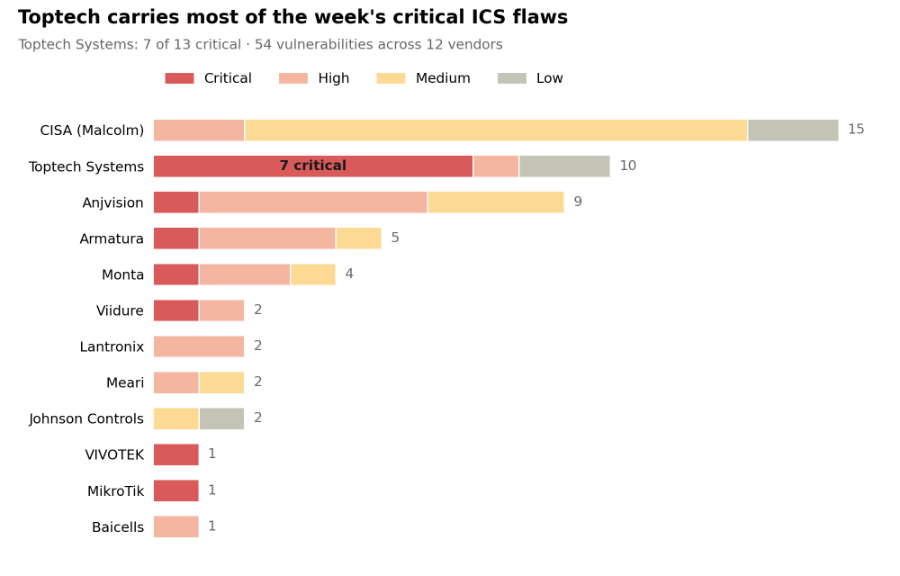
Toptech Systems’ TMS7 and TopHAT version 7.6.3 carried more critical-rated ICS vulnerabilities than any other product this week. They include multiple SQL injection flaws (such as CVE-2026-72510 and CVE-2026-63713), an unrestricted file upload flaw (CVE-2026-70356), and files exposed to external parties (CVE-2026-71379).
TMS7 is a terminal management system that controls liquid fuel and chemical distribution in the Energy, Chemical, and Transportation Systems sectors. In a product that governs fuel terminal operations, these flaws could enable interference with physical processes, not just data theft. Toptech has published security update information.
Two flaws affect Lantronix G520 Series cellular gateways running 2.6.0.4R6_stable. CVE-2026-91191 is an improper cryptographic signature verification flaw, and CVE-2026-84409 is a cross-site scripting (XSS) flaw.
The signature flaw could let attackers bypass firmware integrity checks and push unauthorized firmware to remote field devices. Combined with the XSS bug, it creates a realistic multistage attack path against devices that may be hard to inspect physically. Lantronix has published remediation details.
CVE-2026-84411 is a critical integer underflow vulnerability in MikroTik RouterOS versions before 7.24. Updated versions are available from MikroTik’s download page.
CVE-2026-22755 is a critical command injection flaw affecting 37 VIVOTEK camera models across its V, C, S, Dome, Bullet, and Panoramic series. VIVOTEK has posted an update package.
CVE-2026-95102 is a missing-authentication flaw for a critical function in all versions of monta.app. Three other Monta flaws involve excessive authentication attempts, session expiration, and credential protection. The advisory data referenced no vendor fix.
Anjvision’s YSSD-RTMP-H5 firmware has nine vulnerabilities, led by CVE-2026-100291, a critical insecure default setting. Others include OS command injection, hardcoded credentials, and improper signature verification.
The Viidure Dashcam Android app, version 3.3.1.260403 and earlier, contains hardcoded credentials (CVE-2026-96587, critical). Armatura One is affected by CVE-2023-46604, a critical deserialization flaw, plus hardcoded key and credential issues.
No vendor fixes were referenced for these products, so compensating controls such as network isolation are the main option for now.
In an unusual disclosure, CISA reported 15 vulnerabilities in Malcolm, its own open-source network traffic analysis and threat-hunting platform. The flaws affect versions before 26.06.0.
They span authentication bypass, missing authorization, default credentials, OS command injection, path traversal, and SSRF. Most are rated medium, and two are rated high. Users should update through the Malcolm releases page.
The remaining advisories covered Baicells Technologies, Meari, and Johnson Controls products.
Energy was the most exposed sector this week, followed by Transportation Systems and Commercial Facilities.
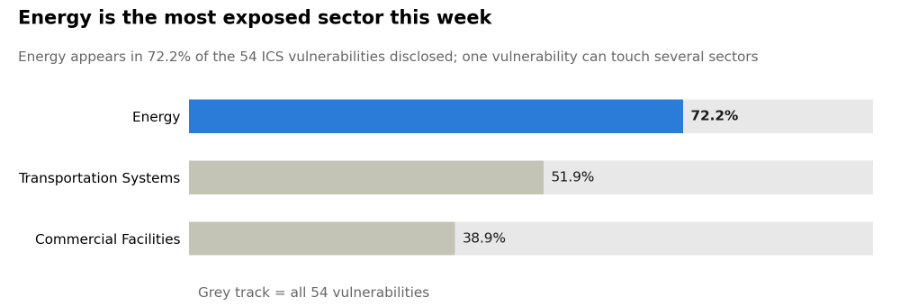
The largest single combination, Energy, Information Technology, and Water and Wastewater, accounted for 27.8% of vulnerabilities. Energy, Chemical, and Transportation Systems made up another 18.5%, driven largely by the Toptech disclosures.
These disclosures cut across traditional infrastructure boundaries rather than clustering in one domain. A single flaw in a shared product can create risk for fuel, water, and transportation operators at once.
This weekly vulnerability report highlights several trends:
With 13 critical ICS vulnerabilities and active exploitation attempts against both new and legacy flaws, organizations face risk across enterprise IT and operational technology (OT) environments.
Cyble’s attack surface management and vulnerability intelligence solutions help organizations identify exposed assets, prioritize remediation, and detect early signs of compromise. Combined with real-time sensor intelligence, they help security teams stay ahead of threats across enterprise and critical infrastructure environments. To see these capabilities in action, schedule a demo with Cyble.
Disclaimer: The data and content written in this blog is based on certain sensor and open web information available. Analysts and researchers are advised to confirm once again from original sources.
Text extracted automatically; images, tables and formatting may be missing. Original: https://cyble.com/blog/weekly-vulnerability-report-langflow-n8n-ics-flaws/
|
| mass≈1M+ internet-exposed Windows SMB servers (public port-445 scans), plus hundreds of millions of legacy Windows endpoints with SMBv1 enabled by default; Siemens… |
KEV |
CVE-2018-10562+1 related CVE | Unauthenticated RCE in Dasan GPON Routers (CVE-2018-10562) CVE-2018-10562 is an OS command injection flaw (CWE-78) in the web management interface of Dasan GPON home routers. When chained with the companion authentication bypass CVE-2018-10561, a remote, unauthenticated attacker can send crafted requests that execute arbitrary commands on the device. Successful exploitation yields full control of the router, enabling device takeover, botnet enrollment, and, per CISA, use in ransomware operations. Anyone operating an affected Dasan GPON router — many of which were deployed by internet service providers — is affected, and CISA notes the impacted products are end-of-life. Exploitation is confirmed in the wild: the flaw is in CISA's KEV (added 2022-03-31) with known ransomware use and a 100% EPSS probability of exploitation within 30 days. Do: Because the product line is end-of-life and CISA's required action is to disconnect impacted devices if still in use, retire or replace affected routers rather than patching in place. If replacement must wait, block or firewall the web management interface from the internet, check the device for signs of compromise, and ensure the related authentication-bypass path CVE-2018-10561 is also closed. | 9.8 | 100% | KEV ransomware PoC ×2 |
| mass≈1 million internet-exposed devices (public scan counts around the 2018 disclosure) | KEV |
| CVE-2019-0708 | Unauthenticated RCE in Microsoft Remote Desktop Services (BlueKeep) CVE-2019-0708 is a use-after-free (CWE-416) vulnerability in Microsoft Remote Desktop Services, formerly Terminal Services, in which an unauthenticated attacker can connect to a target system over RDP and send specially crafted requests to trigger the flaw. Because the trigger requires no authentication, the flaw is wormable: a successful exploit grants remote code execution on the target host, potentially with elevated privileges, and could allow self-propagating attacks similar to WannaCry. Organizations running the affected Microsoft Remote Desktop Services, particularly legacy Windows releases still accepting inbound RDP connections, are in scope. Exploitation is confirmed in the wild: the flaw (nicknamed BlueKeep) is listed in CISA's KEV catalog (added 2021-11-03), CISA notes known ransomware use, and EPSS assigns it a 100% probability of exploitation within 30 days. Do: Apply Microsoft's security updates for CVE-2019-0708 per vendor instructions, prioritizing legacy or end-of-support Windows systems exposed to inbound RDP. As mitigation, restrict RDP (TCP 3389) to trusted networks or VPN access, require Network Level Authentication (NLA), and audit perimeter firewalls and public scans for open RDP listeners. The vulnerability is in the CISA KEV catalog, so patching is treated as a required action for federal and high-risk environments. | 9.8 | 100% | KEV ransomware PoC ×4 |
| masson the order of millions of internet-exposed RDP endpoints and far more internal systems | KEV |
CVE-2019-12255+3 related CVEs | Wind River VxWorks has a Buffer Overflow in the TCP component (issue 1 of 4) Wind River VxWorks has a Buffer Overflow in the TCP component (issue 1 of 4). This is a IPNET security vulnerability: TCP Urgent Pointer = 0 that leads to an integer underflow. NVD description · AI analysis pending | 9.8 group max | 75% | PoC |
| — |
| CVE-2020-11899 | Out-of-Bounds Read in Treck TCP/IP Stack (IPv6) Affecting Dell Wyse Thin Clients CVE-2020-11899 is an out-of-bounds read (CWE-125) in the IPv6 implementation of the Treck TCP/IP stack, present in versions before 6.0.1.66. It is triggered when a device running the vulnerable stack processes specially crafted IPv6 traffic; the CVSS vector indicates an adjacent-network attacker requires no privileges or user interaction, with low integrity and availability impacts and no confidentiality impact. Because the Treck TCP/IP stack is embedded software licensed into many vendors' products, affected products include the Treck stack itself and, per this data, Dell Wyse 5030, Wyse 5050 All-in-One, and Wyse 7030 thin-client firmware. The flaw is listed in CISA's Known Exploited Vulnerabilities catalog (added 2022-03-03), a public proof-of-concept reference exists via JSOF's Ripple20 research page, and EPSS assigns an 18.6% probability of exploitation within 30 days (97th percentile); ransomware use is unknown. Do: Upgrade the Treck TCP/IP stack to 6.0.1.66 or later and apply the Dell firmware updates for Wyse 5030, Wyse 5050 All-in-One, and Wyse 7030 per vendor instructions, which is the CISA KEV required action for federal agencies. Inventory embedded, IoT/OT, and thin-client assets that may bundle the Treck stack, and restrict untrusted IPv6 traffic on adjacent network segments where upgrades are not yet available. Check additional vendors' advisories as well, since the Treck stack ships in many third-party products beyond those listed here. | 5.4 | 18% | KEV PoC |
| masshundreds of thousands to millions of embedded devices running the Treck TCP/IP stack, including enterprise fleets of the listed Dell Wyse thin clients | KEV |
CVE-2020-11900+1 related CVE | The Treck TCP/IP stack before 6.0.1.41 has an IPv4 tunneling Double Free The Treck TCP/IP stack before 6.0.1.41 has an IPv4 tunneling Double Free. NVD description · AI analysis pending | 8.2 group max | 13% | PoC |
| — |
| CVE-2024-25600 | Improper Control of Generation of Code ('Code Injection') vulnerability in Codeer Limited Bricks Builder allows Code Injection.This issue affects Bricks Builder Improper Control of Generation of Code ('Code Injection') vulnerability in Codeer Limited Bricks Builder allows Code Injection.This issue affects Bricks Builder: from n/a through 1.9.6. NVD description · AI analysis pending | 10.0 | 88% |
| — |
| CVE-2024-4577 | OS Command Injection in Windows PHP-CGI Allows Remote Code Execution CVE-2024-4577 is an OS command injection flaw (CWE-78) in Windows-based PHP when it runs in CGI mode, allowing arbitrary code execution on the server. It is triggered when attacker-supplied characters in HTTP requests are mishandled by Windows' character-encoding conversion as the OS invokes php-cgi, letting attackers inject command-line arguments to the PHP interpreter; this bypasses the decade-old fix for CVE-2012-1823. A successful attacker gains the ability to run arbitrary commands and code in the context of the web server. Affected systems are PHP running on Windows through the CGI interface; deployments that do not use PHP-CGI on Windows are not described as affected in the source data. Exploitation is active: the flaw was added to CISA KEV on 2024-06-12 with known ransomware use, and EPSS assigns roughly 100% probability of exploitation within 30 days. Do: Per the CISA KEV required action, apply mitigations per vendor instructions or discontinue use: upgrade Windows PHP-CGI deployments to a PHP release that fixes CVE-2024-4577 per PHP Group advisories, or stop using CGI mode on Windows (e.g., switch to FastCGI) and apply any vendor-recommended workarounds. Given known ransomware abuse, review web server access logs for exploitation attempts (notably %AD-encoded soft hyphens and injected -d/-s arguments in php-cgi query strings) and prioritize patching internet-facing Windows hosts. | 9.8 | 100% | KEV ransomware PoC ×11 |
| large≈10,000–100,000 internet-exposed Windows PHP-CGI systems | KEV |
| CVE-2024-6587 | SSRF in LiteLLM Leaks OpenAI API Keys via api_base Parameter CVE-2024-6587 is a server-side request forgery (SSRF, CWE-918) flaw in the BerriAI LiteLLM LLM proxy, reported for version 1.38.10. It is triggered when a client supplies an attacker-controlled `api_base` parameter in a request to POST /chat/completions, causing LiteLLM to send that request — including the configured OpenAI API key — to the attacker-chosen domain. An attacker who points `api_base` at a server they control can intercept the OpenAI API key and then access or misuse it directly against the OpenAI API, giving a high-confidentiality impact per the 7.5 CVSS score (no integrity or availability impact). Any deployment of LiteLLM that allows callers, without authentication per the CVSS vector (PR:N), to set `api_base` on this endpoint is affected, with internet-exposed proxy instances at greatest risk. No confirmed in-the-wild exploitation of this specific CVE is documented yet, but a public proof-of-concept exists, EPSS assigns a ~35% (98th-percentile) probability of exploitation within 30 days, and defenders are reporting a broader coordinated surge in SSRF exploitation. Do: Upgrade LiteLLM to the latest patched release and stop trusting client-supplied `api_base` values — validate or allow-list them, or disable user-controlled `api_base` on /chat/completions. Review proxy logs for completions requests sent to unexpected external domains and rotate any OpenAI API keys configured in LiteLLM, since a leaked key gives attackers direct access to your OpenAI account and billing. | 7.5 | 35% | PoC |
| moderate≈10,000s of self-hosted proxy deployments (widely adopted open-source LLM gateway; most instances run on internal networks, only a fraction internet-exposed) |
| CVE-2024-7591 | Improper Input Validation vulnerability in Progress LoadMaster allows OS Command Injection.This issue affects Improper Input Validation vulnerability in Progress LoadMaster allows OS Command Injection.This issue affects: * LoadMaster: 7.2.40.0 and above * ECS: All versions * Multi-Tenancy: 7.1.35.4 and above NVD description · AI analysis pending | 7.2 | 44% |
| — |
| CVE-2025-2010 | The JobWP – Job Board, Job Listing, Career Page and Recruitment Plugin plugin for WordPress is vulnerable to SQL Injection via the 'jobwp_upload_resume'… The JobWP – Job Board, Job Listing, Career Page and Recruitment Plugin plugin for WordPress is vulnerable to SQL Injection via the 'jobwp_upload_resume' parameter in all versions up to, and including, 2.3.9 due to insufficient escaping on the user supplied parameter and lack of sufficient preparation on the existing SQL query. This makes it possible for unauthenticated attackers to append additional SQL queries into already existing queries that can be used to extract sensitive information from the database. NVD description · AI analysis pending | 7.5 | 2% |
| — |
| CVE-2025-3248 | Unauthenticated RCE in Langflow /api/v1/validate/code Langflow, an open-source visual framework for building LLM and agentic AI applications, contains a missing authentication flaw (CWE-306) in its /api/v1/validate/code endpoint. A remote attacker with network reachability to the endpoint can send crafted HTTP requests without any credentials, causing arbitrary code execution on the server. Successful exploitation yields code execution under the application's privileges, enabling data theft, backdoor installation, and, per CISA, ransomware deployment. Any running Langflow instance is affected; the tool is typically self-hosted by development teams building AI workflows, so real-world exposure depends on whether each instance is reachable from untrusted networks. Exploitation is confirmed in the wild: the flaw was added to CISA's KEV catalog on 2025-05-05 with known ransomware use, EPSS assigns a 100% probability of exploitation within 30 days (100th percentile), and a public PoC is available. Do: Upgrade Langflow to the latest patched release identified in the vendor's advisory; federal agencies must apply mitigations per vendor instructions under BOD 22-01 or discontinue use if mitigations are unavailable. Until patched, restrict network access to the /api/v1/validate/code endpoint via reverse-proxy authentication, firewall rules, or VPN placement, and avoid exposing Langflow directly to the internet. Because ransomware use is confirmed, review access and process-execution logs for signs of prior compromise. | 9.8 | 100% | KEV ransomware PoC ×2 |
| moderatetens of thousands of self-hosted deployments, with likely only hundreds to low thousands directly exposed to the internet | KEV |
| CVE-2025-46565 | Vite: 6.2.7, 6.1.6, 5.4.19, and 4.5.14, the contents of files in the project root that are denied by a file matching pattern can be… Vite is a frontend tooling framework for javascript. Prior to versions 6.3.4, 6.2.7, 6.1.6, 5.4.19, and 4.5.14, the contents of files in the project root that are denied by a file matching pattern can be returned to the browser. Only apps explicitly exposing the Vite dev server to the network (using --host or server.host config option) are affected. Only files that are under project root and are denied by a file matching pattern can be bypassed. `server.fs.deny` can contain patterns matching against files (by default it includes .env, .env.*, *.{crt,pem} as such patterns). These patterns were able to bypass for files under `root` by using a combination of slash and dot (/.). This issue has been patched in versions 6.3.4, 6.2.7, 6.1.6, 5.4.19, and 4.5.14. NVD description · AI analysis pending | 6.0 | 1% | PoC |
| — |
| CVE-2025-58360 | Actively Exploited XXE in OSGeo GeoServer WMS GetMap Endpoint GeoServer, an open source server for sharing and editing geospatial data, is vulnerable to an XML External Entity (XXE) injection flaw (CWE-611) tracked as CVE-2025-58360. The flaw is triggered when an unauthenticated XML request sent to the /geoserver/wms endpoint with operation GetMap is not sufficiently sanitized or restricted, allowing an attacker to define external entities in the request and have the server resolve them, which can lead to disclosure of local files, SSRF to internal services, and potentially further compromise. It carries a CVSS 3.1 score of 9.8 (critical) with high impact on confidentiality, integrity, and availability, and related reporting describes unauthenticated RCE chains affecting government geoportal backends in this software ecosystem. Any organization running GeoServer 2.26.0 up to but not including 2.26.2, or any version before 2.25.6, is affected. Exploitation is confirmed in the wild: CISA added the flaw to its Known Exploited Vulnerabilities catalog on 2025-12-11, and EPSS assigns a 64.9% probability of exploitation within 30 days (99th percentile). Do: Upgrade immediately to GeoServer 2.25.6, 2.26.3, or 2.27.0, which contain the fix. If patching is delayed, restrict or firewall access to the /geoserver/wms endpoint (particularly GetMap requests) and limit the server's ability to fetch external resources; federal agencies must follow BOD 22-01 guidance per the KEV listing. Review WMS access logs for suspicious XML entity usage and outbound connections or file-read activity from the GeoServer host as indicators of exploitation. | 9.8 | 61% | KEV |
| large≈10,000–30,000 internet-exposed GeoServer instances, plus an unknown number of internal deployments (estimate) | KEV |
| CVE-2025-68613 | Authenticated RCE in n8n Workflow Automation Expression Evaluation n8n, an open source workflow automation platform, contains a critical remote code execution vulnerability (CVE-2025-68613, CWE-913) in its workflow expression evaluation system, affecting versions starting at 0.211.0 and prior to 1.120.4, 1.121.1, and 1.122.0. The flaw is triggered when expressions supplied by authenticated users during workflow configuration are evaluated in an execution context that is not sufficiently isolated from the underlying runtime, allowing the attacker to execute arbitrary code with the privileges of the n8n process. Successful exploitation can result in full compromise of the affected instance, including unauthorized access to sensitive data, modification of workflows, and execution of system-level operations. Any self-hosted or cloud n8n deployment running an affected version is exposed, with public scans indicating roughly 24,700 instances remain exposed on the internet. The flaw was added to CISA's Known Exploited Vulnerabilities catalog on 2026-03-11, EPSS places the 30-day exploitation probability at 99.1% (100th percentile), and Akamai has documented a ZeroBot malware campaign targeting n8n instances. Do: Upgrade immediately to n8n 1.120.4, 1.121.1, or 1.122.0 (or later), as the flaw is in CISA KEV and actively exploited by the ZeroBot malware campaign documented by Akamai. If immediate upgrade is not possible, restrict workflow creation and editing permissions to fully trusted users and run n8n in a hardened environment with restricted OS privileges and network access, keeping in mind these mitigations do not fully eliminate the risk. Review instances for signs of compromise, including unexpected workflow changes and suspicious process activity, and apply BOD 22-01 requirements if the product is used in federal cloud services. | 8.8 | 99% | KEV PoC ×2 |
| large≈24,700 internet-exposed n8n instances (public internet scan counts cited in exploit reporting) | KEV |
| CVE-2026-4020 | Unauthenticated Sensitive Data Exposure in Gravity SMTP WordPress Plugin CVE-2026-4020 is an unauthenticated sensitive information exposure (CWE-200) in the Gravity SMTP plugin for WordPress, affecting all versions up to and including 2.1.4. The plugin registers a REST route at /wp-json/gravitysmtp/v1/tests/mock-data with a permission_callback that unconditionally returns true, so any anonymous visitor can call it; when the ?page=gravitysmtp-settings parameter is appended, the register_connector_data() method populates internal connector data and the endpoint returns roughly 365 KB of JSON containing the full System Report. An unauthenticated attacker therefore gains detailed configuration information, including PHP and WordPress versions, loaded extensions, web server and database server type and version, document root, database table names, all active plugins with versions, the active theme, WordPress configuration details, and any API keys or tokens configured in the plugin, which can enable follow-on attacks. Any WordPress site running Gravity SMTP 2.1.4 or earlier is affected, and related reporting indicates attackers are already exploiting the bug in the wild to expose API keys, with EPSS estimating a 40% probability of exploitation within 30 days (99th percentile). Do: Update Gravity SMTP to the latest available patched release (any version newer than 2.1.4) as soon as possible. Until patched, block or restrict unauthenticated access to /wp-json/gravitysmtp/v1/tests/mock-data, for example via WAF rules or REST API restrictions. Rotate any API keys or tokens configured in the plugin and review web server logs for requests to the endpoint, since in-the-wild attacks are already exposing keys. | 7.5 | 40% |
| moderatelikely on the order of tens of thousands of WordPress sites (exact active-install count not provided in the data) |
| CVE-2026-44825 | Hardcoded credentials in the Basic Authentication setup tool (bin/solr auth enable) in Apache Solr versions 9.4.0 through 9.10.1 and 10.0.0 allows a remote… Hardcoded credentials in the Basic Authentication setup tool (bin/solr auth enable) in Apache Solr versions 9.4.0 through 9.10.1 and 10.0.0 allows a remote attacker to gain full administrative access to the cluster via publicly known default credentials installed silently alongside the user-specified account. As an immediate workaround without upgrading, delete the template users (superadmin, admin, search, index) from security.json or change their passwords. The future, not yet released, versions 9.11.0 and 10.1.0 will not be vulnerable, and it will be enough to upgrade to solve the issue. Not affected: * Clusters where bin/solr auth enable was not used to bootstrap BasicAuth * Clusters where template users have been assigned strong passwords after bootstrap NVD description · AI analysis pending | 9.8 | 3% |
| — |
CVE-2026-63030+1 related CVE | WordPress Core Route Confusion (wp2shell) Enables SQL Injection to RCE WordPress Core contains an interpretation-conflict flaw (CWE-436) in the REST API batch endpoint that causes route confusion, allowing requests to be dispatched to an unintended route. When chained with the author__not_in WP_Query SQL injection (CVE-2026-60137), this allows a remote, unauthenticated attacker to inject SQL and escalate to remote code execution. Any WordPress site running 6.9.x before 6.9.5 or 7.0.x before 7.0.2 is affected, with no privileges or user interaction required (CVSS 3.1: 9.8). Exploitation is confirmed in the wild: the issue was added to CISA's KEV on 2026-07-21, EPSS is 97.3% (100th percentile), and a public PoC is reportedly fueling mass scanning under the 'wp2shell' label. Do: Upgrade immediately to WordPress 6.9.5 (for 6.9.x) or 7.0.2 (for 7.0.x), or later, which fixes both this flaw and the chained SQL injection CVE-2026-60137; prioritize internet-facing sites because exploitation is unauthenticated and being mass-scanned. Review web and REST API logs for suspicious batch requests, SQL errors, unexpected admin users, or modified files. Organizations in scope for CISA BOD 26-04 must apply the required mitigations per vendor instructions or discontinue use. | 9.8 group max | 11% | KEV PoC ×4 |
| massest. hundreds of thousands to millions of WordPress sites (core runs roughly 40% of the web; only unpatched 6.9.x/7.0.x instances remain exploitable) | KEV |
| CVE-2026-9198 | Unauthenticated RCE Chain in IBM Langflow OSS 1.0.0-1.10.0 IBM Langflow OSS 1.0.0 through 1.10.0 contains an unauthenticated code-injection flaw (CWE-94) that can be chained into full remote code execution. An attacker with network access first calls /api/v1/auto_login, which mints a SUPERUSER token to any caller without authentication, then calls /api/v1/validate/code, which executes attacker-supplied code via exec() on the Langflow host. Successful exploitation yields full control of the affected deployment, with high impact on confidentiality, integrity, and availability (CVSS 3.1: 9.8, network-exploitable with no privileges or user interaction required). Anyone running IBM Langflow OSS 1.0.0-1.10.0 is affected, especially default deployments reachable from untrusted networks. CISA added the flaw to the Known Exploited Vulnerabilities catalog on 2026-08-04, confirming active exploitation; EPSS estimates a 60.6% probability of exploitation within 30 days (99th percentile), and ransomware use is unknown. Do: Upgrade IBM Langflow OSS to a release newer than 1.10.0 per IBM's (psirt@us.ibm.com) security advisory, as required under CISA's BOD 26-04 guidance for KEV entries; if mitigations are unavailable, discontinue use of the product per BOD 26-04. Until patched, restrict network access to the /api/v1/auto_login and /api/v1/validate/code endpoints (e.g., firewall rules or reverse-proxy controls) and avoid exposing the instance directly to the internet. Because exploitation is confirmed, review access logs for requests to these endpoints and signs of unauthenticated SUPERUSER token issuance or unexpected code execution. | 9.8 | 29% | KEV PoC |
| largelikely tens of thousands of self-hosted or internet-exposed deployments (estimate) | KEV |