DigitalOcean Ends Open Source Credits Program
DigitalOcean is quietly ending its Open Source Credits program and stopping new or renewed credits.
DigitalOcean is sunsetting its Open Source Credits program without a public blog post, telling projects including Node.js that new applications, renewals, and extensions will not be approved. Existing credits can still be used, after which projects must pay or move infrastructure. Node.js maintainers discussed dropping DigitalOcean branding, after which the company reportedly re-engaged about a more selective program version 2.0. DigitalOcean also dropped GitHub Student Pack credits earlier and recently donated $3 million to the Omacom Foundation behind Omarchy Linux.
- No public announcement; projects including Node.js learned by email.
- New applications, renewals, and credit extensions are no longer accepted.
- Node.js later discussed a possible selective program version 2.0.
- DigitalOcean recently gave $3 million to the Omarchy Linux foundation.
Full article1,182 words · extracted from itsfoss.com · click to collapse

DigitalOcean is ending its Open Source Credits program quietly:
DigitalOcean has decided to sunset the Open Source Credits Program. As part of this change, we are no longer accepting new credit applications or approving credit renewals, extensions, or additional credit requests.
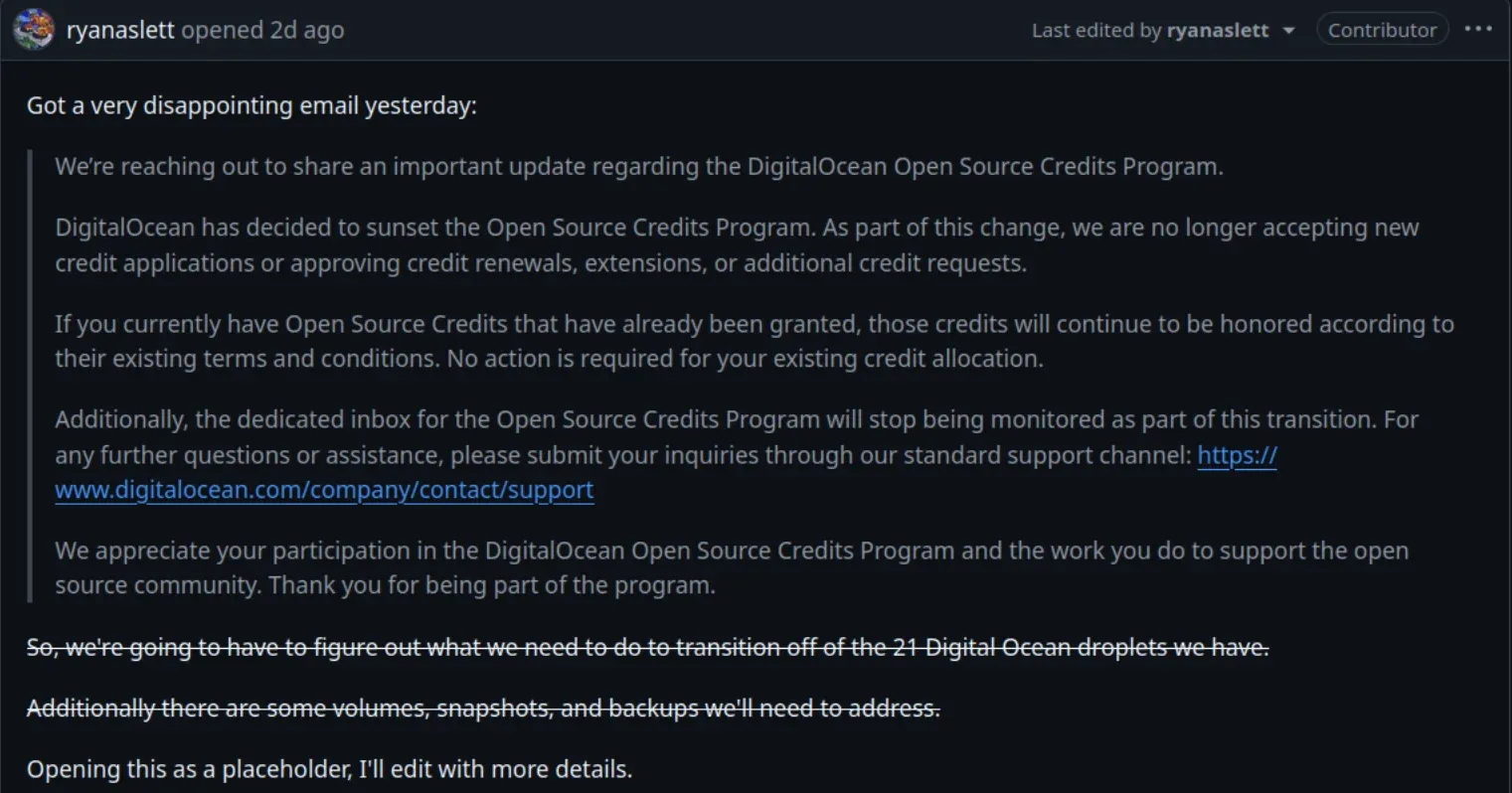
It came to highlight from a GitHub issue where the maintainers of the Node.js project received an email from DigitalOcean notifying them about the sunset of the Open Source Credits program.
📋
When we first published this story, it was a speculation. Now more projects have confirmed that they have received this closure email from DigitalOcean. The article has been edited since to reflect that fact.
What was the Open Source Credits program?
DigitalOcean is a cloud server infrastructure provider. It ran this "Open Source Credits" program and under this scheme, they gave approved open-source projects cloud credits to cover infrastructure costs. This helped project maintainers run their projects without paying the hosting bill.
For example, Node.js used DigitalOcean infrastructure for its build operations, including virtual servers, storage, snapshots and backups.
For years, DigitalOcean promoted this program and invited projects to apply to this program by sending them a message via opensource@digitalocean.com.
This seems to have changed now.
Sunsetting the Open Source Credits program
Note that there is no official announcement on DigitalOcean's blog or social media handles. The program is being ended quietly.
The problem came to light from this GitHub issue where Node.js maintainers discuss this email.
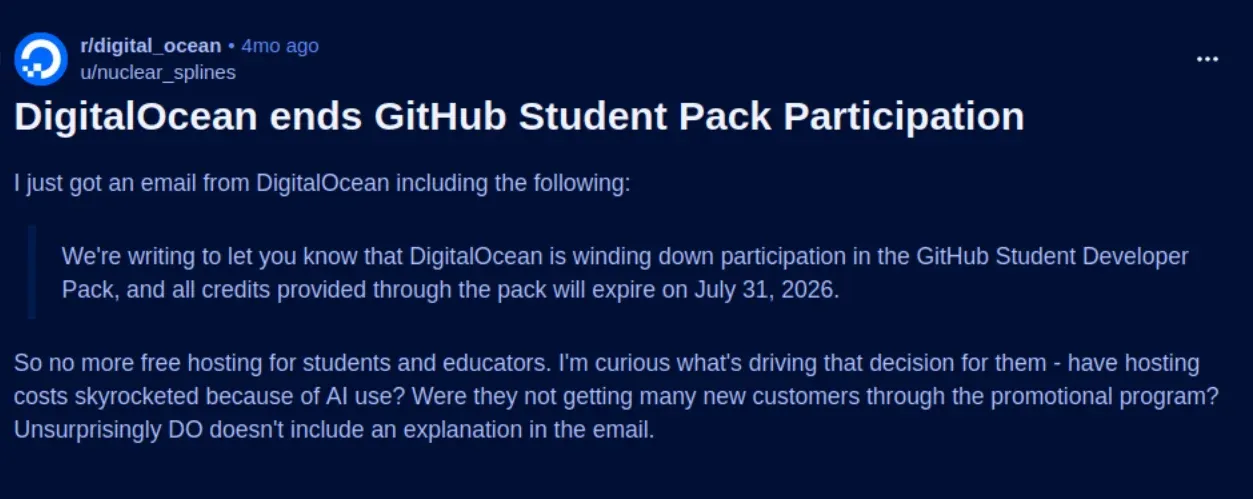
There is also a Reddit thread, but the OP doesn't mention if they received the email themselves or which open source project they maintained.
Earlier, I had scanned Reddit, X and some other social media platforms, but there was not enough chatter about it. But more developers have confirmed receiving this email.
Gray, lead developer of Pidgin messenger, shared this on Mastodon:
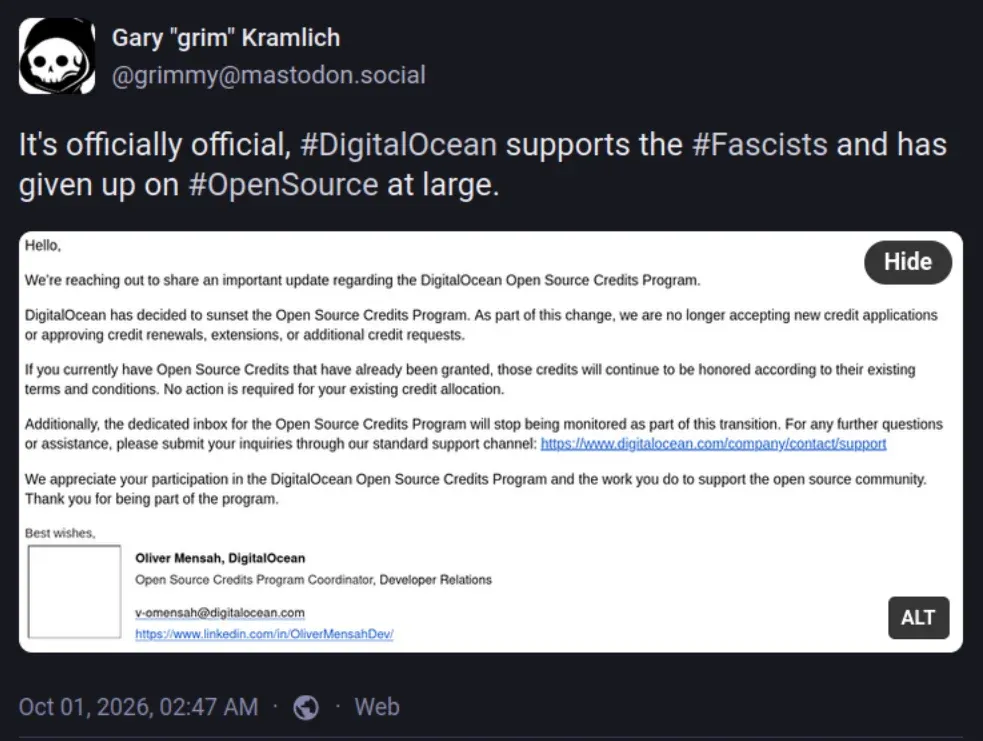
Projects in the program won't receive new credits. The will have to manage with whatever credits that have been issued so far. After that, either they pay to DigitalOcean or move their projects to some other platform provider.
The mail also mentions that new projects will no longer be accepted in the program and the inbox (opensource@digitalocean.com) dedicated for this task will no longer be monitored. That closes the door for new applicants.
A mutual partnership
Programs such as this are a mutually beneficial arrangement. When DigitalOcean offered credits, these projects spun up their CI runners, their documentation sites, their release mirrors, and their testing environments on DigitalOcean infrastructure.
In return, they mentioned DigitalOcean in the project website and documentation. Thousands of developers learned about DigitalOcean's platform through these projects. Some become paying customers individually, whereas some bring it into the companies they worked for.
Both involved parties get something positive from Open Source Credits like programs.
DigitalOcean has been reducing its free offering
This is not the first time DigitalOcean has trimmed its community-facing programs without a clear announcement.
Earlier this year, the GitHub Student Pack credits were removed from DigitalOcean's offerings too. Students trying to redeem the standard $200 in free credits found they were no longer receiving them. Again, there were no formal announcements (because it is a bad outlook). So all you will find is community questions by confused users.
DigitalOcean offers $100 free credit (our partner link) to every new user. This program still runs today (so far). Not sure how long this will be offered, though.
Node got DigitalOcean support back
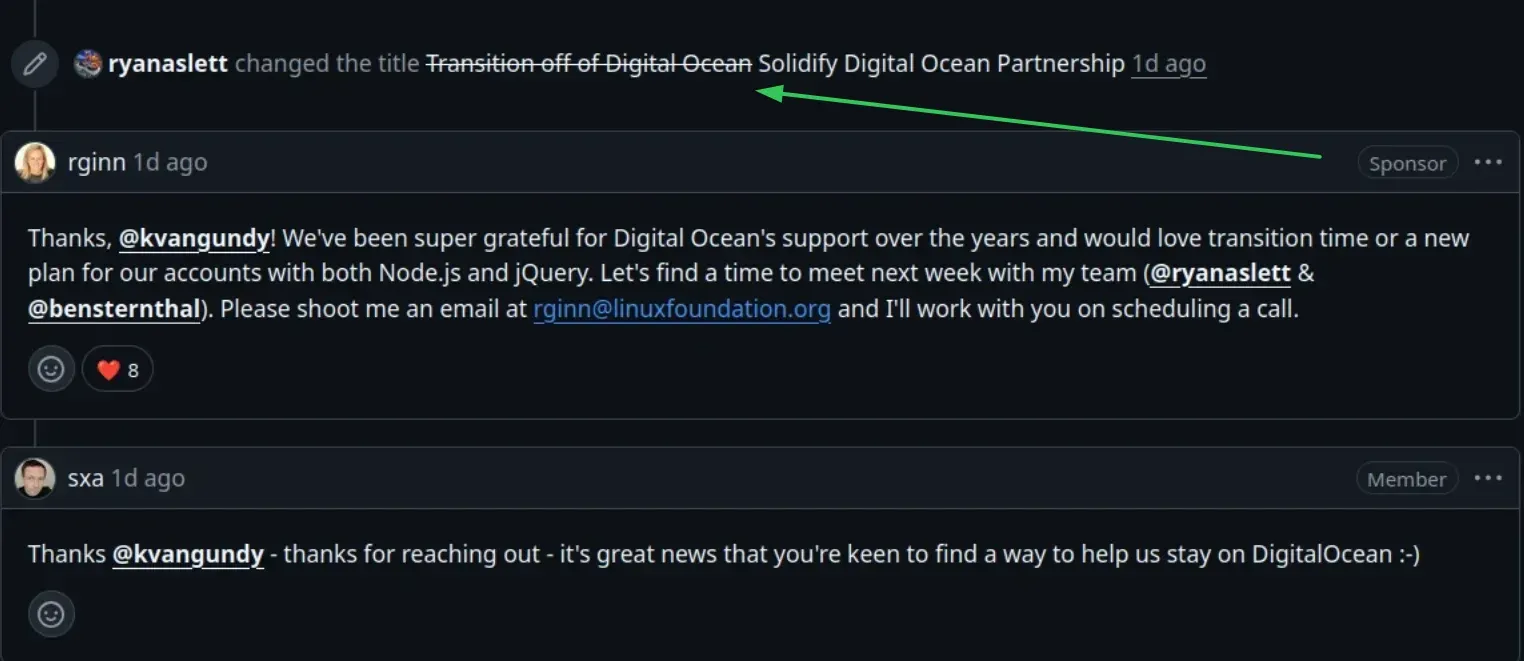
In the same GitHub issue, Node developers discussed their exit strategy. It then led to a discussion of removing DigitalOcean from the homepage, README and partners page.
And as soon as that happened, Digita Ocean reached out with olive branch.
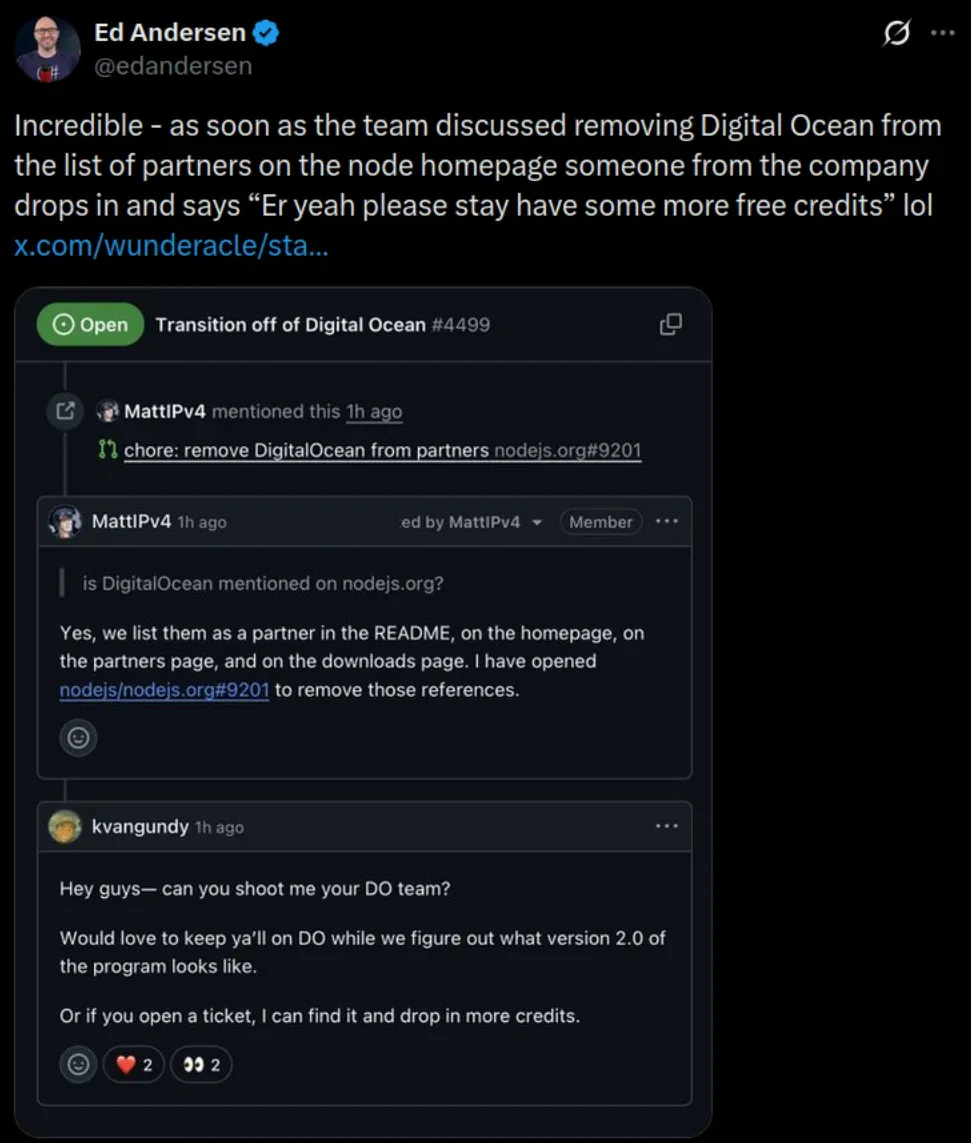
Notice the use of "what version 2.0 of the program looks like" line? This is either a coverup strategy or an actual revamp of the existing program that will be more selective about which projects will be allowed in the program.
The GitHub issue was then promptly renamed from "Transitioning off of Digital Ocean" to "Solidify Digital Ocean Partnership".
But they still got millions to giveaway
It would have made sense if DigitalOcean was facing any financial constrained and this was an attempt to cut down on the expenses.
But that certainly is not the case because only a few weeks ago, DigitalOcean donated $3 million to the Omacom Foundation (the official organization behind Omarchy Linux).
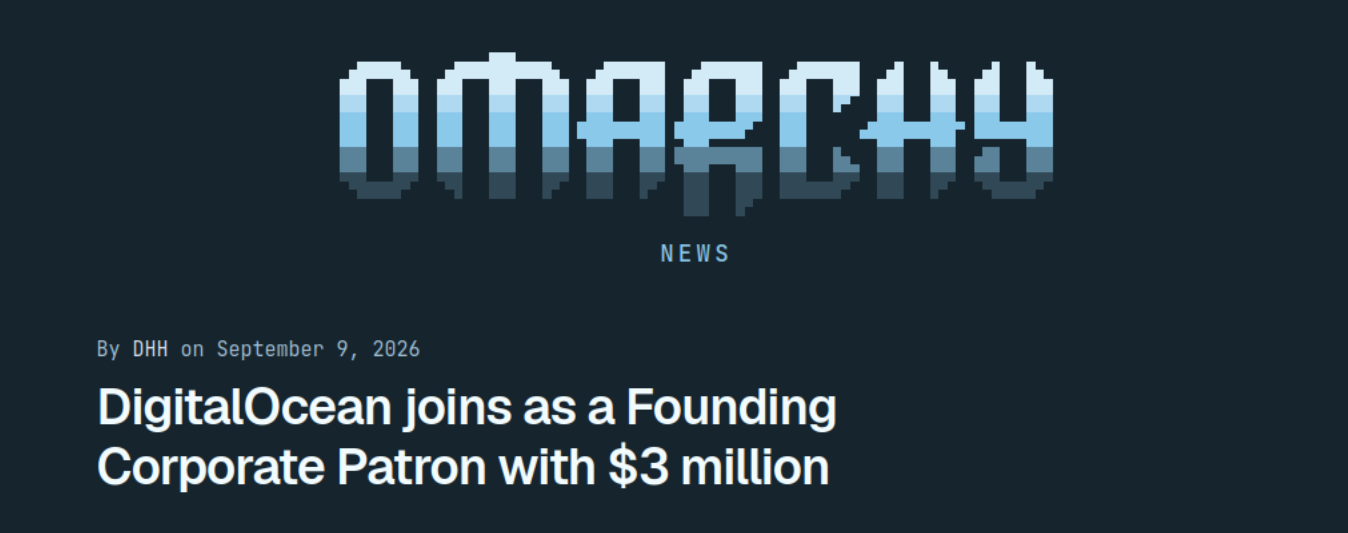
It looks like DigitalOcean gave away all of its open source community budget to Omarchy? That most certainly is not the case.
Other open source projects might not be lucky
Here's what's happening, in my opinion.
Free and Open Source Software movement started in the 80s. It started catching up in the mid- to-late 90s, but it was not as lucrative to coprporates because it contained "free" in its name.
So Open Source was extracted from it and enterprises liked this term over FOSS. From mid 2000s, open source 'ruled' the industry for 20 years. Companies earned brownie points for associating themselves with open source in any way possible.
They liked the idea that a community of developers worked collectively on a project that could have been utilized by them in one way or another.
In the age of AI, open source doesn't have the same edge anymore. AI can generate software on demand, can handle the works of tens or even hundreds of developers. Enterprises don't need to rely on open-source projects as much as they did in the past.
Python, Node and many other projects that AI workflow rely on still get support from corporations. But smaller, end user facing projects and the legacy ones with no usage for AI will be neglected.
What next for impacted projects?
Node.js is a big project popular with developers of all kinds. Getting their name and link removed when their competitors, like Vercel, are still mentioned on Node.js homepage is something DigitalOcean could not afford.
But not all open source projects are going to get that kind of happy ending. The smaller projects are going to think about infrastructure bills and move.
When maintainers are already drowning in AI slop pull requests and bug reports, this is going to put additional strain on the maintainers.
Gary Kramlich, Pidgin lead developer, told It's FOSS that he hadn't actually gotten credits from DigitalOcean for over a year and he had been paying from his own pockets.
...we're trying to find other sponsored hosting or a colo sponsorship or anything really. But in the meantime we're re-evaluating everything we're running and cutting things...
Hopefully, some newer infrastructure providers will come up with similar programs. No harm in thinking positive.
If you are an open source project maintainer who got this Open Source Credits program closure email, please reach out to us.
Enjoyed this update? Support independent Linux news coverage
It's FOSS has been helping people use Linux for the past 14 years. Help us stay independent from big tech. Become a Plus member, enjoy ad-free reading and get 5 eBooks.