Almost 2,000 Exchange servers hacked using ProxyShell exploit
Vulnerabilities mentionedAll →
| CVE | Vulnerability | CVSS | EPSS | Flags | Affected | Exposure | Published |
|---|---|---|---|---|---|---|---|
| CVE-2021-31207 | Security feature bypass in Microsoft Exchange Server (ProxyShell) enables webshell RCE CVE-2021-31207 is a security feature bypass in Microsoft Exchange Server, classified as an unrestricted file-write issue (CWE-434) that lets an attacker bypass intended restrictions and write files of their choosing to the server. It is the final bug in the ProxyShell chain: chained with the autodiscover SSRF and PowerShell backend elevation flaws, it allows an unauthenticated attacker to reach the Exchange PowerShell API, write arbitrary files such as an ASPX webshell, and execute code with SYSTEM privileges. A successful attacker gains full control of the on-premises Exchange server, including mailbox access, stolen credentials, and a foothold for lateral movement; the bug has been used to deploy ransomware and keyloggers. On-premises deployments of Microsoft Exchange Server (2013, 2016, and 2019 per vendor advisories) are affected, while Exchange Online/cloud mailboxes are not. Exploitation is essentially certain and ongoing: the flaw is in CISA's KEV (added 2021-11-03) with known ransomware use, public ProxyShell PoC/exploit code is available, and EPSS puts the 30-day exploitation probability at 99.8%. Do: Apply Microsoft's July 2021 security updates for Exchange Server 2013, 2016, and 2019 (or any later security/cumulative update) per vendor instructions, and restrict untrusted access to Exchange's autodiscover and PowerShell endpoints. Hunt for ASPX webshells under the Exchange FrontEnd directories and review IIS logs for autodiscover.json requests chaining PowerShell, since many servers were compromised before patching. Given known ransomware use and KEV listing, treat any server that was unpatched or internet-exposed during the exploitation window as potentially compromised. | 6.6 | 100% | KEV ransomware PoC |
| massHundreds of thousands of on-premises Exchange servers (public scans around the July 2021 ProxyShell disclosure showed roughly 400,000-600,000 internet-exposed… | |
| CVE-2021-34473 +1 in the same advisory: …34523 | SSRF (CWE-918) in Microsoft Exchange Server Enabling RCE (ProxyShell) Microsoft Exchange Server contains a server-side request forgery (SSRF, CWE-918) in the Autodiscover service that unauthenticated remote attackers can reach over HTTP. This flaw is the first stage of the widely documented 'ProxyShell' chain, in which the SSRF is combined with privilege escalation and an arbitrary file write in the Exchange PowerShell backend to achieve unauthenticated remote code execution on the server. An attacker who successfully exploits it gains the ability to run code on the Exchange server, and ransomware operators (e.g., Cuba ransomware) leveraged this chain to deploy payloads. Organizations running on-premises Microsoft Exchange Server (2013, 2016, and 2019 per the vendor's advisories) are affected; hosted Exchange Online is a separately managed cloud service. Exploitation is confirmed in the wild: CISA added the flaw to the KEV catalog on 2021-11-03 with known ransomware use, and EPSS assigns it a 100% probability of exploitation within 30 days (100th percentile). Do: Apply Microsoft's July 2021 (or later) Exchange Server security updates, which include the ProxyShell fixes, to all on-premises servers. If patching is delayed, restrict internet access to the Autodiscover/EWS frontend endpoints and consider the URL Rewrite mitigation Microsoft published for ProxyShell. Given the KEV listing and known ransomware use, treat internet-facing, unpatched Exchange servers as potentially compromised and hunt for webshells, unusual Exchange processes, and suspicious account or mailbox activity. | 9.1 group max | 100% | KEV ransomware PoC |
| masshundreds of thousands of on-prem Exchange servers; public internet scans at the time of disclosure showed roughly 400,000+ internet-exposed Exchange instances,… |
Full article656 words · extracted from therecord.media · click to collapse
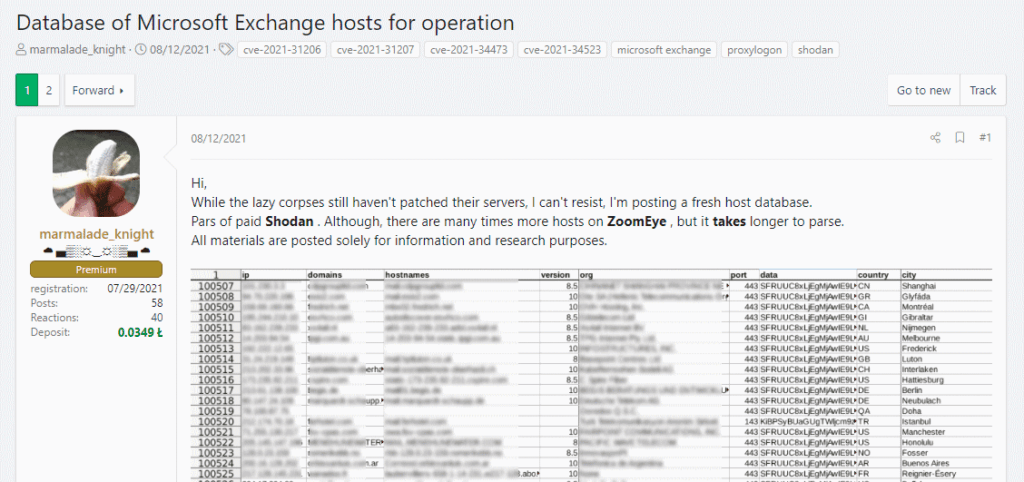
Almost 2,000 Microsoft Exchange email servers have been hacked over the past two days and infected with backdoors after owners did not install patches for a collection of vulnerabilities known as ProxyShell. The attacks, detected by security firm Huntress Labs, come after proof-of-concept exploit code was published online earlier this month, and scans for vulnerable systems began last week. What is ProxyShell? Discovered by Taiwanese security researcher Orange Tsai, ProxyShell is a collection of three different security flaws that can be used to take control of Microsoft Exchange email servers. These include: CVE-2021-34473 provides a mechanism for pre-authentication remote code execution, enabling malicious actors to remotely execute code on an affected system.CVE-2021-34523 enables malicious actors to execute arbitrary code post-authentication on Microsoft Exchange servers due to a flaw in the PowerShell service not properly validating access tokens.CVE-2021-31207 enables post-authentication malicious actors to execute arbitrary code in the context of SYSTEM and write arbitrary files. In the grand scheme of things, ProxyShell is part of a trio of attack chains that Tsai has discovered and put together over the past year since he first began searching for vulnerabilities in Microsoft Exchange servers in mid-2020: ProxyLogonProxyOracleProxyShell Tsai used the ProxyShell exploit during the Pwn2Own 2021 hacking contest in April this year, where he earned $200,000 for a successful server compromise. More than 30,400 Exchange servers exposed to attacks Following his session, details about the exploit were immediately shared with Microsoft, and the company patched the three vulnerabilities in May and July this year. But just like with the ProxyLogon and ProxyOracle disclosures in March and April this year, not all server administrators rushed to patch vulnerable systems. A scan performed on August 8 by ISC SANS, two days after the ProxyShell proof-of-concept code was published, found that more than 30,400 Exchange servers from a total of 100,000 systems had yet to be patched and remained vulnerable to attacks. 1,900+ Exchange servers already hacked Initial exploitation started with scans for vulnerable systems, which then turned into actual attacks over the past weekend, according to honeypot logs collected by security researchers Rich Warren and Kevin Beaumont. Attacks intensified this week, and even a new ransomware operation known as LockFile began using the ProxyShell exploit as a way to enter corporate networks. On Friday, security firm Huntress Labs said it scanned Microsoft Exchange servers that have been hacked using ProxyShell and found more than 140 different web shells on more than 1,900 Exchange servers. "Impacted organizations thus far include building mfgs, seafood processors, industrial machinery, auto repair shops, a small residential airport, and more," said Kyle Hanslovan, CEO and co-founder of Huntress Labs. Making matters worse, earlier this week, a user on a Russian-speaking underground cybercrime forum also published a list of all the 100,000+ internet-accessible Exchange servers, lowering the barrier so even more threat actors can just grab the public exploit and start attacking Exchange servers within minutes. To help system administrators investigate their Exchange servers, Huntress Labs has released indicators of compromise (IOCs). Readers looking to learn more about the ProxyShell vulnerabilities can read Tsai's technical report linked above or watch his Def Con talk embedded below. ProxyShell is now being used to drop corporate ransomware (as is PetitPotam), same IP and actor as in this thread. Myself and @buffaloverflow have been watching them. https://t.co/XZbFLTkami— Kevin Beaumont (@GossiTheDog) August 20, 2021
Keep your Exchange servers safe this weekend. @HuntressLabs has seen 140+ webshells across 1900+ unpatched boxes in 48hrs. Impacted orgs thus far include building mfgs, seafood processors, industrial machinery, auto repair shops, a small residential airport and more. #ProxyShell pic.twitter.com/clhQ0E5rnR— Kyle Hanslovan (@KyleHanslovan) August 20, 2021
No previous article
No new articles
Catalin Cimpanu
is a cybersecurity reporter who previously worked at ZDNet and Bleeping Computer, where he became a well-known name in the industry for his constant scoops on new vulnerabilities, cyberattacks, and law enforcement actions against hackers.
Text extracted automatically; images, tables and formatting may be missing. Original: https://therecord.media/almost-2000-exchange-servers-hacked-using-proxyshell-exploit