Analyzing the vulnerability landscape in Q3 2025
Vulnerabilities mentionedAll →
| CVE | Vulnerability | CVSS | EPSS | Flags | Affected | Exposure | Published |
|---|---|---|---|---|---|---|---|
| CVE-2017-0199 | Remote Code Execution in Microsoft Office and WordPad via crafted document files CVE-2017-0199 is a remote code execution vulnerability in Microsoft Office and WordPad that stems from improper parsing of specially crafted files. Attackers trigger it by getting a user to open a malicious document, after which attacker-controlled code executes with the privileges of the logged-in user. Anyone running the affected Microsoft Office or WordPad software is exposed, and CISA notes the flaw has been leveraged in ransomware campaigns; no CVSS score is available in the source data. The flaw was added to CISA's Known Exploited Vulnerabilities catalog on 2021-11-03, and EPSS assigns a 99.9% probability of exploitation within 30 days (100th percentile), indicating active, ongoing exploitation. Do: Apply Microsoft's security updates for Office and Windows per vendor instructions, as required by CISA's KEV catalog; the flaw was publicly reported as fixed in Microsoft's April 2017 security updates. Until patched, treat unsolicited Office documents and email attachments as high-risk, since exploitation requires a user to open a crafted file. Verify that all Office and WordPad installations across the estate—especially endpoints that handle untrusted documents—have received the update. | 7.8 | 100% | KEV ransomware PoC ×6 |
| masshundreds of millions of Office installations worldwide (exact count unknown) | |
| CVE-2017-11882 | Memory Corruption RCE in Microsoft Office via Legacy Equation Editor CVE-2017-11882 is a memory corruption vulnerability (CWE-119) in Microsoft Office, residing in the legacy Microsoft Equation Editor component (EQNEDT32.EXE), that allows remote code execution in the context of the current user. Attackers trigger it by persuading a user to open a crafted document, most commonly an RTF file or other Office document carrying a malicious embedded equation object, which overflows a buffer while the equation content is parsed. Successful exploitation lets the attacker run arbitrary code with the privileges of the signed-in user, a typical foothold for malware delivery and, per CISA, for ransomware operations. Any environment running affected Microsoft Office builds is exposed; the source data does not enumerate specific affected version ranges. The flaw is confirmed exploited in the wild: it was added to the CISA Known Exploited Vulnerabilities catalog on 2021-11-03 with known ransomware use and holds a 99.9% EPSS score (percentile 100), though the source data lists no public PoC. Do: Apply Microsoft's Office security updates (November 2017 or later) across all endpoints, prioritizing this KEV-listed flaw given its known ransomware use. On systems that cannot yet be patched, disable or unregister the legacy Equation Editor (EQNEDT32.EXE) and consider blocking or warning on RTF attachments as interim mitigations. Check for indicators of abuse such as EQNEDT32.EXE spawning unexpected child processes after document opens. | 7.8 | 100% | KEV ransomware PoC ×10 |
| masshundreds of millions of users/installations (Office is near-ubiquitous on Windows and in enterprises; the share still unpatched is unknown) | |
| CVE-2018-0802 | Memory Corruption RCE in Microsoft Office Equation Editor A memory-corruption flaw (out-of-bounds write, CWE-787) in the legacy Equation Editor component (EQNEDT32.EXE) shipped with Microsoft Office 2007, 2010, 2013, and 2016 allows remote code execution due to improper handling of objects in memory. An attacker triggers it by persuading a user to open a specially crafted document (for example an RTF or DOCX containing a malformed embedded equation object), causing the Equation Editor process to corrupt memory when the file is opened in Word; the user-interaction requirement is reflected in the CVSS 3.1 vector (AV:L/UI:R). Successful exploitation gives the attacker code execution in the context of the current user, with high impact on confidentiality, integrity, and availability (CVSS 3.1 score 7.8, High). Any user of the affected Office versions, the Office Compatibility Pack, or Word on an unpatched system is affected. Exploitation is confirmed in the wild: the flaw is in CISA's Known Exploited Vulnerabilities catalog (added 2021-11-03) with known ransomware use, carries a 93.3% EPSS probability of exploitation within 30 days, and multiple public analyses and proof-of-concepts exist. Do: Apply Microsoft's January 2018 security updates for Office 2007, 2010, 2013, and 2016 and the Office Compatibility Pack, and verify the legacy Equation Editor executable (EQNEDT32.EXE) on endpoints has been patched or removed (Microsoft later retired the component). Because the flaw is exploited in the wild and used in ransomware campaigns, prioritize remediation per CISA KEV required action and hunt for Word spawning EQNEDT32.EXE or unexpected child processes when documents are opened. Until patched, open untrusted documents in Protected View and treat email-delivered RTF/DOCX attachments as untrusted. | 7.8 | 93% | KEV ransomware PoC ×3 |
| masshundreds of millions of Office users at time of disclosure (vulnerable Equation Editor shipped by default with Office 2007-2016); largely patched today, with… | |
| CVE-2019-13272 | Local Privilege Escalation to Root in Linux Kernel ptrace (pkexec PTRACE_TRACEME) CVE-2019-13272 is an improper privilege management flaw in the Linux kernel's ptrace_link function (kernel/ptrace.c), present in kernels before 5.1.17, in which the credentials of a process requesting a ptrace relationship are mishandled. A local attacker triggers it by stepping into a parent-child process chain where a privileged parent drops privileges and calls execve, typically by abusing Polkit's pkexec helper with PTRACE_TRACEME; contributing factors include an object lifetime issue and incorrect marking of the ptrace relationship as privileged. Successful exploitation grants the attacker full root-level privileges on the host, and the object lifetime bug can in some cases cause a system panic. Any Linux system running an unpatched kernel is affected, spanning the upstream kernel and distributions such as Debian, Fedora, Ubuntu, Red Hat Enterprise Linux and its variants, as well as NetApp AFF A700s firmware. The flaw is in CISA's Known Exploited Vulnerabilities catalog (added 2021-12-10), has multiple public proof-of-concept exploits, and carries a high exploitation probability (EPSS ~52%), so defenders should treat it as an active exploitation risk. Do: Upgrade the Linux kernel to 5.1.17 or later, or install the backported kernel update from your distribution (Debian, Ubuntu, Fedora, Red Hat) and NetApp's fixed firmware for AFF A700s, per CISA's required action to apply vendor updates. Where patching is delayed, SELinux with deny_ptrace may serve as a usable mitigation in some environments. Prioritize hosts that expose local shells to untrusted users and that have Polkit's pkexec installed, and verify the running kernel version (not just the installed package) on each system. | 7.8 | 52% | KEV PoC ×5 |
| masstens of millions of installations (Linux hosts on unpatched kernels across servers, cloud instances, desktops and embedded devices) | |
| CVE-2021-22555 | Linux Kernel Netfilter Heap OOB Write Enables Privilege Escalation (CVE-2021-22555) CVE-2021-22555 is a heap out-of-bounds write (CWE-787) in the netfilter x_tables code (net/netfilter/x_tables.c) of the Linux kernel, a flaw present since version v2.6.19-rc1. A local attacker can trigger the heap memory corruption through user namespaces, meaning even unprivileged users, such as workloads running inside containers, can reach the vulnerable code path. Successful exploitation lets the attacker gain elevated kernel-level privileges, typically fully escaping a container, or crash the system in a denial of service. Affected users are essentially any Linux deployment on kernels in the affected range (distributions, cloud servers, container hosts), and CISA's product mapping additionally covers NetApp firmware for its c400/c250, H300S/H410S/H410C/H500S/H700S, FAS 8300/8700 and AFF A400 systems plus Brocade Fabric OS. The flaw has public proof-of-concept exploits (including Google security research), a high 78.7% EPSS exploitation probability over 30 days, and CISA added it to the Known Exploited Vulnerabilities catalog on 2025-10-06, confirming exploitation in the wild. Do: Upgrade Linux kernels to patched versions from your distribution and apply vendor live patches where offered (Ubuntu Kernel Live Patch notices LSN-0080/0081/0083 are referenced in public advisories), and install the corresponding NetApp and Brocade firmware updates for the listed systems. Where patching must wait, restrict creation of unprivileged user namespaces and limit unprivileged users' ability to configure netfilter rules. As a CISA KEV entry, federal agencies must remediate per BOD 22-01 by the catalog due date. | 7.8 | 79% | KEV PoC ×5 |
| massbillions of devices (Linux kernel runs on most servers, cloud instances, container hosts, Android devices and embedded systems) | |
| CVE-2022-0847 | Local Privilege Escalation ('Dirty Pipe') in the Linux Kernel CVE-2022-0847, widely known as 'Dirty Pipe,' is a privilege escalation flaw in the Linux kernel caused by improper initialization of the 'flags' member of the new pipe buffer structure in the copy_page_to_iter_pipe and push_pipe functions, allowing stale flag values to persist (CWE-665). An unprivileged local user can trigger the flaw by writing through a pipe into the page cache of files they can read, overwriting the contents of otherwise read-only files. This enables tampering with privileged files — for example, hijacking SUID binaries per the public proof-of-concepts — to escalate privileges to root on the local system. Affected products include the Linux kernel as tracked by CISA, with downstream distribution and appliance vendors Fedora, Red Hat Enterprise Linux (including EUS, IBM Z, Power little-endian, and Real Time/NFV variants), oVirt, NetApp, Siemens, and SonicWall. Exploitation is confirmed in the wild: the flaw is on CISA's Known Exploited Vulnerabilities catalog (added 2022-04-25), carries an 89.7% EPSS probability of exploitation within 30 days, and multiple public proof-of-concept exploits are available. Do: Apply vendor-supplied fixed kernel updates immediately per the CISA KEV required action, including patches from Fedora and Red Hat Enterprise Linux (all listed variants) and from oVirt, NetApp, Siemens, and SonicWall appliances or products that embed affected kernels; verify the running kernel version on hosts, container hosts, and appliances and reboot into the patched kernel. There is no complete workaround — the kernel itself must be patched — so prioritize multi-user servers, systems running untrusted code or containers, and internet-exposed appliances, since any local account can gain root. | 7.8 | 90% | KEV PoC ×4 |
| mass≈1 billion+ Linux-based systems (servers, cloud VMs, Android/embedded devices) potentially vulnerable on unpatched kernels | |
| CVE-2023-38831 | Code Execution in RARLAB WinRAR via Crafted ZIP File/Folder Name Confusion RARLAB WinRAR before 6.23 mishandles ZIP archives that contain a benign file (such as a JPG) alongside a folder with the same name, causing the folder's contents - which can include malicious executable files - to be processed when the user merely attempts to view the benign file. By sending a crafted ZIP archive, an attacker gains arbitrary code execution on the victim's machine with the user's privileges. Because the flaw is local (AV:L) and requires user interaction, risk is limited to Windows systems running an unpatched copy of WinRAR, while machines without the tool are unaffected. The bug was actively exploited in the wild from April through October 2023, including by government-backed actors (APT28), SideCopy attacks on Indian government entities, ransomware operations, and trading-account theft campaigns, and it was added to CISA's Known Exploited Vulnerabilities catalog on 2023-08-24. Do: Upgrade all Windows systems running WinRAR to version 6.23 or later, which fixes this flaw; if patching is not immediately possible, treat ZIP files from untrusted sources with caution and check archives for duplicate file/folder names before opening. Given KEV listing with known ransomware use and public proof-of-concept exploits, hunt for compromise by reviewing whether unexpected executables or scripts ran when ZIP archives were opened, and apply vendor mitigations per CISA's required action or discontinue use if mitigations are unavailable. | 7.8 | 98% | KEV ransomware PoC ×4 |
| masshundreds of millions of users/installations worldwide (WinRAR is one of the most widely installed Windows archive utilities) | |
| CVE-2025-6218 | Directory Traversal RCE in RARLAB WinRAR RARLAB WinRAR contains a directory traversal flaw (CWE-22) in its handling of file paths within archive files, allowing a crafted archive path to traverse to unintended directories during extraction. Exploitation requires user interaction: the target must open a malicious file (e.g., a booby-trapped archive) or visit a malicious page. A successful attacker executes arbitrary code in the context of the current user, yielding full high-impact code execution on the endpoint (CVSS 3.0: 7.8, local attack vector with required user interaction). Any installation running an affected version of RARLAB WinRAR is exposed; the specific affected version range is not stated in the source data, so defenders should confirm against RARLAB's advisory. The flaw is being actively exploited: CISA added it to the Known Exploited Vulnerabilities catalog on 2025-12-09, Google warned of active exploitation, public reporting ties the campaign to APT-C-08 and at least one other actor group, and EPSS stands at 90.5%. Do: Update WinRAR to the latest vendor release that addresses CVE-2025-6218 per RARLAB's advisory (the fixed version number is not provided in the source data), and treat this as urgent given the KEV listing and 90.5% EPSS. Warn users not to open archives from untrusted or unexpected sources, and inspect email-borne .rar/.zip attachments. Hunt for unusual child processes or file writes outside expected directories following archive extraction, and note U.S. federal civilian agencies must apply mitigations under BOD 22-01. | 7.8 | 91% | KEV PoC ×2 |
| masshundreds of millions of users/installations worldwide | |
| CVE-2025-8088 | WinRAR Path Traversal (CVE-2025-8088) Enables Arbitrary Code Execution A path traversal flaw (CWE-35) in the Windows version of WinRAR allows attackers to achieve arbitrary code execution by delivering a specially crafted archive file that writes outside the expected location when it is opened or processed. Because the CVSS 4.0 vector indicates a local attack requiring user interaction, victims are typically infected by extracting or previewing a malicious archive received via phishing, a malicious download, or another delivery channel. A successful attacker gains the privileges of the user running WinRAR, providing an initial foothold that has been used for both espionage and ransomware operations. Anyone running the Windows version of WinRAR — one of the most widely deployed Windows desktop utilities — is affected, and CPE data additionally lists dtSearch as an affected vendor. Exploitation is confirmed in the wild by nation-state actors (e.g., the China-linked Amaranth-Dragon group per related reporting) and criminal actors including ransomware operators; the flaw was added to CISA's Known Exploited Vulnerabilities catalog on 2025-08-12 and carries a near-maximal 94.6% EPSS score. Do: Update WinRAR to the latest patched release from RARLAB on all Windows endpoints, prioritizing remediation per CISA KEV and BOD 22-01 requirements, and verify that dtSearch deployments bundling the affected component are also updated. Because exploitation requires a user to open or extract a crafted archive, warn users to treat unexpected archive files delivered by email or download with suspicion. Given confirmed ransomware use, hunt across user workstations — not just exposed servers — for suspicious archive-based infections and confirm the patched WinRAR version is installed. | 8.4 | 94% | KEV ransomware |
| masshundreds of millions of Windows users/devices (est.; RARLAB has historically claimed user counts in the hundreds of millions) |
Full article1,821 words · extracted from securelist.com · click to collapse
In the third quarter, attackers continued to exploit security flaws in WinRAR, while the total number of registered vulnerabilities grew again. In this report, we examine statistics on published vulnerabilities and exploits, the most common security issues impacting Windows and Linux, and the vulnerabilities being leveraged in APT attacks that lead to the launch of widespread C2 frameworks. The report utilizes anonymized Kaspersky Security Network data, which was consensually provided by our users, as well as information from open sources.
Statistics on registered vulnerabilities
This section contains statistics on registered vulnerabilities. The data is taken from cve.org.
Let us consider the number of registered CVEs by month for the last five years up to and including the third quarter of 2025.
Total published vulnerabilities by month from 2021 through 2025 (download)
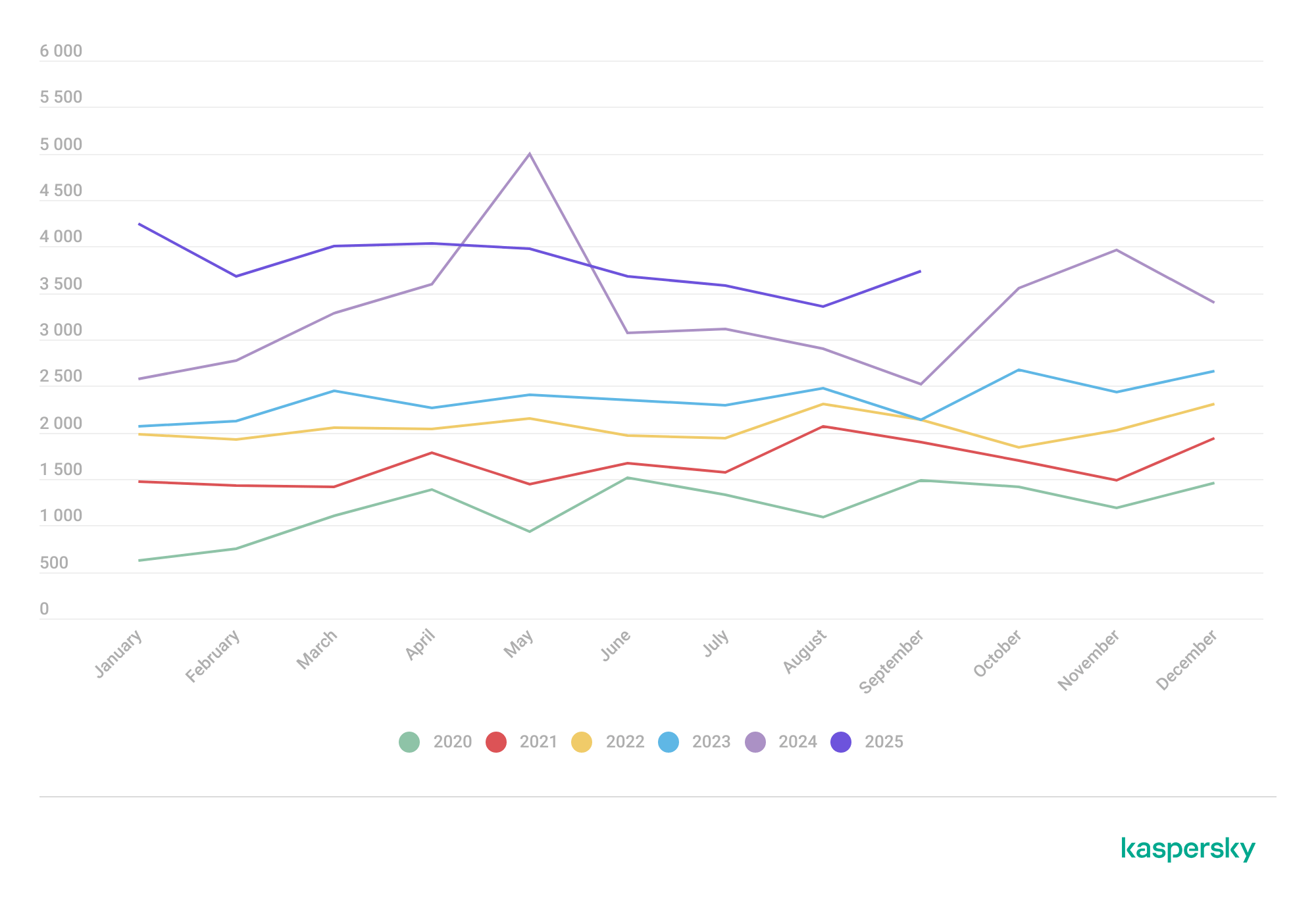
As can be seen from the chart, the monthly number of vulnerabilities published in the third quarter of 2025 remains above the figures recorded in previous years. The three-month total saw over 1000 more published vulnerabilities year over year. The end of the quarter sets a rising trend in the number of registered CVEs, and we anticipate this growth to continue into the fourth quarter. Still, the overall number of published vulnerabilities is likely to drop slightly relative to the September figure by year-end
A look at the monthly distribution of vulnerabilities rated as critical upon registration (CVSS > 8.9) suggests that this metric was marginally lower in the third quarter than the 2024 figure.
Total number of critical vulnerabilities published each month from 2021 to 2025 (download)

Exploitation statistics
This section contains exploitation statistics for Q3 2025. The data draws on open sources and our telemetry.
Windows and Linux vulnerability exploitation
In Q3 2025, as before, the most common exploits targeted vulnerable Microsoft Office products.
Most Windows exploits detected by Kaspersky solutions targeted the following vulnerabilities:
- CVE-2018-0802: a remote code execution vulnerability in the Equation Editor component
- CVE-2017-11882: another remote code execution vulnerability, also affecting Equation Editor
- CVE-2017-0199: a vulnerability in Microsoft Office and WordPad that allows an attacker to assume control of the system
These vulnerabilities historically have been exploited by threat actors more frequently than others, as discussed in previous reports. In the third quarter, we also observed threat actors actively exploiting Directory Traversal vulnerabilities that arise during archive unpacking in WinRAR. While the originally published exploits for these vulnerabilities are not applicable in the wild, attackers have adapted them for their needs.
- CVE-2023-38831: a vulnerability in WinRAR that involves improper handling of objects within archive contents We discussed this vulnerability in detail in a 2024 report.
- CVE-2025-6218 (ZDI-CAN-27198): a vulnerability that enables an attacker to specify a relative path and extract files into an arbitrary directory. A malicious actor can extract the archive into a system application or startup directory to execute malicious code. For a more detailed analysis of the vulnerability, see our Q2 2025 report.
- CVE-2025-8088: a zero-day vulnerability similar to CVE-2025-6218, discovered during an analysis of APT attacks The attackers used NTFS Streams to circumvent controls on the directory into which files were unpacked. We will take a closer look at this vulnerability below.
It should be pointed out that vulnerabilities discovered in 2025 are rapidly catching up in popularity to those found in 2023.
All the CVEs mentioned can be exploited to gain initial access to vulnerable systems. We recommend promptly installing updates for the relevant software.
Dynamics of the number of Windows users encountering exploits, Q1 2023 — Q3 2025. The number of users who encountered exploits in Q1 2023 is taken as 100% (download)
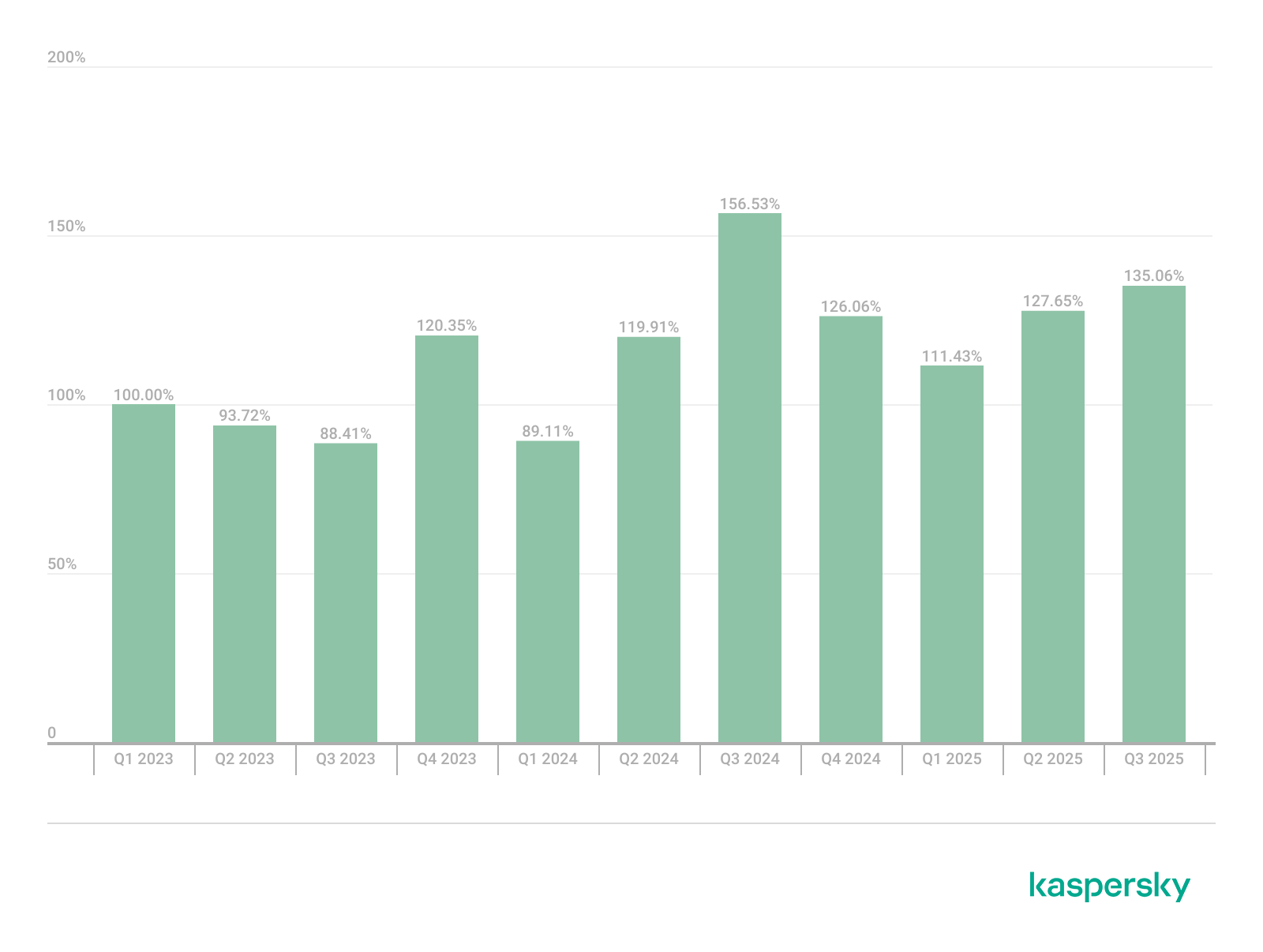
According to our telemetry, the number of Windows users who encountered exploits increased in the third quarter compared to the previous reporting period. However, this figure is lower than that of Q3 2024.
For Linux devices, exploits for the following OS kernel vulnerabilities were detected most frequently:
- CVE-2022-0847, also known as Dirty Pipe: a vulnerability that allows privilege escalation and enables attackers to take control of running applications
- CVE-2019-13272: a vulnerability caused by improper handling of privilege inheritance, which can be exploited to achieve privilege escalation
- CVE-2021-22555: a heap overflow vulnerability in the Netfilter kernel subsystem. The widespread exploitation of this vulnerability is due to its use of popular memory modification techniques: manipulating “msg_msg” primitives, which leads to a Use-After-Free security flaw.
Dynamics of the number of Linux users encountering exploits, Q1 2023 — Q3 2025. The number of users who encountered exploits in Q1 2023 is taken as 100% (download)
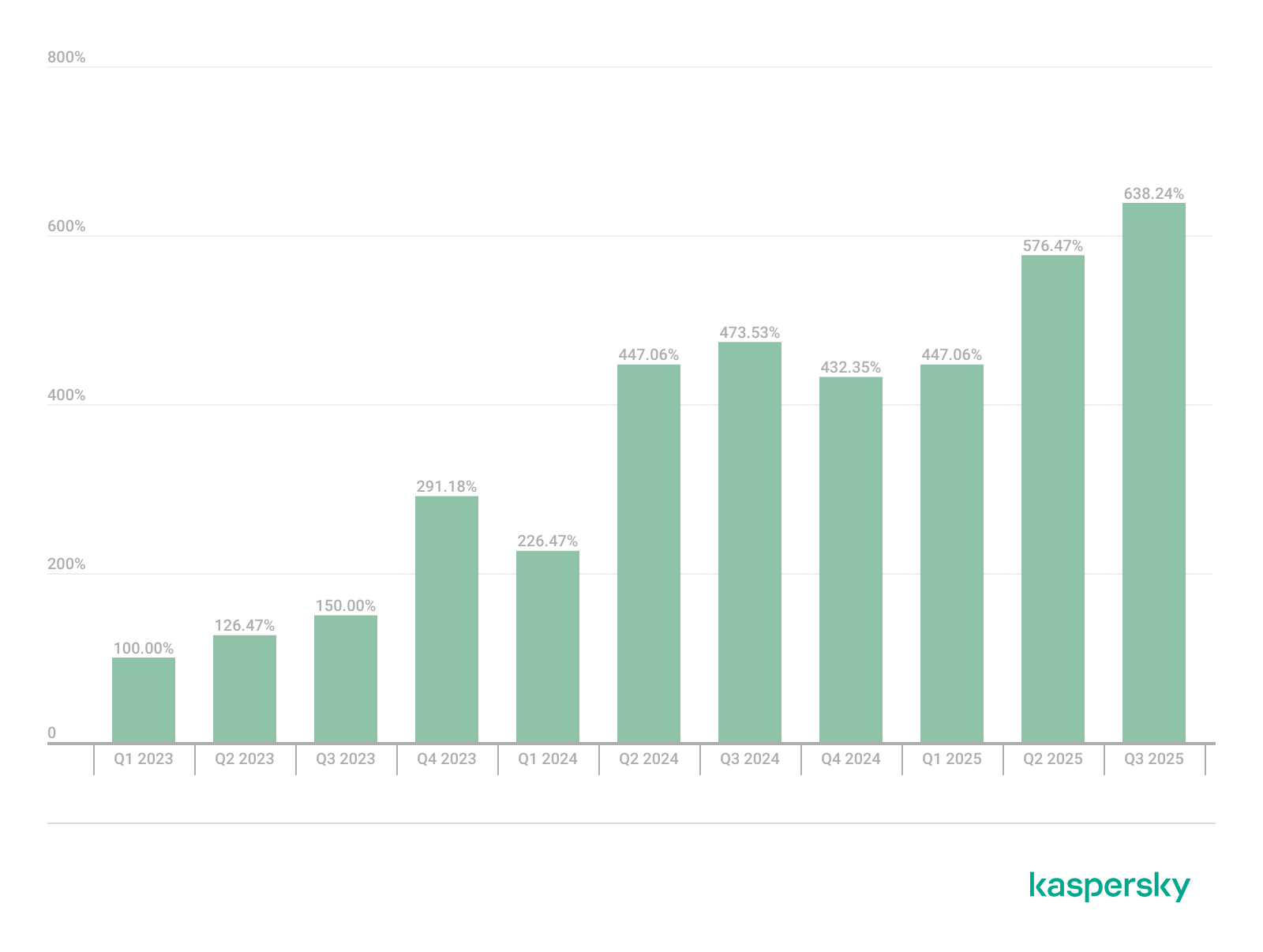
A look at the number of users who encountered exploits suggests that it continues to grow, and in Q3 2025, it already exceeds the Q1 2023 figure by more than six times.
It is critically important to install security patches for the Linux operating system, as it is attracting more and more attention from threat actors each year – primarily due to the growing number of user devices running Linux.
Most common published exploits
In Q3 2025, exploits targeting operating system vulnerabilities continue to predominate over those targeting other software types that we track as part of our monitoring of public research, news, and PoCs. That said, the share of browser exploits significantly increased in the third quarter, matching the share of exploits in other software not part of the operating system.
Distribution of published exploits by platform, Q1 2025 (download)

Distribution of published exploits by platform, Q2 2025 (download)
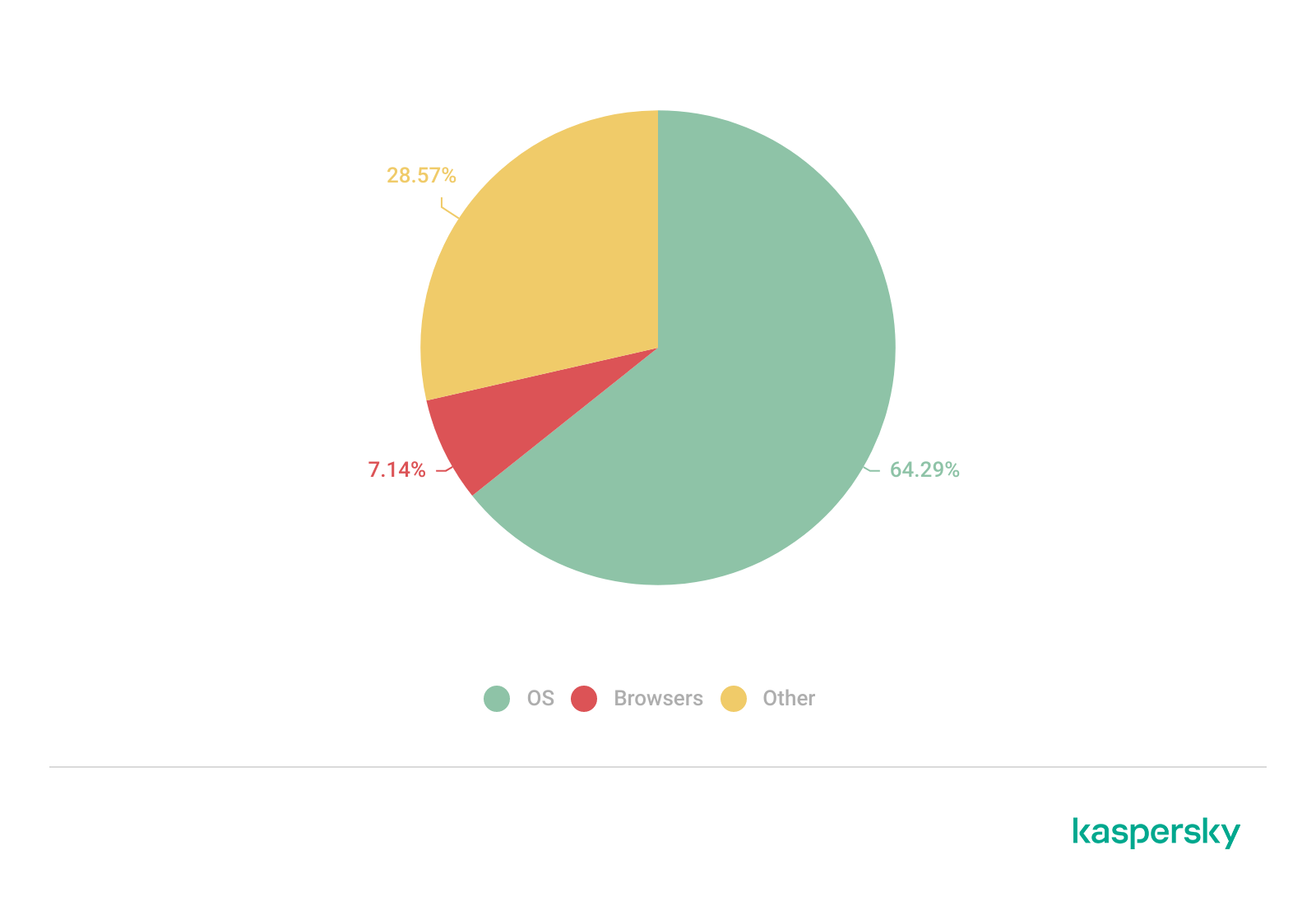
Distribution of published exploits by platform, Q3 2025 (download)
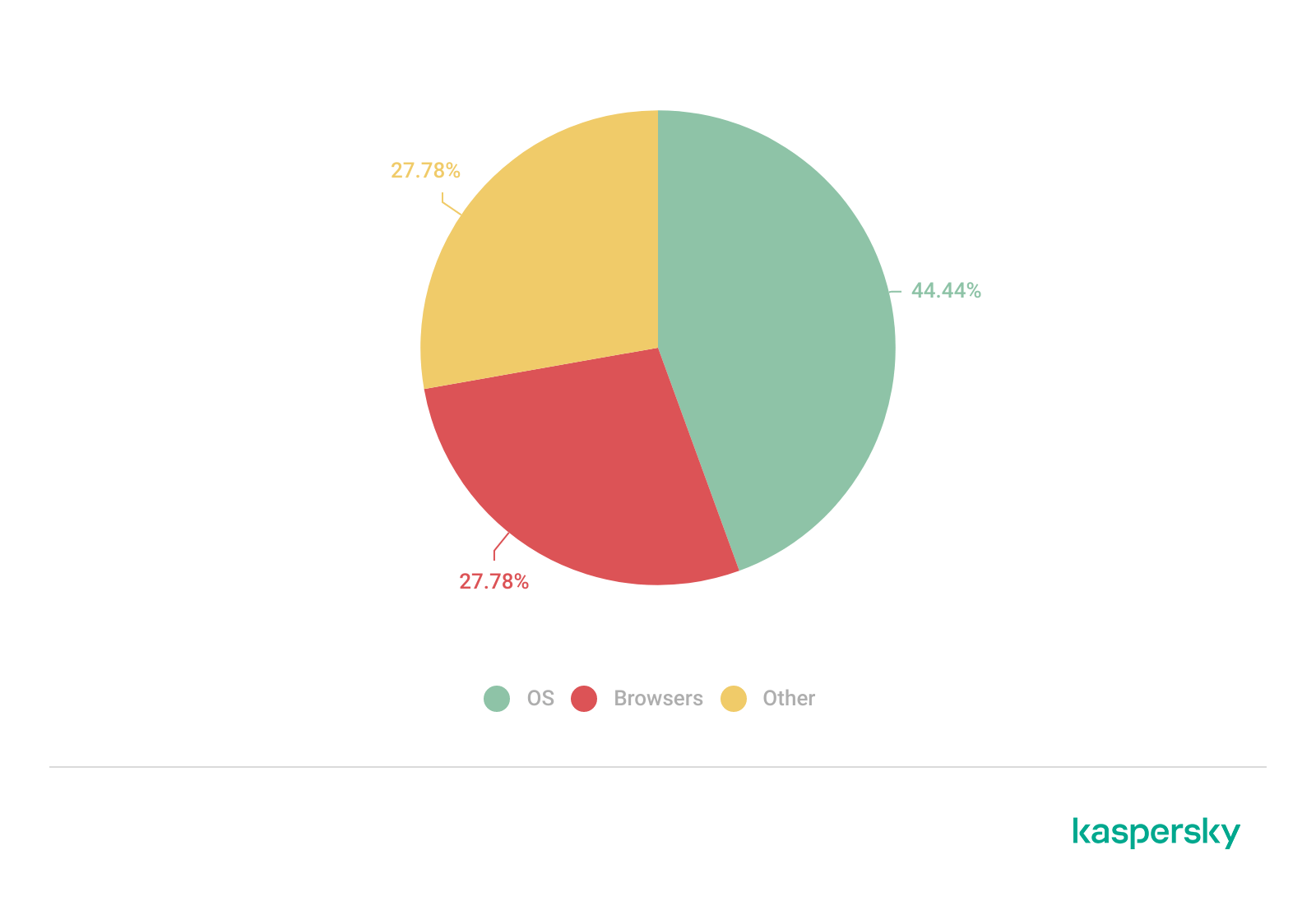
It is noteworthy that no new public exploits for Microsoft Office products appeared in Q3 2025, just as none did in Q2. However, PoCs for vulnerabilities in Microsoft SharePoint were disclosed. Since these same vulnerabilities also affect OS components, we categorized them under operating system vulnerabilities.
Vulnerability exploitation in APT attacks
We analyzed data on vulnerabilities that were exploited in APT attacks during Q3 2025. The following rankings draw on our telemetry, research, and open-source data.
TOP 10 vulnerabilities exploited in APT attacks, Q3 2025 (download)
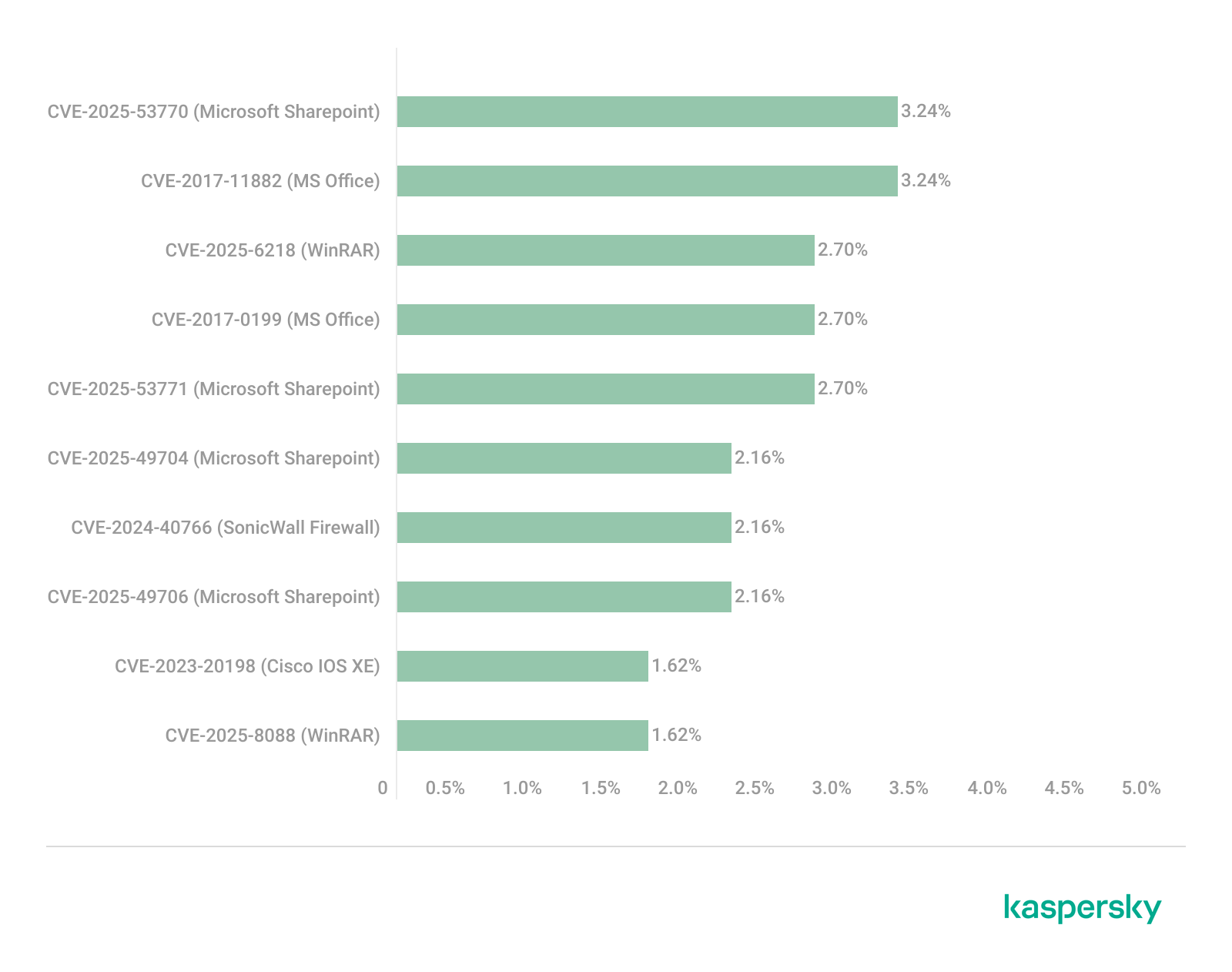
APT attacks in Q3 2025 were dominated by zero-day vulnerabilities, which were uncovered during investigations of isolated incidents. A large wave of exploitation followed their public disclosure. Judging by the list of software containing these vulnerabilities, we are witnessing the emergence of a new go-to toolkit for gaining initial access into infrastructure and executing code both on edge devices and within operating systems. It bears mentioning that long-standing vulnerabilities, such as CVE-2017-11882, allow for the use of various data formats and exploit obfuscation to bypass detection. By contrast, most new vulnerabilities require a specific input data format, which facilitates exploit detection and enables more precise tracking of their use in protected infrastructures. Nevertheless, the risk of exploitation remains quite high, so we strongly recommend applying updates already released by vendors.
C2 frameworks
In this section, we will look at the most popular C2 frameworks used by threat actors and analyze the vulnerabilities whose exploits interacted with C2 agents in APT attacks.
The chart below shows the frequency of known C2 framework usage in attacks on users during the third quarter of 2025, according to open sources.
Top 10 C2 frameworks used by APT groups to compromise user systems in Q3 2025 (download)
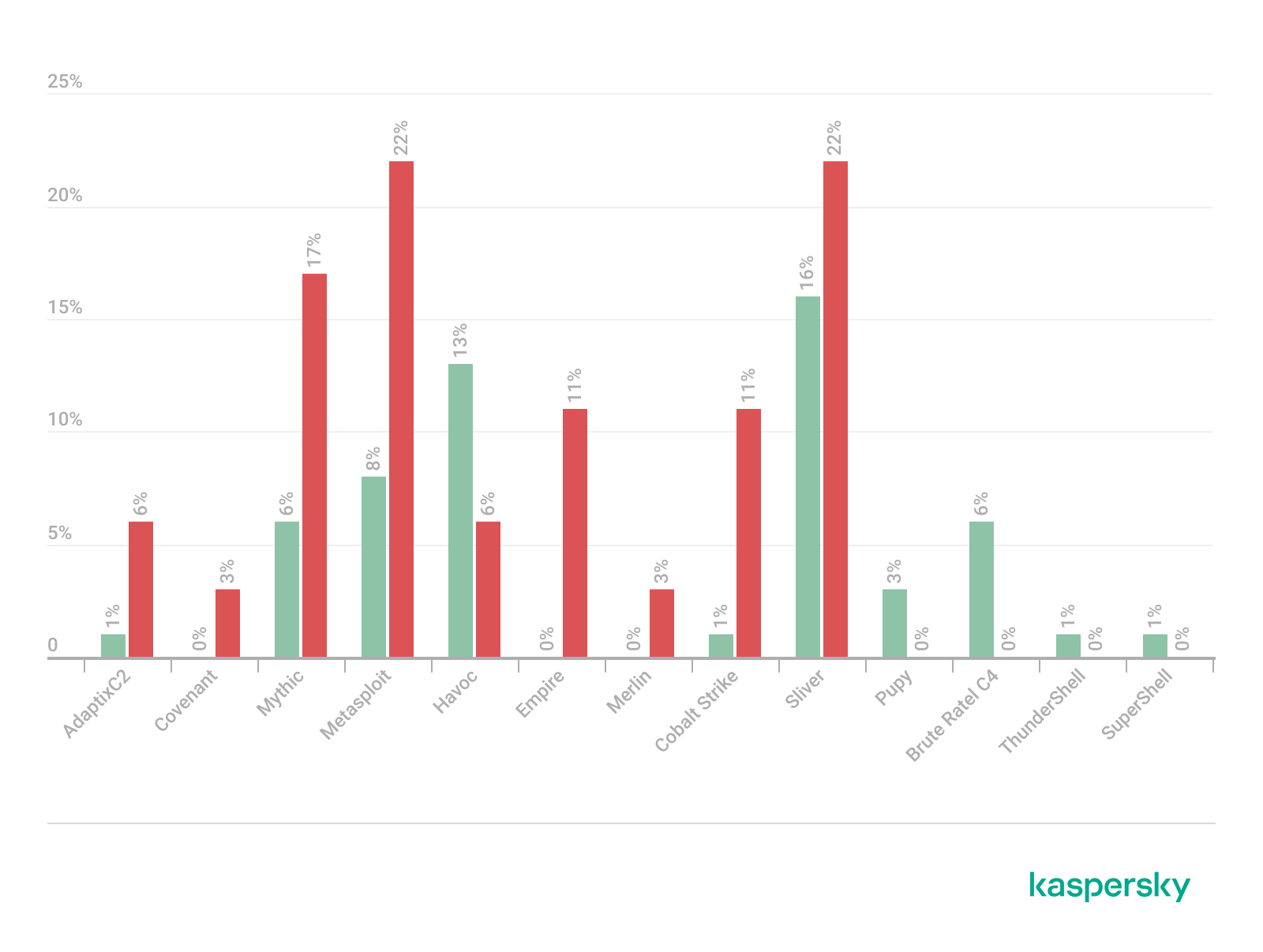
Metasploit, whose share increased compared to Q2, tops the list of the most prevalent C2 frameworks from the past quarter. It is followed by Sliver and Mythic. The Empire framework also reappeared on the list after being inactive in the previous reporting period. What stands out is that Adaptix C2, although fairly new, was almost immediately embraced by attackers in real-world scenarios. Analyzed sources and samples of malicious C2 agents revealed that the following vulnerabilities were used to launch them and subsequently move within the victim’s network:
- CVE-2020-1472, also known as ZeroLogon, allows for compromising a vulnerable operating system and executing commands as a privileged user.
- CVE-2021-34527, also known as PrintNightmare, exploits flaws in the Windows print spooler subsystem, also enabling remote access to a vulnerable OS and high-privilege command execution.
- CVE-2025-6218 or CVE-2025-8088 are similar Directory Traversal vulnerabilities that allow extracting files from an archive to a predefined path without the archiving utility notifying the user. The first was discovered by researchers but subsequently weaponized by attackers. The second is a zero-day vulnerability.
Interesting vulnerabilities
This section highlights the most noteworthy vulnerabilities that were publicly disclosed in Q3 2025 and have a publicly available description.
ToolShell (CVE-2025-49704 and CVE-2025-49706, CVE-2025-53770 and CVE-2025-53771): insecure deserialization and an authentication bypass
ToolShell refers to a set of vulnerabilities in Microsoft SharePoint that allow attackers to bypass authentication and gain full control over the server.
- CVE-2025-49704 involves insecure deserialization of untrusted data, enabling attackers to execute malicious code on a vulnerable server.
- CVE-2025-49706 allows access to the server by bypassing authentication.
- CVE-2025-53770 is a patch bypass for CVE-2025-49704.
- CVE-2025-53771 is a patch bypass for CVE-2025-49706.
These vulnerabilities form one of threat actors’ combinations of choice, as they allow for compromising accessible SharePoint servers with just a few requests. Importantly, they were all patched back in July, which further underscores the importance of promptly installing critical patches. A detailed description of the ToolShell vulnerabilities can be found in our blog.
CVE-2025-8088: a directory traversal vulnerability in WinRAR
CVE-2025-8088 is very similar to CVE-2025-6218, which we discussed in our previous report. In both cases, attackers use relative paths to trick WinRAR into extracting archive contents into system directories. This version of the vulnerability differs only in that the attacker exploits Alternate Data Streams (ADS) and can use environment variables in the extraction path.
CVE-2025-41244: a privilege escalation vulnerability in VMware Aria Operations and VMware Tools
Details about this vulnerability were presented by researchers who claim it was used in real-world attacks in 2024.
At the core of the vulnerability lies the fact that an attacker can substitute the command used to launch the Service Discovery component of the VMware Aria tooling or the VMware Tools utility suite. This leads to the unprivileged attacker gaining unlimited privileges on the virtual machine. The vulnerability stems from an incorrect regular expression within the get-versions.sh script in the Service Discovery component, which is responsible for identifying the service version and runs every time a new command is passed.
Conclusion and advice
The number of recorded vulnerabilities continued to rise in Q3 2025, with some being almost immediately weaponized by attackers. The trend is likely to continue in the future.
The most common exploits for Windows are primarily used for initial system access. Furthermore, it is at this stage that APT groups are actively exploiting new vulnerabilities. To hinder attackers’ access to infrastructure, organizations should regularly audit systems for vulnerabilities and apply patches in a timely manner. These measures can be simplified and automated with Kaspersky Systems Management. Kaspersky Next can provide comprehensive and flexible protection against cyberattacks of any complexity.
Text extracted automatically; images, tables and formatting may be missing. Original: https://securelist.com/vulnerabilities-and-exploits-in-q3-2025/118197/