Experts monitor ongoing attacks using exploits for Log4j library flaws
Vulnerabilities mentionedAll →
| CVE | Vulnerability | CVSS | EPSS | Flags | Affected | Exposure | Published |
|---|---|---|---|---|---|---|---|
| CVE-2021-42550 | In logback version 1.2.7 and prior versions, an attacker with the required privileges to edit configurations files could craft a malicious configuration allowin In logback version 1.2.7 and prior versions, an attacker with the required privileges to edit configurations files could craft a malicious configuration allowing to execute arbitrary code loaded from LDAP servers. NVD description · AI analysis pending | 6.6 | 4% | PoC ×3 |
| — | |
| CVE-2021-44228 | JNDI Injection Remote Code Execution in Apache Log4j2 (Log4Shell) Apache Log4j2, an extremely widely used Java logging library, fails to protect its JNDI lookup feature against attacker-controlled JNDI-related endpoints (CWE-20, CWE-502), so crafted text processed by the logger causes the Java runtime to fetch and load attacker-supplied objects, leading to remote code execution. The flaw is triggered whenever attacker-controlled input reaches the logging API and is parsed for JNDI lookups, a pattern common in web servers and enterprise Java applications that log user-supplied fields such as headers or form values. Successful exploitation yields arbitrary code execution under the privileges of the affected application, giving attackers a foothold for lateral movement, data theft, and ransomware deployment. Any Java application or product that ships or bundles an affected Apache Log4j2 release is exposed, making this one of the most broadly deployed vulnerabilities ever disclosed. Exploitation is confirmed in the wild: CISA added it to the Known Exploited Vulnerabilities catalog on 2021-12-10 with known ransomware use, and EPSS assigns a 100% probability of exploitation within 30 days. Do: Inventory all Java applications and dependencies for Apache Log4j2 and apply the vendor's patched updates, or remove affected assets from the network, as required by CISA's KEV catalog. Where updates are not yet available, use the temporary mitigations in CISA's ED-22-02 recommended-mitigation guidance, such as disabling message lookups, only until patches are applied. Prioritize internet-facing and business-critical systems and hunt for exploitation activity given known ransomware use. | 10.0 | 100% | KEV ransomware PoC ×9 |
| masshundreds of millions of Java applications/devices, with hundreds of thousands of internet-exposed services | |
| CVE-2021-45046 | Remote Code Execution in Apache Log4j2 via Incomplete Log4Shell Fix CVE-2021-45046 is a remote code execution and information disclosure flaw in Apache Log4j2 (CWE-917) that resulted from an incomplete fix to CVE-2021-44228 (Log4Shell), leaving the Thread Context Lookup Pattern vulnerable in certain non-default configurations. It is triggered when an application logs attacker-controlled data using layouts or patterns that perform Thread Context (MDC) lookups, allowing crafted lookup expressions to be evaluated against untrusted input. A successful attacker can achieve remote code execution, or potentially information disclosure, on the affected service. Any deployment of Apache Log4j2 that relies on the affected non-default lookup configurations is exposed, which given Log4j2's ubiquity in Java applications and embedded products means a very large installed base. Exploitation is confirmed: the flaw is in CISA KEV (added 2023-05-01) with known ransomware use, and EPSS assigns a 100% probability of exploitation within 30 days. Do: Upgrade Log4j2 to 2.17.0 or later per vendor instructions (or 2.12.3/2.3.1 for the legacy 2.12/2.3 branches), since the 2.16.0 fix was itself incomplete in some non-default configurations. Where upgrading is not immediately possible, remove the JndiLookup class from the Log4j2 jar or disable lookup processing, and audit applications and dependencies that bundle Log4j2 while following the CISA KEV required action to apply vendor updates. | 9.0 | 100% | KEV ransomware |
| massmillions of Java deployments worldwide, with hundreds of thousands of internet-exposed services observed in public scans during the Log4Shell campaign |
Full article293 words · extracted from securityaffairs.com · click to collapse
 Pierluigi Paganini
 December 27, 2021

Researchers from DrWeb monitored attacks leveraging exploits for vulnerabilities in the Apache Log4j library
Researchers from DrWeb monitored attacks leveraging exploits for vulnerabilities (CVE-2021-44228, CVE-2021-45046, CVE2021-4104, and CVE-2021-42550) in the Apache Log4j library warning of the need to adopt protective measures.
The vulnerabilities can allow threat actors to execute arbitrary code on the target systems, trigger a Denial of Service condition, or disclose confidential information.
Dr. Web set up one of its honeypots to analyze the impact of the Log4J vulnerabilities on systems exposed online and discovered an intense activity between December 17th-20th.

“We record attacks using exploits for the vulnerabilities on one of our honeypots–a special server used by Doctor Web specialists as bait for fraudsters. The most active threat occurred between December 17th-20th, but attacks still continue.” reads the analysis published by DrWeb.
| Day | Number of attacks |
| December 10 | 7 |
| December 11 | 20 |
| December 12 | 25 |
| December 13 | 15 |
| December 14 | 32 |
| December 15 | 21 |
| December 16 | 24 |
| December 17 | 47 |
| December 18 | 51 |
| December 19 | 33 |
| December 20 | 32 |
| December 21 | 14 |
| December 22 | 35 |
| December 23 | 36 |
The attacks are carried out from 72 different IP addresses, most of them were German IP addresses (21%), followed by Russia (19.4%), the USA and China (9.7%).
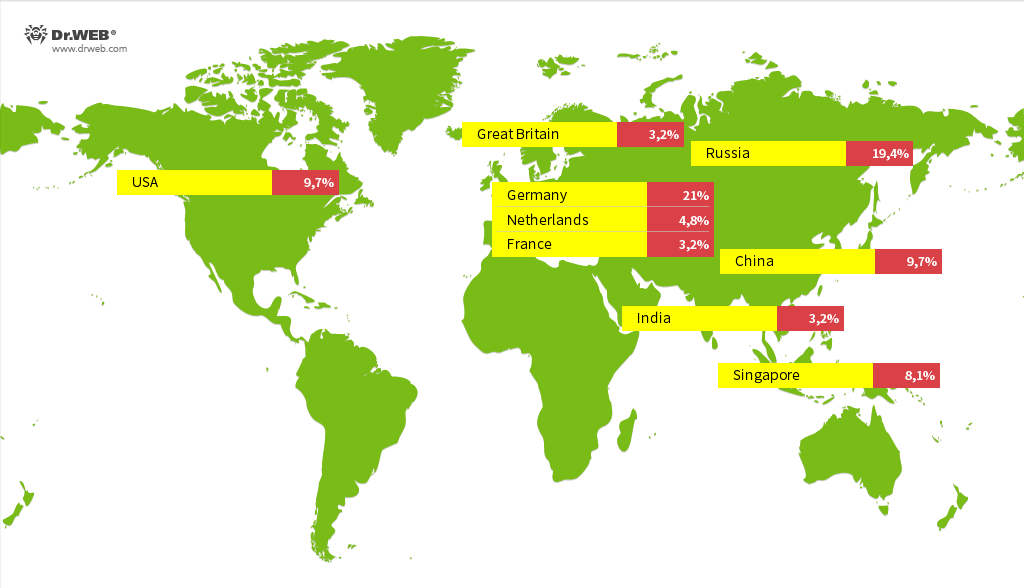

Experts pointed out the difficulty in asses potentially vulnerable systems because some projects don’t have a direct dependence on Log4j.
“One way or another, vulnerabilities affect the performance of many projects worldwide. You need to closely watch the release of software updates that use the Log4j 2 library and install them as soon as possible.” concludes the experts.
Follow me on Twitter: @securityaffairs and Facebook
| [adrotate banner=”9″] | [adrotate banner=”12″] |
(SecurityAffairs – hacking, Log4j)
[adrotate banner=”5″]
[adrotate banner=”13″]
Text extracted automatically; images, tables and formatting may be missing. Original: https://securityaffairs.com/126062/hacking/log4j-ongoing-attacks.html