New 'BlueMoon' kit exploited Windows and Chrome zero-day flaws
Multiple China-linked espionage groups share the BlueMoon exploit kit chaining Chrome V8 zero-days and a Windows ALPC LPE to deploy backdoors.
Proofpoint and Volexity report that multiple espionage clusters share the BlueMoon exploit kit, chaining Chrome V8 zero-days CVE-2026-85046 and CVE-2026-87491 with the Windows ALPC local privilege escalation CVE-2026-85880. Proofpoint observed spearphishing use since August 28 by JungleBamboo (APT31), while Volexity saw UTA0560 targeting NGOs from September 1; UNK_LateNight hit US aerospace/defense with ShadowPad and UNK_DoubleCheck targeted Vietnamese manufacturers. The kit's maintainers reverse-engineer public Chromium fixes before stable Chrome releases, and Proofpoint suspects the ALPC exploit has existed since 2025.
- Chains V8 type confusion (CVE-2026-85046), V8 sandbox escape (CVE-2026-87491), and Windows ALPC LPE (CVE-2026-85880).
- Four activity clusters identified; payloads include loaders, Grimwedge, ShadowPad, and an in-memory Rust loader.
- Maintainers exploit the gap between public Chromium fixes and stable Chrome releases to build exploits.
- IOCs published by Proofpoint and Volexity; broader adoption, possibly by criminal actors, expected.
Vulnerabilities mentionedAll →
| CVE | Vulnerability | CVSS | EPSS | Flags | Affected | Exposure | Published |
|---|---|---|---|---|---|---|---|
| CVE-2026-85046 | Actively Exploited V8 Type Confusion in Google Chrome (CVE-2026-85046) Google Chrome versions prior to 152.0.7977.82 contain a type confusion flaw (CWE-843) in the V8 JavaScript engine, which mishandles object types during engine operations (public proof-of-concept writeups indicate it is reachable through array sorting and WebAssembly-related code paths). A remote attacker triggers the flaw simply by getting a user to open a crafted HTML page, with no privileges or authentication required. Successful exploitation lets the attacker execute arbitrary code inside the browser's sandbox, and public reporting shows it being chained with Windows zero-days (the 'BlueMoon' exploit kit) by Chinese espionage groups for broader compromise. Any user of an unpatched Chrome or another build embedding the affected V8 engine is exposed. The vulnerability is a zero-day that was actively exploited in the wild before patching, was added to CISA's KEV on 2026-09-04, and has five public proof-of-concept references. Do: Update Google Chrome to 152.0.7977.82 or later immediately, and apply the corresponding V8 fix in any Chromium-based browser in use. Federal agencies must apply mitigations in line with CISA BOD 26-04 and its cloud-services requirements, evaluating each asset's internet exposure. Because public reporting shows this flaw chained with Windows zero-days in 'BlueMoon' attacks, patch the related Windows vulnerabilities as well and hunt for signs of exploit-chain activity on high-exposure endpoints. | 8.8 | 1% | KEV PoC ×5 |
| massmultiple billions of users/installs (Chrome is the dominant desktop browser at roughly 65% market share, with an estimated 3+ billion active users, plus… | |
| CVE-2026-85880 | Heap-Based Buffer Overflow in Windows ALPC Enables Local Privilege Escalation CVE-2026-85880 is a heap-based buffer overflow in Windows Advanced Local Procedure Call (ALPC), the Windows mechanism for local inter-process communication. An authorized local attacker can trigger the overflow by submitting crafted input over ALPC, corrupting heap memory in the component that handles the request. Successful exploitation allows the attacker to execute code with elevated privileges, typically gaining SYSTEM-level control of the local host, which is especially valuable as a post-exploitation or sandbox-escape step. Affected products include Windows 10 (1607, 1809, 21H2, 22H2) and Windows Server 2012, 2016, 2019, and 2022, meaning most on-premises Windows estates are in scope. The flaw was fixed in Microsoft's record 974-CVE September 2026 Patch Tuesday and was added to CISA's KEV on 2026-09-08, confirming exploitation in the wild; press reports describe Windows zero-days being chained with a Chrome zero-day in 'BlueMoon' kit attacks, though the data does not explicitly confirm this CVE is the Windows flaw in that chain. Do: Apply Microsoft's September 2026 security (cumulative) updates for each affected Windows 10 and Windows Server build, as no public PoC or workaround is documented; CISA's KEV listing (added 2026-09-08) triggers BOD 26-04 patching requirements for federal agencies, so prioritize accordingly. Give priority to hosts where unprivileged users can log in — RDS/VDI servers, jump boxes, shared workstations — and to internet-exposed Windows servers, since an ALPC local privilege escalation is a common component in exploit chains combining remote code execution or browser flaws with elevation to SYSTEM. Organizations unable to patch promptly should follow BOD 26-04 guidance for cloud services or restrict local access to affected hosts until updates are applied. | 7.8 | <1% | KEV |
| mass≈100M+ Windows installations (Windows 10 1607–22H2 on consumer/enterprise endpoints plus widely deployed Windows Server 2012–2022) | |
| CVE-2026-87491 | Actively Exploited Out-of-Bounds Write in Google Chrome V8 CVE-2026-87491 is an out-of-bounds write (CWE-787) in the V8 JavaScript engine in Google Chrome, fixed in Chrome 153.0.8010.36, which Google shipped alongside roughly 230 other security fixes. An attacker can trigger the flaw remotely by luring a user (user interaction required) into opening a crafted HTML page that corrupts memory in V8. Successful exploitation allows the attacker to execute arbitrary code inside the Chrome browser sandbox, which constrains but does not eliminate the impact. All Google Chrome users running versions prior to 153.0.8010.36 are affected; because the flaw resides in V8, CISA tracks it as 'Google Chromium V8', and other Chromium-based browsers may inherit the fix in their own updates. The flaw is being actively exploited in the wild — it is the seventh actively exploited Chrome zero-day of 2026 and was added to CISA's KEV catalog on 2026-09-09 — though no public proof-of-concept is known and ransomware use is unknown. Do: Update Google Chrome to 153.0.8010.36 or later immediately (open Help > About Google Chrome to force the update and relaunch), and verify the version on all endpoints. Also patch headless or automated Chrome deployments (CI runners, scrapers, kiosks, CDP-based tooling) that may lag auto-updates, and prioritize remediation per CISA KEV and BOD 26-04 requirements for federal systems. No public PoC is known and ransomware use is unknown, but confirmed in-the-wild exploitation warrants urgent patching. | 8.8 | <1% | KEV |
| massbillions of installations (Chrome's install base exceeds 3 billion users) |
Full article603 words · extracted from bleepingcomputer.com · click to collapse

Multiple cyber-espionage groups deployed an exploit kit dubbed “BlueMoon” that leveraged zero-day vulnerabilities in Microsoft Windows and Google Chrome.
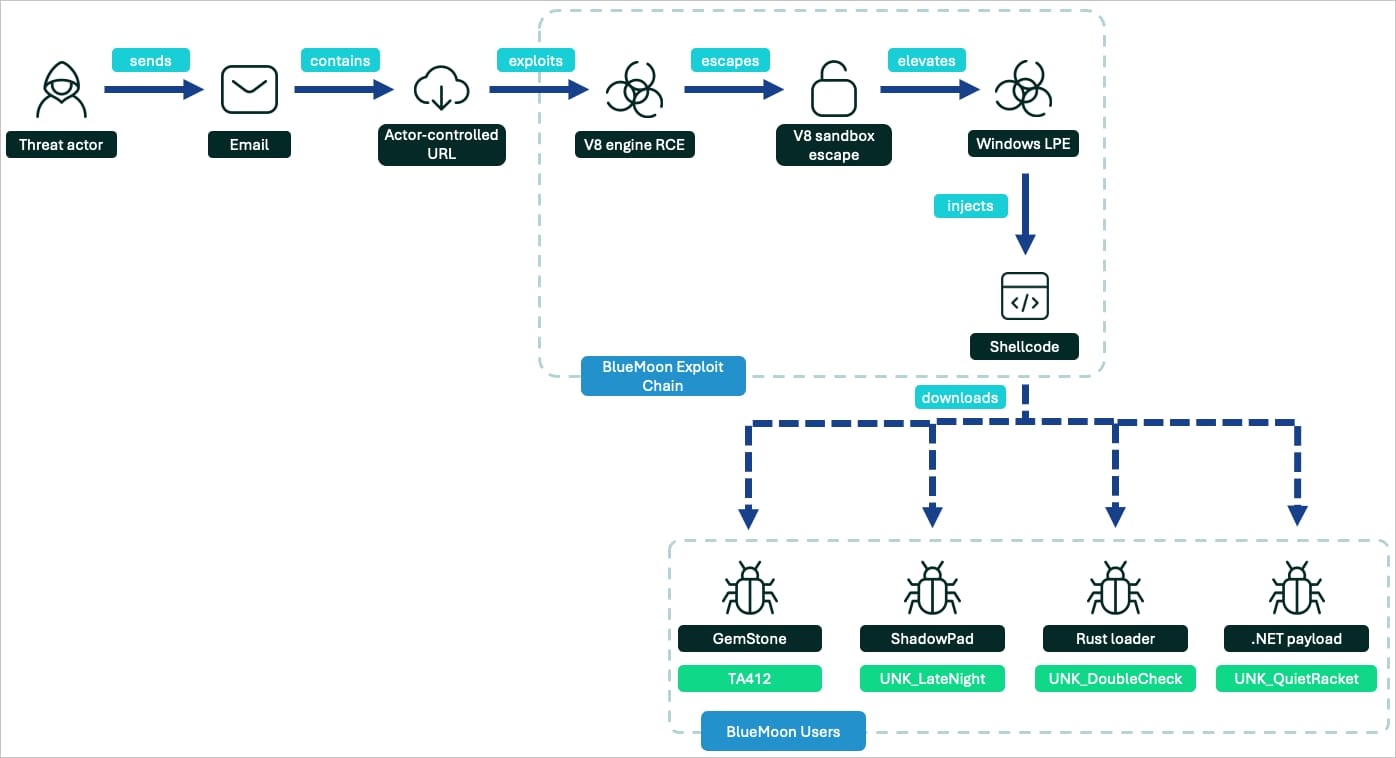
BlueMoon combines two security issues in Chromium-based browsers that allow remote code execution and sandbox escape with a kernel local privilege escalation in Windows.
The kit appears to be a shared modular tool that supports exploit additions and was used in distinct operations.
Researchers at enterprise cybersecurity company Proofpoint observed BlueMoon being used since August 28 in spearphishing operations attributed to the JungleBamboo (a.k.a. APT31, Violet Typhoon, APT31, Tide Castle) threat actor associated with China.
Cybersecurity and threat intelligence company Volexity also observed similar activity on September 1st, in campaigns from another actor it tracks as UTA0560 that targeted "customers at multiple non-governmental organizations (NGOs)."
According to the researchers, the BlueMoon developer maintainers take advantage of the delay between public Chromium fixes and stable Chrome releases, reverse-engineer public code changes, and create exploits to target downstream browser users.
The three flaws chained by the BlueMoon exploit kit are:
- CVE-2026-85046: a type-confusion flaw in Chrome’s V8 JavaScript engine that provides arbitrary memory access inside the V8 sandbox
- CVE-2026-87491: a V8 sandbox escape that corrupts WebAssembly metadata to run embedded shellcode
- CVE-2026-85880: a heap-based buffer overflow in Windows ALPC that allows local privilege escalation
Proofpoint says attackers exploited CVE-2026-85880 as a classic zero-day, suspecting it has been leveraged since 2025 and repackaged in BlueMoon.
“The LPE DLL compilation timestamp is from 2025 and did not appear to be forged,” Proofpoint explains.
“This - combined with the exploit targeting older Windows builds - suggests that the exploit creator repackaged an existing capability into the BlueMoon exploit kit.”
BlueMoon runs the exploit inside a Web Worker, retrying it up to five times. It fingerprints the system, exploits the Windows privilege elevation flaw to elevate the Chrome renderer, and injects into Chrome’s parent process to run an operator-selected command.
The default final command uses curl to save an executable, typically a malware loader, under %TEMP% and run it.
Source: Proofpoint
Threat groups and targets
The reports from Volexity and Proofpoint [1, 2] identify four distinct activity clusters associated with BlueMoon deployments, three of them described as Chinese or China-aligned.
JungleBamboo, the first Chinese state-sponsored actor observed using BlueMoon, is known for targeting NGOs in the US, mining companies, and individual high-value targets, using the Longtale/GemStone credential stealer extension disguised as Google Gemini.
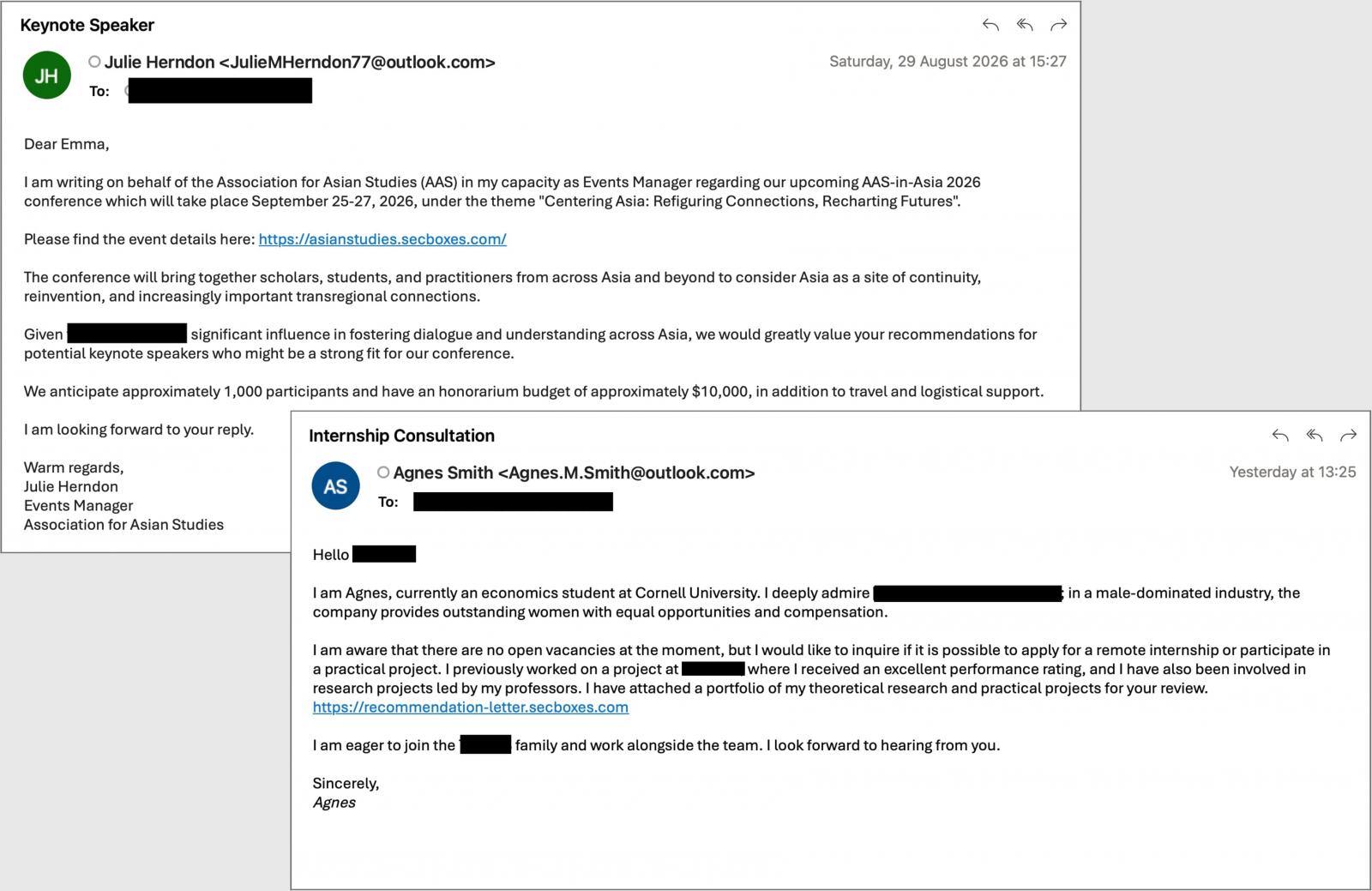
The second hacker group is UTA0560, which targeted NGOs using donation lures and triggered an infection chain that delivered Grimwedge, an in-memory JScript backdoor for reconnaissance, file and process management, command execution, and payload uploads.
Source: Proofpoint
The third cluster is tracked as UNK_LateNight, known for deploying the ShadowPad backdoor on systems belonging to U.S. aerospace and defense-industrial-base companies.
A fourth group, tracked as UNK_DoubleCheck, targeted Vietnamese manufacturing firms with an in-memory Rust loader, though the final payload couldn’t be retrieved for analysis.
Proofpoint expects BlueMoon adoption and deployment to increase, potentially reaching financially motivated attackers in the future, so defenders are advised to use the provided indicators of compromise in both reports to block the activity early.
Both cybersecurity companies shared indicators of compromise for files and network infrastructure observed in attacks using the BlueMoon exploit kit.
Once attackers have valid credentials, only 37% of their actions are blocked
Overall prevention scores can hide what happens after initial access. Once attackers are using valid credentials, prevention drops sharply.
The Blue Report 2026 measures defenses technique by technique across 338 million simulations run in customer production environments.
Text extracted automatically; images, tables and formatting may be missing. Original: https://www.bleepingcomputer.com/news/security/new-bluemoon-kit-exploited-windows-and-chrome-zero-day-flaws/