Gaming the system: how a Chinese-speaking actor turned Brazilian government sites into an SEO weapon
Check Point identifies Chinese-speaking group Gambling Goblin hijacking Brazilian government domains via malicious Apache modules for SEO-manipulated gambling phishing.
Check Point Research tracks a sustained campaign since mid-2025 against Brazilian government and educational organizations by Gambling Goblin, a Chinese-speaking cybercrime cluster linked to Earth Berberoka. Attackers compile and install malicious Apache modules that silently reverse-proxy visitors to phishing pages impersonating Google Play, Microsoft Store, and Amazon, chaining compromised high-reputation domains to inflate search rankings. The group deploys a heavily obfuscated Linux toolkit including DownPro, AlphaAgent, oRAT, a 3snake-based credential stealer, and SSH brute-forcers, with parallel phishing networks localized for Vietnamese, Spanish, and English victims.
- Compromised servers run stealthy reverse proxies with security headers stripped so injected content runs freely.
- Toolkit includes cam-agent, a Go-based reconnaissance agent using httpx, nuclei, naabu, and subfinder modules.
- Phishing pages sit one configuration change away from direct malware delivery, a latent escalation risk.
- Parallel networks with daily fresh domains indicate a scaling model built for export to new regions.
Indicators of compromiseauto-extracted · verify before use · export allAll →
| Type | Indicator | Context |
|---|---|---|
| domain | playfootball.info | d by the second Apache module brought us to a domain called playfootball[.]info that has a phishing page similar to the earlier ones. Unl |
Full article3,078 words · extracted from research.checkpoint.com · click to collapse
Research by: Amit Yardeni
Key Points
A Chinese-speaking actor is now targeting Brazil. Check Point Research has uncovered a sustained campaign against Brazilian organizations, primarily government and educational institutions since mid-2025. We dubbed this group Gambling Goblin: a Chinese-speaking cybercrime cluster connected to a previously documented group, Earth Berberoka, that targeted gambling sites across Asia. It marks a shift from Brazil’s usual home-grown banking-trojan threats to a foreign operator moving in
Compromised web servers turned into stealthy proxies. The attackers compile and install malicious Apache modules on victim servers that silently reverse-proxy visitors to attacker-controlled phishing pages, while the traffic still appears to originate from the legitimate domain, with the site’s own security headers stripped so injected content runs freely.
Large-scale SEO manipulation. The phishing pages pose as trusted app stores such as Google Play, Microsoft Store, and Amazon. Behind that facade, they push online gambling and sports betting, and they chain together compromised high-reputation domains, many of them Brazilian government sites, to inflate search rankings and hijack traffic at scale.
A broad, heavily obfuscated Linux toolkit. Once inside a host, the group deploys custom tools – downloader ( DownPro ), multiple backdoors including the modular AlphaAgent and the oRAT RAT, a 3snake-based credential stealer, an SSH brute-forcer, and a plugin-driven reconnaissance agent. Most of them are wrapped in packing and virtualization layers to slow analysis and evade detection.
The operation reaches well beyond Brazil. We identified parallel phishing networks localized in Vietnamese, Spanish, and English, alongside infrastructure that generates fresh domains daily – evidence the model is built to scale and be exported to new regions.
One step from direct malware delivery. Because the pages already mimic app-download destinations, the same infrastructure sits a single configuration change away from pushing malware straight to victims, a latent escalation risk beyond the current search-fraud scheme.
Introduction
Since mid-2025, Check Point Research has tracked a sustained campaign against Brazilian organizations. The tradecraft points to a Chinese-speaking cybercrime group connected to Earth Berberoka, an actor first documented targeting gambling sites across Asia.
Once inside a victim, the group deploys a broad Linux toolkit: a custom downloader, several backdoors, and familiar offensive utilities. Most of it arrives heavily obfuscated – wrapped in layered virtualization and packing to slow analysis and evade detection.
The purpose becomes clear at the network layer. The attackers install custom Apache modules that quietly proxy visitors to a sprawling set of phishing pages. Many of those pages sit on Brazilian government domains that appear to have been compromised and repurposed without their owners’ knowledge.
The reach extends beyond Brazil. We uncovered a second phishing network run by the same actor; this one is built for Vietnamese victims.
The likely goal is SEO manipulation at scale. By hijacking trusted, high-reputation domains, many of them Brazilian government sites, the operators borrow that reputation to push their own content up the search rankings and hijack the traffic that follows. But the same infrastructure could serve a more dangerous end: the phishing pages impersonate app-download destinations such as Google Play, the Microsoft Store, and Amazon, which leaves the operators one step from pushing malware straight to victims.
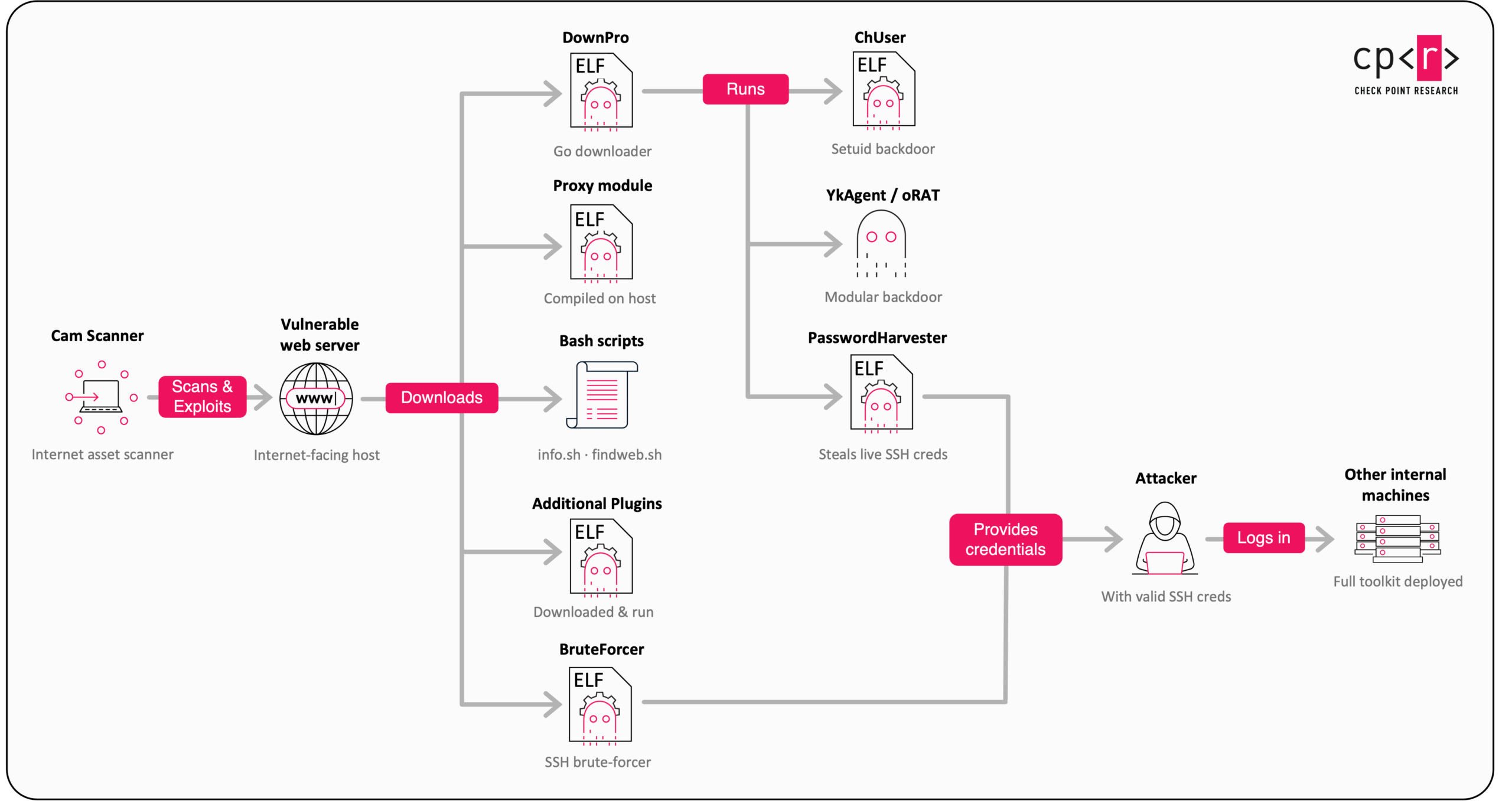
Infection Flow
Figure 1 – Infection chain
Initial Access
We have not directly observed this group’s initial access, but a revealing artifact surfaced on one of their servers: an exposed open directory hosting an ELF binary written in Go that bundles numerous reconnaissance and scanning plugins. The toolset reads like a complete attack-surface-mapping pipeline for internet-facing targets.
The group refers to this agent as “ cluster-asset-mapping ”, or “ cam-agent ” for short. It runs with a handful of flags:
default – long-lived worker session for orchestrated task dispatch
f – foreground mode without logging
flog – enable logging (use with f )
h – show help
v – show version
Figure 2 – Cam-agent help message
The agent carries a configuration that includes:
worker_endpoint
server_id
project
agent_token
embedded PEM certificates and keys for the server and agent
a plugin list
report policies
It logs to payload-run.log under the default directory of /tmp/asset-scan . The agent reads the JSON report policies to decide how to run its scan. The policies are driven by the following fields:
common web ports
batch_size
retry_count
retry_backoff_seconds
level
Figure 3 – Network scan report policy
The agent communicates with its server over gRPC, authenticating with the certificates and keys from its own configuration. It uses many known open-source pentesting tools as modules:
dirprobe – takes URLs and a directory list or profile, sends HTTP requests, and records the status code, response length, and title for each probed path.
httpx – takes URLs, ports, and HTTP options, then collects the status code, response length, title, protocol, TLS details, and banners from each target.
naabu – takes IPs or hostnames, port ranges, and a scan mode, attempts TCP connections across all targets, and marks each port as open, closed, or filtered.
nuclei (v3) – takes URLs, paths, and workflows, executes HTTP/DNS/TCP checks as defined by templates, and emits a structured result for each match (template ID, severity, affected URL, evidence).
subfinder – takes root domains, resolvers, and a depth, then enumerates subdomains via DNS brute force, certificate transparency, and passive sources, returning the discovered subdomains.
whatweb – a Wappalyzer-style fingerprinter that issues HTTP requests to each target and applies rules to identify web servers, frameworks, CMS platforms, JavaScript libraries, and more.
Stealth phishing structure
Apache Modules
The group automates deployment of its malicious Apache module through a Bash installer. The script first confirms it is running as root, then fingerprints the host as either Debian/Ubuntu or CentOS/RedHat and pulls in the matching Apache development packages so the module can be compiled on the victim itself. It downloads the module’s C source, opsproxy.c , from a hardcoded staging server and, notably, patches the source on the fly to insert a missing macro definition so the code compiles cleanly. This is a small touch that shows the operators built the module to run across a range of victim configurations.
Compilation and installation are handled in a single step via Apache’s own apxs tooling, which also wires the module into the server’s configuration. What follows is a deliberate effort to hide the intrusion: the script deletes the source and all build artifacts, then timestomps the resulting .so and its load-configuration files to match legitimate, pre-existing Apache modules such as mod_ssl or mod_suexec , so the malicious files blend in during a casual review. It then enables the stock proxy, headers, and rewrite modules the malicious module depends on, tests the configuration, and restarts Apache to bring everything live.
Throughout, the script’s status messages are written in Chinese and decorated with emoji, a style that may point to AI-assisted development.
Figure 4 – Checking the URL by the Apache module
The source file, opsproxy.c , reveals a purpose-built reverse proxy that quietly grafts attacker-controlled content onto a compromised web server. The module registers itself at Apache’s name-translation stage and inspects every incoming request for one of a small set of hardcoded URL prefixes which in our samples, /wps , /bmw , and /card . When a request matches, the module rewrites it into a reverse-proxy request to a corresponding upstream server hardcoded into the source, silently relaying the visitor to attacker infrastructure while the request still appears, to the outside world, to come from the legitimate compromised domain.
To make that relayed content render without interference, the module strips the upstream site’s Content-Security-Policy headers. It replaces them with a deliberately permissive policy that allows inline and dynamically evaluated scripts, third-party assets, and data: and blob: sources. This removes the restrictions a browser’s CSP normally enforces, allowing injected or externally hosted scripts to execute freely.
Figure 5 – CSP stripping so injected scripts can run
The module also forwards the original Host header and adds standard proxy headers so the upstream sees a convincing request. The effect is a compromised, reputable server acting as a stealthy front door: certain paths transparently serve attacker content, and the browser protections that would ordinarily block foreign scripts are switched off for exactly those paths.
Figure 6 – How the compromised .gov site relays attacker content to visitors
A second ELF Apache module used by the group disguises itself as a basic filter module while registering request and response hooks that examine visitor headers, URI paths, referrers, and client IPs. It carries a static configuration, decrypts it with RC4, and parses it into two rule types:
rule1 – an array of matching rules (path, referrer, or User-Agent, paired with a proxy URL)
rule3 – an optional response-filtering or injection configuration
Figure 7 – JSON struct example
Using a compiled-in regex for <body.*?> to locate its injection point, the module expands placeholders such as {host} , {hip} , {url} , and {name} , fetches remote content with libcurl, and writes that content into Apache responses via ap_rwrite and bucket manipulation. This gives a remote service control over what selected visitors and crawlers see on the compromised server. This is a behavior consistent with SEO cloaking and content-injection malware.
Brazilian infrastructure
Fetching the content served from the three upstream IP addresses hard-coded in the proxy module reveals the phishing infrastructure itself. Each address hosts a page impersonating a trusted app-distribution platform, localized in Brazilian Portuguese ( lang="pt-BR" ) and dressed up with fabricated ratings, review counts, and structured schema.org metadata to appear legitimate to both users and search-engine crawlers.
Figure 8 – Several phishing pages shown by the Apache module.
All those IPs lean heavily on Bing’s thumbnail service ( tse-mm.bing.com ) to source imagery, tag their Open Graph and Twitter cards with @GooglePlay and @microsoftstore handles, and consistently theme around online gambling and sports betting aimed at a Brazilian audience – the actual monetization behind the campaign’s search-manipulation scheme. Tellingly, the pages carry Chinese-language CSS comments (for example a comment translating to “bottom navigation bar — fixed to the bottom on mobile, hidden on desktop”), the same operator fingerprint seen across the group’s server-side tooling.
Inspecting the domain used by the second Apache module brought us to a domain called playfootball[.]info that has a phishing page similar to the earlier ones. Unlike the earlier upstream samples that pulled assets from Bing thumbnails and a fake CDN, this one loads Google’s real production assets – the actual gstatic.com Play Store CSS bundle, Material Icons fonts, and the genuine Google Play logo SVG.
Figure 9 – The phishing page used by the second Apache module
The most revealing finding from this page is that the app tiles and nav links don’t point to a single server; they point to dozens of real Brazilian domains, the majority of them legitimate .gov.br government sites, each serving the attacker’s gambling pages under paths like /jogos and /nova . The compromised institutions span every level of Brazilian government. At the federal level, they include a government ministry and a national public agency. At the state level, victims include a state legislative assembly, state courts of accounts, and a state-owned utility. The largest share, however, is local government: municipal administrations spread across numerous cities and multiple states. A smaller set of commercial .com.br sites such as local news outlets, health clinics, and business associations rounds out the victims.
Beyond Brazil
As we pivoted through the phishing infrastructure, the trail led well beyond Brazil. Several of the IP addresses hosted subdomain and domain generators, giving the operators a fresh supply of domains every day – a rotation scheme built to outpace blocklists and takedowns.
Figure 10 – Domain generator used by the group
Some of the generated domains pointed to adult-content and gambling sites aimed at a Chinese-speaking audience, tying the infrastructure back to the operators’ origin and their long-running focus on the gambling sector.
Figure 11 – A gambling site in Chinese from the domain generator list
More telling, we found phishing pages built on the same template as the Brazilian ones, but localized in Vietnamese, Spanish, and English. The Brazilian operation is not a one-off: the same playbook is being adapted for other regions, and the infrastructure is clearly built to scale.
Figure 12 – Phishing pages in Vietnamese and English
The Attacker’s Arsenal
Across these intrusions, the group draws on two kinds of tooling: well-known offensive utilities that any attacker might reach for, such as netcat , fscan , and pwnkit , and a broad set of custom tools written by the operators themselves: a downloader, several backdoors, a credential stealer, and purpose-built reconnaissance scripts. The sections below focus on that custom toolkit, which is where the group’s tradecraft shows.
DownPro
A downloader written in Go, referred to internally as DownPro . Its job is to pull the rest of the toolkit onto a freshly compromised host and launch it.
The binary is driven by a handful of flags, and a telling detail stands out immediately: their help strings are written in both English and Chinese. The flags are:
u – URL of the main backdoor to download
id – URL of the ChUser payload
up – URL of the unix_updates payload (the PasswordHarvester)
j – offline URL encryptor mode: it takes a plaintext URL via u and outputs the ciphertext to use as the flag value in real runs
logs – where to write logs
The values passed to these flags are AES-GCM encrypted with a hardcoded key and Base64-encoded, so the operator supplies pre-encrypted URLs at runtime rather than leaving them in the clear.
DownPro then decides where to drop its payload based on its effective UID, preparing two sets of candidate destination paths: one for root, one for non-root. Running as root, it selects one of:
/usr/local/bin/systemd-udevd
/usr/local/bin/rsync-tsl
/usr/local/bin/tcp-tsl
/usr/local/bin/snapd-ext
/usr/local/bin/fsck-disk
/usr/local/bin/nftables-init
These names are chosen to blend into a Linux server environment, either mimicking legitimate system components or looking like ordinary utility and network helpers. Running without root, it instead generates one of two temp-style names designed to pass as routine disk clutter:
/tmp/php_sess_<32_hex_chars> – mimicking a PHP session file
/tmp/private-tmp-<5_alnum_chars> – looking like an ephemeral temp artifact
With the destination chosen, it downloads the file from the -u URL and executes it with the argument -si .
Figure 13 – DownPro main logic
The two optional payloads are handled separately. When the -id flag is set, DownPro downloads a file to /usr/bin/chuser , sets its permissions to 0755 , changes its owner to root, and timestomps it to match /bin/ls and turning it into a setuid helper that serves as a persistent local privilege-escalation backdoor. When the -up flag is set, it downloads a file to /usr/sbin/unix_updates and runs it with -v FuckMe#988 , then strips the setuid bit from /usr/bin/pkexec .
ChUser
A simple backdoor that masquerades as a chuser utility. It executes commands passed through the -c flag, but only after passing one of two activation checks:
Remote HTTP activation – the backdoor builds a curl command using the -x <version> flag and runs it. Activation succeeds only if the command’s output matches the expected value, chuser no version .
Local MD5-based activation – the backdoor concatenates a user-supplied secret (from the -s <secret> flag) with a hardcoded salt, FuCkMe# , computes the MD5 of secret + salt , and compares it against a hardcoded target hash. Activation succeeds only on a match.
PasswordHarvester
A credential stealer based on 3snake that monitors newly executed authentication programs, including sshd , sudo , su , doas , ssh , ssh-add , passwd , kinit , and login .
On startup, it sets a clean PATH environment variable and installs signal handlers so the daemon can log and exit cleanly. It runs only as root, exiting otherwise, and gates execution behind a covert activation switch: the CRC32 of the -v argument must match a hardcoded value.
Figure 14: CRC32 gate
Once the CRC gate passes, the stealer resolves the host’s name and IPv4 addresses, then daemonizes by forking, calling umask(0) so it can freely control file permissions, changing its working directory to /tmp , and redirecting stdout and stderr to a file.
To hide itself, it picks at random from roughly 29 fake process names, such as:
[kworker/1:2]
[ksoftirqd/0]
[watchdog/0]
[systemd]
[dbus-daemon]
[journald]
[migration/0]
[ksmd]
It overwrites the original argv with the chosen name and calls prctl to change the kernel-visible task name to match.
Text extracted automatically; images, tables and formatting may be missing. Original: https://research.checkpoint.com/2026/gaming-the-system-how-a-chinese-speaking-actor-turned-brazilian-government-sites-into-an-seo-weapon/