Desktop and IoT threat report for Q2 2025
Vulnerabilities mentionedAll →
| CVE | Vulnerability | CVSS | EPSS | Flags | Affected | Exposure | Published |
|---|---|---|---|---|---|---|---|
| CVE-2024-21762 | Out-of-Bounds Write RCE in Fortinet FortiOS and FortiProxy CVE-2024-21762 is a critical (CVSS 9.8) out-of-bounds write (CWE-787) in the SSL VPN functionality of Fortinet FortiOS and FortiProxy, allowing an unauthenticated remote attacker to execute unauthorized code or commands by sending specifically crafted requests to the vulnerable service. No authentication or user interaction is required, and network access to the SSL VPN interface is the only precondition. Organizations running affected FortiOS versions (on FortiGate appliances) or any affected FortiProxy version are exposed, particularly where the SSL VPN is internet-facing. The flaw is actively exploited: it was added to CISA's Known Exploited Vulnerabilities catalog on 2024-02-09 with ransomware use noted, EPSS puts the 30-day exploitation probability at 84.3%, and public scans suggest roughly 150,000 internet-exposed Fortinet devices may be impacted. Do: Upgrade FortiOS and FortiProxy to fixed releases outside the affected ranges per Fortinet's advisory, prioritizing internet-facing devices; as an interim mitigation, disable SSL VPN (or SSL VPN web mode) where it is not required, per vendor and CISA guidance. After patching, check for signs of compromise and rotate credentials, since Fortinet has warned that attackers retained access to FortiGate devices post-patching. The flaw is in CISA KEV with known ransomware use, so treat this as an urgent patching priority. | 9.8 | 84% | KEV ransomware |
| mass≈150,000 internet-exposed FortiGate/FortiProxy devices (public internet-wide scans) | |
| CVE-2024-55591 | Unauthenticated Super-Admin Bypass in Fortinet FortiOS and FortiProxy CVE-2024-55591 is an authentication bypass (CWE-288) in the Node.js websocket module of Fortinet FortiOS and FortiProxy that lets a remote, unauthenticated attacker gain super-admin privileges via crafted websocket requests. It affects FortiOS 7.0.0 through 7.0.16 and FortiProxy 7.0.0 through 7.0.19 and 7.2.0 through 7.2.12, and is trivially triggerable from the network with no user interaction given network access to the management/websocket interface. Successful exploitation gives full super-admin control of the appliance, which attackers can use to pivot, create persistent access, and deploy ransomware. Any organization running the affected FortiOS or FortiProxy versions, especially with admin interfaces reachable from the internet, is affected. Exploitation is confirmed in the wild: CISA added it to the Known Exploited Vulnerabilities catalog on 2025-01-14, and multiple ransomware crews (reported as Gunra, SuperBlack, and Mora_001) are actively exploiting it. Do: Upgrade all affected systems beyond the vulnerable ranges — FortiOS later than 7.0.16 and FortiProxy later than 7.0.19 / 7.2.12 — following Fortinet's advisory, or apply the vendor's mitigations where upgrades are not possible (per CISA KEV instructions). Restrict access to the admin/websocket interface from the internet, and hunt for unauthorized super-admin accounts and suspicious websocket connections, since ransomware operators are actively exploiting this flaw. Verify device versions and audit logs for signs of compromise before and after patching. | 9.8 | 98% | KEV ransomware |
| large≈48,000+ internet-exposed Fortinet devices per public scans, out of an installed base in the hundreds of thousands | |
| CVE-2024-57726 | Missing-Authorization Privilege Escalation in SimpleHelp Remote Support <= 5.5.7 SimpleHelp remote support software versions 5.5.7 and earlier contain a missing-authorization flaw (CWE-862) that lets low-privileged technicians create API keys with excessive permissions. A network attacker holding only a technician-level account can mint such an over-privileged API key and use it to escalate to the SimpleHelp server admin role, with no user interaction required (CVSS 3.1 score 9.9, scope changed). Successful exploitation yields full administrative control of the SimpleHelp server, the remote-access/RMM platform support staff use to reach endpoints, which can also expose downstream customer environments when the server is run by an MSP. Any organization running SimpleHelp 5.5.7 or earlier is affected, with MSPs at particular risk given their downstream reach. The flaw is confirmed exploited in the wild: it was added to CISA KEV on 2026-04-24 with known ransomware use, carries a 66.6% EPSS score (99th percentile), and public reporting describes ransomware operators chaining SimpleHelp flaws in double-extortion attacks against an MSP and its customers. Do: Upgrade SimpleHelp to the latest vendor release newer than 5.5.7 and apply vendor mitigation guidance; federal agencies must meet BOD 22-01 requirements or discontinue use. Audit existing API keys (especially those created by technician accounts) for excessive permissions, review audit logs for unexpected key creation or admin activity, and restrict internet exposure of SimpleHelp servers. Organizations whose MSP uses SimpleHelp should confirm the MSP's instance is patched before trusting remote sessions. | 9.9 group max | 67% | KEV ransomware |
| moderatelow thousands of exposed self-hosted SimpleHelp server deployments (est.), amplified to many downstream endpoints where instances are run by MSPs | |
| CVE-2025-29824 | Use-After-Free Privilege Escalation in Microsoft Windows CLFS Driver (Actively Exploited) CVE-2025-29824 is a use-after-free flaw (CWE-416) in the Windows Common Log File System (CLFS) kernel driver, scored 7.8 (High) with a local attack vector, low privileges required, and no user interaction. An authorized local attacker can trigger it by interacting with CLFS-managed log files in a way that references freed kernel memory. Successful exploitation elevates the attacker's local privileges, typically to SYSTEM, providing full control of the host that can be chained into ransomware deployment or lateral movement. Any unpatched system running the listed Windows 10, Windows 11, or Windows Server versions is affected. The flaw was exploited as a zero-day — reportedly by Play ransomware — before Microsoft shipped fixes in the April 2025 Patch Tuesday release; it was added to CISA's KEV catalog on 2025-04-08 with known ransomware use, and EPSS estimates a 13.9% probability of continued exploitation over 30 days (96th percentile). Do: Apply Microsoft's April 2025 Patch Tuesday security updates for your Windows version immediately — the vendor update is the only complete fix, and the flaw is on the KEV list with known ransomware use, so prioritize servers and endpoints used by privileged users. Until patched, limit untrusted local code execution and review hosts for post-exploitation privilege escalation; public detection and mitigation scripts (e.g., Vicarius) are available to help hunt for exploitation. Federal agencies must apply the vendor mitigations per BOD 22-01 deadlines or discontinue use of affected versions. | 7.8 | 14% | KEV ransomware PoC ×2 |
| massHundreds of millions of Windows devices worldwide | |
| CVE-2025-31324 | Unauthenticated File Upload RCE in SAP NetWeaver Visual Composer CVE-2025-31324 is a critical (CVSS 9.8) unrestricted file upload flaw (CWE-434) in the Visual Composer Metadata Uploader component of SAP NetWeaver, which lacks proper authorization. An unauthenticated attacker can send crafted upload requests over the network to the Metadata Uploader endpoint and plant malicious executable binaries, such as webshells, on the host. Executing the uploaded files yields remote code execution with full impact on confidentiality, integrity, and availability, enabling system compromise, lateral movement, and ransomware deployment. Any organization running the affected SAP NetWeaver component is at risk, with the greatest exposure for instances reachable from the internet. Exploitation is confirmed in the wild: the flaw was added to CISA KEV on 2025-04-29, a public PoC exists, and researchers and media report active attacks, including by Chinese-linked actors deploying Golang-based implants on Linux systems and known ransomware use, often chained with CVE-2025-42999. Do: Apply SAP's patch for CVE-2025-31324 (released in the April 2025 security updates) and follow the vendor mitigation instructions per CISA KEV/BOD 22-01 requirements. As interim mitigation, restrict or disable the Visual Composer Metadata Uploader endpoint and ensure it is not reachable from the internet; also patch the related CVE-2025-42999 since the flaws are being chained. Check affected hosts for uploaded webshells, Golang-based implants, and signs of ransomware activity. | 9.8 | 100% | KEV ransomware PoC |
| largetens of thousands of enterprise deployments worldwide, with several thousand instances directly internet-exposed |
Full article2,581 words · extracted from securelist.com · click to collapse
IT threat evolution in Q2 2025. Non-mobile statistics
IT threat evolution in Q2 2025. Mobile statistics
The statistics in this report are based on detection verdicts returned by Kaspersky products unless otherwise stated. The information was provided by Kaspersky users who consented to sharing statistical data.
The quarter in numbers
In Q2 2025:
- Kaspersky solutions blocked more than 471 million attacks originating from various online resources.
- Web Anti-Virus detected 77 million unique links.
- File Anti-Virus blocked nearly 23 million malicious and potentially unwanted objects.
- There were 1,702 new ransomware modifications discovered.
- Just under 86,000 users were targeted by ransomware attacks.
- Of all ransomware victims whose data was published on threat actors’ data leak sites (DLS), 12% were victims of Qilin.
- Almost 280,000 users were targeted by miners.
Ransomware
Quarterly trends and highlights
Law enforcement success
The alleged malicious actor behind the Black Kingdom ransomware attacks was indicted in the U.S. The Yemeni national is accused of infecting about 1,500 computers in the U.S. and other countries through vulnerabilities in Microsoft Exchange. He also stands accused of demanding a ransom of $10,000 in bitcoin, which is the amount victims saw in the ransom note. He is also alleged to be the developer of the Black Kingdom ransomware.
A Ukrainian national was extradited to the U.S. in the Nefilim case. He was arrested in Spain in June 2024 on charges of distributing ransomware and extorting victims. According to the investigation, he had been part of the Nefilim Ransomware-as-a-Service (RaaS) operation since 2021, targeting high-revenue organizations. Nefilim uses the classic double extortion scheme: cybercriminals steal the victim’s data, encrypt it, then threaten to publish it online.
Also arrested was a member of the Ryuk gang, charged with organizing initial access to victims’ networks. The accused was apprehended in Kyiv in April 2025 at the request of the FBI and extradited to the U.S. in June.
A man suspected of being involved in attacks by the DoppelPaymer gang was arrested. In a joint operation by law enforcement in the Netherlands and Moldova, the 45-year-old was arrested in May. He is accused of carrying out attacks against Dutch organizations in 2021. Authorities seized around €84,800 and several devices.
A 39-year-old Iranian national pleaded guilty to participating in RobbinHood ransomware attacks. Among the targets of the attacks, which took place from 2019 to 2024, were U.S. local government agencies, healthcare providers, and non-profit organizations.
Vulnerabilities and attacks
Mass exploitation of a vulnerability in SAP NetWeaver
In May, it was revealed that several ransomware gangs, including BianLian and RansomExx, had been exploiting CVE-2025-31324 in SAP NetWeaver software. Successful exploitation of this vulnerability allows attackers to upload malicious files without authentication, which can lead to a complete system compromise.
Attacks via the SimpleHelp remote administration tool
The DragonForce group compromised an MSP provider, attacking its clients with the help of the SimpleHelp remote administration tool. According to researchers, the attackers exploited a set of vulnerabilities (CVE-2024-57727, CVE-2024-57728, CVE-2024-57726) in the software to launch the DragonForce ransomware on victims’ hosts.
Qilin exploits vulnerabilities in Fortinet
In June, news broke that the Qilin gang (also known as Agenda) was actively exploiting critical vulnerabilities in Fortinet devices to infiltrate corporate networks. The attackers allegedly exploited the vulnerabilities CVE-2024-21762 and CVE-2024-55591 in FortiGate software, which allowed them to bypass authentication and execute malicious code remotely. After gaining access, the cybercriminals encrypted data on systems within the corporate network and demanded a ransom.
Exploitation of a Windows CLFS vulnerability
April saw the detection of attacks that leveraged CVE-2025-29824, a zero-day vulnerability in the Windows Common Log File System (CLFS) driver, a core component of the Windows OS. This vulnerability allows an attacker to elevate privileges on a compromised system. Researchers have linked these incidents to the RansomExx and Play gangs. The attackers targeted companies in North and South America, Europe, and the Middle East.
The most prolific groups
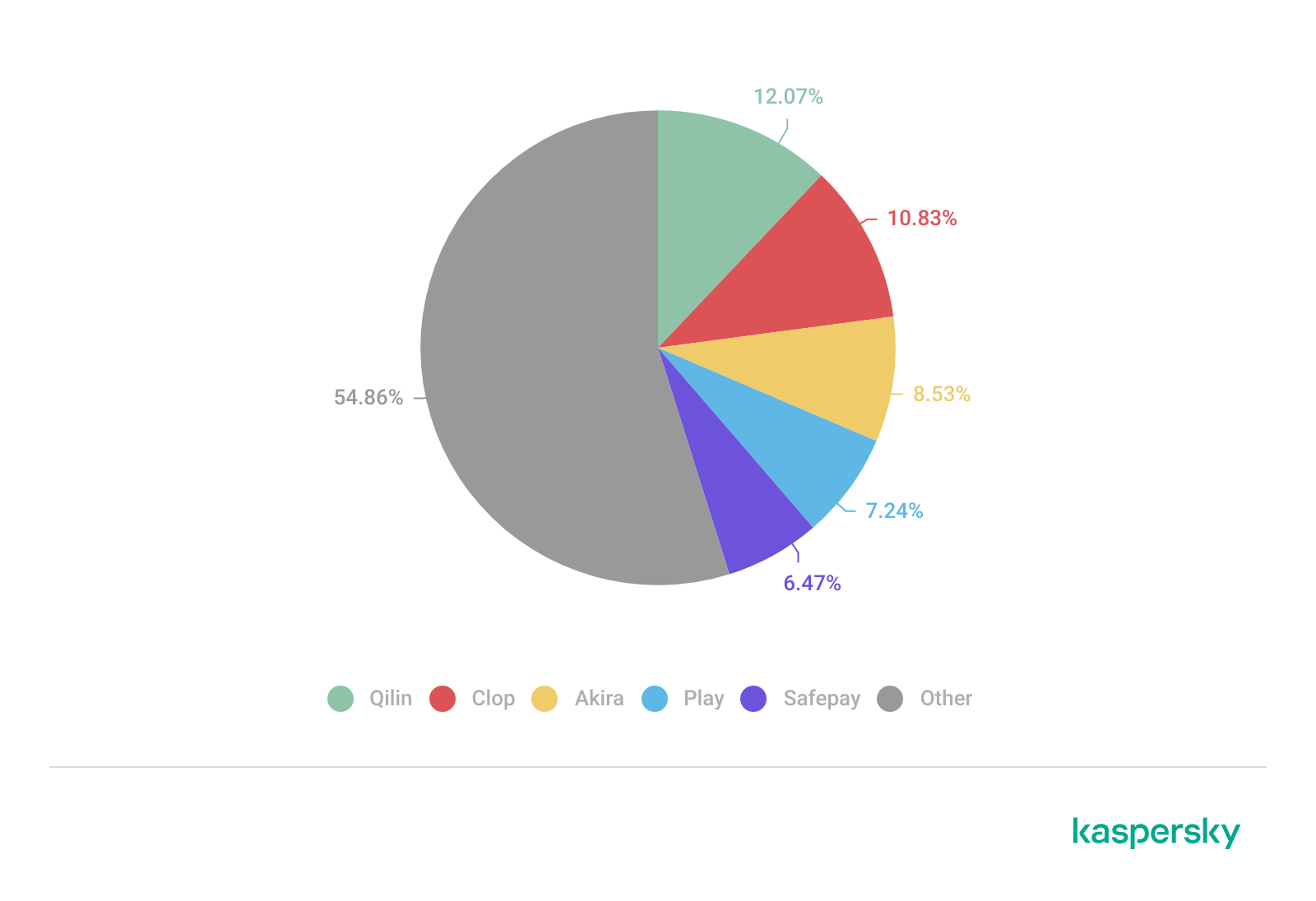
This section highlights the most prolific ransomware gangs by number of victims added to each group’s DLS during the reporting period. In the second quarter, Qilin (12.07%) proved to be the most prolific group. RansomHub, the leader of 2024 and the first quarter of 2025, seems to have gone dormant since April. Clop (10.83%) and Akira (8.53%) swapped places compared to the previous reporting period.
Number of each group’s victims according to its DLS as a percentage of all groups’ victims published on all the DLSs under review during the reporting period (download)
Number of new variants
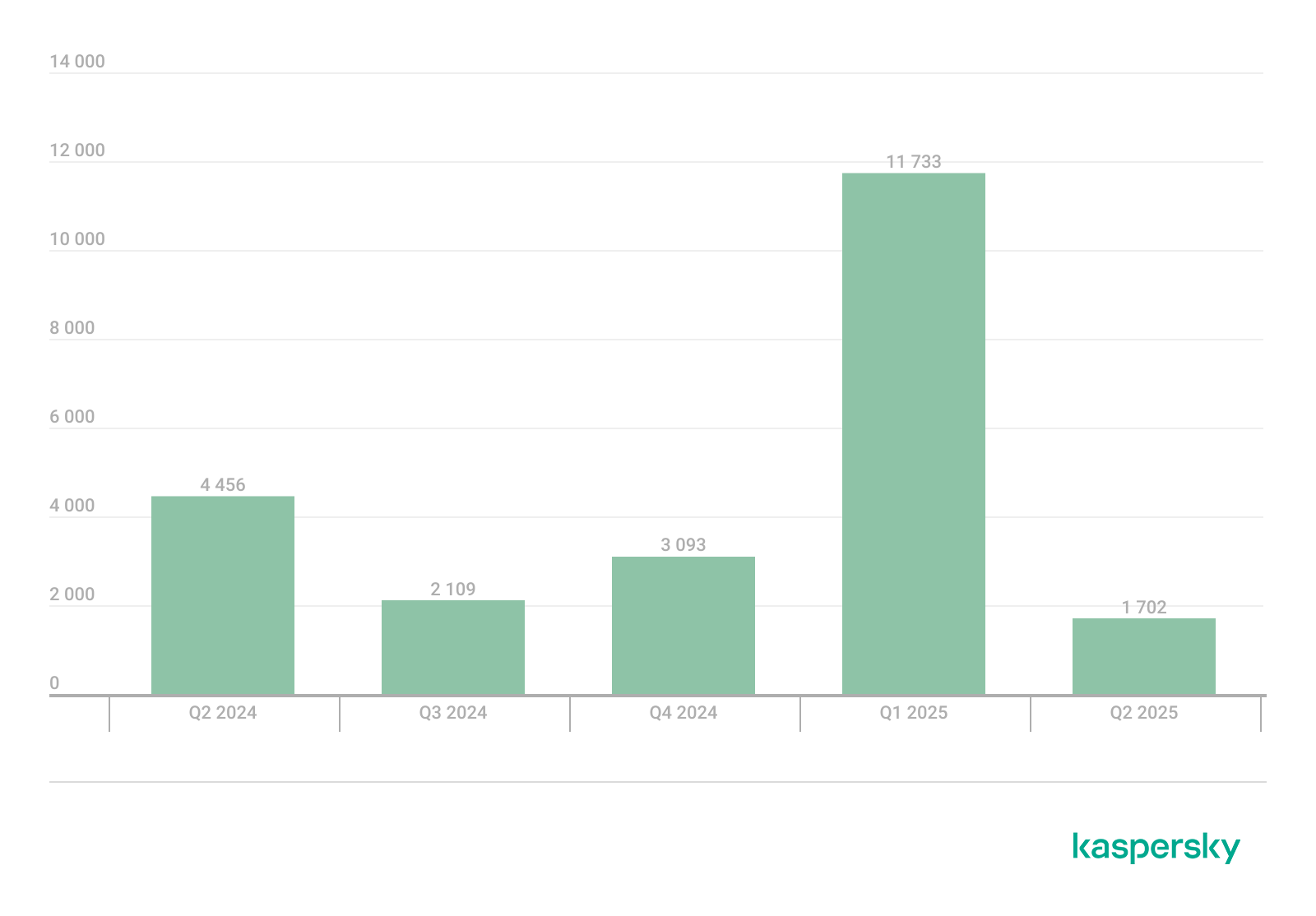
In the second quarter, Kaspersky solutions detected three new families and 1,702 new ransomware variants. This is significantly fewer than in the previous reporting period. The decrease is linked to the renewed decline in the count of the Trojan-Ransom.Win32.Gen verdicts, following a spike last quarter.
Number of new ransomware modifications, Q2 2024 — Q2 2025 (download)
Number of users attacked by ransomware Trojans
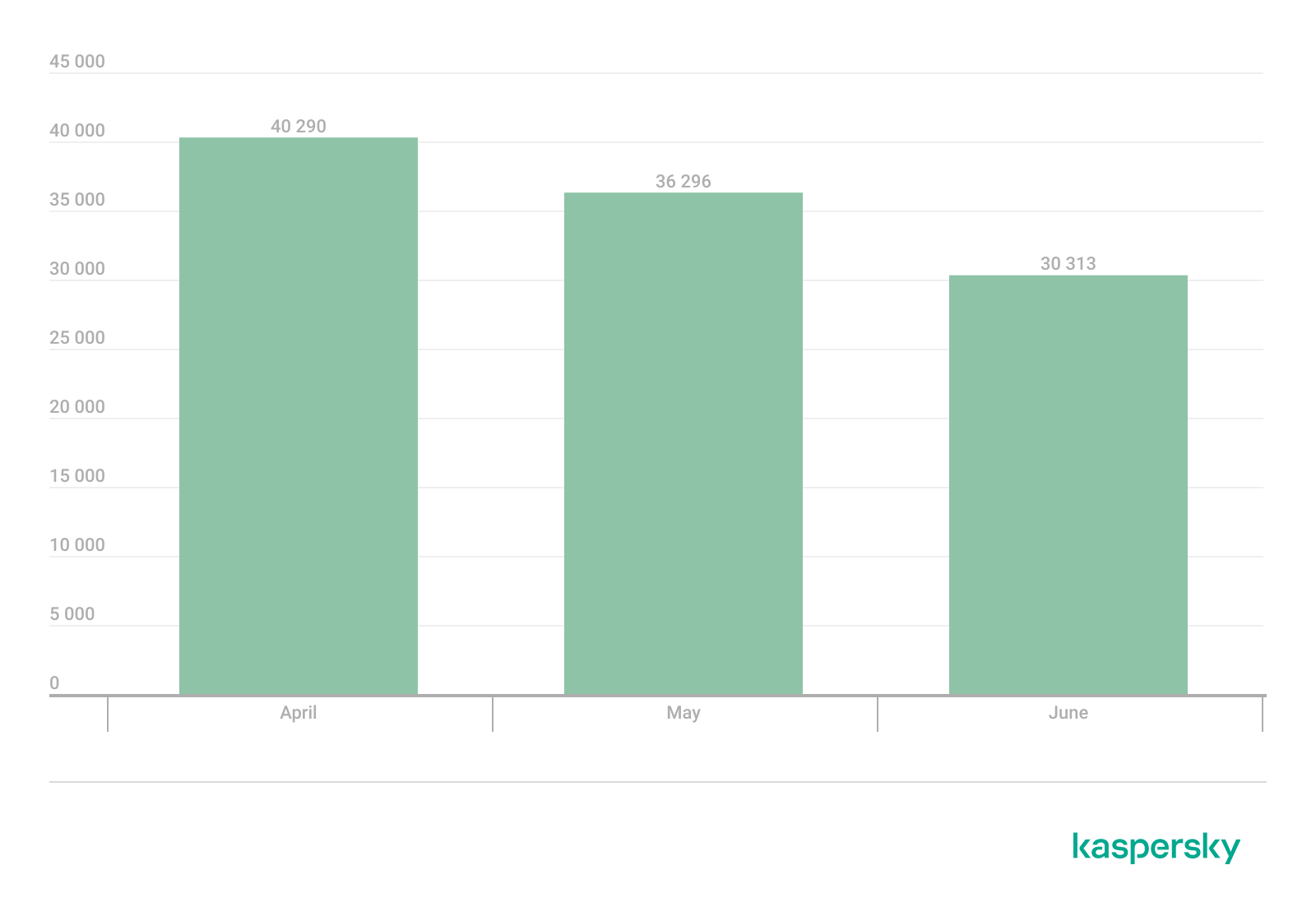
Our solutions protected a total of 85,702 unique users from ransomware during the second quarter.
Number of unique users attacked by ransomware Trojans, Q2 2025 (download)
Geography of attacked users
TOP 10 countries and territories attacked by ransomware Trojans
| Country/territory* | %** | |
| 1 | Libya | 0.66 |
| 2 | China | 0.58 |
| 3 | Rwanda | 0.57 |
| 4 | South Korea | 0.51 |
| 5 | Tajikistan | 0.49 |
| 6 | Bangladesh | 0.45 |
| 7 | Iraq | 0.45 |
| 8 | Pakistan | 0.38 |
| 9 | Brazil | 0.38 |
| 10 | Tanzania | 0.35 |
* Excluded are countries and territories with relatively few (under 50,000) Kaspersky users.
** Unique users whose computers were attacked by ransomware Trojans as a percentage of all unique users of Kaspersky products in the country/territory.
TOP 10 most common families of ransomware Trojans
| Name | Verdict | %* | |
| 1 | (generic verdict) | Trojan-Ransom.Win32.Gen | 23.33 |
| 2 | WannaCry | Trojan-Ransom.Win32.Wanna | 7.80 |
| 3 | (generic verdict) | Trojan-Ransom.Win32.Encoder | 6.25 |
| 4 | (generic verdict) | Trojan-Ransom.Win32.Crypren | 6.24 |
| 5 | (generic verdict) | Trojan-Ransom.Win32.Agent | 3.75 |
| 6 | Cryakl/CryLock | Trojan-Ransom.Win32.Cryakl | 3.34 |
| 7 | PolyRansom/VirLock | Virus.Win32.PolyRansom / Trojan-Ransom.Win32.PolyRansom | 3.03 |
| 8 | (generic verdict) | Trojan-Ransom.Win32.Crypmod | 2.81 |
| 9 | (generic verdict) | Trojan-Ransom.Win32.Phny | 2.78 |
| 10 | (generic verdict) | Trojan-Ransom.MSIL.Agent | 2.41 |
* Unique Kaspersky users attacked by the specific ransomware Trojan family as a percentage of all unique users attacked by this type of threat.
Miners
Number of new variants
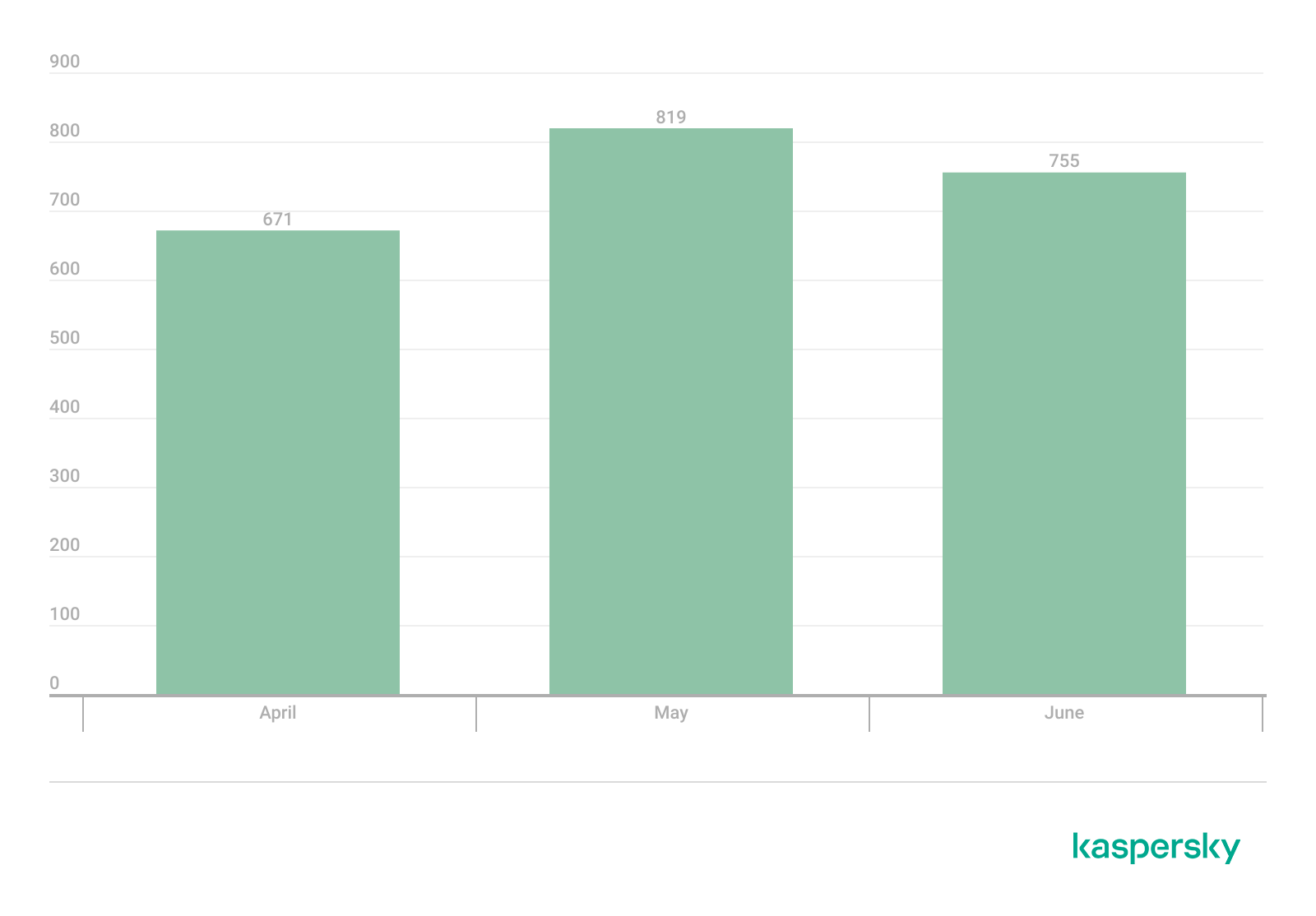
In the second quarter of 2025, Kaspersky solutions detected 2,245 new modifications of miners.
Number of new miner modifications, Q2 2025 (download)
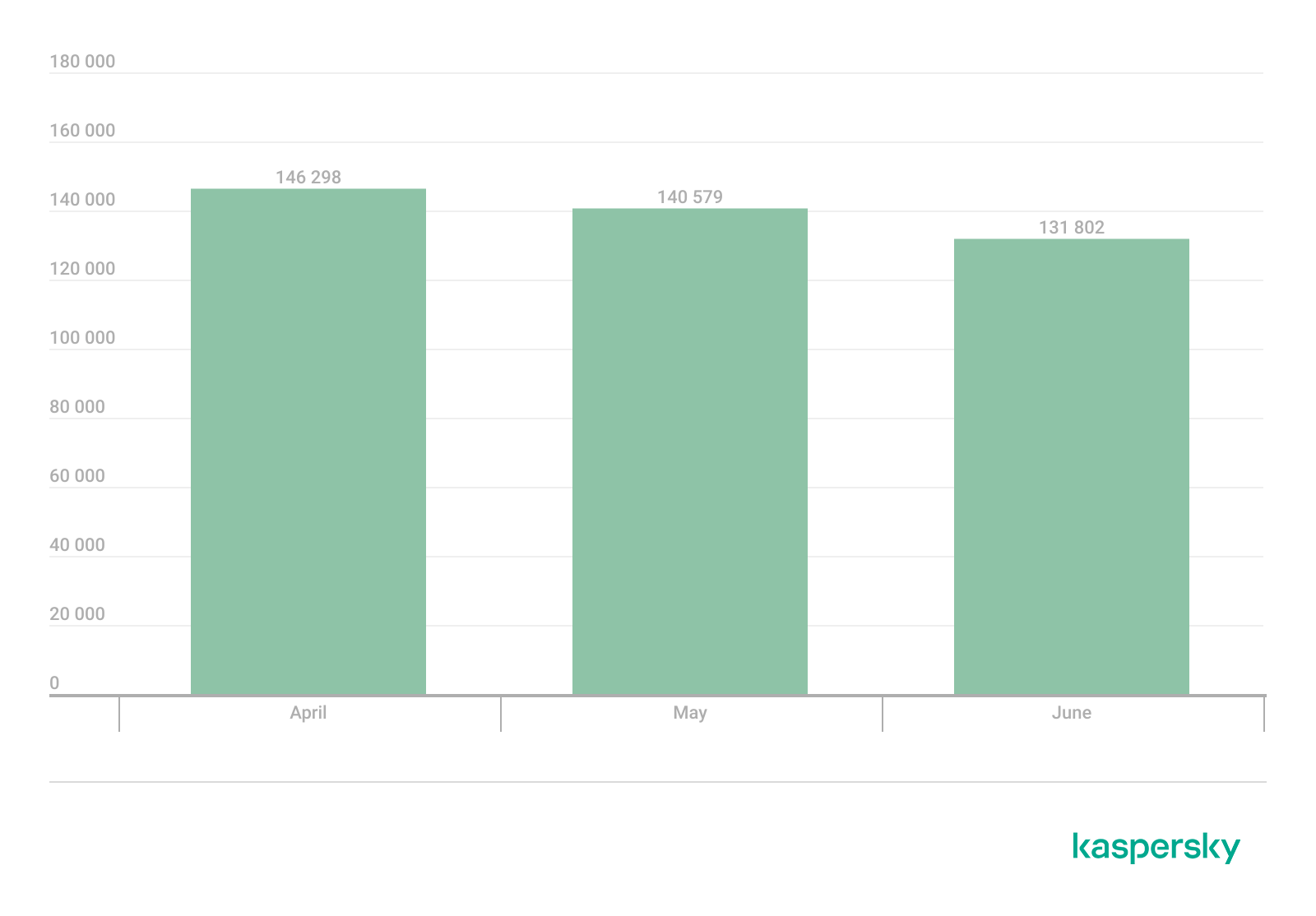
Number of users attacked by miners
During the second quarter, we detected attacks using miner programs on the computers of 279,630 unique Kaspersky users worldwide.
Number of unique users attacked by miners, Q2 2025 (download)
Geography of attacked users
TOP 10 countries and territories attacked by miners
| Country/territory* | %** | |
| 1 | Senegal | 3.49 |
| 2 | Panama | 1.31 |
| 3 | Kazakhstan | 1.11 |
| 4 | Ethiopia | 1.02 |
| 5 | Belarus | 1.01 |
| 6 | Mali | 0.96 |
| 7 | Tajikistan | 0.88 |
| 8 | Tanzania | 0.80 |
| 9 | Moldova | 0.80 |
| 10 | Dominican Republic | 0.80 |
* Excluded are countries and territories with relatively few (under 50,000) Kaspersky users.
** Unique users whose computers were attacked by miners as a percentage of all unique users of Kaspersky products in the country/territory.
Attacks on macOS
Among the threats to macOS, one of the biggest discoveries of the second quarter was the PasivRobber family. This spyware consists of a huge number of modules designed to steal data from QQ, WeChat, and other messaging apps and applications that are popular mainly among Chinese users. Its distinctive feature is that the spyware modules get embedded into the target process when the device goes into sleep mode.
Closer to the middle of the quarter, several reports (1, 2, 3) emerged about attackers stepping up their activity, posing as victims’ trusted contacts on Telegram and convincing them to join a Zoom call. During or before the call, the user was persuaded to run a seemingly Zoom-related utility, but which was actually malware. The infection chain led to the download of a backdoor written in the Nim language and bash scripts that stole data from browsers.
TOP 20 threats to macOS
* Unique users who encountered this malware as a percentage of all attacked users of Kaspersky security solutions for macOS (download)

* Data for the previous quarter may differ slightly from previously published data due to some verdicts being retrospectively revised.
A new piece of spyware named PasivRobber, discovered in the second quarter, immediately became the most widespread threat, attacking more users than the fake cleaners and adware typically seen on macOS. Also among the most common threats were the password- and crypto wallet-stealing Trojan Amos and the general detection Trojan.OSX.Agent.gen, which we described in our previous report.
Geography of threats to macOS
| Country/territory | %* Q1 2025 | %* Q2 2025 |
| Mainland China | 0.73% | 2.50% |
| France | 1.52% | 1.08% |
| Hong Kong | 1.21% | 0.84% |
| India | 0.84% | 0.76% |
| Mexico | 0.85% | 0.76% |
| Brazil | 0.66% | 0.70% |
| Germany | 0.96% | 0.69% |
| Singapore | 0.32% | 0.63% |
| Russian Federation | 0.50% | 0.41% |
| South Korea | 0.10% | 0.32% |
* Unique users who encountered threats to macOS as a percentage of all unique Kaspersky users in the country/territory.
IoT threat statistics
This section presents statistics on attacks targeting Kaspersky IoT honeypots. The geographic data on attack sources is based on the IP addresses of attacking devices.
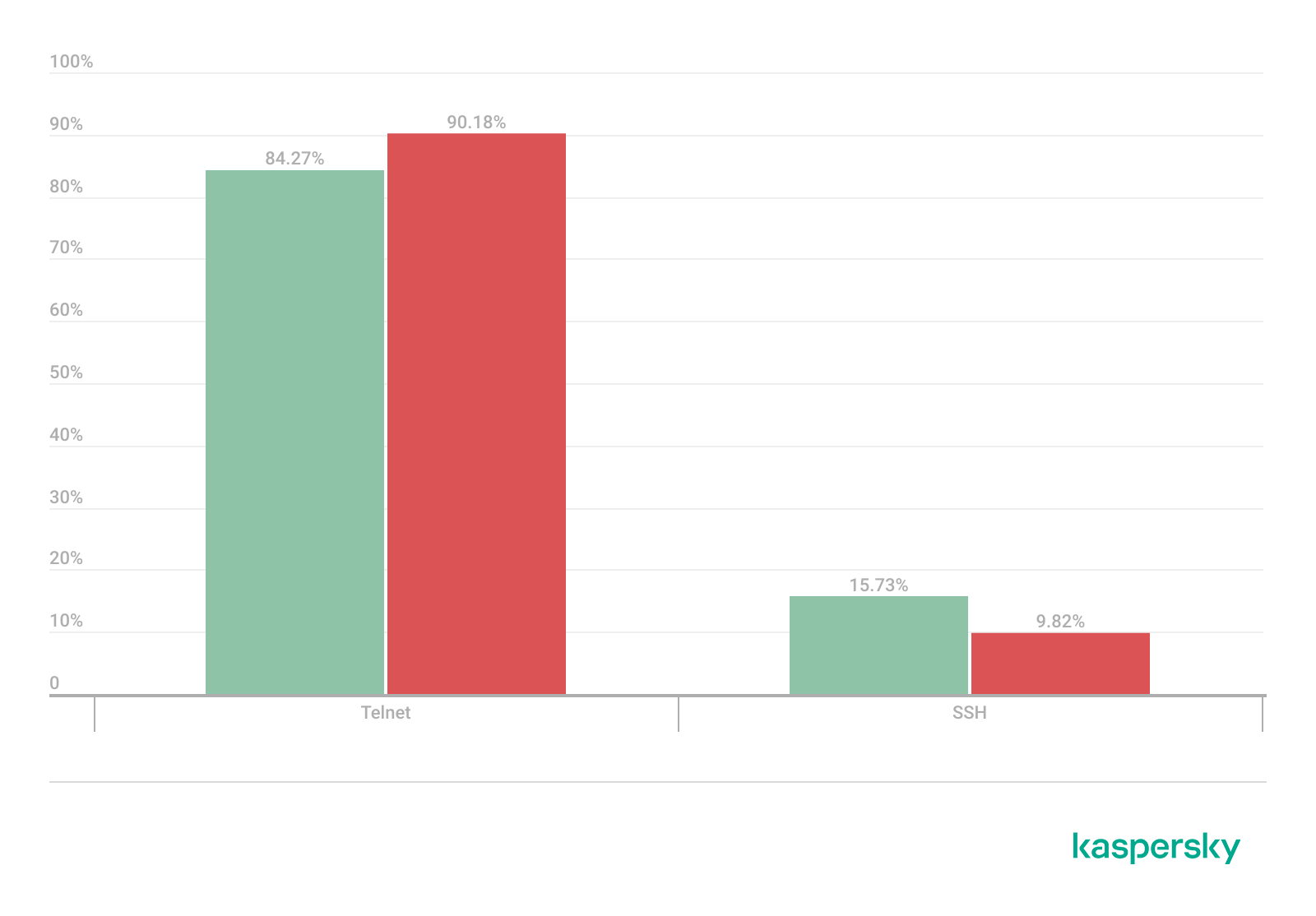
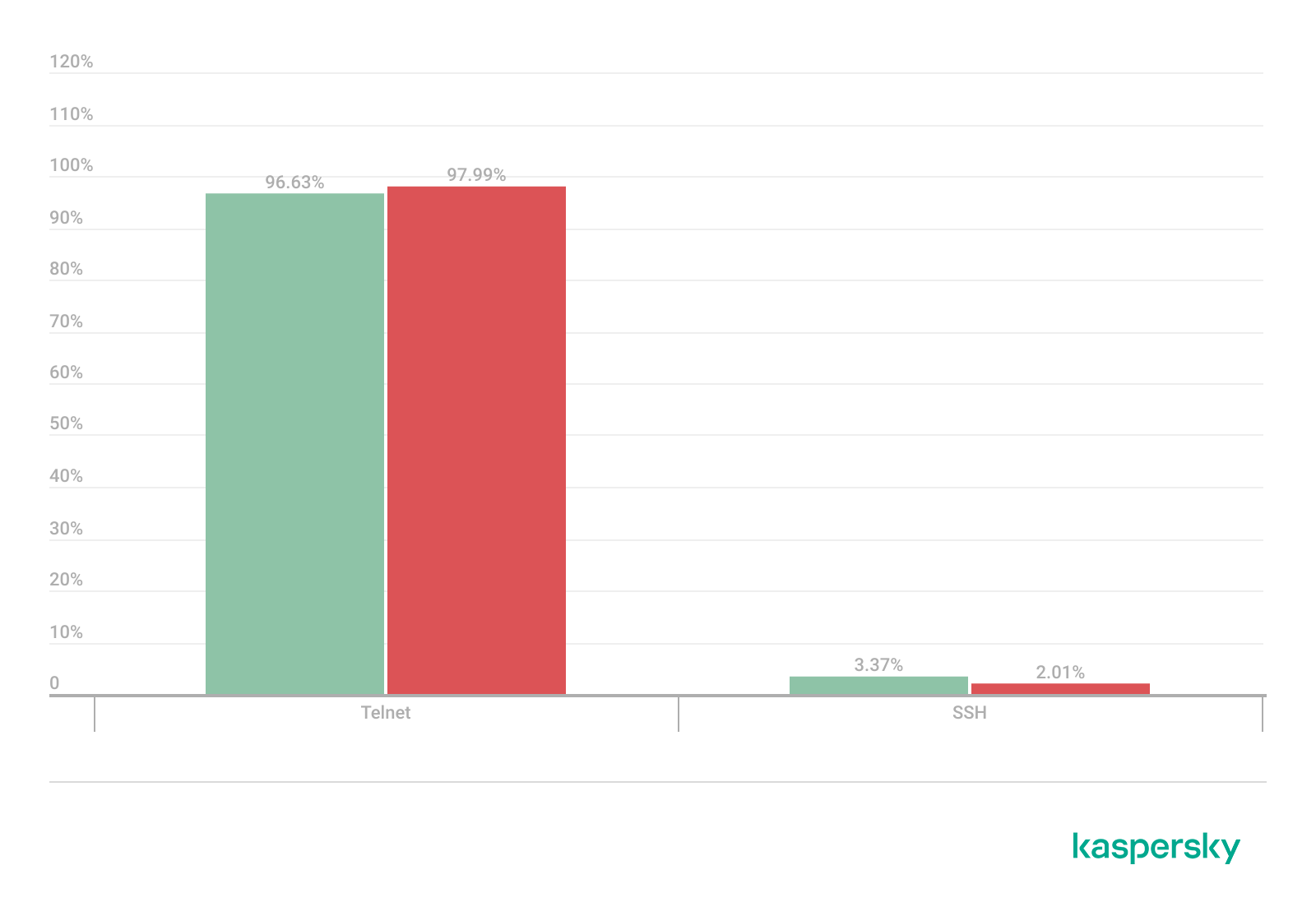
In the second quarter of 2025, there was another increase in both the share of attacks using the Telnet protocol and the share of devices connecting to Kaspersky honeypots via this protocol.
Distribution of attacked services by number of unique IP addresses of attacking devices (download)
Distribution of attackers’ sessions in Kaspersky honeypots (download)
TOP 10 threats delivered to IoT devices
Share of each threat delivered to an infected device as a result of a successful attack, out of the total number of threats delivered (download)
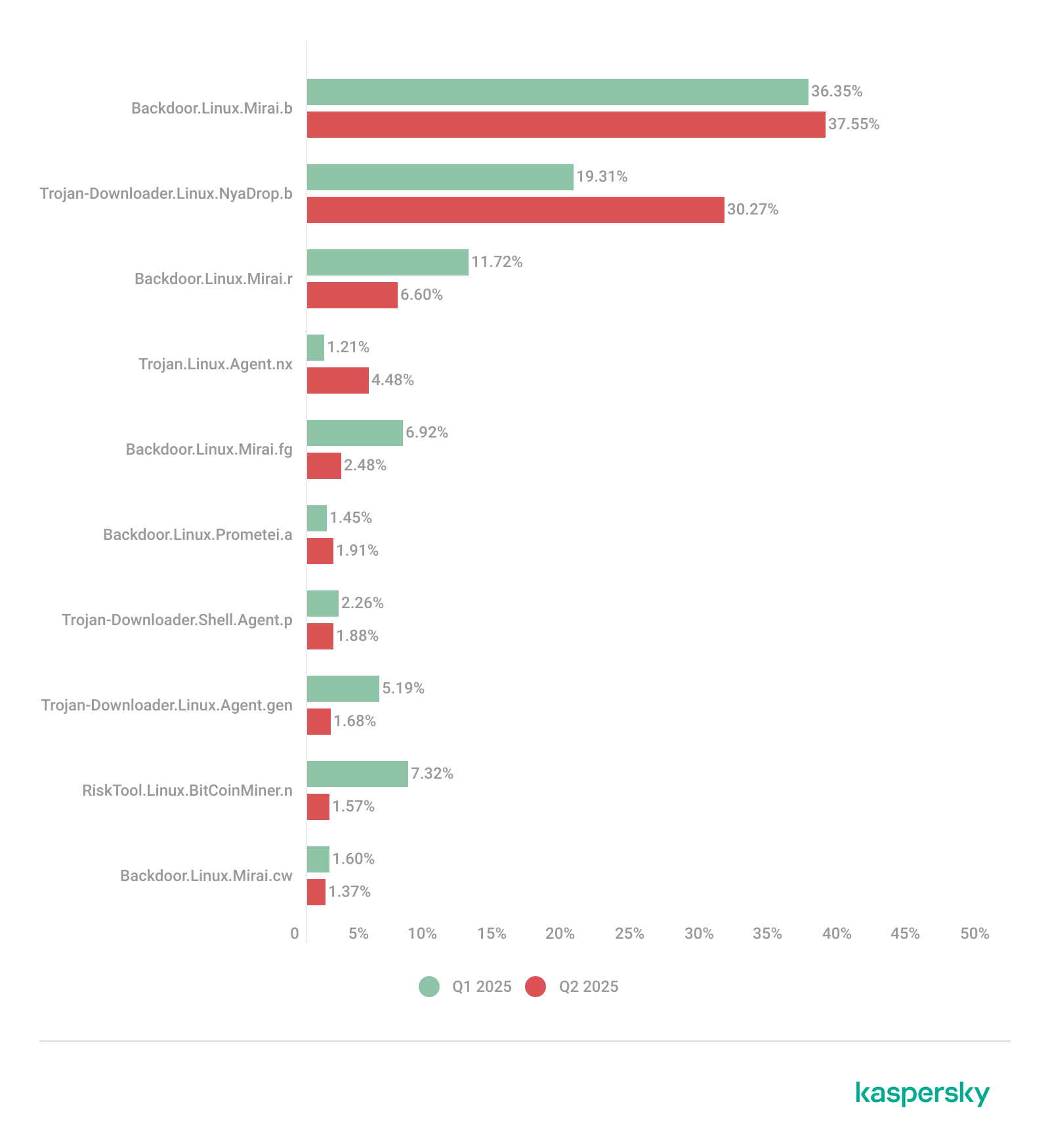
In the second quarter, the share of the NyaDrop botnet among threats delivered to our honeypots grew significantly to 30.27%. Conversely, the number of Mirai variants on the list of most common malware decreased, as did the share of most of them. Additionally, after a spike in the first quarter, the share of BitCoinMiner miners dropped to 1.57%.
During the reporting period, the list of most common IoT threats expanded with new families. The activity of the Agent.nx backdoor (4.48%), controlled via P2P through the BitTorrent DHT distributed hash table, grew markedly. Another newcomer to the list, Prometei, is a Linux version of a Windows botnet that was first discovered in December 2020.
Attacks on IoT honeypots
Geographically speaking, the percentage of SSH attacks originating from Germany and the U.S. increased sharply.
| Country/territory | Q1 2025 | Q2 2025 |
| Germany | 1.60% | 24.58% |
| United States | 5.52% | 10.81% |
| Russian Federation | 9.16% | 8.45% |
| Australia | 2.75% | 8.01% |
| Seychelles | 1.32% | 6.54% |
| Bulgaria | 1.25% | 3.66% |
| The Netherlands | 0.63% | 3.53% |
| Vietnam | 2.27% | 3.00% |
| Romania | 1.34% | 2.92% |
| India | 19.16% | 2.89% |
The share of Telnet attacks originating from China and India remained high, with more than half of all attacks on Kaspersky honeypots coming from these two countries combined.
| Country/territory | Q1 2025 | Q2 2025 |
| China | 39.82% | 47.02% |
| India | 30.07% | 28.08% |
| Indonesia | 2.25% | 5.54% |
| Russian Federation | 5.14% | 4.85% |
| Pakistan | 3.99% | 3.58% |
| Brazil | 12.03% | 2.35% |
| Nigeria | 3.01% | 1.66% |
| Germany | 0.09% | 1.47% |
| United States | 0.68% | 0.75% |
| Argentina | 0.01% | 0.70% |
Attacks via web resources
The statistics in this section are based on detection verdicts by Web Anti-Virus, which protects users when suspicious objects are downloaded from malicious or infected web pages. Cybercriminals create malicious pages with a goal in mind. Websites that host user-generated content, such as message boards, as well as compromised legitimate sites, can become infected.
Countries that served as sources of web-based attacks: TOP 10
This section gives the geographical distribution of sources of online attacks blocked by Kaspersky products: web pages that redirect to exploits; sites that host exploits and other malware; botnet C2 centers, and the like. Any unique host could be the source of one or more web-based attacks.
To determine the geographic source of web attacks, we matched the domain name with the real IP address where the domain is hosted, then identified the geographic location of that IP address (GeoIP).
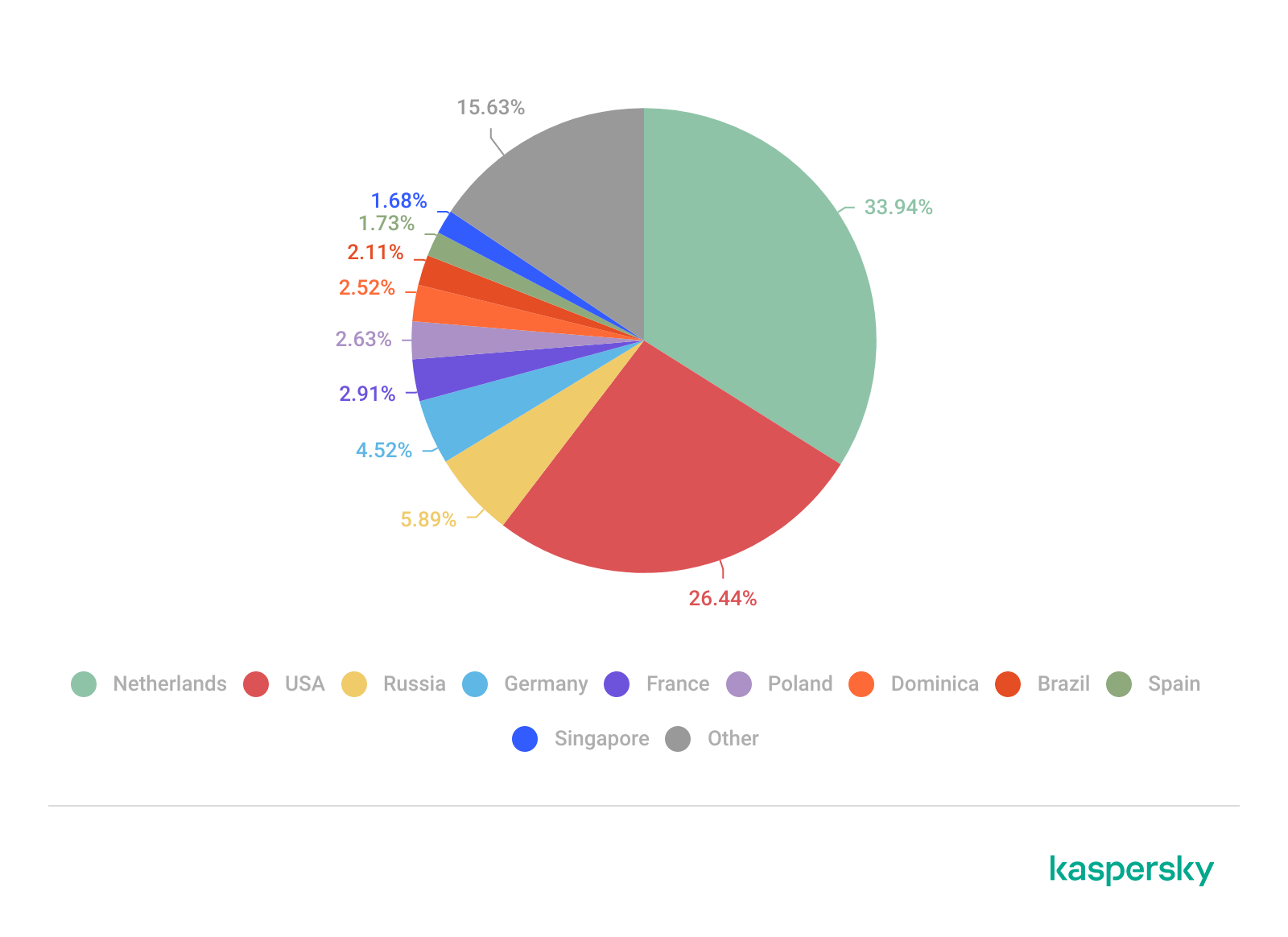
In the second quarter of 2025, Kaspersky solutions blocked 471,066,028 attacks from internet resources worldwide. Web Anti-Virus responded to 77,371,384 unique URLs.
Web-based attacks by country, Q2 2025 (download)
Countries and territories where users faced the greatest risk of online infection
To assess the risk of malware infection via the internet for users’ computers in different countries and territories, we calculated the share of Kaspersky users in each location who experienced a Web Anti-Virus alert during the reporting period. The resulting data provides an indication of the aggressiveness of the environment in which computers operate in different countries and territories.
This ranked list includes only attacks by malicious objects classified as Malware. Our calculations leave out Web Anti-Virus detections of potentially dangerous or unwanted programs, such as RiskTool or adware.
| Country/territory* | %** | |
| 1 | Bangladesh | 10.85 |
| 2 | Tajikistan | 10.70 |
| 3 | Belarus | 8.96 |
| 4 | Nepal | 8.45 |
| 5 | Algeria | 8.21 |
| 6 | Moldova | 8.16 |
| 7 | Turkey | 8.08 |
| 8 | Qatar | 8.07 |
| 9 | Albania | 8.03 |
| 10 | Hungary | 7.96 |
| 11 | Tunisia | 7.95 |
| 12 | Portugal | 7.93 |
| 13 | Greece | 7.90 |
| 14 | Serbia | 7.84 |
| 15 | Bulgaria | 7.79 |
| 16 | Sri Lanka | 7.72 |
| 17 | Morocco | 7.70 |
| 18 | Georgia | 7.68 |
| 19 | Peru | 7.63 |
| 20 | North Macedonia | 7.58 |
* Excluded are countries and territories with relatively few (under 10,000) Kaspersky users.
** Unique users targeted by Malware attacks as a percentage of all unique users of Kaspersky products in the country.
On average during the quarter, 6.36% of internet users’ computers worldwide were subjected to at least one Malware web-based attack.
Local threats
Statistics on local infections of user computers are an important indicator. They include objects that penetrated the target computer by infecting files or removable media, or initially made their way onto the computer in non-open form. Examples of the latter are programs in complex installers and encrypted files.
Data in this section is based on analyzing statistics produced by anti-virus scans of files on the hard drive at the moment they were created or accessed, and the results of scanning removable storage media. The statistics are based on detection verdicts from the On-Access Scan (OAS) and On-Demand Scan (ODS) modules of File Anti-Virus. This includes malware found directly on user computers or on connected removable media: flash drives, camera memory cards, phones, and external hard drives.
In the second quarter of 2025, our File Anti-Virus recorded 23,260,596 malicious and potentially unwanted objects.
Countries and territories where users faced the highest risk of local infection
For each country and territory, we calculated the percentage of Kaspersky users whose devices experienced a File Anti-Virus triggering at least once during the reporting period. This statistic reflects the level of personal computer infection in different countries and territories around the world.
Note that this ranked list includes only attacks by malicious objects classified as Malware. Our calculations leave out File Anti-Virus detections of potentially dangerous or unwanted programs, such as RiskTool or adware.
| Country/territory* | %** | |
| 1 | Turkmenistan | 45.26 |
| 2 | Afghanistan | 34.95 |
| 3 | Tajikistan | 34.43 |
| 4 | Yemen | 31.95 |
| 5 | Cuba | 30.85 |
| 6 | Uzbekistan | 28.53 |
| 7 | Syria | 26.63 |
| 8 | Vietnam | 24.75 |
| 9 | South Sudan | 24.56 |
| 10 | Algeria | 24.21 |
| 11 | Bangladesh | 23.79 |
| 12 | Belarus | 23.67 |
| 13 | Gabon | 23.37 |
| 14 | Niger | 23.35 |
| 15 | Cameroon | 23.10 |
| 16 | Tanzania | 22.77 |
| 17 | China | 22.74 |
| 18 | Iraq | 22.47 |
| 19 | Burundi | 22.30 |
| 20 | Congo | 21.84 |
* Excluded are countries and territories with relatively few (under 10,000) Kaspersky users.
** Unique users on whose computers Malware local threats were blocked, as a percentage of all unique users of Kaspersky products in the country/territory.
Overall, 12.94% of user computers globally faced at least one Malware local threat during the second quarter.
The figure for Russia was 14.27%.
Text extracted automatically; images, tables and formatting may be missing. Original: https://securelist.com/malware-report-q2-2025-pc-iot-statistics/117421/