Experts spotted spam campaigns delivering XTRAT and DUNIHI backdoors bundled with the Adwind RAT
Vulnerabilities mentionedAll →
| CVE | Vulnerability | CVSS | EPSS | Flags | Affected | Exposure | Published |
|---|---|---|---|---|---|---|---|
| CVE-2017-11882 | Memory Corruption RCE in Microsoft Office via Legacy Equation Editor CVE-2017-11882 is a memory corruption vulnerability (CWE-119) in Microsoft Office, residing in the legacy Microsoft Equation Editor component (EQNEDT32.EXE), that allows remote code execution in the context of the current user. Attackers trigger it by persuading a user to open a crafted document, most commonly an RTF file or other Office document carrying a malicious embedded equation object, which overflows a buffer while the equation content is parsed. Successful exploitation lets the attacker run arbitrary code with the privileges of the signed-in user, a typical foothold for malware delivery and, per CISA, for ransomware operations. Any environment running affected Microsoft Office builds is exposed; the source data does not enumerate specific affected version ranges. The flaw is confirmed exploited in the wild: it was added to the CISA Known Exploited Vulnerabilities catalog on 2021-11-03 with known ransomware use and holds a 99.9% EPSS score (percentile 100), though the source data lists no public PoC. Do: Apply Microsoft's Office security updates (November 2017 or later) across all endpoints, prioritizing this KEV-listed flaw given its known ransomware use. On systems that cannot yet be patched, disable or unregister the legacy Equation Editor (EQNEDT32.EXE) and consider blocking or warning on RTF attachments as interim mitigations. Check for indicators of abuse such as EQNEDT32.EXE spawning unexpected child processes after document opens. | 7.8 | 100% | KEV ransomware PoC ×10 |
| masshundreds of millions of users/installations (Office is near-ubiquitous on Windows and in enterprises; the share still unpatched is unknown) |
Indicators of compromiseauto-extracted · verify before use · export allAll →
| Type | Indicator | Context |
|---|---|---|
| domain | badnulls.hopto.org | oin[.]com:62103, while the Adwind/jRAT variant contacts the badnulls[.]hopto[.]org:3011. Experts suggest a multilayered approach to securi |
| domain | hopto.org | Both campaigns abuse the legitimate free dynamic DNS server hopto[.]org. “Notably, cybercriminals behind the Adwind- XTRAT -Loki |
| domain | junpio70.hopto.org | . Notably, Adwind and XTRAT connect to the same C&C server: junpio70[.]hopto[.]org.” continues the analysis. Adwind is a cross-platform Ja |
| domain | pm2bitcoin.com | load and execute both DUNIHI and Adwind. DUNIHi connects to pm2bitcoin[.]com:62103, while the Adwind/jRAT variant contacts the badnull |
Full article412 words · extracted from securityaffairs.com · click to collapse

Security experts at Trend Micro have spotted spam campaigns delivering XTRAT and DUNIHI Backdoors and Loki malware bundled with the Adwind RAT.
Malware researchers at Trend Micro have uncovered a spam campaign that delivers the infamous Adwind RAT (aka jRAT) alongside the XTRAT backdoor (aka XtremeRAT) and the Loki info stealer. In a separate Adwind RAT spam campaign, the researchers observed the use of the VBScript with backdoor tracked as DUNIHI.
Both campaigns abuse the legitimate free dynamic DNS server hopto[.]org.
“Notably, cybercriminals behind the Adwind-XTRAT-Loki and Adwind-DUNIHI bundles abuse the legitimate free dynamic DNS server hopto[.]org.” reads the analysis published by Trend Micro. “The delivery of different sets of backdoors is believed to be a ploy used to increase the chances of system infection: If one malware gets detected, the other malware could attempt to finish the job.”
The experts detected 5,535 unique infections of Adwind between January 1 and April 17, most of them in the US, Japan, Australia, Italy, Taiwan, Germany, and the U.K.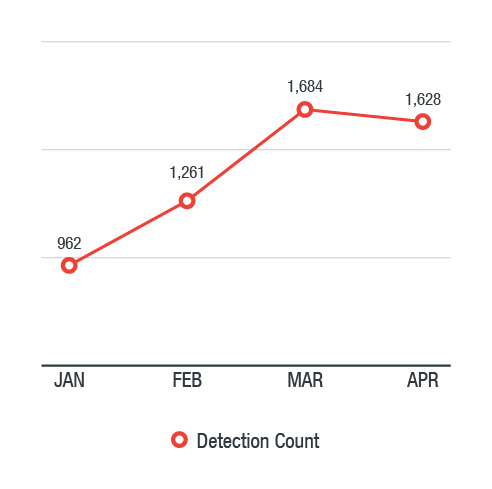
Crooks behind the Adwind, XTRAT, and Loki used weaponized RTF document that triggers the CVE-2017-11882 vulnerability to deliver the Adwind, XTRAT, and Loki bundles.
Below the attack chain:
“The dropped files are effective RATs with multiple backdoor capabilities, anti-VM, anti-AV, and are highly configurable. Notably, Adwind and XTRAT connect to the same C&C server: junpio70[.]hopto[.]org.” continues the analysis.
Adwind is a cross-platform Java backdoor that has been observed in the wild since 2013. XTRAT shares similar capabilities with Adwind, it also implements features to control both device camera and microphone.
Loki was known as a password and cryptocurrency wallet stealer well-known in the cybercrime ecosystem.
The experts also observed Adwind bundled with DUNIHI backdoor, attackers used a JAR dropper that ships a VBS dropper delivered via spam mail. The VBS dropper download and execute both DUNIHI and Adwind.
DUNIHi connects to pm2bitcoin[.]com:62103, while the Adwind/jRAT variant contacts the badnulls[.]hopto[.]org:3011.
Experts suggest a multilayered approach to security when dealing with a cross-platform threat like Adwind.
“IT administrators should regularly keep networks and systems patched and updated.”
“Both variants of Adwind arrive via email, so it is imperative to secure the email gateway to mitigate threats that abuse email as an entry point to the system and network.” concluded Trend Micro.
“Businesses should commit to training employees, review company policies, and develop good security habits.”
| [adrotate banner=”9″] | [adrotate banner=”12″] |
(Security Affairs – Adwind RAT, cybercrime)
[adrotate banner=”13″]
[adrotate banner=”5″]
Text extracted automatically; images, tables and formatting may be missing. Original: https://securityaffairs.com/71644/malware/adwind-rat-spam-campaigns.html